Downy Dodder Laurel
Cassytha pubescens
Last updated:
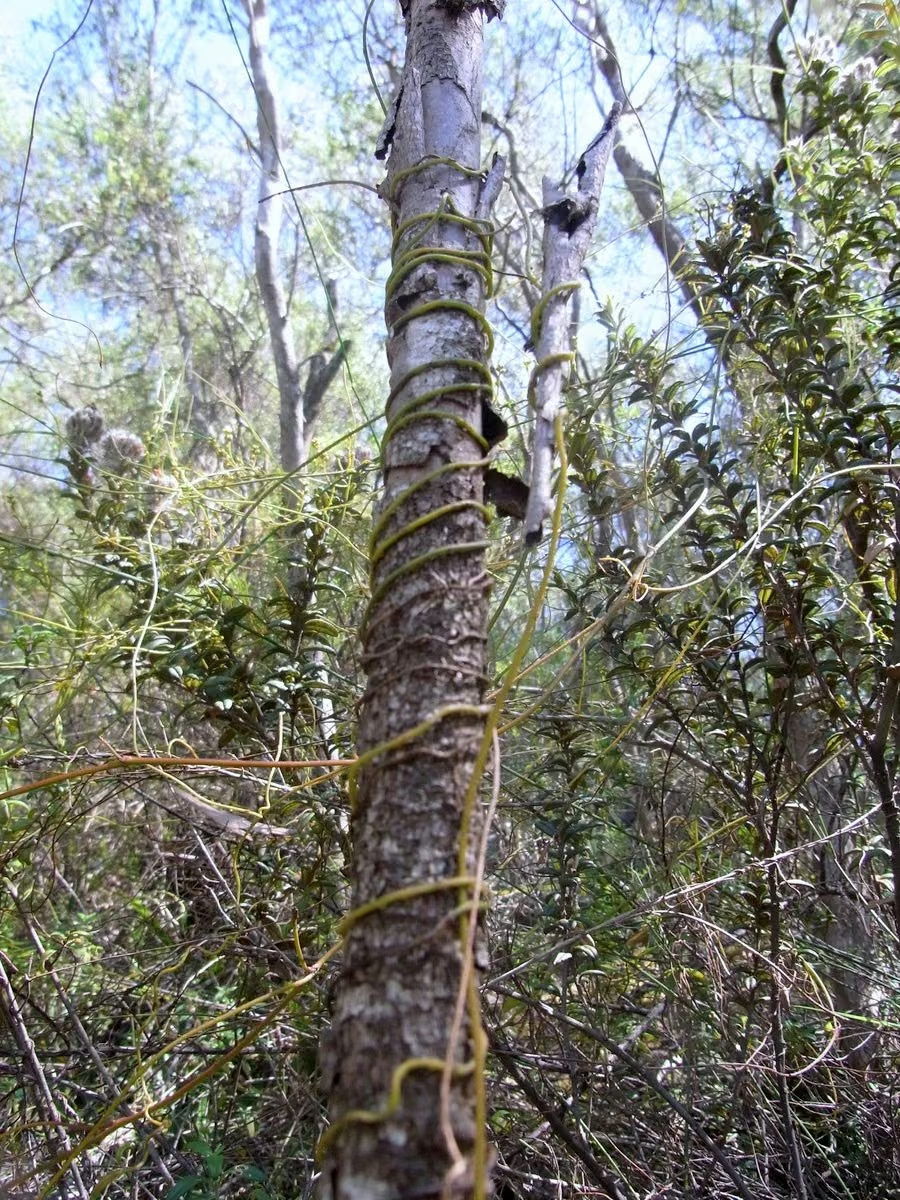
Downy dodder laurel (Cassytha pubescens) is a leafless parasitic vine whose slender, rusty-haired stems coil around shrubs, grasses and rushes and feed on them through suckers called haustoria. It is common in Australia but in New Zealand is known only from Waipoua Forest in Northland, where it grows mainly on manuka and Dracophyllum. Botanists are unsure whether it arrived naturally or was brought in with forestry tree stock, so it is classed as a Non-resident Native - Coloniser. It is a curiosity of the Northland flora rather than a garden plant. Explore more native vines in our native plant guide.
Plant Description
Cassytha pubescens is a twining, leafless stem parasite. Its stems reach only about 2 mm in diameter and are greenish but densely covered in hairs with a rusty, ferruginous tone, which gives the vine a fuzzy brownish look. The leaves are reduced to minute scales, and the stems attach to their hosts by small suckers at each coil.
The flowers are tiny, greenish white, and crowded on simple, short spikes. They appear from December to February. The fruit is a globular drupe 5 to 6 mm across that remains greenish when ripe and is covered in a felt of hairs.
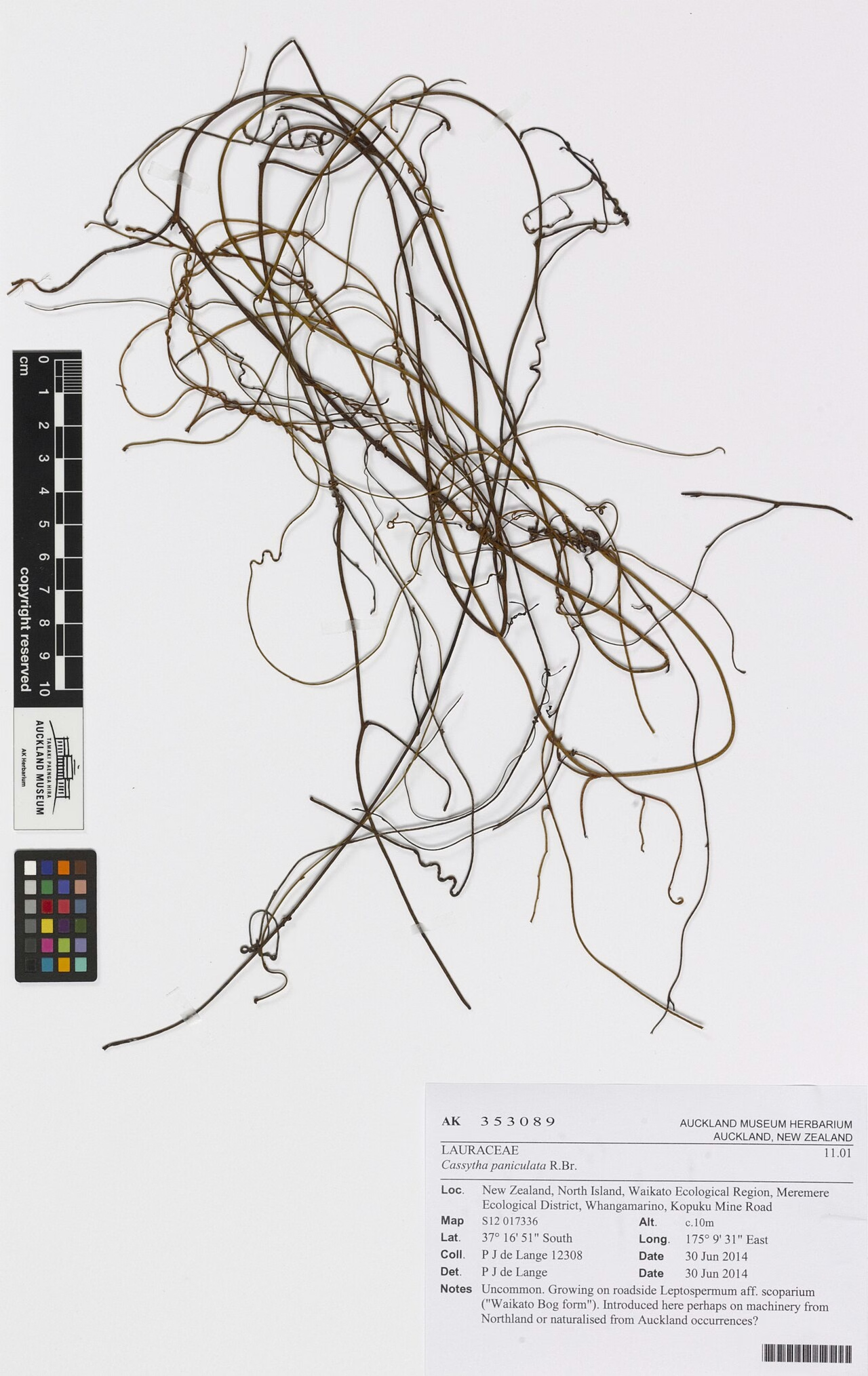
Its only New Zealand relative is Cassytha paniculata, a more widespread Northland species whose yellowish stems become hairless with age and whose flowers are spaced well apart on longer spikes. Neither should be confused with the unrelated true dodders (Cuscuta).
Quick Facts
| Scientific Name | Cassytha pubescens |
|---|---|
| Height | Climbs to the height of its host vegetation |
| Spread | Forms dense tangled masses over host plants |
| Water Needs | Draws water from its host |
| Light | Open, sunny scrub |
| Frost Tolerance | Low; known only from warm Northland |
| Salt Tolerance | No information available |
| Growth Rate | Fast once established on a host |
| Lifespan | Perennial |
Climate Best Suited to
Grows in the mild, humid lowland climate of western Northland, with warm summers and few frosts.
Regional Suitability
| City | Climate Suitability |
|---|---|
| Auckland | Medium |
| Wellington | Low |
| Christchurch | Low |
| Dunedin | Low |
Plant Habitat
In New Zealand Cassytha pubescens is recorded only from Waipoua Forest in western Northland. Because it is so localised and was first treated as an introduced plant, it is not regarded as a resident member of the native flora.
There it grows over scrub and open vegetation, parasitising manuka (Leptospermum) and Dracophyllum, and also recorded on grasses, rushes and pines. In Australia it is common in heath, woodland and open forest.
Growing Requirements
Soil Requirements
It does not root in the soil once established, so soil matters only through its effect on the host plants. At Waipoua its hosts include scrub plants of infertile northern soils.
- Hosts such as manuka tolerate poor soils
- Seedlings need host plants within reach
Light Requirements
Like other dodder laurels it grows best spread over sunny, open vegetation.
- Favours open scrub and margins
- Little growth under dense canopy
Water Requirements
All water is drawn from the host plants through haustoria.
- No independent water needs
- Depends on healthy, well-watered hosts
Planting and Establishing
Cassytha pubescens is not grown in gardens and should not be introduced to new areas. It is a parasite whose New Zealand origin is uncertain, and spreading it could harm native or garden plants.
Anyone who finds it outside Waipoua Forest should record the find with a photo, for example on iNaturalist NZ, so botanists can track whether it is spreading.
Ecological Role
The vine coils around host stems and leaves and forms haustoria that tap into the host's water and food. In Australia it is known to parasitise a very wide range of host plants, and in New Zealand it has been recorded on manuka, Dracophyllum, grasses, rushes and pines.
NZPCN notes that its fleshy drupes are dispersed by fruit-eating animals and by water. Insect visitors to its flowers in New Zealand have not been recorded.
Uses & Significance
Garden Uses
It has no garden use and should not be cultivated in New Zealand.
- Not available from nurseries
- Of interest to botanists studying parasitic plants
Ecological Value
Its ecological value in New Zealand is uncertain. It adds to the diversity of parasitic plants at Waipoua but may also be a recent arrival.
- Fruit may be eaten by birds
- An example of trans-Tasman plant dispersal or introduction
Landscaping Uses
Downy dodder laurel has no role in landscaping. In Australia it is sometimes valued as a native plant and studied as a potential biological control for invasive shrubs, but that does not apply here.
In New Zealand the priority is simply to monitor its distribution and avoid moving it to new sites on plant material or machinery.
Seasonal Care Calendar
Spring
Stems extend over host plants as growth resumes.
- Rusty-haired stems become more obvious on new growth
Summer
Flowers open between December and February.
- Small greenish white flowers crowded on short spikes
Autumn
Hairy green fruit 5 to 6 mm across matures on the stems.
- Fruit remains green when ripe
Winter
Growth slows but stems remain attached to their hosts.
- Easiest to spot as dense brownish tangles on scrub
When to Prune and How Much
Pruning does not apply. If it appears on cultivated plants, all stems and attached coils should be removed, along with any host twigs carrying haustoria.
In the Waipoua population it is left as part of the vegetation unless managers decide otherwise.
How to Grow Downy Dodder Laurel
Cassytha pubescens should not be propagated in New Zealand. As an obligate parasite of uncertain origin here, deliberately spreading it would risk harming other plants. Understanding how it reproduces is nonetheless useful for anyone monitoring it. It reproduces by seed contained in hairy fleshy drupes and spreads vegetatively as its stems reach from one host to the next, attaching wherever they make contact.
From Seed (natural Establishment)
Seed falls or is carried by animals and water to the ground, where it germinates and sends up a slender stem that must find a host quickly. Once attached by haustoria, the seedling loses its root connection and depends entirely on the host. No germination studies on New Zealand plants have been published, so how long seed survives in the soil at Waipoua is not known.
- Fruit ripens from late summer while remaining green and hairy
- Animals or water move seed away from the parent
- Seed germinates on the ground near potential hosts
- The seedling coils around a nearby stem and forms haustoria
- The young vine then spreads across the host canopy
From Stem Fragments (vegetative Spread)
Broken stems that land on a suitable host can attach and continue growing, so fragments carried on machinery, tools or plant material can start new infestations.
- Avoid moving brush or plant material from infested sites
- Clean tools and vehicles after working in infested scrub
- Report any plants seen outside Waipoua Forest
- Photograph and map new finds so their spread can be followed over time
Pests & Diseases
No pests or diseases of Cassytha pubescens have been recorded in New Zealand.
The plant is itself a potential nuisance on host plants, although it is not listed as a pest plant in New Zealand.
Cultural Significance
NZPCN records the names taihoa and māwhai for this species, but these are shared with the more widespread Cassytha paniculata. No traditional Māori use of Cassytha pubescens is recorded, which is unsurprising given its very restricted and possibly recent presence in New Zealand.
The species was described by the botanist Robert Brown in 1810 from Australian specimens. The epithet pubescens means downy, referring to its hairy stems and fruit.
Bonus Tip
If you are botanising in Northland and see a dodder-like vine, rub a stem between your fingers: a dense coat of rusty hairs points to Cassytha pubescens, which is worth reporting with a location, while smooth yellowish stems indicate the common C. paniculata.
Related Plants
Explore other native plants that share similar characteristics or habitats with Downy Dodder Laurel (Cassytha pubescens), offering further insights into New Zealand's diverse flora. These related species provide context and opportunities for complementary planting in your garden.
Carpha alpina
Carpha alpina
Pigface
Carpobrotus glaucescens
Cassinia amoena
Cassinia amoena
Dodder Laurel
Cassytha paniculata
Adams's Daisy
Celmisia adamsii
Silver Cushion Mountain Daisy
Celmisia argentea
Armstrong's Mountain Daisy
Celmisia armstrongii
Common Shrub Mountain Daisy
Celmisia brevifolia
Plant Conservation
Cassytha pubescens is ranked Non-resident Native - Coloniser (2023) with the qualifier Secure Overseas, because it is abundant in Australia and has only a toehold in New Zealand. It was listed as exotic in the 2004 and 2009 assessments. Northland's 2026 regional assessment rates it Regionally At Risk - Regionally Naturally Uncommon.
No active conservation management is needed. The main need is better information on whether it is spreading and on how it arrived, which records from botanists and iNaturalist observers can help provide.
Frequently Asked Questions
Where does Cassytha pubescens grow in New Zealand?
It is known only from Waipoua Forest in Northland. Elsewhere it is widespread in Australia, where it is commonly called downy dodder laurel.
Is Cassytha pubescens native to New Zealand?
Its status is uncertain. The Flora of New Zealand suggests it was presumably introduced with tree stock, but it may be a natural arrival, so it is currently ranked Non-resident Native - Coloniser.
How do you tell Cassytha pubescens from Cassytha paniculata?
Cassytha pubescens has thinner stems, to about 2 mm, densely covered in rusty brown hairs, crowded flowers on short spikes and fruit that stays green and hairy, while C. paniculata has smoother yellowish stems up to 3 mm thick.
Sources and Further Reading
The botanical, growing, and conservation details for Downy Dodder Laurel (Cassytha pubescens) on this page draw on the New Zealand plant references below. Consult them for full technical records and the latest distribution data.