Cassinia
Cassinia amoena
Last updated:
Cassinia amoena is a small, densely branched shrub that rarely exceeds 1 m tall, known in the wild only from the Surville Cliffs near North Cape in Northland. Its stout branchlets carry a grey woolly coating, its narrow leathery leaves are white-felted beneath, and from August to December it is smothered in tight clusters of small white flower heads. NZPCN ranks it At Risk - Naturally Uncommon because it occupies a single small area, although the Flora of New Zealand now merges it into the widespread tauhinu, Ozothamnus leptophyllus. It is an interesting coastal shrub for specialist collections. Explore more native shrubs in our native plant guide.
Plant Description
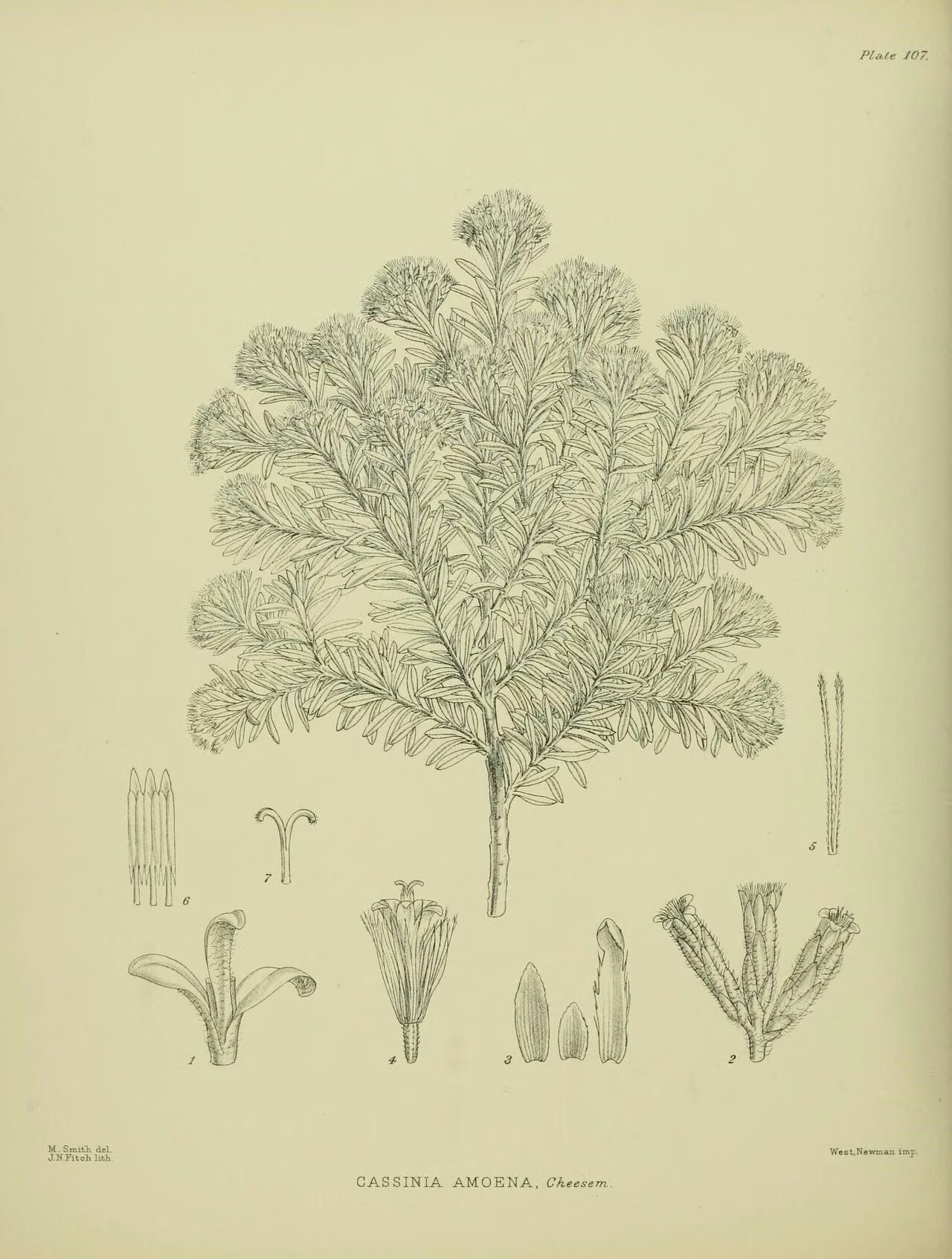
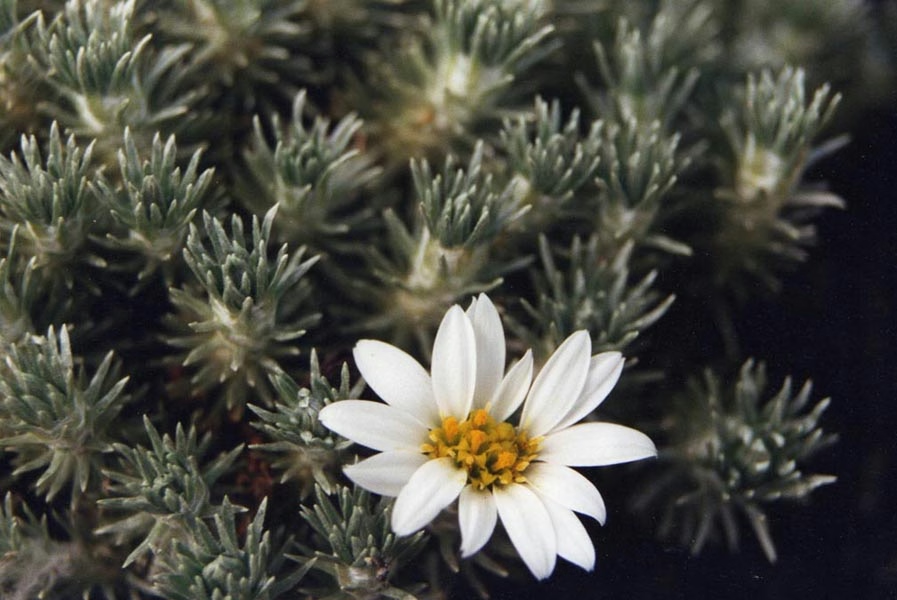
Cassinia amoena is a compact shrub occasionally reaching 1 m tall, with stout branchlets covered in a greyish woolly tomentum that gives young growth a soft, felted look. The leaves are narrow, linear-obovate to spoon-shaped, 6 to 18 mm long and 2 to 3 mm wide, and leathery in texture. Mature leaves are hairless above but densely white-tomentose below, with margins that roll slightly backwards.
The flowers are white and produced in great numbers in close, rounded corymbs at the branch tips. Each small flower head holds only four to six florets. The seeds are tiny achenes topped with a pappus of bristles, typical of the everlasting daisies.
The closest relative is tauhinu, Ozothamnus leptophyllus, which NZPCN separates by its much smaller leaves (2 to 4 mm long) and taller habit of 2 to 3 m. NZPCN also notes that hybrids involving related plants have been documented historically in the North Cape district, which helps explain why some botanists now treat Cassinia amoena as one extreme of a variable tauhinu.
Quick Facts
| Scientific Name | Cassinia amoena |
|---|---|
| Height | Up to about 1 m |
| Spread | About 1 to 1.5 m |
| Water Needs | Low once established; dislikes waterlogging |
| Light | Full sun |
| Frost Tolerance | Low to moderate; comes from a frost-free far northern coast |
| Salt Tolerance | High; grows on exposed seaside cliffs |
| Growth Rate | Moderate |
| Lifespan | Perennial shrub |
Climate Best Suited to
Suits a mild, frost-free or near frost-free coastal climate with strong winds, salt spray and dry summers, like that of the far northern tip of Northland.
Regional Suitability
| City | Climate Suitability |
|---|---|
| Auckland | High |
| Wellington | Medium |
| Christchurch | Low |
| Dunedin | Low |
Plant Habitat
In the wild Cassinia amoena is known only from the Surville Cliffs area near North Cape, at the northern tip of the North Island. This is a botanically famous site on ultramafic (serpentinite) rock that supports several plants found nowhere else.
NZPCN describes its habitat simply as seaside cliffs. Plants grow on exposed coastal cliffs and rocky headlands where they are subject to constant wind and salt spray and the soils are thin and dry.
Growing Requirements
Soil Requirements
In cultivation it needs very free-draining soil. Its native cliffs have thin, rocky, mineral soils, and heavy wet ground is likely to cause root rot.
- Gravelly, sandy or rocky mixes suit it best
- Avoid heavy clay and waterlogged sites
- Low fertility is acceptable; it is a plant of poor cliff soils
Light Requirements
Grow in full sun with good air movement, which keeps the woolly foliage dry and the plant compact.
- Full sun all day is ideal
- Shade makes it leggy and prone to fungal problems
Water Requirements
Water regularly while it establishes, then it copes with dry summers. Overwatering is a greater risk than drought.
- Water deeply but infrequently in the first summer
- Do not let roots sit in wet soil over winter
Planting and Establishing
Plant in autumn or early spring in a sunny, well-drained spot such as a raised bed, bank, rock garden or coastal slope. Dig a hole wider than the pot, backfill with gritty soil and firm in gently, keeping the base of the stem at the original soil level.
Space plants about 1 to 1.5 m apart. Because it is a localised, naturally uncommon plant, obtain stock only from a reputable nursery and never collect from the Surville Cliffs, which are a protected reserve.
Ecological Role
The dense white flower clusters produced over late winter and spring offer nectar and pollen to small native insects such as flies, bees and moths, as other daisy shrubs do. The wind-dispersed, bristle-topped seeds allow it to colonise bare cliff faces.
Specific pollinator and insect associations for Cassinia amoena have not been documented. Its position on the Surville Cliffs places it within one of New Zealand's most significant plant communities, alongside other range-restricted species adapted to ultramafic soils.
Uses & Significance
Garden Uses
A specialist plant for coastal and native collections rather than a common garden shrub, valued for its grey felted foliage and heavy spring flowering.
- Coastal gardens exposed to wind and salt
- Rock gardens and dry banks
- Conservation and botanical collections
Ecological Value
Its value lies mainly in representing a distinctive northern form within the tauhinu group and in its role in the unique Surville Cliffs vegetation.
- Flowers provide nectar for small insects
- Stabilises thin soils on coastal cliffs
- Part of a nationally important ultramafic plant community
Landscaping Uses
Use its grey, woolly texture as a contrast against green-leaved coastal plants such as flaxes, hebes and coprosmas. Its compact, rounded form suits the front of a coastal border or a gap in a rockery.
Plant in small groups on a sunny bank to create a mounded grey ground layer that turns white in spring. It works well with gravel mulch, which keeps the base dry and reflects its seaside origins.
Seasonal Care Calendar
Spring
Peak flowering, with the shrub covered in rounded white clusters.
- Flowering continues from late winter
- Fruit begins forming from September
Summer
Flowering finishes by December and seed ripens through to January.
- Collect ripe seed heads
- Water young plants during long dry spells
Autumn
A good time to plant and to lightly tidy the shrub after seed has dispersed.
- Plant new stock while soils are warm
- Trim spent flower heads if desired
Winter
Growth slows; buds for the next flowering form and the first flowers can open in August.
- Ensure drainage is good during wet months
- Protect from hard frost in cold districts
When to Prune and How Much
Lightly trim after flowering to remove spent flower heads and keep the shrub dense. Cut back to just above a leafy shoot rather than into bare old wood.
Heavy pruning is rarely needed. Remove any dead or straggly stems at the same time.
How to Grow Cassinia
Cassinia amoena can be raised from seed or from semi-hardwood cuttings. Seed is generally the preferred method, though cuttings give plants that are identical to the parent, which matters given the close relationship with tauhinu and the history of hybridisation recorded around North Cape. Only use material from cultivated plants or from collections made with permission, because the wild population is confined to a protected reserve.
From Seed
Seed ripens between September and January. The tiny achenes carry a pappus and are dispersed by wind, so collect heads as soon as they turn fluffy and begin to open.
- Collect ripe seed heads on a dry day and store them in a paper bag
- Sow fresh seed thinly on the surface of a free-draining seed raising mix
- Cover very lightly with fine grit or none at all, as daisy seed often benefits from light
- Keep the tray evenly moist in a sheltered, bright place
- Prick out seedlings into individual pots once they have a few true leaves
- Grow on in full sun for a season before planting out
From Semi-Hardwood Cuttings
Take cuttings from firm, current season growth in late summer or autumn. Cuttings from a known plant avoid uncertainty about hybrid seedlings.
- Cut 6 to 10 cm lengths of semi-ripe shoots
- Strip the lower leaves and dip the base in rooting hormone
- Insert into a gritty propagating mix of bark and pumice or sand
- Keep in a humid but well-ventilated position out of direct sun
- Pot up once roots have formed, usually after several weeks
Pests & Diseases
No specific pests of Cassinia amoena are recorded. In cultivation the main risk is root rot and fungal problems in damp, poorly drained or humid sites, which its woolly foliage is not suited to.
Scale insects and mealybugs can occasionally infest related daisy shrubs; check stems if growth looks sooty or weak.
Cultural Significance
No Māori name or traditional use is recorded specifically for Cassinia amoena. Related tauhinu shrubs are well known in New Zealand, but uses cannot be assumed to apply to this localised form.
The name was published by Thomas Cheeseman in 1896. The epithet amoena is Latin for delightful or pleasing, while the genus Cassinia honours the French botanist Alexandre de Cassini.
Bonus Tip
If you want to grow true Cassinia amoena rather than ordinary tauhinu, check leaf size: NZPCN separates it by leaves 6 to 18 mm long. Plants raised from seed near other tauhinu may hybridise, so propagate your best plants from cuttings.
Related Plants
Explore other native plants that share similar characteristics or habitats with Cassinia (Cassinia amoena), offering further insights into New Zealand's diverse flora. These related species provide context and opportunities for complementary planting in your garden.
Carmichaelia uniflora
Carmichaelia uniflora
Carmichaelia vexillata
Carmichaelia vexillata
Carpha alpina
Carpha alpina
Pigface
Carpobrotus glaucescens
Dodder Laurel
Cassytha paniculata
Downy Dodder Laurel
Cassytha pubescens
Adams's Daisy
Celmisia adamsii
Silver Cushion Mountain Daisy
Celmisia argentea
Plant Conservation
NZPCN ranks Cassinia amoena At Risk - Naturally Uncommon (2023) with the qualifier One Location, because it is known only from the Surville Cliffs. Northland's 2026 regional assessment also rates it Regionally Naturally Uncommon. Its taxonomic standing is debated, as the Flora of New Zealand treats it as part of Ozothamnus leptophyllus.
Any single-site plant is vulnerable to chance events such as fire or slips, as well as weeds invading its cliff habitat. Protecting the Surville Cliffs reserve, keeping weeds out and growing plants in cultivation from properly sourced material all help secure it.
Frequently Asked Questions
Where does Cassinia amoena grow naturally?
It is recorded only from the Surville Cliffs near North Cape in the far north of the North Island, where it grows on seaside cliffs.
Is Cassinia amoena the same as tauhinu?
Opinions differ. NZPCN keeps it as a separate endemic species, but the Flora of New Zealand lists Cassinia amoena as a synonym of Ozothamnus leptophyllus, the common tauhinu or cottonwood.
How do you tell Cassinia amoena from Ozothamnus leptophyllus?
NZPCN notes that Cassinia amoena has larger leaves, 6 to 18 mm long, and stays under about 1 m, whereas tauhinu has leaves only 2 to 4 mm long and usually grows 2 to 3 m tall.
When does Cassinia amoena flower?
It flowers from August to December, producing many white flower heads in close corymbs, and fruit follows from September to January.
Sources and Further Reading
The botanical, growing, and conservation details for Cassinia (Cassinia amoena) on this page draw on the New Zealand plant references below. Consult them for full technical records and the latest distribution data.