Carpha
Carpha alpina
Last updated:
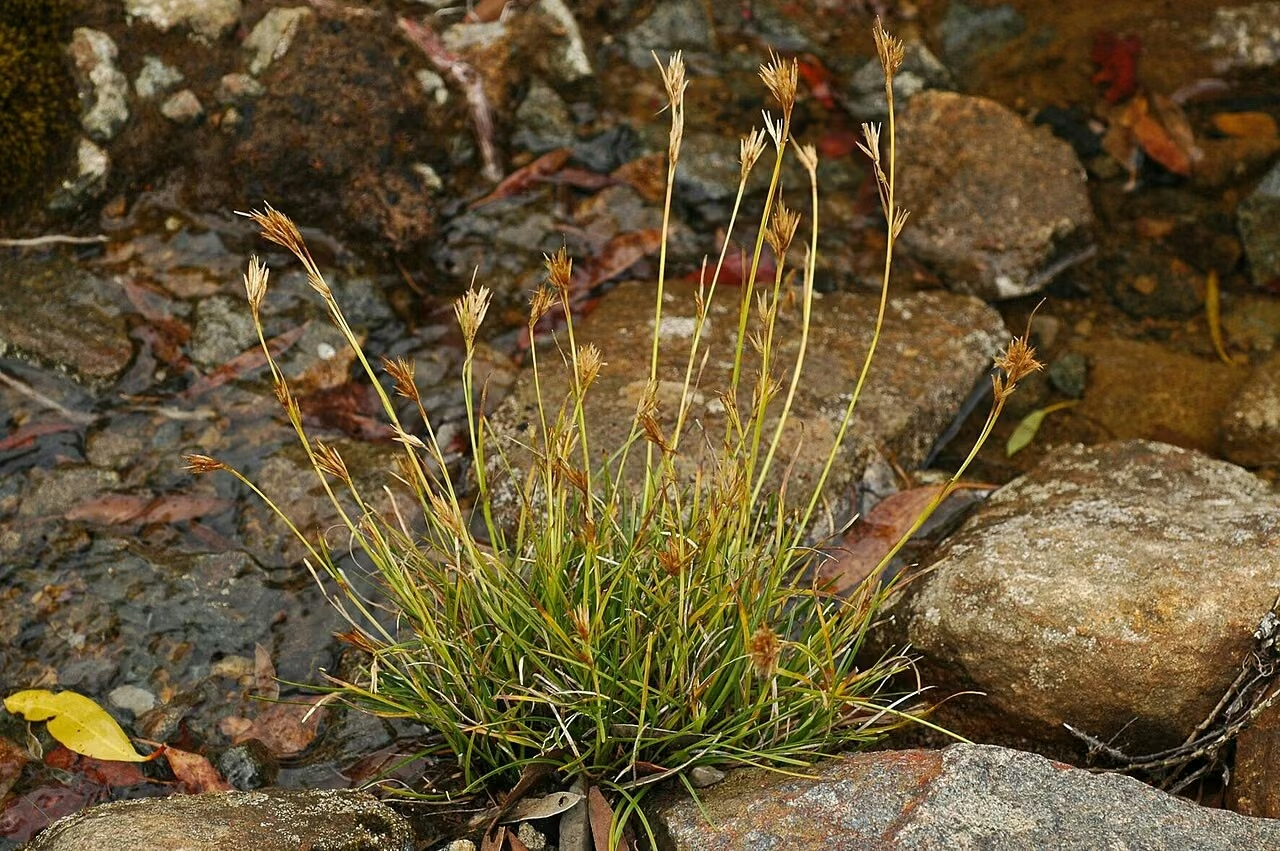
Carpha alpina is a tufted perennial sedge of bogs, mires and wet, peaty shrublands, found in New Zealand and Australia. It forms grass-like tufts with rigid, narrow grey-green or red-green leaves, and in early summer produces flat-topped clusters of pale, shining spikelets. Its small nuts carry six feathery bristles that help them blow away on the wind. Despite its name it ranges from the coast to the alpine zone, from Te Moehau on the Coromandel southward along the North Island's main ranges and volcanic plateau, and through the South, Stewart and Auckland Islands. It is Not Threatened. Explore more native grasses and flaxes in our native plant guide.
Plant Description
Carpha alpina is a tufted perennial sedge. Its culms are very variable in height, usually 6 to 30 cm but ranging from 3 to 75 cm, 0.5 to 1.5 mm thick, grooved, and either flaccid or rather rigid, sometimes curved at the tip. The leaves are usually shorter than the culms, 10 to 20 cm long and up to 2 mm wide, rigid, narrow-linear and flat or slightly curved in section with a blunt tip. They are grey-green or red-green. The leaf sheaths are broad, brown and shining.
The flowers are held in a terminal corymb, a flat-topped cluster, of pale, lustrous spikelets 8 to 12 mm long, each containing a single flower. The fruit is a three-angled nut 2.5 to 3 mm long, raised on a short stalk and surrounded by six feathery (plumose) bristles.
When not in flower it can resemble the grasses in Rytidosperma, but it is distinguished by its rigid flat leaves, corymbose inflorescence and stalked nut, which has no lemma or palea.
Quick Facts
| Scientific Name | Carpha alpina |
|---|---|
| Height | Usually 0.06-0.3 m, occasionally to 0.75 m |
| Spread | A tuft, usually under 0.3 m across |
| Water Needs | Wet; an obligate wetland plant |
| Light | Full sun to partial shade in open bog vegetation |
| Frost Tolerance | High; grows to the alpine zone |
| Salt Tolerance | No information available, though it occurs down to coastal bogs |
| Growth Rate | Slow |
| Lifespan | Perennial |
Climate Best Suited to
Suits cool, wet climates with high rainfall, from coastal lowlands in the south to alpine areas. It needs constantly wet ground and is unsuited to dry districts.
Regional Suitability
| City | Climate Suitability |
|---|---|
| Auckland | Low |
| Wellington | Medium |
| Christchurch | Medium |
| Dunedin | High |
Plant Habitat
Carpha alpina is indigenous to New Zealand and Australia. In New Zealand it occurs in the North Island from Te Moehau southward along the main axial ranges and the volcanic plateau, and is present throughout the South Island, on Stewart Island/Rakiura and on the subantarctic Auckland Islands.
It grows from the coast to the alpine zone in bogs, mires and other moderately open shrublands that overlie poorly drained soils and peat. It is an obligate wetland plant, almost always found in waterlogged ground.
Growing Requirements
Soil Requirements
It grows on peat and poorly drained soils in bogs and mires, which are typically acidic and low in nutrients.
- Peaty, permanently wet soil
- Low-nutrient, acidic conditions suit it
- Avoid rich garden soils or fertiliser
Light Requirements
Its bog and mire habitats are moderately open, giving it good light among low shrubs and other sedges.
- Full sun to light shade
- Avoid deep shade under trees
Water Requirements
As an obligate wetland plant it needs its roots constantly wet, and NZPCN recommends growing it in a pot partially submerged in water.
- Keep permanently wet
- Rainwater is preferable to hard tap water for bog plants
Planting and Establishing
The easiest way to grow carpha is in a pot of peaty mix stood partly submerged in a pond, bog garden or tray of water, as NZPCN recommends. It is slow growing and resents root disturbance, so plant it once in its final position and leave it alone.
In restoration it can be included when replanting degraded bogs and mires within its natural range, alongside other wetland sedges and rushes.
Ecological Role
Carpha alpina flowers from November to January and fruits from February to May. Its nuts carry feathery bristles that act like a pappus, and NZPCN records that they are dispersed by wind.
It is a component of peat bog and mire vegetation throughout much of New Zealand, contributing to the low, mixed sedge and shrub cover that characterises these wetlands. Specific insect associations are not documented in the sources consulted.
Uses & Significance
Garden Uses
A modest, slow-growing sedge for bog gardens and pond margins.
- Bog gardens
- Pots partly submerged at pond edges
- Wetland restoration in peaty sites
Ecological Value
It contributes to the plant diversity of native bogs and mires, wetland types that have been greatly reduced by drainage.
- Part of native peat bog and mire communities
- Occurs from the coast to the alpine zone
- Wind-dispersed seed helps it colonise new wet sites
Landscaping Uses
Carpha forms neat, fine-leaved tufts that soften pond edges. The pale, glossy flower clusters stand out in early summer against the grey-green or reddish foliage.
Use it in small groups in bog gardens with other low wetland plants, where it will not be overshadowed by taller rushes.
Seasonal Care Calendar
Spring
New growth begins as the ground warms.
- Check water levels in bog gardens
- Plant new specimens without disturbing roots
Summer
Flowering takes place from November to January, with pale, shining spikelets in flat clusters.
- Keep pots topped up with water
- Admire the flower heads
Autumn
Fruit ripens from February to May, when the feathery-bristled nuts are released.
- Collect seed for sowing
- Leave plants undisturbed
Winter
Plants remain evergreen and tolerate frost and snow in upland bogs.
- No feeding needed
- Keep roots wet
When to Prune and How Much
No pruning is required. Old dead leaves can be pulled gently from the base in spring.
Avoid cutting the tuft hard back, as it is slow to recover.
How to Grow Carpha
NZPCN describes Carpha alpina as rather slow growing but easily cultivated in a pot partially submerged in water. It resents root disturbance and can be fickle from seed, so propagation needs patience. Seed is the main way to raise new plants, and careful division of large cultivated clumps is possible but should be done gently given the plant's dislike of root disturbance. As the species is Not Threatened, small amounts of seed can be collected responsibly from the wild where permitted, ideally from local bogs for restoration work.
From Seed
Seed ripens from February to May. The plumed nuts blow away easily, so collect heads just as they mature. Germination can be erratic, so sow plenty of seed.
- Collect ripe heads when the bristles begin to fluff out
- Sow on the surface of a wet, peaty seed mix
- Stand the seed tray in a shallow tray of water
- Keep in good light and be patient, as germination can be slow and uneven
- Prick out seedlings carefully into individual pots
By Division
Division can be used on large, established pot-grown tufts, but because the plant resents root disturbance, keep divisions large and expect them to sulk for a season before growing away.
- Divide in spring as growth starts
- Split the clump into two or three large pieces with plenty of roots
- Pot into wet peaty mix and stand in water
- Keep in light shade until new growth appears
Pests & Diseases
No specific pests or diseases are recorded for Carpha alpina. In cultivation, the main cause of failure is drying out or root disturbance.
In the wild, drainage and degradation of bogs and mires are greater threats than pests.
Cultural Significance
No Māori name or traditional Māori use is recorded for Carpha alpina in the sources consulted.
The species was described by the Scottish botanist Robert Brown. The genus name Carpha comes from the Greek for straw, and alpina refers to mountainous regions.
Bonus Tip
Because carpha resents root disturbance, sow or pot it directly into the container it will live in, then sink that whole pot into your pond margin or bog garden. You can lift and move the pot later without ever disturbing the roots.
Related Plants
Explore other native plants that share similar characteristics or habitats with Carpha (Carpha alpina), offering further insights into New Zealand's diverse flora. These related species provide context and opportunities for complementary planting in your garden.
South Island Broom
Carmichaelia arborea
Cromwell Broom
Carmichaelia compacta
Carmichaelia uniflora
Carmichaelia uniflora
Carmichaelia vexillata
Carmichaelia vexillata
Pigface
Carpobrotus glaucescens
Cassinia amoena
Cassinia amoena
Dodder Laurel
Cassytha paniculata
Downy Dodder Laurel
Cassytha pubescens
Plant Conservation
Carpha alpina is ranked Not Threatened (2023) and has held that ranking in every assessment since 2004. It is also Regionally Not Threatened in Otago and Wellington (2025).
Although secure overall, it depends on bogs and mires, and protecting these wetlands from drainage and weed invasion is the best way to maintain its populations.
Frequently Asked Questions
Is Carpha alpina a grass?
No. Although it looks grass-like, it is a sedge in the family Cyperaceae. Its nut lacks the lemma and palea of a grass floret and carries six feathery bristles.
Where does Carpha alpina grow in New Zealand?
It grows from Te Moehau southward along the North Island's main ranges and volcanic plateau, and throughout the South Island, Stewart Island and the Auckland Islands, in bogs and mires.
Can Carpha alpina be grown in a garden pond?
NZPCN says it is easily cultivated in a pot partially submerged in water, although it is rather slow growing, resents root disturbance and can be fickle from seed.
Sources and Further Reading
The botanical, growing, and conservation details for Carpha (Carpha alpina) on this page draw on the New Zealand plant references below. Consult them for full technical records and the latest distribution data.