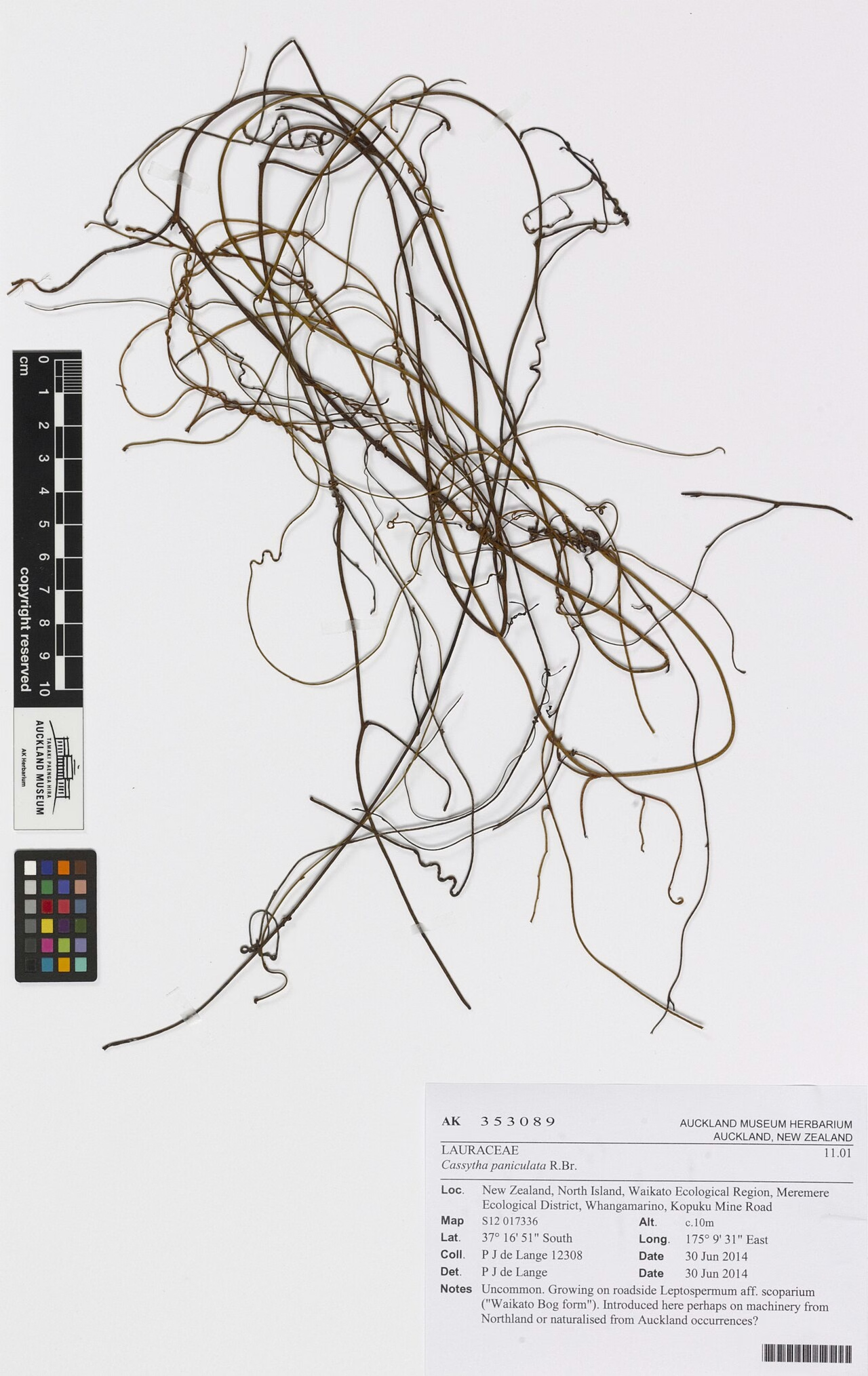
Dodder Laurel
Cassytha paniculata
Last updated:
Dodder laurel (Cassytha paniculata), also known as māwhai or taihoa, is a leafless, parasitic twining vine of the northern North Island. Its thin yellowish green stems, up to about 3 mm thick, wind around shrubs and tap into them with sucker-like haustoria, sometimes forming dense tangled masses over manuka scrub on Northland gumland. It belongs to the laurel family, Lauraceae, and Cassytha is the only parasitic genus in that family. It is indigenous to New Zealand and Australia and is ranked Not Threatened. It is a fascinating plant to find in the wild but is not grown in gardens. Explore more native vines in our native plant guide.
Plant Description
Cassytha paniculata is a twining, parasitic vine with no green leaves. Its stems are up to about 3 mm in diameter, usually yellowish green, finely hairy when young and becoming smooth with age. The only leaves are tiny scales 1 to 2 mm long, ovate and fringed with fine hairs. Wherever a stem coils around a host it forms short sucker-like haustoria that penetrate the host's tissue.
The flowers are small, about 2 to 3 mm across, with six green tepals and nine stamens, carried on spikes 2 to 10 cm long that are simple or sometimes branched. The flowers are well spaced, especially towards the base of the spike, and appear from December to February. The fruit is a small globular drupe 4 to 5.5 mm across, smooth or finely hairy, which is spread by fruit-eating birds and by water.
It is most easily confused with dodder (Cuscuta), which is unrelated. The second New Zealand species, Cassytha pubescens, known only from Waipoua Forest, has thinner stems (to about 2 mm) that are densely covered in rusty hairs and fruit that stays greenish and hairy.
Quick Facts
| Scientific Name | Cassytha paniculata |
|---|---|
| Height | Climbs over shrubs, usually to the height of its host scrub |
| Spread | Can form dense mats over several square metres of scrub |
| Water Needs | Draws water from its host |
| Light | Full sun on open scrub |
| Frost Tolerance | Low; confined to the mild far north |
| Salt Tolerance | No information available |
| Growth Rate | Fast once attached to a host |
| Lifespan | Perennial |
Climate Best Suited to
A plant of the warm, humid, largely frost-free northern North Island, thriving in sunny open scrub on infertile soils.
Regional Suitability
| City | Climate Suitability |
|---|---|
| Auckland | Medium |
| Wellington | Low |
| Christchurch | Low |
| Dunedin | Low |
Plant Habitat
In New Zealand Cassytha paniculata is found in the upper half of the North Island and is mostly associated with Northland. Herbarium records come from areas such as Kaikohe and other North Auckland sites, and older accounts describe it from North Cape through the Kaitaia and Mangonui districts. It is also native to Australia.
Its typical habitat is gumland, the infertile, often poorly drained clay soils of Northland that support low manuka scrub. There it scrambles over manuka and its associates. NZPCN gives it a facultative wetland rating, meaning it occurs equally in wet and dry sites.
Growing Requirements
Soil Requirements
As a parasite it does not depend on soil once attached. Seedlings root briefly in the ground before finding a host, and the shrubs it grows on are typically on infertile gumland clays and podzols.
- Associated with nutrient-poor gumland soils
- Hosts grow on both wet and dry ground
Light Requirements
It grows over the tops of open scrub where it receives full sun.
- Most vigorous on low, sunny scrub
- Rarely found under a closed forest canopy
Water Requirements
Water and nutrients are taken from the host through haustoria, so its water needs are those of the host plants.
- No watering requirements of its own
- Thrives where its manuka hosts thrive
Planting and Establishing
Dodder laurel is not grown in gardens and is not available from nurseries. As an obligate parasite it cannot survive without a living host, and introducing it to a garden would put shrubs at risk.
The best way to enjoy it is in the wild in Northland gumland and scrub, where it can be seen draped over manuka, particularly when flowering or fruiting in summer.
Ecological Role
Cassytha paniculata is a stem parasite. Its stems twine several times around soft host branchlets and send haustoria into the tissue at each point of contact, drawing so much from the host that attacked branchlets can wither. Lateral shoots spread from plant to plant, and under favourable conditions it can form a thick network over the scrub canopy.
Its fleshy drupes are eaten and dispersed by birds and can also be carried by water. Recorded hosts include manuka, kanuka, several Pomaderris species, mingimingi (Leucopogon fasciculatus), Dracophyllum lessonianum, the sedge Schoenus tendo and planted radiata pine. Pollinators of the small green flowers in New Zealand have not been documented.
Uses & Significance
Garden Uses
It has no practical garden use because it lives entirely off other plants.
- Not cultivated
- Best appreciated in natural gumland scrub
Ecological Value
It is a characteristic part of Northland gumland and an example of how parasitism has evolved independently in an otherwise woody plant family.
- Fruit provides food for birds
- Adds structural complexity to manuka scrub
- A natural component of nationally reduced gumland ecosystems
Landscaping Uses
Dodder laurel is not used in landscaping. Restoration of gumland and manuka scrub in Northland indirectly supports it by maintaining the open shrubland it depends on.
Land managers restoring gumland should treat it as a native part of the community rather than a weed, even though it can look like an invasive tangle over shrubs.
Seasonal Care Calendar
Spring
New stem growth extends across the host canopy.
- Yellow-green stems become more noticeable
Summer
Flowering takes place from December to February on spikes along the stems.
- Tiny green flowers on spikes 2 to 10 cm long
- Fruit begins forming
Autumn
Small round drupes ripen and are taken by birds.
- Fruit 4 to 5.5 mm across
Winter
Stems persist on their hosts, with growth slowing in cooler weather.
- Tangled masses remain visible over manuka
When to Prune and How Much
There is no pruning in the garden sense. Where it grows on a valued shrub, removing all stems including the coils attached by haustoria will free the host, but in natural scrub it should be left alone.
On planted pines or shelter shrubs, pulling the stems away and cutting off attached host branchlets is usually enough, because it cannot persist without a host.
How to Grow Dodder Laurel
Cassytha paniculata is not propagated for gardens. As an obligate parasite it gets all its nourishment from a host, so it can only establish where a suitable shrub is close by. In nature it reproduces by seed in fleshy drupes that birds and water carry away, and it also spreads vegetatively as stems grow from one host to the next. The notes below describe how it establishes in the wild and how it might be grown for research or teaching under controlled conditions.
From Seed
In nature the seed germinates in the ground and produces a short-lived rooted seedling that must find and coil around a host quickly. Once haustoria have formed, the root connection withers and the plant becomes fully parasitic. No specific germination requirements for this species have been published in New Zealand sources.
- Collect ripe drupes in late summer or autumn
- Remove the flesh and sow seed in a pot alongside a healthy young host such as manuka
- Keep the mix moist and the pot in a warm, bright position
- Guide the emerging seedling stem onto the host so it can coil and attach
- Grow only in secure containment to avoid infecting other plants
From Stem Segments
Living stem pieces can attach to a new host if they are placed in contact with it, which is how the vine spreads across scrub in the wild.
- Take a length of healthy stem with growing tips
- Drape it over a young host plant so several coils touch soft green shoots
- Keep the host well watered so it supports the parasite
- Check for new haustoria forming at points of contact after a few weeks
Pests & Diseases
No pests or diseases of Cassytha paniculata are recorded in New Zealand. The plant itself is sometimes regarded as a pest on planted pines, but in native scrub it is a natural member of the community.
Its main vulnerability is loss of habitat, since gumland and manuka scrub in Northland have been greatly reduced by development and conversion to farmland and forestry.
Cultural Significance
NZPCN and the Flora of New Zealand record the names māwhai and taihoa for Cassytha. No traditional Māori uses for this plant have been documented in the sources consulted. The name māwhai is also applied to other twining plants, so it should be used with care.
The genus name comes from the Greek kassyo, meaning to sew or patch, describing how the stems stitch through the host. Cassytha paniculata was named by Robert Brown and was featured as Plant of the Month in the NZPCN Trilepidea newsletter in August 2015.
Bonus Tip
To tell dodder laurel from true dodder in the field, look for the flowers and fruit: Cassytha has small green flowers on spikes and produces round fleshy drupes, whereas Cuscuta has clusters of tiny bell-shaped flowers and dry capsules.
Related Plants
Explore other native plants that share similar characteristics or habitats with Dodder Laurel (Cassytha paniculata), offering further insights into New Zealand's diverse flora. These related species provide context and opportunities for complementary planting in your garden.
Carmichaelia vexillata
Carmichaelia vexillata
Carpha alpina
Carpha alpina
Pigface
Carpobrotus glaucescens
Cassinia amoena
Cassinia amoena
Downy Dodder Laurel
Cassytha pubescens
Adams's Daisy
Celmisia adamsii
Silver Cushion Mountain Daisy
Celmisia argentea
Armstrong's Mountain Daisy
Celmisia armstrongii
Plant Conservation
Cassytha paniculata is ranked Not Threatened (2023) with the qualifier Secure Overseas, reflecting its wide range in Australia. It was listed as At Risk - Naturally Uncommon in 2009 but has been Not Threatened since 2012, and Northland's 2026 regional assessment rates it Regionally Not Threatened.
Its fortunes are tied to the gumland and manuka scrub it parasitises. Protecting and restoring these Northland shrublands, and controlling invasive weeds such as hakea and pines that replace them, helps keep it common.
Frequently Asked Questions
Is Cassytha paniculata a dodder?
Not a true dodder. It looks like dodder (Cuscuta) because it is a leafless twining parasite, but Cassytha belongs to the laurel family and is a separate, unrelated lineage that evolved the same lifestyle.
What plants does dodder laurel grow on?
In Northland it is mainly recorded on manuka (Leptospermum scoparium) and associated gumland shrubs such as Pomaderris, mingimingi and Dracophyllum, and it has also been recorded on kanuka and radiata pine.
Where is Cassytha paniculata found in New Zealand?
It occurs in the upper half of the North Island, mainly in Northland, where it is common in manuka scrub on gumland. It is also native to Australia.
Does Cassytha paniculata kill its host?
It can kill individual branchlets it coils around, and dense growth can weaken shrubs, but it is described as far less aggressive than true dodder.
Sources and Further Reading
The botanical, growing, and conservation details for Dodder Laurel (Cassytha paniculata) on this page draw on the New Zealand plant references below. Consult them for full technical records and the latest distribution data.