Dwarf Broom
Carmichaelia vexillata
Last updated:
Dwarf broom (Carmichaelia vexillata) is a low, spreading native broom up to 15 cm tall and 40 cm wide, endemic to the eastern South Island from South Canterbury to Otago. Its stout stems carry flattened green-yellow branchlets, often red-tipped in winter, and in late spring and summer small purple-and-white pea flowers in clusters of two or three. The upright standard petal, taller than the lower petals, gives the species its name. It grows on recent moraine, river alluvium, terraces, disturbed soils and schist-derived soils, and is ranked At Risk - Declining because weeds and browsing reduce flowering and seed set. Explore more native ground covers in our native plant guide.
Plant Description
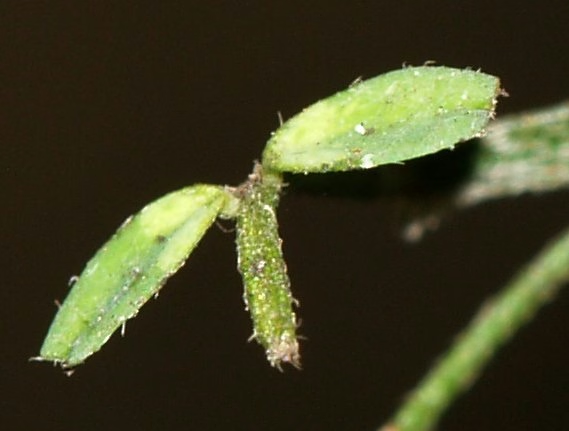
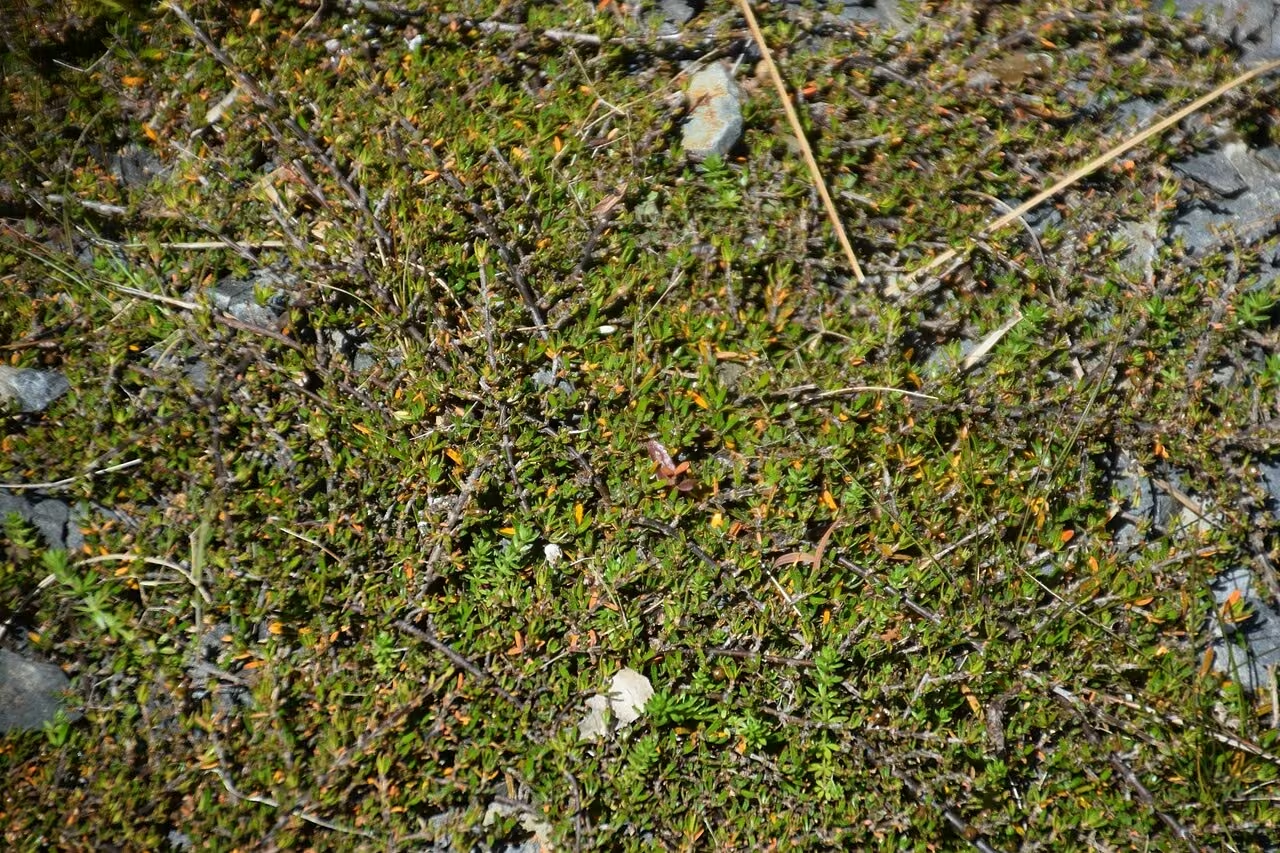
Carmichaelia vexillata is a dwarf, spreading shrub up to 15 cm tall and 40 cm wide. Its stems are stout and either curve upwards or lie horizontally. The branchlets (cladodes) are linear, 20 to 95 mm long and 1.5 to 4 mm wide, finely grooved, green-yellow and often flushed red, with tips that frequently turn red in winter. They may be sparsely hairy when young and are hairless at maturity. Seedlings, and occasionally mature plants, carry simple, fleshy, green to bronze leaves.
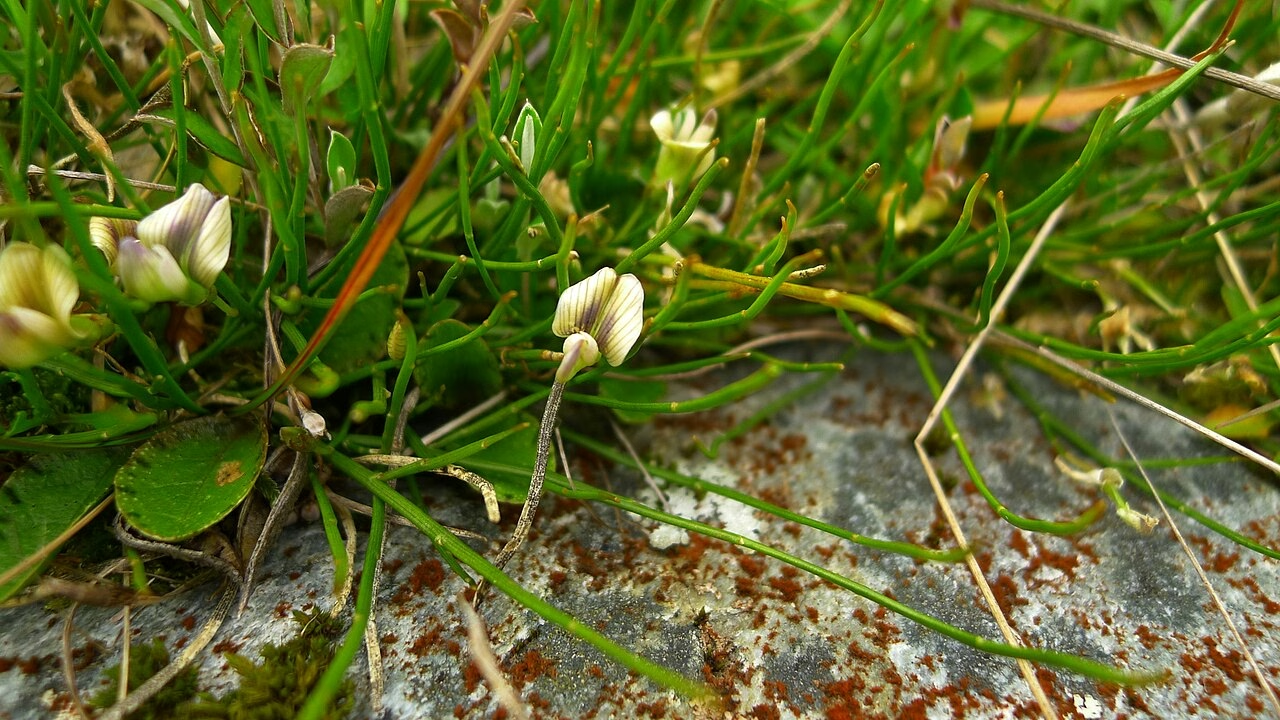
The flowers are 4 to 5.5 mm long, in clusters of two or three. They are purple with whitish margins, or sometimes cream with purple veins. The standard petal is upright and taller than the wings and keel, with a purple centre and white margins. The pods are oblong, flattened and slightly curved, dark brown to black or light grey, and contain four to thirteen yellow to olive green seeds mottled with black.
Similar species include Carmichaelia monroi, C. astonii and C. corrugata. C. vexillata has thin stems and a standard petal taller than the lower petals; C. monroi has a smaller standard; C. astonii has hairy stems and is larger overall; and C. corrugata spreads by underground stems.
Quick Facts
| Scientific Name | Carmichaelia vexillata |
|---|---|
| Height | Up to 0.15 m |
| Spread | Up to 0.4 m |
| Water Needs | Low; dry, free-draining sites |
| Light | Full sun |
| Frost Tolerance | High; grows in cold inland basins |
| Salt Tolerance | No information available |
| Growth Rate | Slow |
| Lifespan | Perennial |
Climate Best Suited to
Suits the dry, continental climate of inland South Canterbury and Otago, with cold frosty winters and warm dry summers. NZPCN notes that it dislikes humid climates.
Regional Suitability
| City | Climate Suitability |
|---|---|
| Auckland | Low |
| Wellington | Low |
| Christchurch | Medium |
| Dunedin | Medium |
Plant Habitat
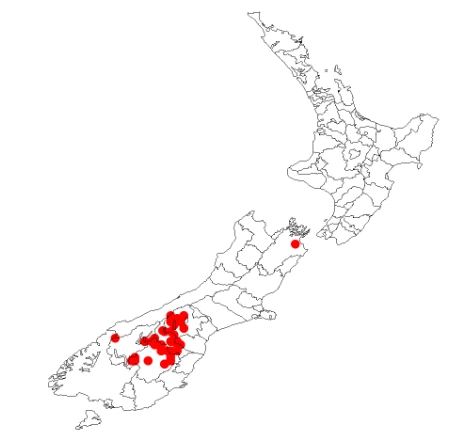
Carmichaelia vexillata is endemic to the eastern South Island, ranging to South Canterbury and Otago.
It grows on recent moraines, alluvium, river terraces and terrace risers, disturbed soils and soils derived from schist. These open, low-competition sites are prone to invasion by weeds, which is one reason the species is declining.
Growing Requirements
Soil Requirements
It favours young, stony soils on moraine, alluvium and schist, where competition from other plants is low.
- Gravelly, free-draining soil
- Schist or alluvial gravels suit it
- Low fertility helps limit weeds
Light Requirements
As a plant of open terraces and moraines it needs full exposure to sun.
- Full sun
- Do not let taller plants shade it
Water Requirements
It grows in some of the drier parts of the South Island and is adapted to dry, well-drained conditions.
- Water sparingly once established
- Avoid humid, damp sites
Planting and Establishing
Plant in spring into a sunny scree bed, rock garden or trough with a gritty, free-draining mix. Keep surrounding weeds and grasses well clear, since competition suppresses flowering.
In humid districts it is better grown in a pot or raised bed with good air movement. Protect young plants from rabbits and hares.
Ecological Role
Flowering is recorded from October to March by NZPCN, with fruit from November to May. NZPCN notes that seeds are possibly dispersed by wind and granivory.
Weeds and browsing animals inhibit its flowering and fruit set, yet NZPCN points out that without browsing animals many of the open habitats it relies on would disappear under weed growth. As a nitrogen-fixing legume it contributes to the development of young soils on moraine and terraces.
Uses & Significance
Garden Uses
A small specialist plant for dry gardens and troughs, where its red-tipped winter branchlets and purple flowers can be seen close up.
- Scree and rock gardens
- Alpine troughs in low-humidity areas
- Restoration of terrace and moraine sites within its range
Ecological Value
It is part of the dryland flora of the eastern South Island, much of which has been reduced by land development and weeds.
- Fixes nitrogen on young soils
- Flowers provide nectar for small insects
- Contributes to the plant diversity of open terraces and moraines
Landscaping Uses
With its horizontal, upward-curving stems, this broom forms a small, low dome that suits the edge of a rock or gravel garden.
Its red-flushed branchlets in winter add seasonal interest when combined with silver or grey dryland plants.
Seasonal Care Calendar
Spring
Flowering begins in late spring, with clusters of purple and white pea flowers.
- Weed around plants
- Plant out new stock
Summer
Flowering continues and pods develop from November.
- Water young plants sparingly in drought
- Watch for browsing damage
Autumn
Pods ripen and darken, ready for seed collection until about May.
- Collect ripe pods
- Take semi-hardwood cuttings
Winter
The branchlet tips often turn red in winter.
- Ensure good drainage
- Little care needed
When to Prune and How Much
Pruning is not needed for this tiny shrub. Its low, spreading form develops naturally.
Remove only dead stems or any weeds growing through the plant.
How to Grow Dwarf Broom
NZPCN records that Carmichaelia vexillata is easy to grow from fresh seed and from semi-hardwood cuttings, but that it dislikes humid climates. This means young plants should be raised in an airy, bright place rather than kept in a humid propagating environment for long. Since it is ranked At Risk - Declining, wild collection should be avoided unless it is part of an authorised recovery or restoration project; cultivated plants are the best source of seed and cuttings for gardeners. Each pod can contain up to thirteen seeds, so a few pods give plenty of seed.
From Seed
Fresh seed germinates well. Pods ripen from about November to May and turn dark brown, black or grey when mature. Sowing promptly after collection avoids the deeper dormancy that hard legume seed can develop in storage.
- Collect pods when they have darkened
- Extract the mottled seeds and nick the coat or soak in hot water
- Sow fresh in a gritty, free-draining mix
- Keep evenly moist in a bright, well-ventilated spot
- Pot on seedlings into individual containers
From Cuttings
Semi-hardwood cuttings of the flattened branchlets root readily according to NZPCN. Because the plant is so small, each cutting will be short, so choose healthy, firm branchlets from the outer part of the plant.
- Take cuttings of semi-firm branchlets in late summer or autumn
- Insert into a mix of pumice and sand
- Keep lightly moist but avoid high humidity
- Pot on once rooted and grow in full sun
Pests & Diseases
Browsing animals, such as rabbits and hares, can reduce flowering and fruiting. Weeds that overgrow the plant are a major threat.
In cultivation, humid conditions and wet soils are likely to cause decline. No specific insect pests are recorded in the sources consulted.
Cultural Significance
No Māori name or traditional Māori use specific to Carmichaelia vexillata was found in the sources consulted.
The species was described by Peter Heenan, whose revision of Carmichaelia clarified the many native brooms. The epithet vexillata refers to the vexillum, or standard petal, which in this species is upright and taller than the other petals.
Bonus Tip
To confirm you have C. vexillata rather than C. monroi, look at a flower side-on: if the upper petal stands upright and taller than the lower petals, it is C. vexillata. This single character is the quickest way to tell the two apart in the field.
Related Plants
Explore other native plants that share similar characteristics or habitats with Dwarf Broom (Carmichaelia vexillata), offering further insights into New Zealand's diverse flora. These related species provide context and opportunities for complementary planting in your garden.
Plant Conservation
Carmichaelia vexillata is ranked At Risk - Declining (2023) with the qualifiers Data Poor: Size, Data Poor: Trend and Recruitment Failure. In Otago it is listed as Regionally At Risk - Regionally Declining (2025).
Weeds and browsing animals inhibit flowering and fruit set. Because some browsing keeps weeds from closing over its habitat, conservation management needs to balance weed control against grazing pressure.
Frequently Asked Questions
How do you identify Carmichaelia vexillata?
Look for a dwarf, spreading broom under 15 cm tall with green-yellow flattened branchlets and purple flowers whose upright main petal is taller than the two lower united petals.
How is Carmichaelia vexillata different from Carmichaelia monroi?
In C. vexillata the main (standard) petal is upright and taller than the lower petals, whereas in C. monroi the main petal is smaller than the lower petals.
What habitat does Carmichaelia vexillata grow in?
It grows on recent moraines, alluvium, river terraces and terrace risers, disturbed soils and soils derived from schist in South Canterbury and Otago.
Does browsing harm Carmichaelia vexillata?
Browsing and weeds inhibit its flowering and fruiting, but NZPCN notes that without some browsing many of its open habitats would be overgrown by weeds, so management is a balance.
Sources and Further Reading
The botanical, growing, and conservation details for Dwarf Broom (Carmichaelia vexillata) on this page draw on the New Zealand plant references below. Consult them for full technical records and the latest distribution data.