Simplicia
Simplicia buchananii
Last updated:
Simplicia buchananii is a slender, tufted native grass in Simplicia, a genus found only in New Zealand. It forms loose tufts and patches up to 1 m across and 0.5 m tall, with narrow leaves and slim, mostly linear flower heads of tiny one-flowered spikelets. It grows in semi-shade on base-rich ground, on or near limestone and marble outcrops in North West Nelson and around titoki trees on calcareous river terraces near Taihape. Ranked Threatened - Nationally Critical, it is known from only a handful of small sites, and the single remaining South Island population makes it one of New Zealand's rarest grasses. Explore more native grasses and flaxes in our native plant guide.
Plant Description
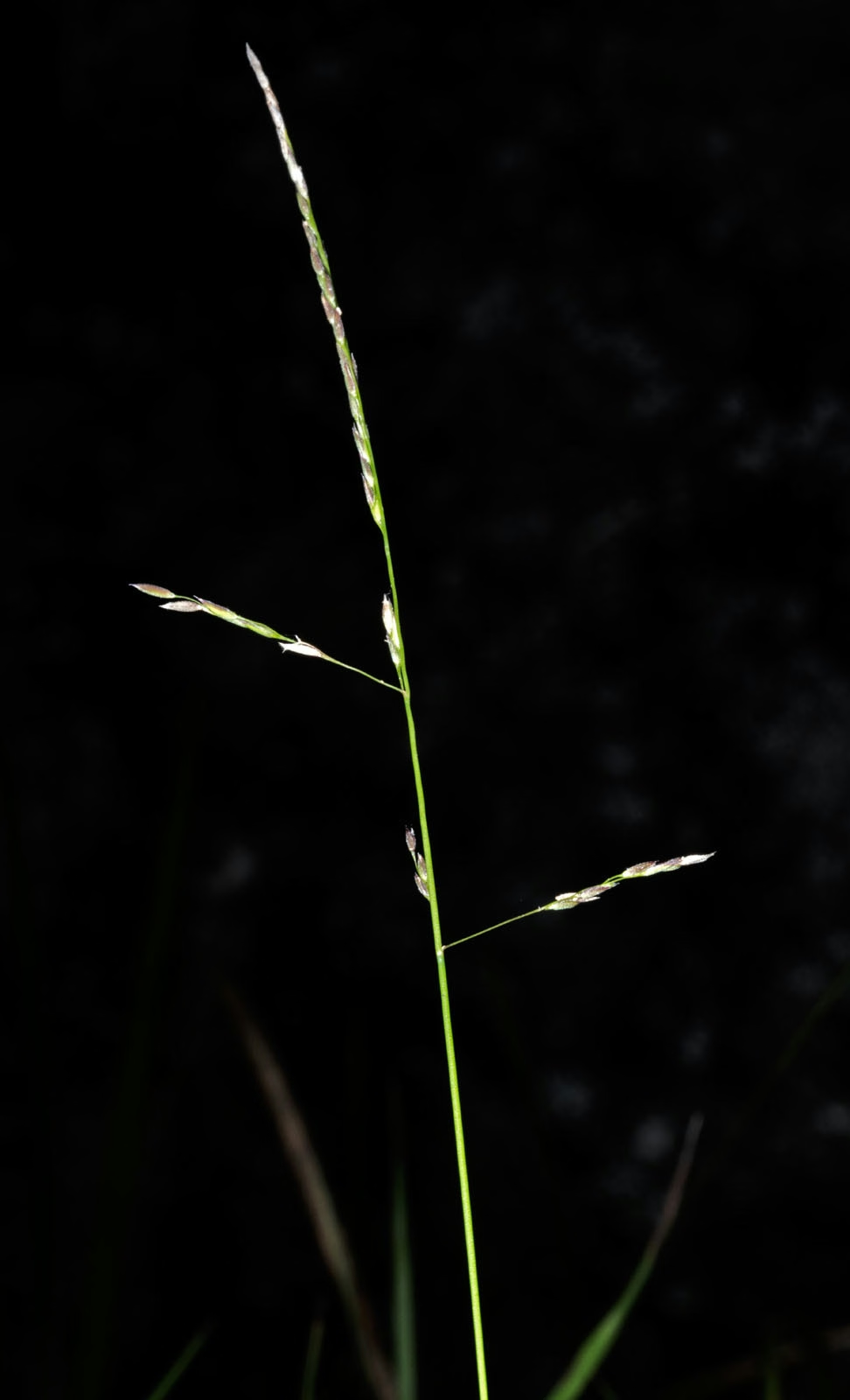
Simplicia buchananii is a slender grass forming loose tufts and patches up to 1 m across and about 0.5 m tall, with flowering stems from 25 to 105 cm. The leaf sheaths are membranous and strongly ribbed, the basal sheaths dark brown. The leaf blades are narrow, 100 to 200 mm long and 1.5 to 4 mm wide.
The flower head is a slim panicle 40 to 180 mm long, mostly linear in outline with its branches held close to the stem. The spikelets are tiny, 2.8 to 3 mm long, and usually contain a single floret, which inspired the original name Poa uniflora. The lemma is three-nerved and scabrid or shortly hairy, and the anthers are purplish or yellow. Flowers are green and inconspicuous.
The other Simplicia species, S. laxa and S. felix, are sprawling grasses that root freely at the nodes and have pyramidal flower heads with reflexed lower branches. S. buchananii is more upright and tufted, with a narrow, contracted head. DNA studies suggest both S. buchananii and S. laxa have hybrid origins.
Quick Facts
| Scientific Name | Simplicia buchananii |
|---|---|
| Height | Up to 0.5 m |
| Spread | Patches up to 1 m across |
| Water Needs | Moderate; evenly moist but free-draining |
| Light | Semi-shade |
| Frost Tolerance | Moderate; lowland to montane |
| Salt Tolerance | Low; an inland species |
| Growth Rate | Moderate |
| Lifespan | Short-lived perennial |
Climate Best Suited to
Suits cool, moist inland climates with sheltered, semi-shaded conditions, as in the lowland to montane forests of North West Nelson and the river terraces of the central North Island.
Regional Suitability
| City | Climate Suitability |
|---|---|
| Auckland | Low |
| Wellington | Medium |
| Christchurch | Medium |
| Dunedin | Medium |
Plant Habitat
Simplicia buchananii is endemic to New Zealand. NZPCN records it from three sites near Taihape in the southern North Island and from North West Nelson in the South Island, where only one population is currently known. The type specimen was collected on Mt Arthur in 1874.
It favours base-rich substrates in semi-shade, in forest or near rock overhangs. In the South Island it grows on or near limestone and marble outcrops in lowland to montane forest. At the North Island site, plants grow around the bases of tītoki trees on calcareous river terraces.
Growing Requirements
Soil Requirements
It needs base-rich, lime-influenced soils, matching its natural limestone, marble and calcareous terrace sites.
- Free-draining soil with added lime or limestone chips
- Moderate fertility with leaf litter
- Avoid acidic, peaty mixes
Light Requirements
It grows in semi-shade under forest or near rock overhangs.
- Dappled or partial shade
- Protect from hot afternoon sun
Water Requirements
Under forest canopy the soil stays moderately moist but never waterlogged.
- Keep evenly moist through summer
- Ensure good drainage, especially in pots
Planting and Establishing
Simplicia buchananii is mainly grown in conservation and botanic garden collections. Plant in a semi-shaded spot under trees or beside rocks, in free-draining soil enriched with lime. Any material used in restoration should come from the population it is returning to, under DOC guidance.
Because plants are short-lived, keep a succession of young plants from seed. In the North Island habitat they grow among tītoki roots, so planting under a light canopy of native trees on a limey terrace mimics its natural setting.
Ecological Role
Like other grasses, Simplicia buchananii is wind-pollinated. Its seeds are small and probably fall close to the parent or are moved by water and animals; no specific dispersal studies were found.
It is part of the specialised flora of base-rich rocks and soils in New Zealand forests. Its tiny populations make it vulnerable to weeds, browsing, trampling and chance events such as slips or tree fall.
Uses & Significance
Garden Uses
This is a plant for specialist collections rather than general gardens.
- Conservation collections and seed orchards
- Shaded limestone or rock gardens in botanic gardens
- Teaching collections of rare native grasses
Ecological Value
As a member of an endemic genus with only three species, it is of high conservation and evolutionary value.
- Represents a lineage found nowhere else
- Part of the distinctive limestone and marble flora
- Holds genetic evidence of hybrid origin within Simplicia
Landscaping Uses
In a collection, grow it at the base of a shaded limestone outcrop or among rocks under deciduous or native trees, where its fine leaves and slender heads can be seen against the stone.
Its loose tufts are subtle, so place it near a path with labelling rather than among vigorous groundcovers that would overwhelm it.
Seasonal Care Calendar
Spring
Flowering begins from about September, peaking around November.
- Weed around plants
- Keep soil moist
Summer
Flowering continues into February and seed ripens from late spring.
- Collect seed as heads ripen
- Water in dry spells
Autumn
Late seed is shed until about May.
- Sow fresh seed
- Lift and pot rooted pieces
Winter
Growth slows; plants persist as low tufts.
- Avoid waterlogging
- Check for slug damage
When to Prune and How Much
Pruning is not required. Old flowering stems can be cut away once seed has been collected to keep tufts tidy.
Because plants are short-lived, replace old, declining tufts with seedlings rather than trying to rejuvenate them.
How to Grow Simplicia
NZPCN describes Simplicia buchananii as very easy to grow from fresh seed and from rooted pieces, and it can also be grown from node cuttings. Unlike Simplicia laxa, it flowers readily in cultivation and produces abundant seed that germinates easily, which makes it much easier to maintain in collections. Plants are short-lived, however, so regular propagation is needed to keep a stock. As a Nationally Critical species, wild material should only be collected with permission and kept separate by source population.
From Seed
Seed ripens from about October to May. Collect heads when the spikelets turn straw-coloured and the seeds fall easily. Fresh seed germinates readily.
Seedlings grow quickly, and NZPCN notes that this species flowers readily once established in cultivation.
- Collect ripe seed heads and dry them in a paper bag
- Sow fresh seed on a free-draining mix with added lime
- Cover lightly with fine grit and keep moist in a shaded spot
- Prick out seedlings into individual pots when large enough to handle
- Plant out into semi-shade once well rooted
By Division and Node Cuttings
Established tufts can be divided into rooted pieces, and stem pieces with a node will root when kept moist. This is useful for keeping particular genetic lines.
- Lift a healthy tuft in spring or autumn
- Tease apart rooted pieces with a few shoots each
- Or cut stem sections with a node and insert in moist mix
- Keep in shade and humidity until new growth appears
Pests & Diseases
No specific pest problems are recorded for this species. In cultivation, slugs and snails may graze young shoots, and poor drainage can cause the roots to rot.
In the wild, the main threats are habitat change, weeds and the very small size of most populations, rather than particular pests.
Cultural Significance
No Māori name or traditional use is recorded for Simplicia buchananii. Its epithet honours John Buchanan (1819-1898), a Scottish-born botanist and scientific artist who was New Zealand's first government-employed botanist.
Buchanan described it as Poa uniflora, but that name was already in use, so in 1971 Victor Zotov transferred it to Simplicia under a new name honouring Buchanan.
Bonus Tip
If you want to keep a Simplicia going in a collection, start with S. buchananii: it flowers and seeds freely in cultivation, unlike S. laxa, so you can maintain it by sowing a fresh batch each year before the short-lived parent plants fade.
Related Plants
Explore other native plants that share similar characteristics or habitats with Simplicia (Simplicia buchananii), offering further insights into New Zealand's diverse flora. These related species provide context and opportunities for complementary planting in your garden.
Senecio repangae
Senecio repangae
Senecio rufiglandulosus
Senecio rufiglandulosus
Senecio scaberulus
Senecio scaberulus
Guano Groundsel
Senecio sterquilinus
Simplicia laxa
Simplicia laxa
Small-Flowered Nightshade
Solanum americanum
Cook Strait Kōwhai
Sophora molloyi
Sparganium subglobosum
Sparganium subglobosum
Plant Conservation
Simplicia buchananii is ranked Threatened - Nationally Critical (2023) with qualifiers Sp, DPR, DPS, DPT and RR. It can be locally common, but most sites are very small, and only one South Island population is currently known. The status of the North West Nelson populations needs further survey.
Protection of its limestone and terrace habitats, weed control, exclusion of stock and keeping cultivated seed lines in botanic gardens are the main conservation actions.
Frequently Asked Questions
What is Simplicia buchananii?
It is a rare, slender tufted grass in the endemic New Zealand genus Simplicia. It was first described by John Buchanan as Poa uniflora and later moved to Simplicia by Victor Zotov.
Where does Simplicia buchananii grow?
NZPCN records it from three sites near Taihape in the southern North Island and from North West Nelson, where only one South Island population is currently known. It grows in semi-shade on limestone, marble or calcareous soils.
How do you tell Simplicia buchananii from Simplicia laxa?
S. buchananii is an upright tufted grass with a linear, contracted flower head and a scabrid lemma, while S. laxa sprawls, roots at the nodes and has a pyramidal head with reflexed lower branches and a hairy lemma.
Sources and Further Reading
The botanical, growing, and conservation details for Simplicia (Simplicia buchananii) on this page draw on the New Zealand plant references below. Consult them for full technical records and the latest distribution data.