Rostkovia
Rostkovia magellanica
Last updated:
Rostkovia (Rostkovia magellanica) is a small tufted rush of cold, wet southern bogs. It forms tufts 5 to 20 cm tall, occasionally to 40 cm, with very narrow, rigid leaves and a single red-brown flower at the top of each stem, followed by a hard, shining chestnut-brown capsule. In New Zealand it is found in Otago, Fiordland and on the Auckland and Campbell Islands, and it also grows in Patagonia, the Falkland Islands and South Georgia. This sub-Antarctic distribution makes it a classic example of the plant links between New Zealand and South America. It is ranked Not Threatened but is local on the South Island. Explore more native grasses and flaxes in our native plant guide.
Plant Description
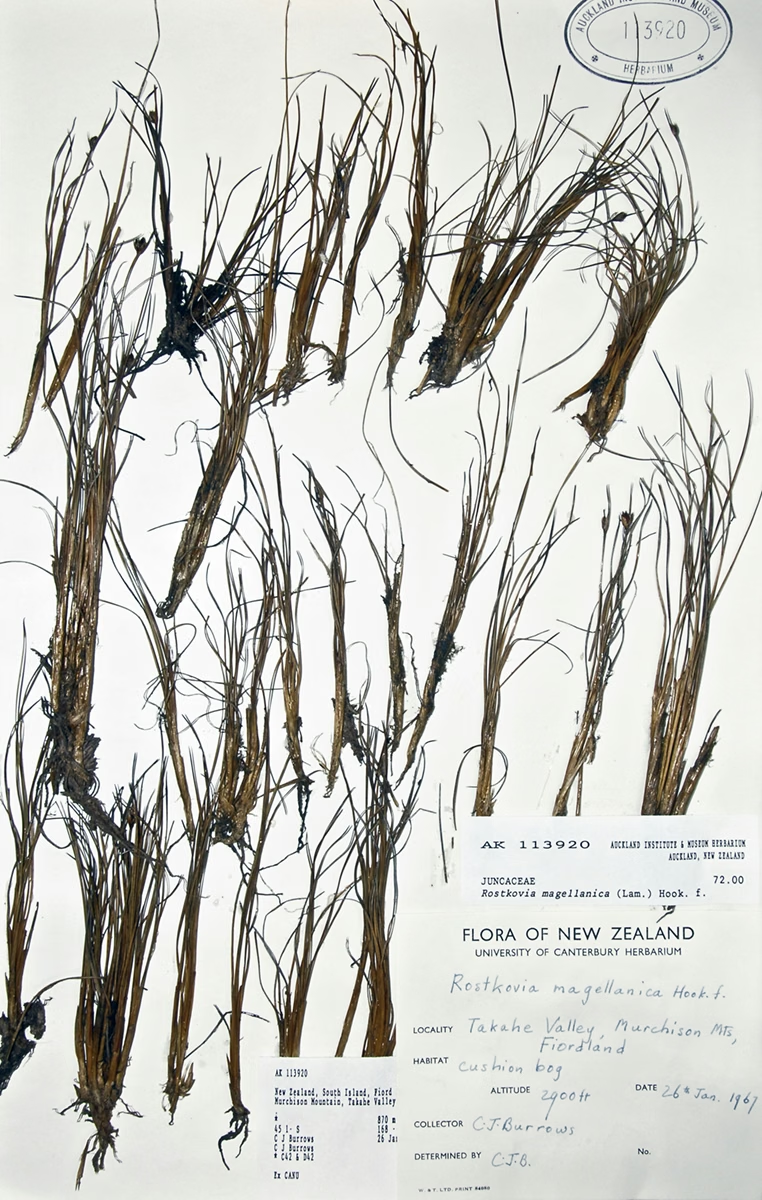
Rostkovia magellanica grows in small tufts 5 to 20 cm tall, occasionally reaching 40 cm. A short rhizome 1 to 2 mm thick creeps between tufts that sit less than 4 cm apart. The stems are slender, about 0.5 mm in diameter, rigid, and often wrapped in leaf sheaths for half their length. The leaves are usually longer than the stems and less than 1 mm wide, becoming almost cylindrical towards the tip.
Each stem ends in a single flower 5 to 10 mm long, held beside a rigid, leaf-like bract 1 to 3.5 cm long. The tepals are lance-shaped and red-brown with paler membranous edges. The fruit is a hard, smooth, shining chestnut-brown capsule 3.5 to 10.5 mm long, slightly longer than the tepals, which splits near its tip to release glossy, almost black seeds. It flowers from December to February and fruits from February to April.
Its solitary terminal flowers and large glossy capsules separate it from the small Juncus species that share its boggy habitats, whose flowers are usually clustered and whose capsules are smaller and duller.
Quick Facts
| Scientific Name | Rostkovia magellanica |
|---|---|
| Height | 0.05-0.2 m (occasionally to 0.4 m) |
| Spread | Small tufts; shortly creeping rhizome |
| Water Needs | High; permanently wet bog |
| Light | Full sun, open boggy ground |
| Frost Tolerance | Very high |
| Salt Tolerance | No information available; grows on windswept subantarctic islands |
| Growth Rate | Slow |
| Lifespan | Perennial |
Climate Best Suited to
Rostkovia belongs to the cool, wet, windy climates of Fiordland, the southern South Island mountains and the subantarctic islands, where summers are short and soils stay saturated.
Regional Suitability
| City | Climate Suitability |
|---|---|
| Auckland | Low |
| Wellington | Low |
| Christchurch | Low |
| Dunedin | Medium |
Plant Habitat
In New Zealand, Rostkovia magellanica is recorded from Otago and Fiordland on the South Island, where NZPCN describes it as rather local, and from the Auckland Islands and Campbell Island/Motu Ihupuku. Beyond New Zealand it occurs in Patagonia, the Falkland Islands and South Georgia, with an outlying population in Ecuador.
It is classed as a facultative wetland plant, usually found in wet ground. It typically grows in peat bogs, wet herbfields and seepages, often among cushion plants, mosses and low sedges where the ground is waterlogged for most of the year.
Growing Requirements
Soil Requirements
It grows in acidic, peaty soils that are saturated for much of the year.
- Wet peat or peaty mineral soil
- Acidic and low in nutrients
- No added fertiliser
Light Requirements
Bogs and herbfields are open habitats, and this small rush is easily shaded out by taller vegetation.
- Full sun
- Keep clear of taller, overshadowing plants
Water Requirements
Constant moisture is essential; it does not tolerate drying out.
- Keep peat permanently moist
- Use rainwater rather than hard tap water
- Ideal for a bog garden or tray standing in water
Planting and Establishing
Rostkovia is not available commercially, and it would need a cool, constantly wet, acidic bog garden to have any chance in cultivation. A container of peat and sand standing in a saucer of rainwater, in a cool position, is the most practical way to replicate its habitat.
Gardeners in Southland and coastal Otago, where summers are cool, have the best prospects. Wild plants should not be dug up; seed collected with permission is the appropriate source.
Ecological Role
Like other rushes, Rostkovia is wind-pollinated, with its small brown flowers shedding pollen into the air. The hard capsules release smooth seeds that probably disperse short distances by water or wind, though its distribution around the Southern Ocean suggests occasional long-distance dispersal, possibly by birds, over geological time.
In subantarctic bogs it forms part of a low turf with mosses, cushion plants and small sedges, helping to bind peat surfaces. Little is recorded about insects that feed on it.
Uses & Significance
Garden Uses
This is a plant for specialist collections, botanic gardens and bog restoration within its natural range.
- Cool, acidic bog gardens
- Educational displays of subantarctic flora
- Restoration of southern peat bogs using local seed
Ecological Value
It contributes to the distinctive flora of southern bogs and subantarctic islands.
- Part of the peat-forming bog turf
- Evidence of historic plant links between New Zealand and South America
- Habitat structure for small bog invertebrates
Landscaping Uses
In a bog garden, plant Rostkovia in small groups at the front where its fine tufts and glossy brown capsules can be seen. It contrasts well with green cushions of moss and with small native bog plants such as sundews.
Its small size means it is easily lost among vigorous plants, so give it an uncrowded position.
Seasonal Care Calendar
Spring
New leaves grow from the tufts as bogs thaw and warm.
- Top up water levels
- Remove encroaching moss if it starts to smother tufts
Summer
Flowering occurs from December to February, with a single red-brown flower on each stem.
- Never let the peat dry
- Shade the container from midday heat in warm districts
Autumn
Glossy chestnut-brown capsules ripen from February to April.
- Collect capsules as they begin to split
- Sow seed fresh
Winter
The plant is fully hardy and tolerates snow and hard frost in its natural habitat.
- Keep wet but not under stagnant water
- No other care needed
When to Prune and How Much
No pruning is required. Old flowering stems can be cut off at the base once the seed has been collected or shed, and any dead leaves can be combed out by hand.
Avoid cutting the tufts back hard; small rushes from cold climates regrow slowly.
How to Grow Rostkovia
NZPCN lists the propagation of Rostkovia magellanica as not known, and there is no published record of it being grown in New Zealand. The approaches below are those generally used for small rushes and bog plants and should be treated as trial methods. Any seed or plant material should come from populations where collection is permitted; the subantarctic islands are nature reserves with strict entry rules.
From Seed
Rushes generally have small seeds that need light and constant moisture to germinate. Rostkovia seeds are larger than most, about 1.2 to 2 mm long, which may make them easier to handle. Seed from cold climates often benefits from a period of cold before germination.
- Collect capsules in late summer or autumn as they begin to split at the tip
- Sow seeds on the surface of a mix of peat and sand
- Stand the pot in a tray of rainwater so the mix stays saturated
- Place outdoors in a cool, bright spot over winter
- Pot seedlings on individually once they form small tufts
By Division
Because plants form tufts linked by a short rhizome, a cultivated clump can probably be separated into smaller pieces. Division is best done in spring when new growth begins and the cool, wet conditions help pieces re-establish.
- Lift a well-established clump in spring
- Tease apart tufts, keeping roots and a section of rhizome with each
- Replant into wet peat immediately
- Keep cool and saturated until growth resumes
Pests & Diseases
No pests or diseases are recorded for Rostkovia magellanica. In cultivation the main problems would be drying out, summer heat and competition from mosses or liverworts that overgrow small plants in permanently wet pots.
In the wild, past browsing and trampling by introduced animals on the subantarctic islands affected bog vegetation generally; their removal has allowed many native plants there to recover.
Cultural Significance
No Māori name or traditional use is recorded for Rostkovia magellanica. The genus name honours Rostkov, a German botanist, and the species name refers to the Strait of Magellan in southern South America, where the plant was first collected and described, as Juncus magellanicus, in 1789.
The plant is of scientific interest as one of many species shared between New Zealand, its subantarctic islands and southern South America, a pattern that has long fascinated botanists studying Southern Hemisphere biogeography.
Bonus Tip
When looking for Rostkovia in a southern bog, search in late summer for the large, glossy, chestnut-brown capsules perched on wiry stems. They are far more conspicuous than the plant's narrow leaves and make it easy to separate from the small Juncus species that often grow alongside it.
Related Plants
Explore other native plants that share similar characteristics or habitats with Rostkovia (Rostkovia magellanica), offering further insights into New Zealand's diverse flora. These related species provide context and opportunities for complementary planting in your garden.
Plant Conservation
Rostkovia magellanica is ranked Not Threatened in the 2023 New Zealand Threat Classification. Otago's 2025 regional assessment lists it as Regionally At Risk - Regionally Naturally Uncommon, because on the South Island it is rather local in its occurrences.
Its bog habitats can be damaged by drainage, peat extraction, fire and trampling. On the South Island, protecting peatlands and keeping vehicles and stock out of wet herbfields are the most helpful measures.
Frequently Asked Questions
What kind of plant is Rostkovia magellanica?
It is a small tufted member of the rush family (Juncaceae), with rigid narrow leaves and solitary red-brown flowers, rather than a grass or sedge.
Where does Rostkovia grow in New Zealand?
It occurs in Otago and Fiordland on the South Island and on the subantarctic Auckland and Campbell Islands, where it grows in wet, boggy ground.
Why is Rostkovia also found in South America?
It is a sub-Antarctic species that also grows in Patagonia, the Falkland Islands, South Georgia and Ecuador, part of a wider pattern of shared plants around the Southern Ocean. Its name refers to the Strait of Magellan.
Is Rostkovia magellanica threatened?
It is ranked Not Threatened nationally (2023), but it is rather local on the South Island and Otago lists it as Regionally Naturally Uncommon.
Sources and Further Reading
The botanical, growing, and conservation details for Rostkovia (Rostkovia magellanica) on this page draw on the New Zealand plant references below. Consult them for full technical records and the latest distribution data.