Buttercup
Ranunculus urvilleanus
Last updated:
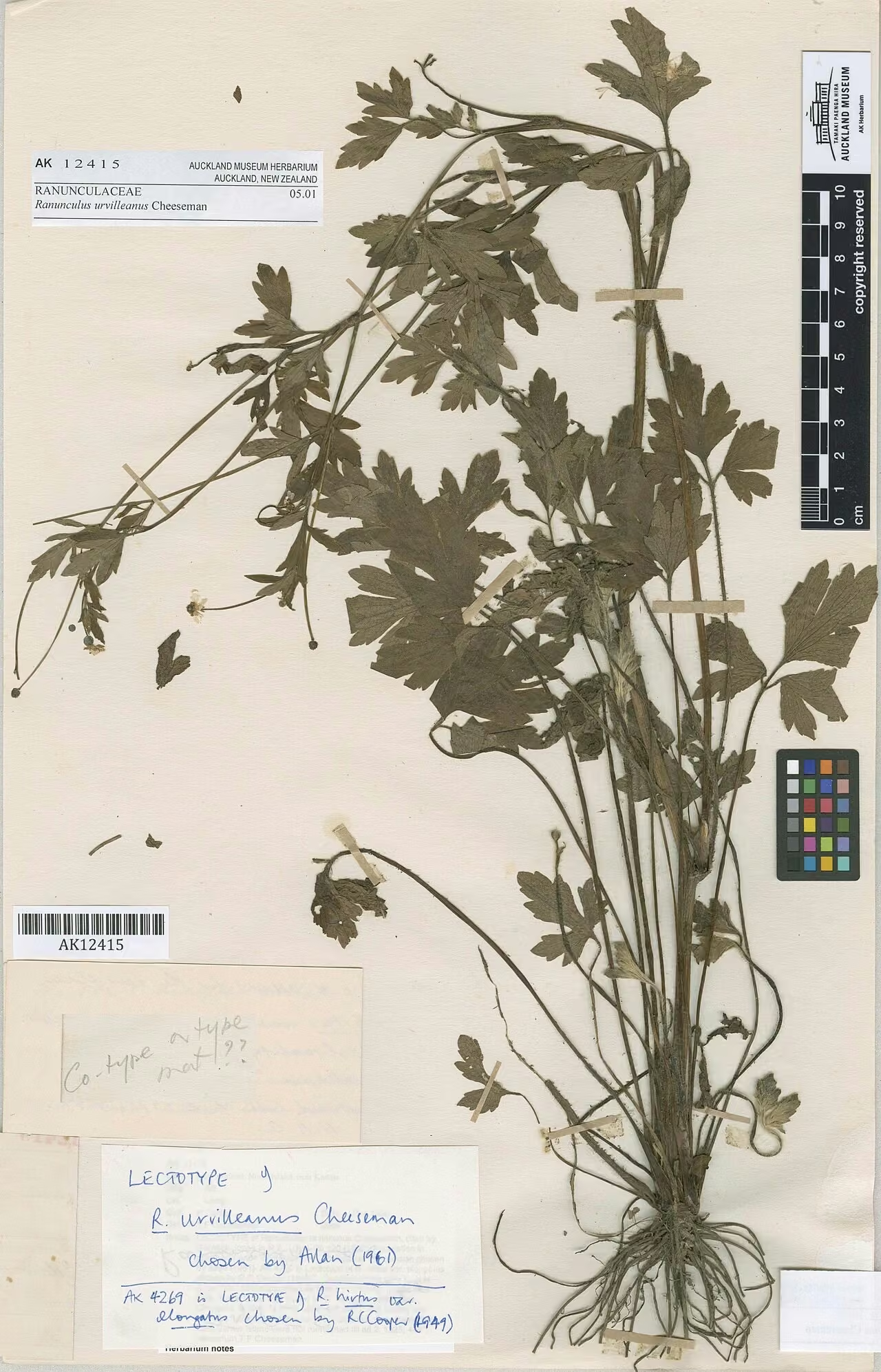
Ranunculus urvilleanus is a tall, hairy, endemic buttercup of damp lowland ground in the northern North Island. It forms a tuft of deeply divided, three-parted leaves and erect stems up to 80 cm tall carrying many small yellow flowers 8 to 12 mm wide from October to January. It grows on swamp margins, stream banks and wet ground in scrub from North Cape to about latitude 38 degrees, mainly in eastern Northland and on inshore islands, and in Auckland and Waikato. Its lax, weedy look means it is easily mistaken for introduced buttercups. It is ranked At Risk - Declining. Explore more native flowering plants in our native plant guide.
Plant Description
Ranunculus urvilleanus is a tufted perennial up to 80 cm tall, without a rhizome. Its erect stems are covered with long, fine, spreading hairs in the lower part and short, flattened hairs higher up. The basal and lower leaves are divided into three stalked, broadly ovate leaflets, each 3 to 5 cm long and cut about three quarters of the way into three, with the lobes again three-lobed and deeply, sharply toothed. The leaves are hairy.
Each stem carries many flowers 8 to 12 mm across, with five yellow petals. Flowering runs from October to January and fruiting from November to February. The fruit is a rounded head of 30 to 50 rather dark, flattened, hairless achenes.
Its tall, branching, hairy stems and small flowers give it the appearance of a weedy introduced buttercup, and it is easily confused with several common introduced buttercups and with the native R. reflexus. The ternate leaves with stalked, deeply and sharply toothed leaflets and the flattened, hairless achenes in globose heads are the features to check.
Quick Facts
| Scientific Name | Ranunculus urvilleanus |
|---|---|
| Height | Up to 0.8 m in flower |
| Spread | Tufts about 0.2-0.4 m across |
| Water Needs | Moist to wet |
| Light | Full sun to partial shade |
| Frost Tolerance | Light frosts only; a northern lowland species |
| Salt Tolerance | No information available |
| Growth Rate | Moderate |
| Lifespan | Perennial |
Climate Best Suited to
It suits the warm temperate, humid climate of northern New Zealand, with mild winters and moist ground year round.
Regional Suitability
| City | Climate Suitability |
|---|---|
| Auckland | High |
| Wellington | Medium |
| Christchurch | Low |
| Dunedin | Low |
Plant Habitat
Ranunculus urvilleanus is endemic to the northern North Island. It ranges from North Cape south to about latitude 38 degrees, in Northland (mostly eastern districts and inshore islands), Auckland and Waikato. The type locality is near Kaitaia.
It grows on swamp margins, stream banks and wet ground in scrub, typically in damp, open places. Its wetland indicator status is facultative wetland, meaning it is usually found in wetlands but occasionally on drier ground.
Growing Requirements
Soil Requirements
It grows in damp to wet soils at the edges of swamps and streams, where the ground is fertile and rarely dries out.
- Moist to wet soil
- Swamp and stream margins
- Tolerates heavier, poorly drained ground
Light Requirements
It favours damp open habitats but also grows in wet ground among scrub.
- Full sun to partial shade
- Open sites where it is not overtopped
Water Requirements
Its habitats stay damp for most of the year, and it should be kept moist in cultivation.
- Regular water in summer
- Suited to wetland edges
- Avoid prolonged drying
Planting and Establishing
No published cultivation guidance was found for this species, and it is not commonly available. As a lowland wetland-edge plant of Northland and Auckland, it would be expected to grow in moist, sunny garden soil or at the margin of a pond or swale in the north.
If it is used in wetland restoration, eco-sourced plants from nearby populations should be used, and it should be planted where weeds such as introduced buttercups and grasses can be controlled so it is not lost among them.
Ecological Role
Its many small yellow flowers are open from spring into midsummer and offer nectar and pollen to native and introduced insects at wetland margins. Pollination and seed dispersal have not been specifically studied.
It is a component of the herbaceous margins of northern swamps and streams, habitats that have been extensively drained and invaded by introduced grasses and herbs in Northland, Auckland and Waikato.
Uses & Significance
Garden Uses
It suits wetland restoration and naturalistic damp plantings in northern New Zealand, where it adds a native buttercup to pond and stream edges.
- Wetland and swale margins
- Stream bank restoration in Northland and Auckland
- Native meadow plantings on damp ground
Ecological Value
It is a declining endemic of northern wetland margins and a reminder that not every buttercup in a swamp is a weed.
- Endemic to the northern North Island
- Nectar and pollen for wetland insects
- Part of native swamp margin vegetation
Landscaping Uses
In a restoration planting it fits between sedges and rushes at the water's edge, where its tall stems of small yellow flowers can rise above the lower vegetation.
Label it clearly in plantings so that maintenance crews do not remove it as a weedy buttercup.
Seasonal Care Calendar
Spring
Flowering begins in October.
- Tall flowering stems develop
- Control competing weeds
Summer
Flowering continues to January and fruit ripens from November to February.
- Collect ripe seed heads
- Keep plants moist
Autumn
Plants return to a leafy tuft after flowering.
- Sow fresh seed
- Tidy old flowering stems
Winter
The leafy tuft persists in mild northern winters.
- Little growth
- Keep weeds from smothering the tuft
When to Prune and How Much
Cut back old flowering stems once the seed has ripened or been collected, to keep the tuft tidy.
No other pruning is needed, but surrounding grasses and weeds should be kept back so the plant is not swamped.
How to Grow Buttercup
No propagation information for Ranunculus urvilleanus was found in the sources consulted, and it is not a nursery plant. The methods below are those that generally work for tufted lowland buttercups and are offered as a starting point rather than proven technique. Because it is At Risk - Declining and Regionally Critical in Northland, wild seed should only be collected with landowner permission and ideally as part of a local restoration project using eco-sourced material.
From Seed
Seed ripens from November to February in rounded heads of 30 to 50 dark, flattened achenes. Lowland buttercups usually germinate best from fresh seed sown soon after collection.
Keep seedlings labelled and separate from other buttercups, because young plants look much like the weedy introduced species that are common in damp northern pasture.
- Collect seed heads when the achenes darken and loosen
- Sow fresh on a moist, standard seed-raising mix
- Cover lightly and keep evenly moist in a sheltered spot
- Prick out seedlings into individual pots once they have true leaves
- Grow on in moist conditions and plant out in autumn or spring
By Division
Mature tufts can be split into smaller clumps in autumn or early spring, each with a share of the roots, which is a quick way to multiply cultivated plants.
Water divisions well until new leaves show they have rooted.
- Lift the tuft carefully
- Divide into pieces with leaves and roots
- Replant or pot up immediately and keep well watered
Pests & Diseases
No specific pests or diseases are recorded for Ranunculus urvilleanus. Slugs and snails are likely to damage young plants in cultivation.
In the wild, competition from introduced grasses and weedy buttercups at wetland margins is a likely problem, but the specific causes of its decline are not described in the sources consulted.
Cultural Significance
No Māori name or traditional use is recorded for Ranunculus urvilleanus in the sources consulted.
Thomas Cheeseman named the species in 1925 in honour of Jules Dumont d'Urville, whose French expeditions visited New Zealand in the 1820s and 1840s. A 1997 study by Peter de Lange and Rhys Gardner in the Auckland Botanical Society Journal reviewed its distribution, ecology and conservation status.
Bonus Tip
Before weeding buttercups from a Northland or Auckland wetland edge, check for tall plants with many small flowers, hairy stems and leaves divided into three stalked, sharply toothed leaflets; if in doubt, photograph the plant and post it to iNaturalist NZ for identification rather than pulling it out.
Related Plants
Explore other native plants that share similar characteristics or habitats with Buttercup (Ranunculus urvilleanus), offering further insights into New Zealand's diverse flora. These related species provide context and opportunities for complementary planting in your garden.
Ranunculus pinguis
Ranunculus pinguis
Ranunculus recens
Ranunculus recens
Eyre Mountains Buttercup
Ranunculus scrithalis
Ranunculus simulans
Ranunculus simulans
Raoulia buchananii
Raoulia buchananii
Stewart Island Vegetable Sheep
Raoulia goyenii
Green Vegetable Sheep
Raoulia haastii
Raoulia mammillaris
Raoulia mammillaris
Plant Conservation
Ranunculus urvilleanus has been ranked At Risk - Declining since 2017 (NZTCS 2023, qualifiers DPR, DPS, DPT and RR), after earlier rankings of Not Threatened. Regionally it is listed as Regionally Critical in Northland (2026) and Regionally Vulnerable in Auckland (2025).
Protecting and restoring swamp and stream margins in Northland, Auckland and Waikato, controlling weeds and better recognition of the species in the field are the main ways to support it.
Frequently Asked Questions
Who is Ranunculus urvilleanus named after?
It honours Jules Sébastien César Dumont d'Urville (1790-1842), the French explorer whose expeditions visited New Zealand and collected plants in the early nineteenth century.
Why is Ranunculus urvilleanus hard to recognise?
It has a lax, weedy habit and is easily confused with several common introduced buttercups and with the more abundant native lowland species R. reflexus, so it is probably under-recorded.
Where does Ranunculus urvilleanus grow?
It occurs in Northland, mostly in eastern districts and on inshore islands, and in Auckland and Waikato, on swamp margins, stream banks and wet ground in scrub.
Is Ranunculus urvilleanus threatened?
It has been ranked At Risk - Declining since 2017 nationally, and it is listed as Regionally Critical in Northland and Regionally Vulnerable in Auckland.
Sources and Further Reading
The botanical, growing, and conservation details for Buttercup (Ranunculus urvilleanus) on this page draw on the New Zealand plant references below. Consult them for full technical records and the latest distribution data.