Buttercup
Ranunculus simulans
Last updated:
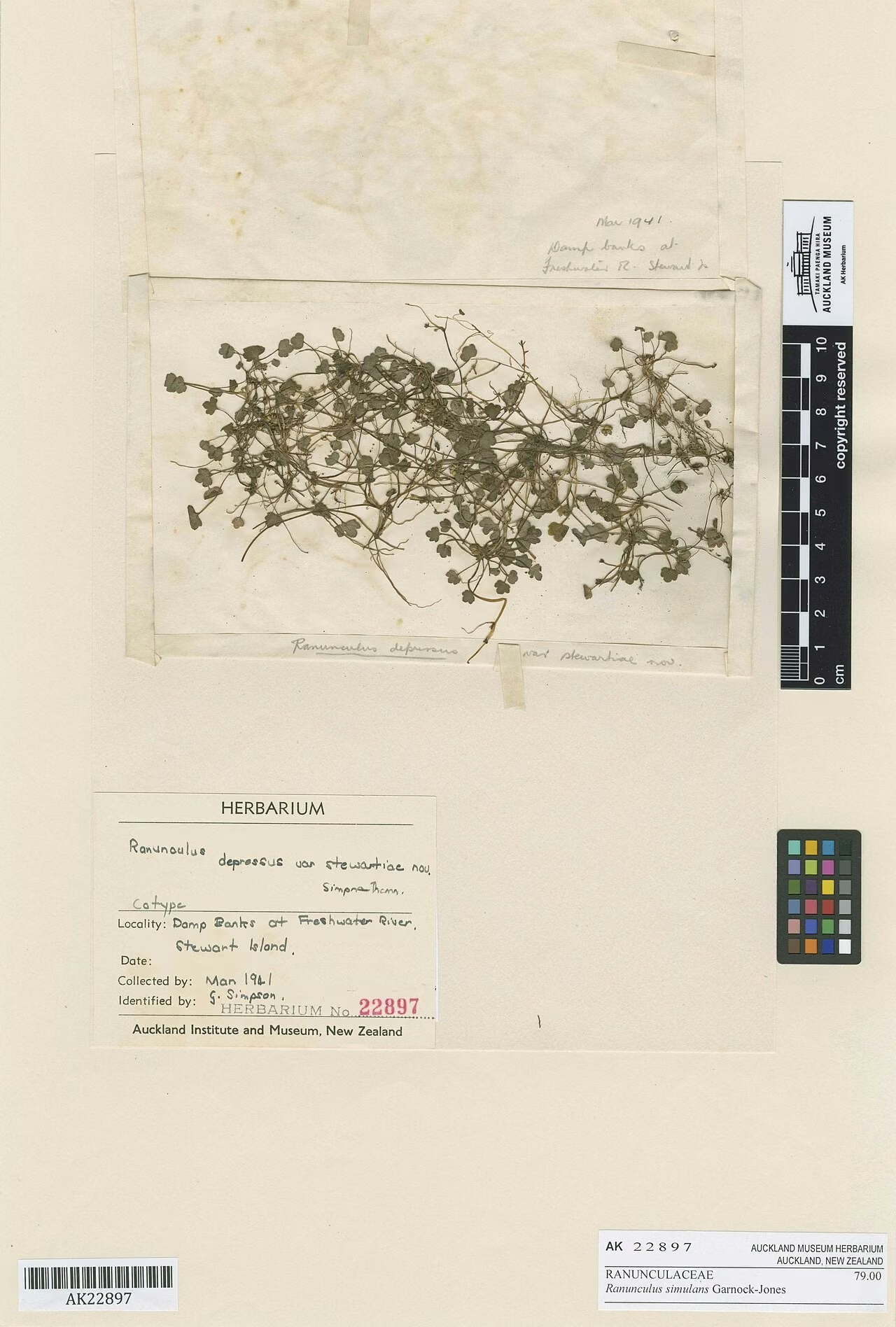
Ranunculus simulans is one of New Zealand's smallest buttercups, a diminutive, tufted rosette plant that spreads by slender, arching stolons rooting at the nodes. Its rounded, shallowly three-lobed leaves are just 3 to 10 mm across, dark green to bronze-green, and its yellow flowers are only 3 to 5 mm wide, sometimes lacking petals altogether. It grows from sea level to 1200 m in damp seepages and pools in forest, on stream banks and in flushes in subalpine scrub and herbfield, on Mt Taranaki, the Kaimanawa and Ruahine ranges, north-west Nelson and Fiordland. Easily overlooked, it is ranked Data Deficient. Explore more native flowering plants in our native plant guide.
Plant Description
Ranunculus simulans is a diminutive, tufted, rosette-forming perennial that spreads by numerous slender, trailing and arching stolons which root at the nodes, so a single plant can produce a loose colony of tiny rosettes. The basal leaves are 3 to 10 mm across, almost circular with a distinctly rounded to squared-off base, shallowly three-lobed at the tip, and dark green to bronze-green.
The flowers are tiny, only 3 to 5 mm in diameter, with up to five yellow petals; some flowers have none. Flowering is from November to January. Each flower produces a small head of 5 to 15 achenes, 1.4 to 1.9 mm long and buff to brown, which ripen from January to April.
Its small size, slender arching stolons, leaves 3 to 10 mm across and flowers 3 to 5 mm across distinguish it from other New Zealand buttercups. The most similar species is R. cheesemanii, which has larger leaves (7 to 35 mm) and larger flowers (6 to 10 mm). It was once treated as a variety of R. depressus, var. stewartiae.
Quick Facts
| Scientific Name | Ranunculus simulans |
|---|---|
| Height | Under 0.05 m |
| Spread | Spreads slowly by stolons into small patches |
| Water Needs | Wet; seepages, pools and flushes |
| Light | Shade to full sun |
| Frost Tolerance | Good; grows up to 1200 m |
| Salt Tolerance | No information available |
| Growth Rate | Moderate |
| Lifespan | Perennial |
Climate Best Suited to
It suits cool, wet climates with high rainfall, from the lowland forests of Fiordland and north-west Nelson to the subalpine zone of the central North Island.
Regional Suitability
| City | Climate Suitability |
|---|---|
| Auckland | Low |
| Wellington | Medium |
| Christchurch | Low |
| Dunedin | Medium |
Plant Habitat
Ranunculus simulans is endemic to New Zealand. In the North Island it is known from Mt Taranaki and the Kaimanawa and Ruahine ranges, and in the South Island from north-west Nelson and Fiordland. It is widely scattered and biologically sparse.
It grows from sea level to 1200 m in damp seepages and small pools within forest, along stream banks, and in seepages and flushes in subalpine scrub and herbfield. Its wetland indicator status is facultative, meaning it occurs both in wetlands and on damp non-wetland ground.
Growing Requirements
Soil Requirements
It roots into wet, often silty or mossy ground in seepages, small pools and stream margins.
- Permanently moist to wet soil
- Fine silt, moss or peat
- Low competition from taller plants
Light Requirements
It occurs both in shaded forest seepages and in open subalpine flushes, so it tolerates a range of light.
- Shade to partial shade in forest
- Full sun in subalpine flushes
- Needs protection from being overgrown
Water Requirements
Constant moisture is essential; all its known habitats are fed by seeping or standing water.
- Keep wet at all times
- Pots can stand in water
- No drought tolerance
Planting and Establishing
NZPCN states that propagation is not known but that it is probably easily grown, and likely to need pot culture so that it is not overtaken by taller plants and weeds. It is not commercially available.
If it is grown in a conservation collection, a shallow pan of moist, fine, peaty mix kept in a cool, partly shaded spot and stood in water would best match its seepage habitat.
Ecological Role
Its minute flowers, sometimes without petals, are likely to be visited by small flies and other tiny insects, or to set seed with little help from pollinators; pollination has not been studied.
The stoloniferous habit lets it spread across wet ground and recolonise disturbed patches of seepage, while its very small size means it depends on open, moist microsites where taller vegetation cannot dominate.
Uses & Significance
Garden Uses
It is too small and too little known for general garden use, but would interest collectors of miniature wetland natives.
- Pot culture in conservation collections
- Miniature bog pans
- Study material for buttercup taxonomy
Ecological Value
It is a cryptic part of New Zealand's seepage and flush flora, which supports many small specialised plants.
- Endemic to North and South islands
- Indicator of undisturbed seepages
- Poorly known; records add to conservation knowledge
Landscaping Uses
It has no landscaping role. Its value is in wild seepage habitats in forests and subalpine areas.
When working on tracks and drainage in its known areas, avoiding the diversion or drying of small seepages helps protect it.
Seasonal Care Calendar
Spring
Rosettes and stolons resume growth.
- New leaves appear
- Stolons extend across wet ground
Summer
Flowering runs from November to January.
- Minute yellow flowers
- Fruits begin to form
Autumn
Achenes ripen from January to April.
- Seed shed into the seepage
- Stolons root at nodes
Winter
Plants persist as small rosettes, under snow at higher sites.
- Little growth
- Keep cultivated plants wet but frost free
When to Prune and How Much
No pruning is required. In cultivation, simply remove any weeds, mosses or taller plants that threaten to smother the rosettes.
Stolons can be trimmed back if a pot becomes crowded, and rooted pieces potted separately.
How to Grow Buttercup
NZPCN records that propagation of Ranunculus simulans is not known, though it is probably easily grown in pots kept free of competition. Because so little is known about the species, any wild material should be collected only with permission and with the aim of contributing to knowledge, and records of success or failure are valuable. The stoloniferous habit offers a likely easy route alongside seed.
By Rooted Stolons
Because the stolons root at their nodes, small rooted rosettes can be detached and grown on, much as with strawberry runners. This is likely to be the simplest method.
- Choose a rosette that has rooted at a stolon node
- Cut the stolon on either side with clean scissors
- Pot into a shallow pan of moist, fine peaty mix
- Stand the pan in a tray of water in partial shade
- Keep free of weeds and mosses while the rosette establishes
From Seed
Seed has not been documented as a propagation method for this species. Fresh achenes collected from January to April and sown at once on a wet surface would be the logical approach, given that related seepage buttercups grow readily from fresh seed.
Label the pots carefully, because seedlings of this species are easily confused with other tiny buttercups or with weedy seedlings in the mix until they produce stolons.
- Collect ripe buff to brown achenes
- Sow immediately on moist fine mix
- Keep wet and cool
- Prick out seedlings carefully when large enough to handle
Pests & Diseases
No pests or diseases are recorded for this species. Slugs would be the most likely problem in cultivation because the rosettes are so small.
In the wild, competition from weeds and taller plants, and changes to the water supply of seepages, are more likely to affect it than pests.
Cultural Significance
No Māori name or traditional use is recorded for Ranunculus simulans in the sources consulted.
It was originally named as a variety of R. depressus (var. stewartiae) by George Simpson and J.S. Thomson, and later recognised as a separate species by Phil Garnock-Jones. The name simulans means imitating, presumably referring to its resemblance to other small buttercups.
Bonus Tip
If you think you have found it, photograph the leaves beside a ruler and note the flower width; leaves under 10 mm and flowers under 5 mm separate it from R. cheesemanii, and confirmed records on iNaturalist NZ help fill the data gaps behind its Data Deficient ranking.
Related Plants
Explore other native plants that share similar characteristics or habitats with Buttercup (Ranunculus simulans), offering further insights into New Zealand's diverse flora. These related species provide context and opportunities for complementary planting in your garden.
Ranunculus pilifer
Ranunculus pilifer
Ranunculus pinguis
Ranunculus pinguis
Ranunculus recens
Ranunculus recens
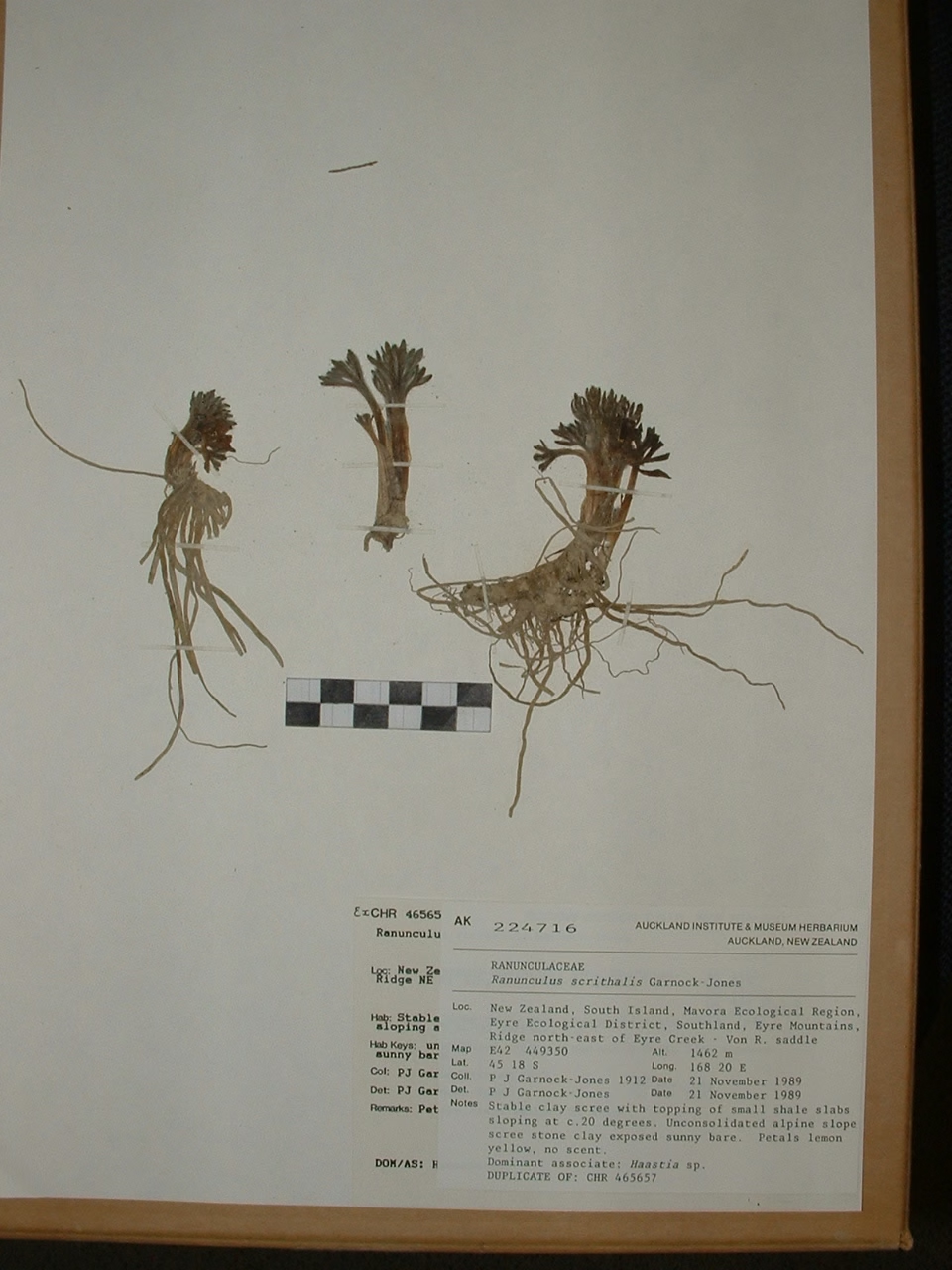
Eyre Mountains Buttercup
Ranunculus scrithalis
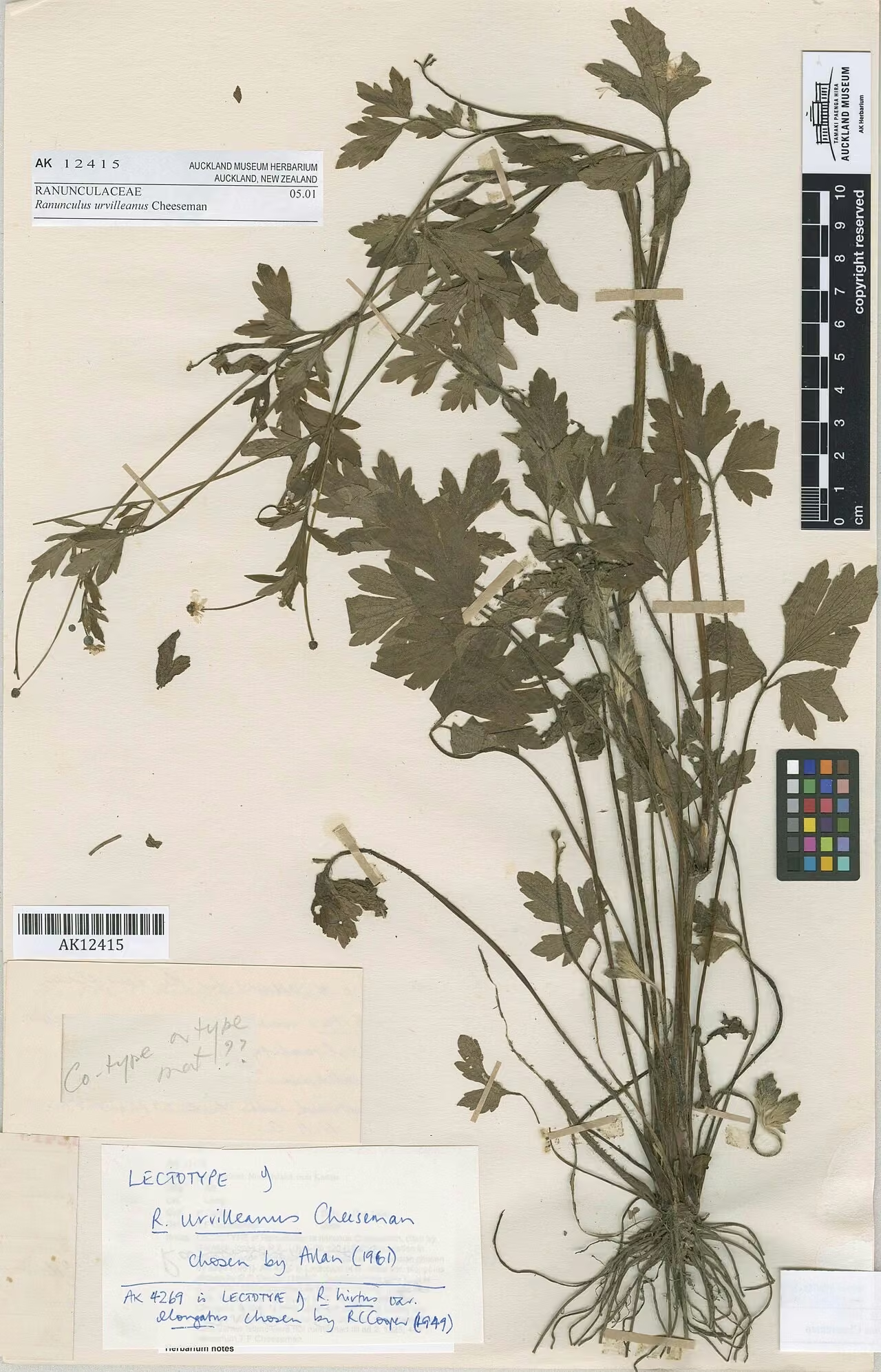
Ranunculus urvilleanus
Ranunculus urvilleanus
Raoulia buchananii
Raoulia buchananii
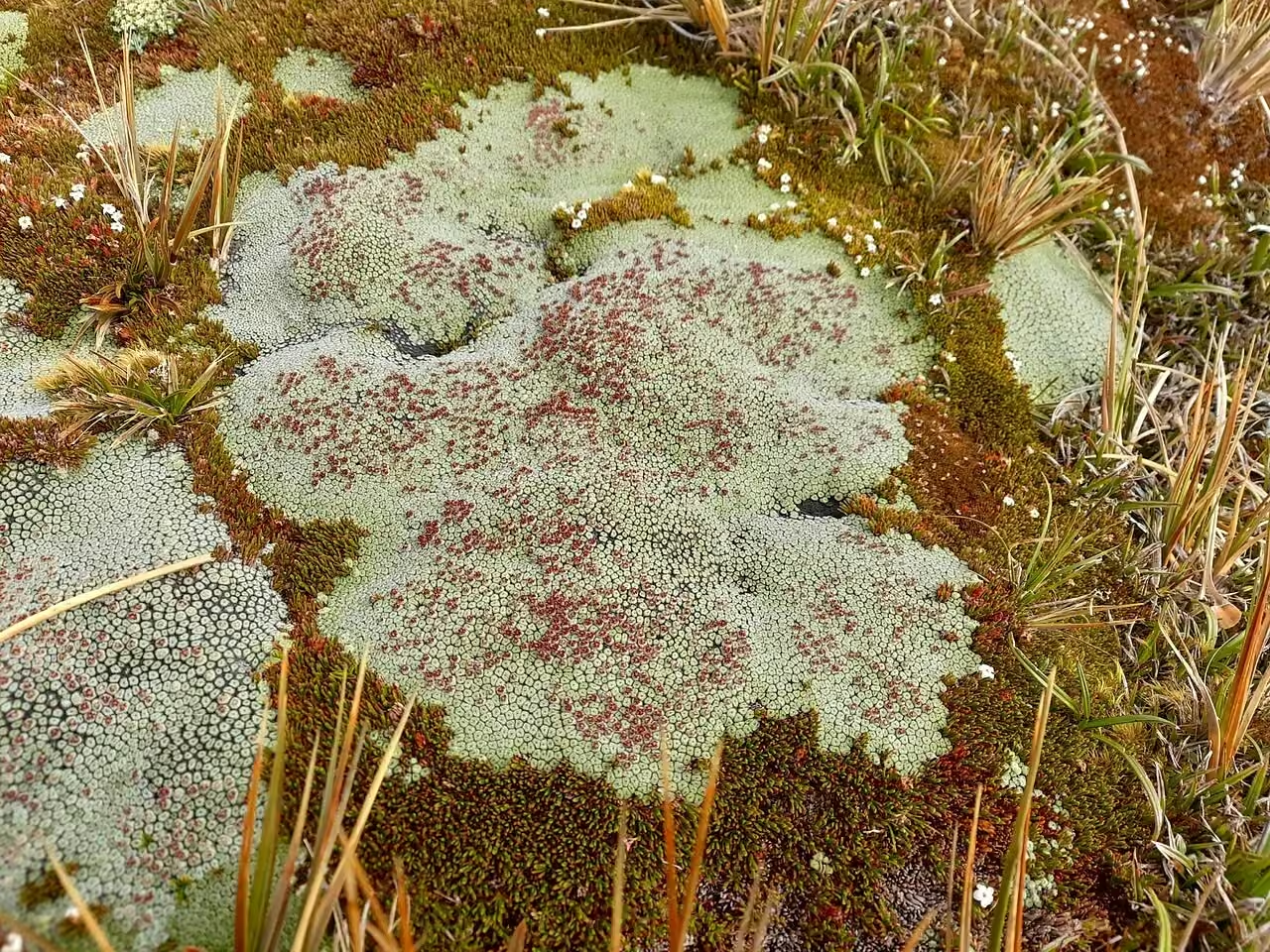
Stewart Island Vegetable Sheep
Raoulia goyenii
Green Vegetable Sheep
Raoulia haastii
Plant Conservation
Ranunculus simulans is ranked Data Deficient (NZTCS 2023, qualifier Sp, sparse). NZPCN describes it as very uncommon, widely distributed and biologically sparse, very easily overlooked, with no clear evidence of past or ongoing decline. The Otago regional assessment (2025) ranks it Regionally Endangered.
Better survey of seepages in its known regions is the main need, so that its true distribution and trend can be established.
Frequently Asked Questions
How do you identify Ranunculus simulans?
Look for tiny rosettes joined by slender arching stolons that root at the nodes, with rounded leaves 3 to 10 mm wide and minute yellow flowers 3 to 5 mm across.
What is the difference between Ranunculus simulans and Ranunculus cheesemanii?
R. cheesemanii is its closest relative but is larger in every part, with leaves 7 to 35 mm across and flowers 6 to 10 mm wide.
Why is Ranunculus simulans listed as Data Deficient?
NZPCN describes it as very uncommon, widely scattered and easily overlooked, with no clear evidence of decline, so there is not enough information to assign a threat ranking.
Where does Ranunculus simulans grow?
It is known from Mt Taranaki and the Kaimanawa and Ruahine ranges in the North Island, and from north-west Nelson and Fiordland in the South Island, in damp seepages from lowland to subalpine.
Sources and Further Reading
The botanical, growing, and conservation details for Buttercup (Ranunculus simulans) on this page draw on the New Zealand plant references below. Consult them for full technical records and the latest distribution data.