Buttercup
Ranunculus pinguis
Last updated:
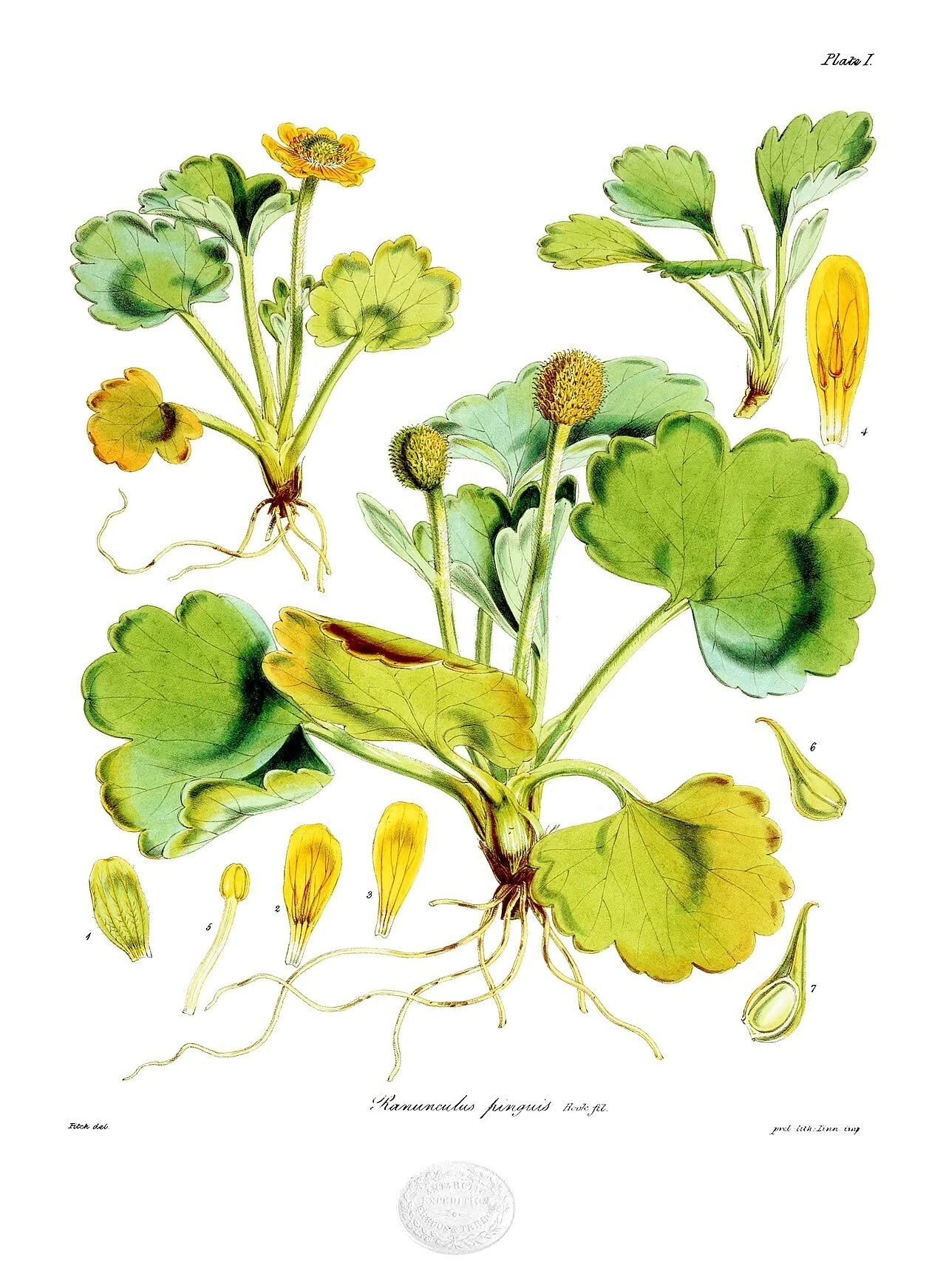
Ranunculus pinguis is a stout, fleshy buttercup found only on New Zealand's subantarctic Auckland Islands and Campbell Island/Motu Ihupuku. It forms rosettes 5 to 25 cm high from a thick rhizome with many white roots, with dark green, kidney-shaped, deeply lobed leaves up to 8 cm across on broad sheathing stalks. Pale yellow flowers 2 to 3 cm wide appear in December and January, with small, stiff petals barely longer than the sepals. It grows from sea level to 600 m in damp to flooded ground in grassland, rocky fellfield and moorland. It is ranked At Risk - Naturally Uncommon because of its tiny island range. Explore more native flowering plants in our native plant guide.
Plant Description
Ranunculus pinguis is a short, stout and rather fleshy perennial forming rosettes 50 to 250 mm high, with all parts hairless or sparsely clothed in long soft hairs. The fleshy rhizome is 7 to 12 mm thick and carries many fleshy white roots. Leaves sit on stout, fleshy stalks 20 to 100 mm long with very broad sheathing bases. The leaf blade is dark green, kidney shaped to rhombic, 20 to 80 mm across and deeply cut into three to five (occasionally seven) lobes with scalloped edges.
One to three stout, unbranched flowering stems, as long as or longer than the leaves, each usually carry a single flower 20 to 30 mm across. There are five or six oblong sepals and six to ten pale yellow, narrow petals that are small and stiff, scarcely as long as the sepals, with a reduced glossy area. Fruiting heads hold numerous small achenes 1.4 to 2 mm long, pale brown, orange or dark red-brown, with beaks 1.1 to 2 mm long.
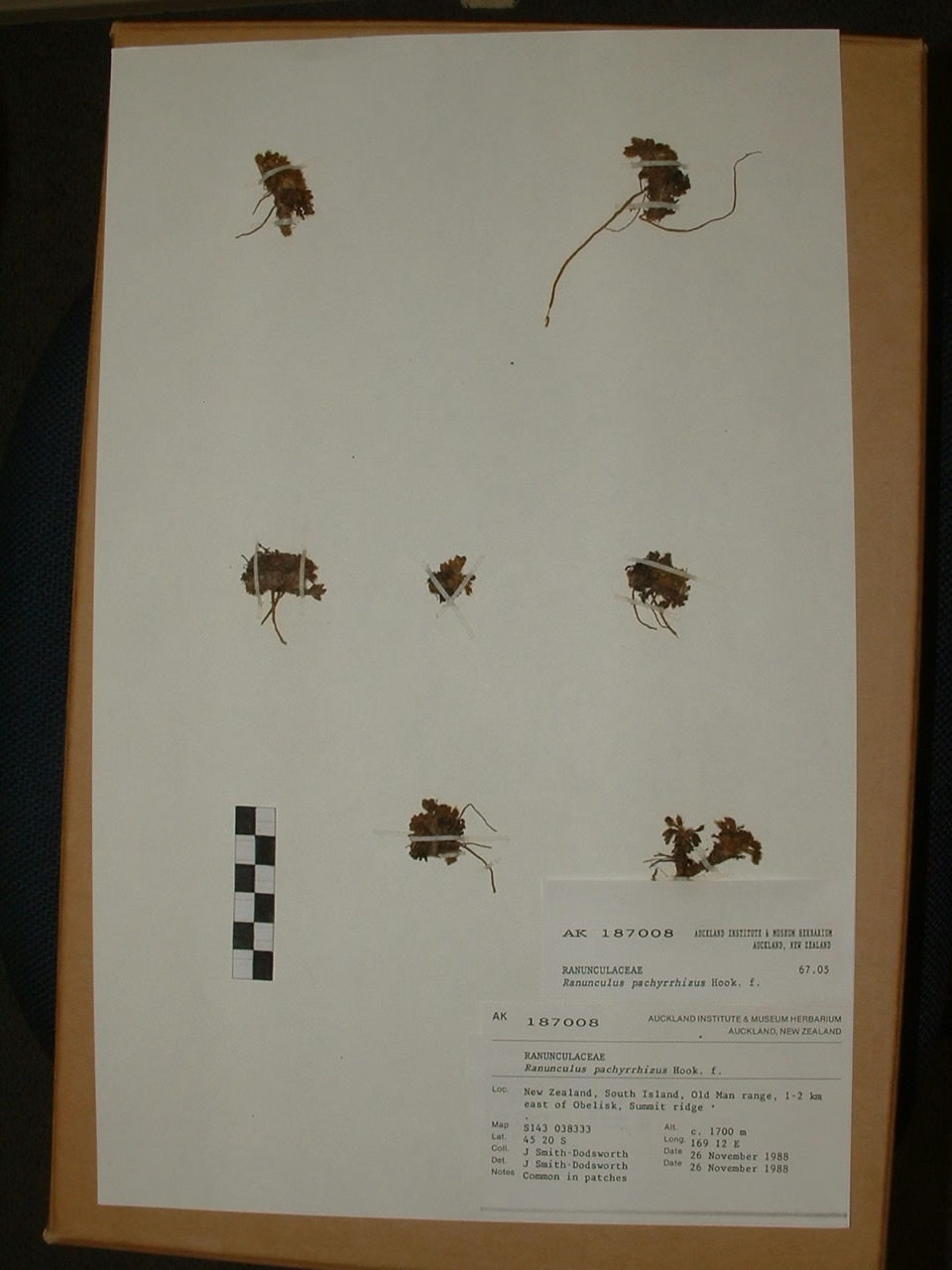
It is the only large buttercup on the Auckland Islands and Campbell Island, so it is hard to confuse there. NZPCN notes it is structurally closest to the South Island alpine species R. pachyrrhizus and R. viridis, but differs from them in leaf hairiness, leaf lobing and rhizome structure.
Quick Facts
| Scientific Name | Ranunculus pinguis |
|---|---|
| Height | 0.05-0.25 m |
| Spread | Rosettes about 0.1-0.3 m across |
| Water Needs | Wet; damp to flooded ground |
| Light | Full sun to the bright overcast of the subantarctic |
| Frost Tolerance | Moderate to high; cold oceanic climate |
| Salt Tolerance | Likely moderate, as it grows near sea level on windswept islands, but not documented |
| Growth Rate | Slow |
| Lifespan | Perennial |
Climate Best Suited to
It is adapted to the cold, wet, windy and cloudy oceanic climate of the subantarctic islands, with cool summers, frequent rain and few warm days.
Regional Suitability
| City | Climate Suitability |
|---|---|
| Auckland | Low |
| Wellington | Low |
| Christchurch | Low |
| Dunedin | Low |
Plant Habitat
Ranunculus pinguis is endemic to two of New Zealand's subantarctic island groups: the Auckland Islands and Campbell Island/Motu Ihupuku, which lie several hundred kilometres south of Stewart Island/Rakiura.
It grows from sea level to about 600 m in damp to flooded ground within tussock grassland and in rocky fellfield and moorland. These are peaty, waterlogged habitats in an almost constantly moist, windy climate.
Growing Requirements
Soil Requirements
Its island habitats have deep, wet, acidic peat and peaty mineral soils, often waterlogged for long periods.
- Wet, peaty soil
- Acidic and low in nutrients
- Tolerates periodic flooding
Light Requirements
The open grassland and fellfield it occupies receive full but often diffuse light under persistent cloud.
- Open, treeless sites
- Cool, overcast conditions
Water Requirements
Rain falls on most days of the year on the subantarctic islands, and the plant grows in ground that ranges from damp to flooded.
- Constant moisture
- Tolerates standing water
- No tolerance of drying out
Planting and Establishing
NZPCN describes this species as difficult to grow and says it should not be removed from the wild. The subantarctic islands are nature reserves and World Heritage areas, so no collecting is allowed without a permit.
Its need for cool, constantly wet, cloudy conditions year round would make it very hard to keep alive in mainland New Zealand gardens, even in the far south.
Ecological Role
On the subantarctic islands, flowers are mainly visited by flies, as bees are largely absent and the windy climate limits insect activity. The pale, small-petalled flowers of R. pinguis fit this fly-visited flora.
Fruit ripens from February to April. The achenes have no special dispersal structures, and most probably fall near the parent in the wet turf. Like the rest of the island herb flora, it now grows on Campbell Island free of the sheep, cattle and rats that were removed from the island during the late twentieth and early twenty-first centuries.
Uses & Significance
Garden Uses
It has no practical garden use. Its interest is as one of the endemic flowering plants of the subantarctic.
- Botanical interest only
- Seen by visitors on guided subantarctic trips
- Not available in cultivation
Ecological Value
It is a characteristic plant of the wet subantarctic grasslands and moors and part of an internationally recognised island flora.
- Endemic to two subantarctic island groups
- Nectar and pollen for island flies
- Component of World Heritage plant communities
Landscaping Uses
This species is not suitable for any landscape use on the mainland.
Visitors to the islands can see it from boardwalks on Campbell Island and Enderby Island, where keeping to the walkways protects the soft peat it grows in.
Seasonal Care Calendar
Spring
New leaves emerge from the fleshy rhizome as the islands warm slightly.
- Rosettes rebuild
- Flower stems develop
Summer
Flowering occurs in December and January.
- Pale yellow flowers on stout stems
- Fruit begins to form
Autumn
Achenes ripen from February to April.
- Seed heads mature
- Foliage begins to age
Winter
Growth slows in the cold, wet, short days.
- Rhizome stores reserves
- Plants persist in waterlogged turf
When to Prune and How Much
There is no pruning to consider for this wild subantarctic herb.
Old leaves wither back into the rosette naturally, and the thick sheathing bases help protect the growing point.
How to Grow Buttercup
NZPCN rates propagation of Ranunculus pinguis as difficult and advises it should not be removed from the wild. All its habitat lies within the New Zealand Subantarctic Islands, which are nature reserves where collection requires a Department of Conservation permit. The notes below outline how a permitted conservation or research programme might approach it, based on practice with other fleshy alpine buttercups; there is no documented success with this species.
From Seed
Fresh seed sown in a cool, constantly moist mix is the most likely route. Subantarctic plants often struggle with mainland summer heat, so growing on would need refrigerated or very cool conditions.
- Collect ripe achenes only under permit, in February to April
- Sow fresh on a moist mix of peat and fine grit
- Keep trays cool, ideally below 15 degrees, and never let them dry
- Expect slow germination over weeks or months
- Pot seedlings individually into deep pots of wet peaty mix
- Grow on in a cool, humid, bright but sunless position
By Rhizome Division
Large plants with branched rhizomes could potentially be divided, keeping the fleshy white roots attached to each piece.
Because no division has been recorded for this species, any attempt should be documented and shared with the Department of Conservation or a botanic garden so that knowledge of its cultivation can build over time.
- Divide only cultivated plants, as growth begins
- Keep each division with a growing point and roots
- Replant at once in wet peaty mix and keep cool and humid
Pests & Diseases
No specific pests or diseases are recorded for this species. Introduced grazing animals once damaged the native herb flora of Campbell Island and the Auckland Islands, and feral pigs on main Auckland Island have long rooted up vegetation there.
Biosecurity rules for visitors, including cleaning boots and gear, guard against introducing new weeds and invertebrates that could affect the islands' plants.
Cultural Significance
No Māori name or traditional use is recorded for Ranunculus pinguis in the sources consulted.
Joseph Dalton Hooker described it in 1844 from collections made on James Clark Ross's Antarctic expedition, which called at the Auckland Islands and Campbell Island in 1840. Hooker also named two varieties, pilosus and rhombifolius, which are no longer recognised.
Bonus Tip
On a subantarctic expedition, look for it in the wettest hollows beside the boardwalks rather than among the showy megaherbs; its pale, small-petalled flowers are easy to overlook next to the Pleurophyllum and Bulbinella displays.
Related Plants
Explore other native plants that share similar characteristics or habitats with Buttercup (Ranunculus pinguis), offering further insights into New Zealand's diverse flora. These related species provide context and opportunities for complementary planting in your garden.
Grassland Buttercup
Ranunculus multiscapus
Mount Egmont Buttercup
Ranunculus nivicola
Ranunculus pachyrrhizus
Ranunculus pachyrrhizus
Ranunculus pilifer
Ranunculus pilifer
Ranunculus recens
Ranunculus recens
Eyre Mountains Buttercup
Ranunculus scrithalis
Ranunculus simulans
Ranunculus simulans
Ranunculus urvilleanus
Ranunculus urvilleanus
Plant Conservation
Ranunculus pinguis is ranked At Risk - Naturally Uncommon (NZTCS 2023, qualifier RR, Range Restricted). NZPCN notes it is a narrow-range island endemic but abundant within its known habitats.
Its main protection is the strict reserve status and biosecurity of the subantarctic islands, along with the past removal of introduced grazing mammals and rodents from Campbell Island.
Frequently Asked Questions
Where is Ranunculus pinguis found?
It is endemic to the Auckland Islands and Campbell Island/Motu Ihupuku in the New Zealand subantarctic, where it grows from sea level to about 600 m.
What does pinguis mean?
Pinguis is Latin for fat or plump, which suits the stout, fleshy rhizome, thick leaf stalks and broad sheathing leaf bases of this subantarctic buttercup.
Is Ranunculus pinguis rare?
It is ranked At Risk - Naturally Uncommon because it is confined to two remote island groups, but NZPCN notes it is abundant within its known habitats there.
How can you recognise Ranunculus pinguis on the subantarctic islands?
NZPCN describes it as very distinctive and the only large buttercup on the Auckland Islands and Campbell Island, with fleshy kidney-shaped leaves and pale yellow flowers whose petals are small and stiff.
Sources and Further Reading
The botanical, growing, and conservation details for Buttercup (Ranunculus pinguis) on this page draw on the New Zealand plant references below. Consult them for full technical records and the latest distribution data.