Buttercup
Ranunculus pilifer
Last updated:
Ranunculus pilifer, often written R. piliferus, is a robust, summer-green alpine buttercup found only on a handful of mountain ranges in western Otago and Southland. From stout, fleshy rhizomes it forms dense patches up to 1 m across and 40 cm high, with broad kidney-shaped to rounded, hairy, scalloped leaves and large flowers 4 to 5 cm wide with yellow-green to light green sepals. It grows in sparsely vegetated rock slides and rock fields of greywacke and schist in the Hector, Eyre, Thomson and Takitimu mountains and on East Dome. It is ranked At Risk - Declining. It was previously known as Ranunculus pilifera and Ranunculus piliferus. Explore more native flowering plants in our native plant guide.
Plant Description
Ranunculus pilifer is a robust, summer-green herb that dies back to stout, fleshy rhizomes in winter. The rhizomes produce numerous long, fleshy roots that anchor the plant deep in moving rock debris, and over time it forms dense patches up to 1 m across and about 40 cm high.
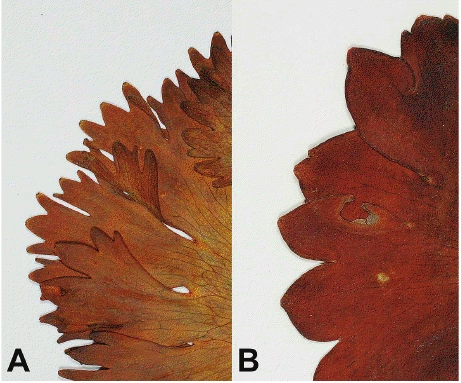
The leaves are broadly kidney shaped to almost circular, 60 to 75 mm long and 75 to 130 mm wide, only weakly divided, with coarsely scalloped margins and a covering of long soft hairs, which gives the species its name (pilifer means bearing hairs). The flowers are large, 40 to 50 mm across, with four to six yellow-green to light green sepals and 110 to 139 stamens; the stalks are hairy. Flowering is from November to January and fruit follows from December to February.
It belongs to the R. haastii complex of fleshy scree buttercups. Its closest relative is R. acraeus, which has finely rather than coarsely scalloped leaf and bract margins and hairless flower stalks. R. haastii itself differs in having much more divided, hairless leaves. Wikipedia's account of R. acraeus adds that R. pilifer has sepals hairy on both surfaces.
Quick Facts
| Scientific Name | Ranunculus pilifer |
|---|---|
| Height | Up to 0.4 m |
| Spread | Patches up to 1 m across |
| Water Needs | Moist below the surface, sharply drained above |
| Light | Full sun |
| Frost Tolerance | Very high; high alpine |
| Salt Tolerance | No information available; an inland alpine plant |
| Growth Rate | Slow |
| Lifespan | Long-lived perennial |
Climate Best Suited to
It suits a cold, continental high alpine climate with heavy winter snow, intense summer sun, strong winds and large temperature swings.
Regional Suitability
| City | Climate Suitability |
|---|---|
| Auckland | Low |
| Wellington | Low |
| Christchurch | Low |
| Dunedin | Low |
Plant Habitat
Ranunculus pilifer is endemic to the southern South Island. It is known from the Hector Mountains in west Otago and from the Eyre, Thomson and Takitimu mountains and East Dome in Southland.
It is a high alpine plant of sparsely vegetated rock slides and rock fields formed from greywacke and non-foliated schist. Its deep, fleshy roots reach the moist fine material beneath the loose surface stones, allowing it to survive where few other plants can establish.
Growing Requirements
Soil Requirements
Its habitat is coarse, mobile rock debris over fine, moist silt and clay derived from greywacke and schist.
- Very deep, stony, sharply drained substrate
- Fine moist material well below the surface
- Low organic matter
Light Requirements
Rock fields above the tree line are fully exposed, and the plant grows in strong alpine light.
- Full sun
- Open sites with little competition
Water Requirements
Surface stones dry quickly, but snowmelt and rain keep the deeper layers moist where the long roots feed.
- Consistent deep moisture in summer
- Free drainage around the crown
- Dry, cold dormancy under snow in winter
Planting and Establishing
NZPCN describes this species as difficult to grow and says it should not be removed from the wild. It is not available from nurseries.
Scree buttercups in general need very deep containers or beds of coarse rock over a moist, gritty base, plus cold winters. Outside specialist alpine collections in cold southern districts, cultivation is unlikely to succeed.
Ecological Role
Its large, pale flowers open in early summer when alpine insects such as native flies, moths and solitary bees are active on the rock fields, and the many stamens provide abundant pollen.
As a scree specialist it helps stabilise loose rock debris with its deep root system and creates small sheltered patches in otherwise bare ground. Seed falls mostly among the stones close to the parent, which may explain why it is common at known sites but confined to a few ranges.
Uses & Significance
Garden Uses
This is a plant to admire in the wild rather than grow. Its value is botanical and ecological.
- Specialist alpine research collections only
- Photography on Southland and Otago ranges
- Study of the R. haastii complex
Ecological Value
It is a member of a small group of fleshy buttercups that are among the few flowering plants able to live in active scree.
- Pollen and nectar for alpine insects
- Stabilises mobile rock debris
- Endemic to a few southern ranges
Landscaping Uses
It has no place in general landscaping. Designers wanting a scree feature should use easier alpine plants that are available in cultivation.
On the mountains, avoid walking across occupied rock slides, because shifting stones can damage the shallow parts of the rhizomes.
Seasonal Care Calendar
Spring
New growth begins as the snow retreats from the rock fields in late spring.
- Shoots emerge from the rhizomes
- Buds form quickly
Summer
Flowering runs from November to January and fruit ripens from December to February.
- Large pale yellow-green flowers
- Seed heads ripen
Autumn
Leaves die back with the first hard frosts.
- Plants retreat to their rhizomes
- Seed shed among the stones
Winter
Dormant under snow on the high rock fields.
- Rhizomes rest deep in the scree
- No growth
When to Prune and How Much
No pruning is involved. The foliage is summer-green and dies back naturally each autumn.
In any cultivated specimen, remove dead foliage once it has withered so it does not rot over the crown.
How to Grow Buttercup
NZPCN rates the propagation of Ranunculus pilifer as difficult and advises that it should not be removed from the wild. Because it is At Risk - Declining and confined to a few ranges, any propagation should be part of a recognised conservation or research programme with the appropriate permits. The methods below are those used for related scree buttercups and are given for context rather than as proven techniques for this species.
From Seed
Seed of scree buttercups is usually sown fresh and needs a long cold, moist period to break dormancy. Germination may be slow and seedlings need very deep pots for their fleshy roots.
Record the source, sowing date and treatment of every batch, because there is little documented experience with this species and careful notes make each attempt useful to others.
- Obtain seed only through an authorised programme
- Sow fresh achenes in autumn on a deep, very gritty mix
- Expose the pots to winter cold outdoors or provide several months of moist refrigeration
- Keep the surface well drained and the base moist
- Transfer seedlings to tall pots once the first leaves form
- Keep them cool in summer and avoid root disturbance
By Rhizome Division
Mature cultivated plants have branched fleshy rhizomes that could be divided, but the long roots resent disturbance and losses are likely.
- Divide only established cultivated plants at the start of growth
- Keep long roots intact on each piece
- Replant immediately in deep gritty mix and keep shaded and cool
Pests & Diseases
No specific pests are recorded for Ranunculus pilifer. Browsing mammals such as hares, deer and chamois are known to graze alpine herbs on southern ranges, and several related scree buttercups are threatened by browsing.
Any cultivated plant would be most vulnerable to summer heat, poor drainage and rot.
Cultural Significance
No Māori name or traditional use is recorded for Ranunculus pilifer in the sources consulted.
It was first described by F.J.F. Fisher as a subspecies of R. haastii, and raised to species rank by Peter Heenan, Peter Lockhart and colleagues in 2006 after DNA and morphological study of the R. haastii complex, in the same paper that described the related R. acraeus.
Bonus Tip
On a Southland or west Otago rock field, check the leaves of any fleshy grey-green buttercup closely: soft long hairs and only shallowly divided, coarsely scalloped leaves point to R. pilifer, whereas finely divided, hairless leaves suggest R. haastii.
Related Plants
Explore other native plants that share similar characteristics or habitats with Buttercup (Ranunculus pilifer), offering further insights into New Zealand's diverse flora. These related species provide context and opportunities for complementary planting in your garden.
Ranunculus mirus
Ranunculus mirus
Grassland Buttercup
Ranunculus multiscapus
Mount Egmont Buttercup
Ranunculus nivicola
Ranunculus pachyrrhizus
Ranunculus pachyrrhizus
Ranunculus pinguis
Ranunculus pinguis
Ranunculus recens
Ranunculus recens
Eyre Mountains Buttercup
Ranunculus scrithalis
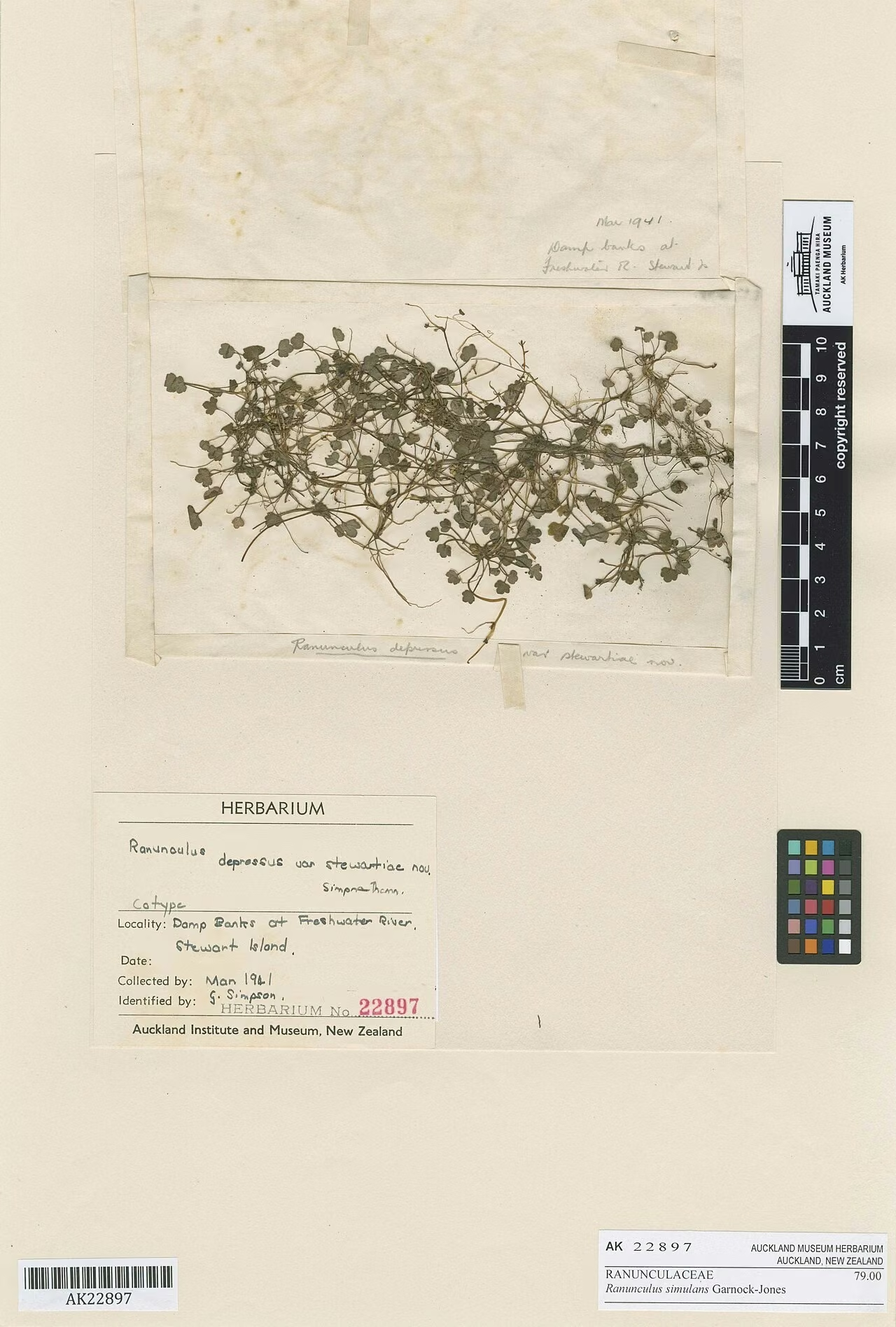
Ranunculus simulans
Ranunculus simulans
Plant Conservation
Ranunculus pilifer is ranked At Risk - Declining (NZTCS 2023) with the qualifiers DPT, RR and RF, and the Otago regional assessment (2025) lists it as Regionally At Risk - Regionally Declining. NZPCN notes it is uncommon overall but common at sites within its small geographic area.
Controlling browsing animals on its ranges, limiting disturbance of occupied scree and monitoring known populations are the main ways to support it.
Frequently Asked Questions
How is Ranunculus pilifer spelt?
It was published as Ranunculus piliferus, but NZPCN notes the correct form is pilifer because Ranunculus is a masculine second declension noun. Both spellings appear in databases.
How do you tell Ranunculus pilifer from the scree buttercup Ranunculus haastii?
R. pilifer has much less divided leaves that are covered in long soft hairs, whereas R. haastii has more finely divided leaves that are hairless.
Where does Ranunculus pilifer grow?
It is endemic to the South Island, growing on high alpine greywacke and schist rock fields in the Hector Mountains of west Otago and the Eyre, Thomson and Takitimu mountains and East Dome in Southland.
Why is Ranunculus pilifer ranked At Risk - Declining?
The 2023 assessment lists it as At Risk - Declining with qualifiers noting its restricted range, recruitment failure and that trend data are poor, although NZPCN notes it is common at sites within its small range.
Sources and Further Reading
The botanical, growing, and conservation details for Buttercup (Ranunculus pilifer) on this page draw on the New Zealand plant references below. Consult them for full technical records and the latest distribution data.