Buttercup
Ranunculus kirkii
Last updated:
Ranunculus kirkii is a small, tufted buttercup found only on Stewart Island/Rakiura. It grows to about 25 cm tall from a cluster of fleshy roots, with loose rosettes of three-parted leaves, and carries one to three small yellow flowers 8 to 18 mm across on silky-haired stalks between October and February. It lives in damp ground among scrub and tussock grassland from near sea level to the island's alpine tops. It has no established common name and is ranked At Risk - Naturally Uncommon solely because its natural range is so small; NZPCN considers it not under active threat. Explore more native flowering plants in our native plant guide.
Plant Description
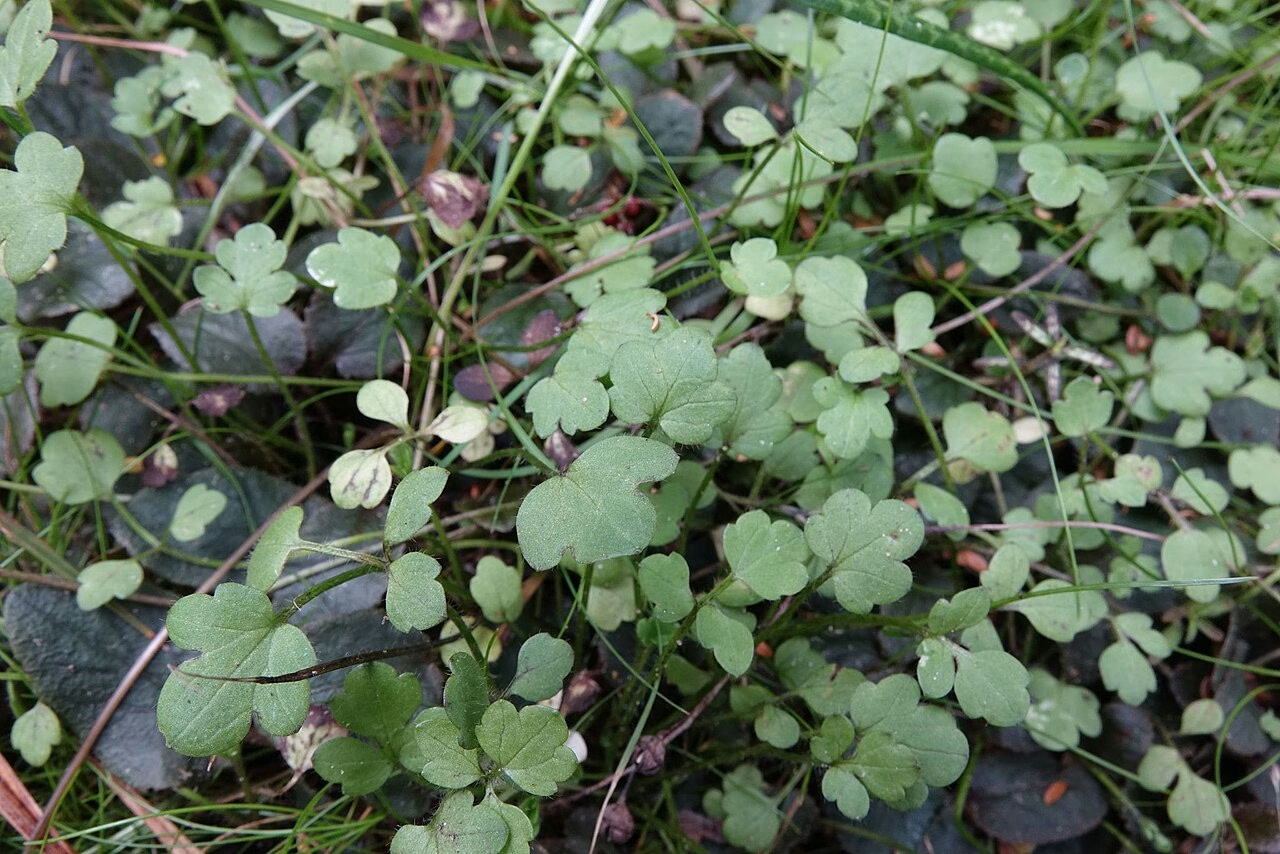
Ranunculus kirkii is a non-rhizomatous, tufted perennial up to about 250 mm tall, with numerous fleshy roots. Its leaves are mostly in loose rosettes. Each is ternate, made up of three short-stalked leaflets 5 to 25 mm across, and each leaflet is cut roughly halfway into three lobes with rounded or blunt teeth. The leaf surfaces can be hairy or become hairless with age.
One to three flowers, 8 to 18 mm across, are carried on each stem. The flower stalks are conspicuous for their long, pressed silky hairs, and the spreading sepals are silky-hairy too. There are five narrow yellow petals 2 to 4 mm long, each with a single nectary about 2 mm from the base hidden under a small rounded scale, and the receptacle is hairy. The fruit is a head of 10 to 15 flattened, hairless achenes 2.5 to 3.4 mm long with straight or curved beaks 0.5 to 1 mm long.
Its most similar relative is Ranunculus brevis, which has more finely divided, twice-ternate leaves with linear to linear-lanceolate lobes. In R. kirkii the leaves are only once divided and the stalked leaflets have broader, blunt-toothed lobes.
Quick Facts
| Scientific Name | Ranunculus kirkii |
|---|---|
| Height | 0.05-0.25 m |
| Spread | 0.05-0.15 m |
| Water Needs | Consistently damp; a facultative wetland plant |
| Light | Sun to light shade among scrub and tussock |
| Frost Tolerance | Good; extends to alpine elevations |
| Salt Tolerance | Not recorded; no information found |
| Growth Rate | Slow to moderate |
| Lifespan | Perennial |
Climate Best Suited to
It suits Rakiura's cool, wet, oceanic climate with frequent rain, mild summers and cold, windy uplands. Mild, humid northern climates are unlikely to suit it.
Regional Suitability
| City | Climate Suitability |
|---|---|
| Auckland | Low |
| Wellington | Low |
| Christchurch | Low |
| Dunedin | Medium |
Plant Habitat
Ranunculus kirkii is endemic to Stewart Island/Rakiura and is not known from the South Island mainland. It ranges from lowland to alpine elevations, which on Rakiura means from near the coast up to the open tops of the island's higher ranges.
It grows in damp ground, typically among scrub and in tussock grassland. Its wetland indicator rating is facultative wetland, meaning it is usually found in wet places but occasionally on drier ground.
Growing Requirements
Soil Requirements
It favours damp, often peaty soils of the kind that develop under Rakiura's high rainfall in scrub and tussock country.
- Moist, acidic, peaty or organic soils
- Low fertility
- Soil that stays damp but is not permanently flooded
Light Requirements
It grows among scrub and tussock, so it receives good light with some shelter from surrounding vegetation.
- Full sun to light shade
- Benefits from the shelter of tussocks and low shrubs
Water Requirements
Constant moisture is important; Rakiura's frequent rain keeps its habitats damp all year.
- Never allow the root zone to dry out
- Tolerates wet ground but not deep standing water
Planting and Establishing
NZPCN rates Ranunculus kirkii as difficult to propagate and says it should not be removed from the wild. It is not available commercially and most of its range lies within Rakiura National Park.
If grown from legitimately sourced material for conservation or research, it would need a cool, moist, sheltered spot with peaty, free-draining soil, much like a bog garden margin in a southern climate.
Ecological Role
Flowers open from October to February and fruit ripens from December to May. The small yellow flowers with hidden nectaries are typical of New Zealand buttercups, which are visited by small flies and native bees, although specific pollinators of this species have not been recorded in the sources consulted.
The achenes probably fall near the parent plant. As a small herb of damp openings in scrub and tussock, it forms part of the low herb layer that helps make Rakiura's upland vegetation so distinctive.
Uses & Significance
Garden Uses
It has very limited garden use and is not offered by nurseries.
- Possible bog-garden plant for specialist growers in cool southern gardens
- Educational value in botanic garden collections of Rakiura plants
Ecological Value
It is one of a group of plants found nowhere except Stewart Island/Rakiura, which contributes to the island's high level of endemism.
- Nectar and pollen for small insects over a long flowering season
- Part of the herb layer in damp scrub and tussock communities
- A narrow-range endemic worth recording on visits to the island
Landscaping Uses
Ranunculus kirkii has no real landscaping role. In a southern restoration project on Rakiura it could be part of a natural herb layer in damp tussock, but it would normally establish itself rather than being planted.
Gardeners wanting a small native buttercup for a damp spot will find more widespread lowland species easier to obtain and grow.
Seasonal Care Calendar
Spring
New rosettes of leaves develop and flowering starts in October.
- Look for silky-haired flower stalks
- Keep cultivated plants moist
Summer
Flowering continues to February, and fruit heads begin ripening from December.
- Peak flowering and fruiting overlap
- Avoid trampling damp herb patches off track
Autumn
Achenes continue to ripen and fall until May.
- Fresh seed is available for legitimate collection
- Growth slows as temperatures fall
Winter
Plants persist as small rosettes or die back to their fleshy roots during Rakiura's cold, wet winter.
- No action needed in the wild
- Keep cultivated plants cool and moist but not waterlogged
When to Prune and How Much
No pruning is needed. Old leaves and spent flower stems wither naturally.
In cultivation, pick off yellowing leaves and old stems to keep the rosette tidy and reduce fungal problems in damp conditions.
How to Grow Buttercup
NZPCN lists Ranunculus kirkii as difficult and states that it should not be removed from the wild. No specific propagation trials for this species have been published in the sources consulted, so the methods below describe the general techniques used for small New Zealand buttercups of damp habitats. Material should come only from plants already held in cultivation or be collected under authority from the Department of Conservation, as most of its range is protected within Rakiura National Park. A cool, humid but well-ventilated growing area that imitates Rakiura's climate gives the best chance of success.
From Seed
Fruit ripens between December and May. Small buttercup achenes are best sown fresh, as many species lose viability or become more dormant once dried and stored.
- Collect fully ripe achenes when the fruit head breaks up easily
- Sow on the surface of a moist peat and sand mix
- Cover lightly with fine grit and keep in a cool, shaded spot
- Keep the mix damp, standing pots in a shallow tray of water if needed
- Prick out seedlings once they have two or three true leaves
By Division
Tufted plants with several crowns can be gently separated in spring, keeping a good portion of fleshy roots with each crown.
- Lift a cultivated clump as new growth starts
- Tease apart crowns, keeping roots intact
- Pot into damp peaty mix and keep shaded for two weeks while roots re-establish
Pests & Diseases
No specific pests or diseases of Ranunculus kirkii are recorded, and NZPCN regards it as not threatened in the wild. Browsing by introduced white-tailed deer, which are present on Rakiura, may affect herbs in its habitat, but this has not been documented for this species.
In cultivation, slugs and snails are likely to graze the leaves, and alpine and subalpine buttercups in general are susceptible to powdery mildew in warm, humid weather.
Cultural Significance
No Māori name or traditional Māori use is recorded for Ranunculus kirkii in the sources consulted.
The species honours Thomas Kirk (1828-1898), one of New Zealand's leading nineteenth-century botanists, author of The Forest Flora of New Zealand and a lecturer in natural sciences. It was described by Donald Petrie.
Bonus Tip
On Rakiura tramps, look for this buttercup in damp, open patches among tussock and low scrub rather than in deep forest. The long, flattened silky hairs on the flower stalks are a quick field clue that you are looking at R. kirkii and not one of the hairless lowland wetland buttercups.
Related Plants
Explore other native plants that share similar characteristics or habitats with Buttercup (Ranunculus kirkii), offering further insights into New Zealand's diverse flora. These related species provide context and opportunities for complementary planting in your garden.
Yellow Alpine Buttercup
Ranunculus godleyanus
Ranunculus gracilipes
Ranunculus gracilipes
Graham's Buttercup
Ranunculus grahamii
Haast's Buttercup
Ranunculus haastii
Mud Buttercup
Ranunculus limosella
Swamp Buttercup
Ranunculus macropus
Ranunculus maculatus
Ranunculus maculatus
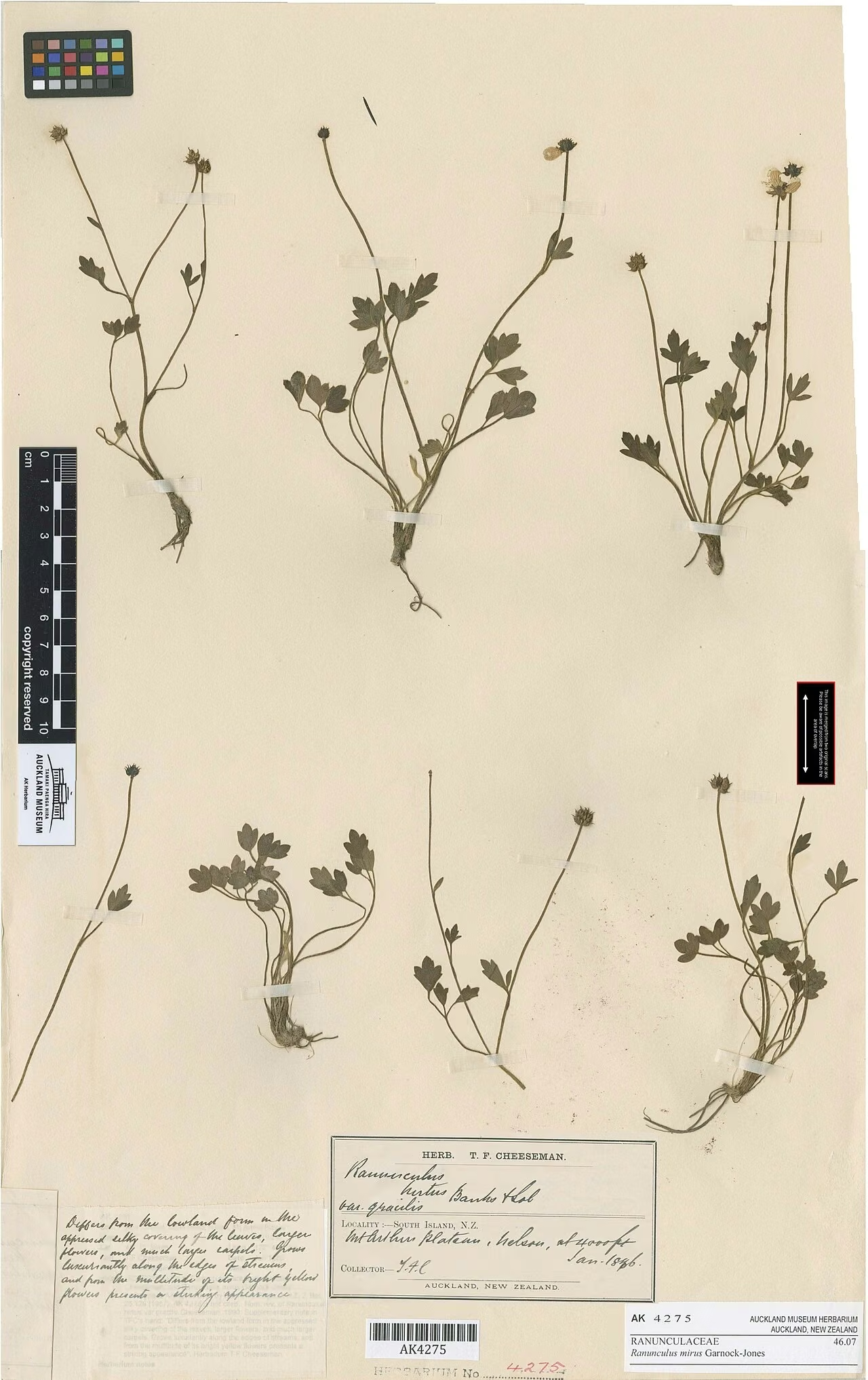
Ranunculus mirus
Ranunculus mirus
Plant Conservation
Ranunculus kirkii has been ranked At Risk - Naturally Uncommon in every assessment since 2009, with the qualifier Range Restricted. NZPCN notes it is listed only because it is a narrow-range endemic and is not otherwise threatened.
Protection of Rakiura's natural habitats within the national park is the main safeguard. Keeping weeds out of the island's tussock and wetland areas and recording sightings on iNaturalist NZ helps track its status.
Frequently Asked Questions
Where is Ranunculus kirkii found?
Only on Stewart Island/Rakiura, where it grows in damp ground among scrub and tussock grassland from lowland to alpine elevations.
Is Ranunculus kirkii endangered?
No. It is ranked At Risk - Naturally Uncommon because it is a narrow-range endemic, but NZPCN describes it as not threatened within its Rakiura habitat.
How do you tell Ranunculus kirkii from Ranunculus brevis?
Ranunculus kirkii has once-divided leaves with stalked leaflets cut about halfway into three blunt-toothed lobes, whereas R. brevis has twice-divided leaves with narrow linear to linear-lanceolate lobes.
Who is Ranunculus kirkii named after?
It honours Thomas Kirk (1828-1898), a leading New Zealand botanist and natural science lecturer who was prominent in botanical research for more than thirty years.
Sources and Further Reading
The botanical, growing, and conservation details for Buttercup (Ranunculus kirkii) on this page draw on the New Zealand plant references below. Consult them for full technical records and the latest distribution data.