Buttercup
Ranunculus gracilipes
Last updated:
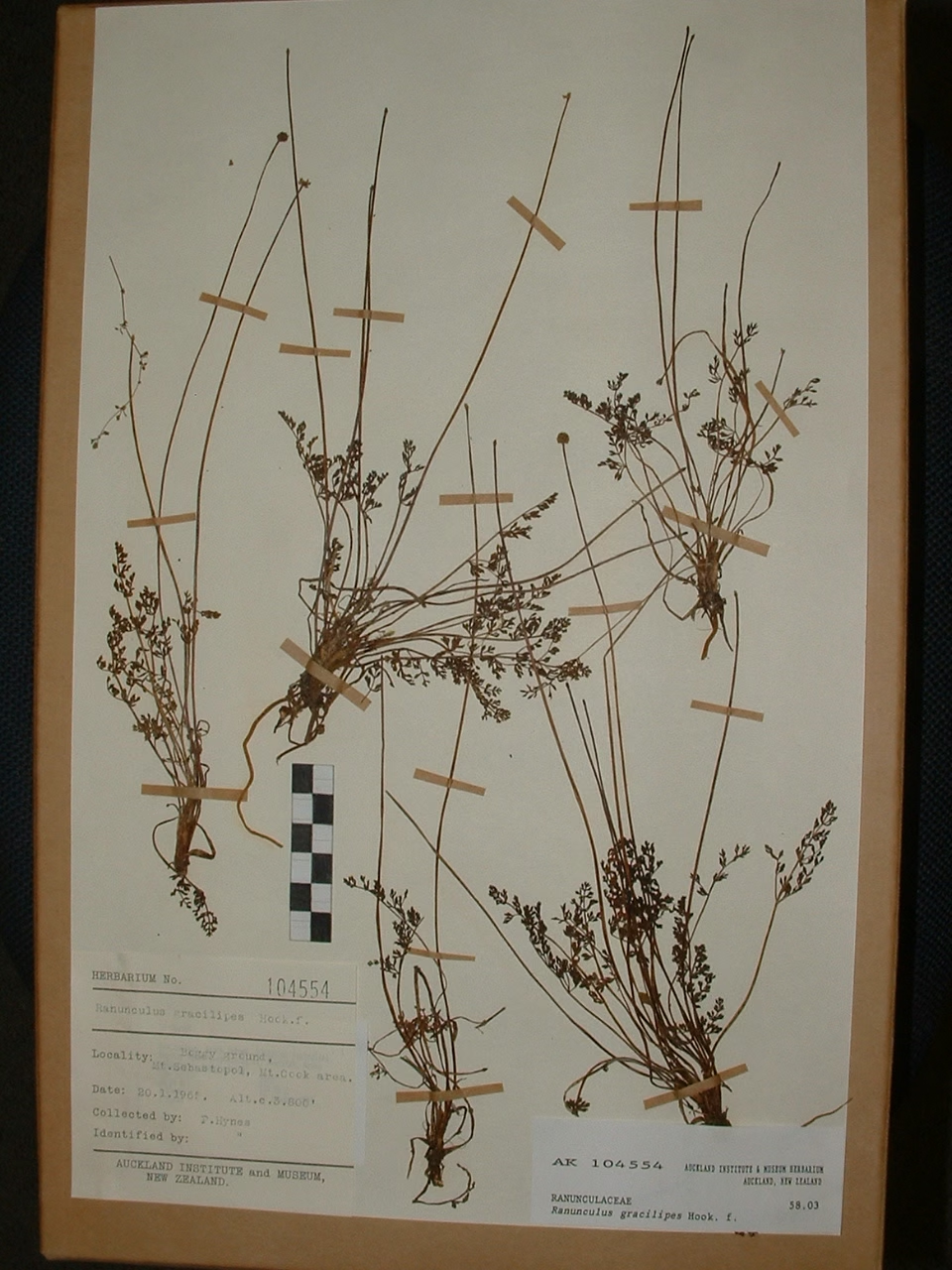
Ranunculus gracilipes is a small, tufted alpine buttercup endemic to the southern half of New Zealand. Only 5 to 12 cm tall, it has finely divided, almost fern-like basal leaves with up to six pairs of leaflets, and single yellow flowers 1 to 2 cm across on slender stalks, which give it the name gracilipes, meaning slender foot. It grows in damp subalpine and alpine grassland and scrub, and sometimes along streams or in bogs, at 900 to 1500 m in Westland, Canterbury, Fiordland, Otago, Southland and on Stewart Island. It is ranked Not Threatened. Explore more native flowering plants in our native plant guide.
Plant Description
Ranunculus gracilipes is a tufted perennial 5 to 12 cm tall, growing from a stout, erect rootstock. The basal leaves are ovate-oblong to linear-oblong in outline, 2 to 12 cm long, and divided once or twice into pinnate or many-cleft segments, with two to six pairs of stalkless leaflets. This gives the rosette a finely cut, almost ferny appearance.
Each slender stalk (scape) carries a single flower 1 to 2 cm across with five to seven yellow petals. Each petal has a cylindrical nectary pocket at its base, a feature used to separate it from some relatives. The fruit is a head of 15 to 30 smooth, plump achenes with straight beaks.
Its combination of small size, pinnately divided leaves and solitary small yellow flowers on slender stalks distinguishes it from the larger, broad-leaved alpine buttercups that share its range. Fisher's 1965 account of the New Zealand alpine buttercups gives a fuller description and illustration.
Quick Facts
| Scientific Name | Ranunculus gracilipes |
|---|---|
| Height | 0.05-0.12 m |
| Spread | Small tufts about 0.1 m across |
| Water Needs | Moist to wet |
| Light | Full sun to light shade |
| Frost Tolerance | Very high; subalpine to alpine |
| Salt Tolerance | No information available; an inland mountain species |
| Growth Rate | Slow |
| Lifespan | Perennial |
Climate Best Suited to
Suits cool to cold, wet mountain climates of the western and southern South Island and Stewart Island, with high rainfall, frequent cloud and winter snow.
Regional Suitability
| City | Climate Suitability |
|---|---|
| Auckland | Low |
| Wellington | Low |
| Christchurch | Low |
| Dunedin | Medium |
Plant Habitat
Ranunculus gracilipes is endemic to New Zealand, recorded from Westland, Canterbury, Fiordland, Otago and Southland in the South Island, and from Stewart Island/Rakiura.
It grows in subalpine and alpine damp grassland and scrub at 900 to 1500 m, sometimes on streamsides or in bogs. It is typically found in low, moist turf among tussocks and other alpine herbs.
Growing Requirements
Soil Requirements
It grows in moist to wet, often peaty alpine soils in grassland, scrub margins, streamsides and bogs.
- Damp, humus-rich or peaty soil
- Low-fertility alpine turf
- Ground that stays moist through summer
Light Requirements
It grows in open grassland and scrub, receiving full sun or light shade from neighbouring tussocks and shrubs.
- Full sun to light shade
- Easily overtopped by tall, dense vegetation
Water Requirements
It favours consistently damp ground, from moist grassland to wet bog margins, and suffers if the soil dries out.
- Keep moist throughout the growing season
- Tolerates wet soil better than drought
Planting and Establishing
Ranunculus gracilipes is rarely cultivated and no nursery sources were found. It would suit a cool, moist trough or the drier margin of a bog garden in southern districts, in peaty, gritty soil.
Grow it where it will not be smothered by larger plants, and keep it shaded from hot afternoon sun in warmer areas. Only use material from cultivated plants or collected with permission.
Ecological Role
It is part of the small-herb community of damp alpine grassland and bog margins, growing among tussocks, sedges and mosses. Its flowers provide nectar from the cylindrical petal pockets, but the insects that visit them are not documented in the sources consulted.
Its seeds fall near the parent, and plants tend to occur scattered through suitable damp turf rather than forming large patches.
Uses & Significance
Garden Uses
It is a plant for alpine and bog garden enthusiasts rather than general gardens.
- Moist troughs and alpine pots
- Bog garden margins in cool southern climates
- Collections of small New Zealand alpine buttercups
Ecological Value
It adds to the diversity of the herb layer in South Island and Stewart Island alpine grassland and wetlands.
- Part of damp alpine turf and bog communities
- Flowering herb for alpine insects
- Widespread endemic of southern mountains
Landscaping Uses
In a naturalistic alpine planting, scatter Ranunculus gracilipes through a low, moist turf of small sedges and mosses, where its finely cut rosettes and small yellow flowers can be seen close to eye level in a raised bed.
Its small size means it is lost in general borders, so reserve it for troughs or raised beds near paths.
Seasonal Care Calendar
Spring
Rosettes of finely divided leaves emerge as snow melts from damp alpine grassland.
- Begin watering cultivated plants
- Check for slugs on new leaves
Summer
Single yellow flowers appear on slender stalks during the alpine summer, though exact flowering months are not recorded in the sources consulted.
- Keep soil moist in warm weather
- Collect ripe achenes as heads mature
Autumn
Fruiting heads ripen and leaves begin to yellow.
- Sow fresh seed outdoors
- Remove fallen leaves from around rosettes
Winter
The plant is dormant, surviving on its stout rootstock under snow.
- Keep potted plants cold but not waterlogged
- No feeding required
When to Prune and How Much
No pruning is needed for this small alpine herb.
Old flower stalks can be snipped off after seed collection, and dead leaves removed by hand.
How to Grow Buttercup
No propagation information for Ranunculus gracilipes is given by NZPCN or the other sources consulted, and it is not offered by New Zealand nurseries. The methods below are the general approaches used for small New Zealand alpine buttercups and are suggestions rather than tested techniques for this species. Its stout, erect rootstock means it does not spread by runners, so seed is likely to be the main option, though older plants that have formed several crowns might be carefully divided. Any material should be gathered sparingly, from plants in cultivation or with permission from the landowner or the Department of Conservation.
From Seed
Seed should be sown fresh. Alpine buttercup seed commonly needs a winter of cold, moist conditions before germinating in spring.
- Collect the smooth, plump achenes when the fruiting head starts to shed
- Sow on a peaty, gritty seed mix and cover lightly
- Leave the pot outdoors in a cool, shaded spot through winter
- Keep moist at all times
- Pot seedlings individually when they have two or three true leaves
By Division
A mature clump with more than one crown can sometimes be split in early spring, though this species is small and division yields few pieces.
- Lift a cultivated clump as new growth begins
- Separate crowns with a clean knife, keeping roots on each
- Replant into a moist, peaty, gritty mix
- Keep cool and shaded until fresh leaves show it has re-established
Pests & Diseases
No specific pests or diseases are recorded for Ranunculus gracilipes in the sources consulted. Slugs and snails are the most likely problem in cultivation.
In warm, humid lowland conditions the crown may rot, so good air movement and cool temperatures are important.
Cultural Significance
No traditional Māori name or use is recorded for Ranunculus gracilipes in the sources consulted.
Joseph Hooker described the species in his Handbook of the New Zealand Flora in 1864. NZ Flora lists Ranunculus sinclairii as a synonym.
Bonus Tip
When you spot a small yellow buttercup in damp alpine turf in Fiordland or on the Otago and Southland ranges, check the leaves: finely divided rosettes with several pairs of leaflets and a single flower on each slender stalk are good signs of Ranunculus gracilipes, setting it apart from the broader-leaved buttercups nearby.
Related Plants
Explore other native plants that share similar characteristics or habitats with Buttercup (Ranunculus gracilipes), offering further insights into New Zealand's diverse flora. These related species provide context and opportunities for complementary planting in your garden.
Plant Conservation
Ranunculus gracilipes is ranked Not Threatened nationally (2023), as it was in 2013 and 2017. Otago lists it as Regionally Not Threatened (2025) with the qualifier TL.
Much of its alpine range lies within national parks and other conservation land. Protecting damp alpine grassland and bogs from drainage, weeds and trampling maintains its habitat.
Frequently Asked Questions
What does gracilipes mean?
It combines the Latin gracilis, slender, and pes, foot, referring to the slender flower stalks that each carry a single yellow flower.
How do you recognise Ranunculus gracilipes?
Look for a small tufted buttercup 5 to 12 cm tall with pinnately divided basal leaves bearing two to six pairs of stalkless leaflets, and single yellow flowers 1 to 2 cm across with five to seven petals.
Does Ranunculus gracilipes grow in wetlands?
NZPCN rates it as a facultative wetland plant: it is usually found in wet places such as damp grassland, streamsides and bogs, but occasionally grows on drier ground.
Sources and Further Reading
The botanical, growing, and conservation details for Buttercup (Ranunculus gracilipes) on this page draw on the New Zealand plant references below. Consult them for full technical records and the latest distribution data.