Oliver's Greenhood
Pterostylis oliveri
Last updated:
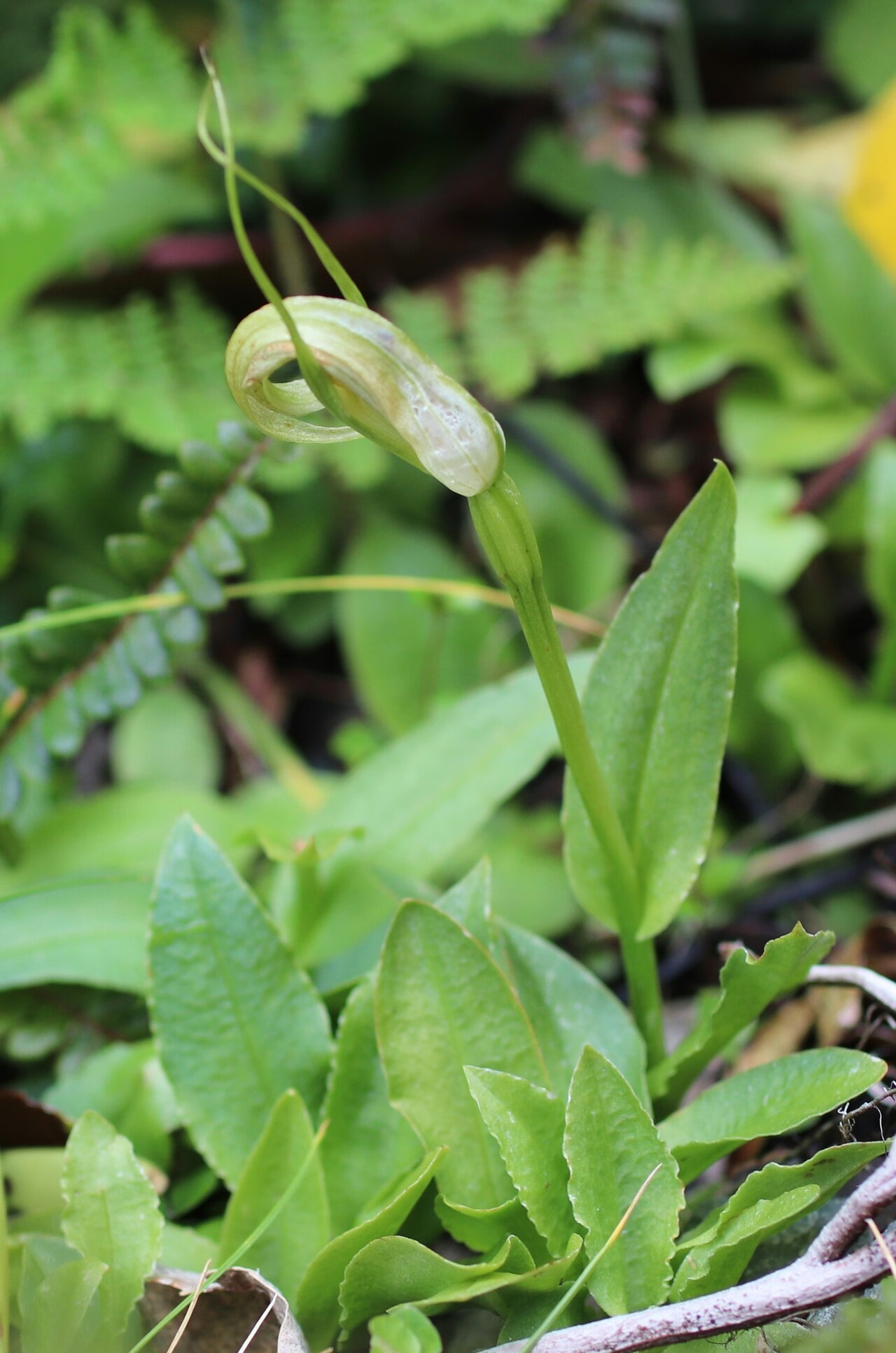
Oliver's greenhood (Pterostylis oliveri) is a terrestrial orchid found only in the western South Island, from North-west Nelson south to about Arthur's Pass National Park. Plants grow 10 to 38 cm tall with four to six spreading leaves and a single large green flower finely striped with white, opening in December and January. It favours montane forest and subalpine scrub, often along streams or in deep drifts of partly rotted leaf litter. It is closely related to Pterostylis patens but tends to sprawl rather than stand stiffly upright. It is ranked Not Threatened but is difficult to grow and should be left in the wild. Explore more native flowering plants in our native plant guide.
Plant Description
Pterostylis oliveri is a tuberous ground orchid 10 to 38 cm tall, with a smooth stem about 2 mm thick. It carries four to six spreading leaves; the lower ones are oval to broadly elliptic, about 5 to 10 cm long and 2 to 3 cm wide, and the upper leaves become progressively more pointed and stalkless.
The solitary flower has a dark green hood (galea) finely striped with white, the white stripes widening toward the back of the hood. The dorsal sepal stands about 3 to 4 cm tall and ends in a long narrow tip, while the lateral sepals diverge at a narrow angle and have very long lobes. The narrow triangular labellum is arched and protrudes from the flower, and the column is shorter than the labellum.
Its closest relative is Pterostylis patens, which has a similar striped flower. Oliver's greenhood is usually separated by its often decumbent or sprawling habit, compared with the stiffly erect growth of P. patens, and by its western South Island range.
Quick Facts
| Scientific Name | Pterostylis oliveri |
|---|---|
| Height | 0.1-0.38 m in flower |
| Spread | Single plants or loose groups |
| Water Needs | Constantly moist leaf litter |
| Light | Shade to semi-shade under forest or scrub |
| Frost Tolerance | High; a montane to subalpine species |
| Salt Tolerance | Low; an inland mountain plant |
| Growth Rate | Seasonal; regrows from a tuber |
| Lifespan | Perennial (tuberous) |
Climate Best Suited to
Suits the cool, very wet montane climate of the western South Island, with high rainfall, mild summers and cold winters. It would struggle in warm or dry lowland gardens.
Regional Suitability
| City | Climate Suitability |
|---|---|
| Auckland | Low |
| Wellington | Low |
| Christchurch | Low |
| Dunedin | Low |
Plant Habitat
Oliver's greenhood is endemic to the western South Island. Its range runs from North-west Nelson south to about Arthur's Pass National Park, taking in the mountains of Kahurangi and the ranges of Buller and Westland.
It grows in montane forest and subalpine scrub, rarely above 1200 m. It is often found along stream sides or under shrubs, growing through dense drifts of partially decomposed leaf litter where moisture stays high year round.
Growing Requirements
Soil Requirements
Its tubers sit in deep, loose layers of rotting leaf litter over forest soil.
- Deep, moist, humus-rich leaf litter
- Cool, acidic forest soils
- Loose surface layers that never dry out completely
Light Requirements
It grows beneath forest canopy or under subalpine shrubs, out of direct sun.
- Shade to semi-shade
- Often at the sheltered edges of streams
Water Requirements
The western South Island mountains receive very high rainfall, and the plant favours the dampest spots within them.
- Needs consistently moist conditions while in growth
- Stream margins and damp hollows are typical sites
Planting and Establishing
Oliver's greenhood is not commercially available, and NZPCN describes it as difficult to grow, stating that it should not be removed from the wild.
The best way to support it is to protect the leaf litter and shrubs where it grows. Avoid raking or clearing litter in forest margins where greenhoods occur.
Ecological Role
Like other greenhoods it has a hinged, sensitive labellum that tips a visiting insect into the hood, forcing it past the pollen on its way out. Greenhoods are generally pollinated by small flies such as fungus gnats; the specific pollinator of this species is not documented in the sources consulted.
Its dust-like seed depends on soil fungi to germinate, and the plant relies on its underground tuber to survive the dormant season. Thick leaf litter in damp montane forest supplies both the fungi and the moisture it needs.
Uses & Significance
Garden Uses
It is not a garden plant, since it is difficult to cultivate and should not be taken from the wild.
- Best enjoyed in the forests of Kahurangi, Paparoa and Arthur's Pass
- Of interest to orchid photographers in midsummer
- Not available from nurseries
Ecological Value
It is part of the rich ground orchid flora of western South Island beech and montane forest.
- An endemic orchid restricted to the western South Island
- Indicates intact, undisturbed forest floor and leaf litter
- Provides a trap flower resource for small flies
Landscaping Uses
It has no landscaping use. Its value lies in the natural settings where it grows, often in groups along shaded stream banks among mosses and ferns.
In private forest remnants within its range, leaving leaf litter, logs and shrubs in place and keeping stock out are the most useful ways to keep greenhoods present.
Seasonal Care Calendar
Spring
Leaves emerge from the tubers in the damp forest floor as the mountains warm.
- Avoid trampling stream margins
- Watch for leafy shoots in deep litter
Summer
Flowering runs through December and January, when the large striped hoods are easy to spot.
- Photograph rather than pick
- Look along streams and under subalpine shrubs
Autumn
Fruiting continues from January to April, and capsules release their fine seed.
- Leave seed capsules undisturbed
- Foliage begins to die back
Winter
The plant rests as an underground tuber beneath cold, often snowy montane forest.
- No visible growth
- Leaf litter protects the tubers
When to Prune and How Much
No pruning is required. The leaves and flower stem wither naturally after fruiting.
In the wild, leave old stems and surrounding litter alone, since the litter layer is the plant's habitat.
How to Grow Oliver's Greenhood
NZPCN rates Pterostylis oliveri as difficult to propagate and says it should not be removed from the wild, and it is not commercially available. No published propagation protocol specific to this species was found in the sources consulted. The notes below describe how specialist growers approach greenhoods in general, for anyone holding legally obtained material for research or conservation. Expect slow progress and frequent failures, because greenhoods depend on soil fungi and very particular moisture conditions, and wild plants are best left where they are.
From Seed
Greenhood seed is extremely fine and germinates only in association with suitable mycorrhizal fungi. Growers usually scatter seed into pots that already support established greenhoods, so that the fungus is present.
- Collect capsules from cultivated plants as they start to yellow in late summer
- Sprinkle the seed on the surface of a pot holding established greenhoods
- Keep the pot cool, shaded and evenly moist
- Leave seedlings undisturbed for at least a year before checking for tubers
By Tuber Division
Many greenhoods produce extra tubers that can be separated while dormant. Whether Oliver's greenhood does so readily in cultivation is not recorded in the sources consulted.
- Wait until the foliage has completely withered in late autumn
- Gently remove the potting mix and look for small daughter tubers
- Replant each tuber shallowly in a free-draining, leafy mix
- Keep it cool and only lightly moist until new shoots appear in spring
Pests & Diseases
No specific pests are recorded for this species. Slugs and snails commonly graze greenhood leaves and flowers, and browsing by deer could damage plants in accessible forest.
In cultivation, rot from stale, waterlogged mix is the most likely cause of failure.
Cultural Significance
Greenhood orchids are known in te reo Māori as tutukiwi, but no Māori name or use specific to Pterostylis oliveri is recorded in the sources consulted.
Donald Petrie, an Otago-based school inspector and botanist, described the species in 1894 and named it after Professor Daniel Oliver of the Royal Botanic Gardens, Kew, in thanks for his assistance.
Bonus Tip
To find Oliver's greenhood, walk a montane stream-side track in Kahurangi or near Arthur's Pass during December or January and scan the deep leaf litter under shrubs. A sprawling stem with a white-striped green hood points to this species rather than the stiffly upright Pterostylis patens.
Related Plants
Explore other native plants that share similar characteristics or habitats with Oliver's Greenhood (Pterostylis oliveri), offering further insights into New Zealand's diverse flora. These related species provide context and opportunities for complementary planting in your garden.
Pterostylis cardiostigma
Pterostylis cardiostigma
Pterostylis humilis
Pterostylis humilis
Pterostylis irsoniana
Pterostylis irsoniana
Nodding Greenhood
Pterostylis nutans
Pterostylis patens
Pterostylis patens
Shrimp-Flowered Greenhood
Pterostylis porrecta
Antipodes Saltgrass
Puccinellia antipoda
Chatham Islands Salt Grass
Puccinellia chathamica
Plant Conservation
Pterostylis oliveri is ranked Not Threatened (2023). Much of its range lies within public conservation land, including Kahurangi, Paparoa and Arthur's Pass National Parks.
Because it relies on undisturbed forest floor, the main things that help are controlling browsing animals, keeping visitors on tracks and never collecting plants from the wild.
Frequently Asked Questions
Where does Oliver's greenhood grow?
It is endemic to the western South Island, from North-west Nelson to about Arthur's Pass National Park, in montane forest and subalpine scrub rarely above 1200 m.
How do you tell Pterostylis oliveri from Pterostylis patens?
NZPCN says the two are close, but Oliver's greenhood is often decumbent or sprawling, while Pterostylis patens holds itself consistently and stiffly erect.
Who is Oliver's greenhood named after?
Donald Petrie described it in 1894 and named it after Professor Daniel Oliver of Kew Gardens, who had helped Petrie with his work.
When does Oliver's greenhood flower?
It flowers in December and January, with seed capsules ripening from January to April.
Sources and Further Reading
The botanical, growing, and conservation details for Oliver's Greenhood (Pterostylis oliveri) on this page draw on the New Zealand plant references below. Consult them for full technical records and the latest distribution data.