Greenhood
Pterostylis humilis
Last updated:
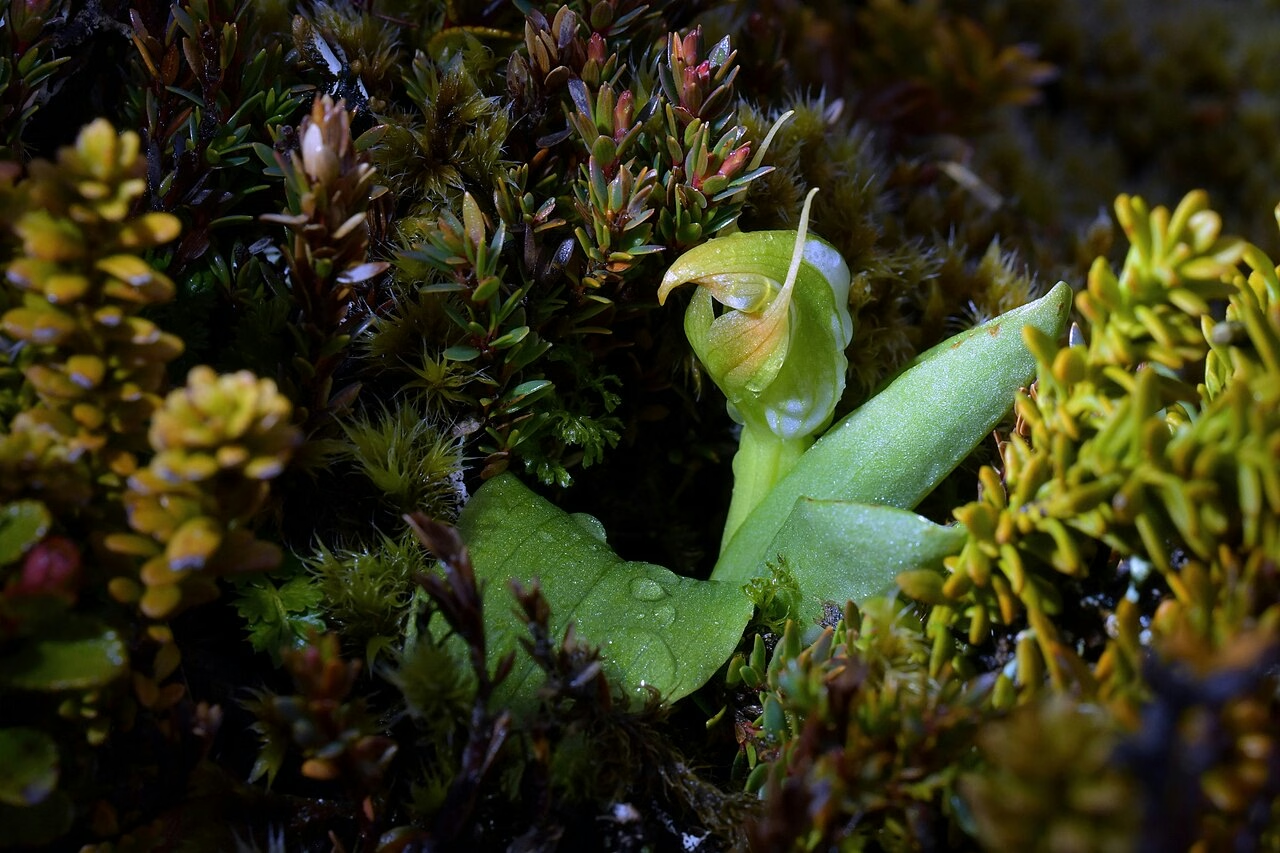
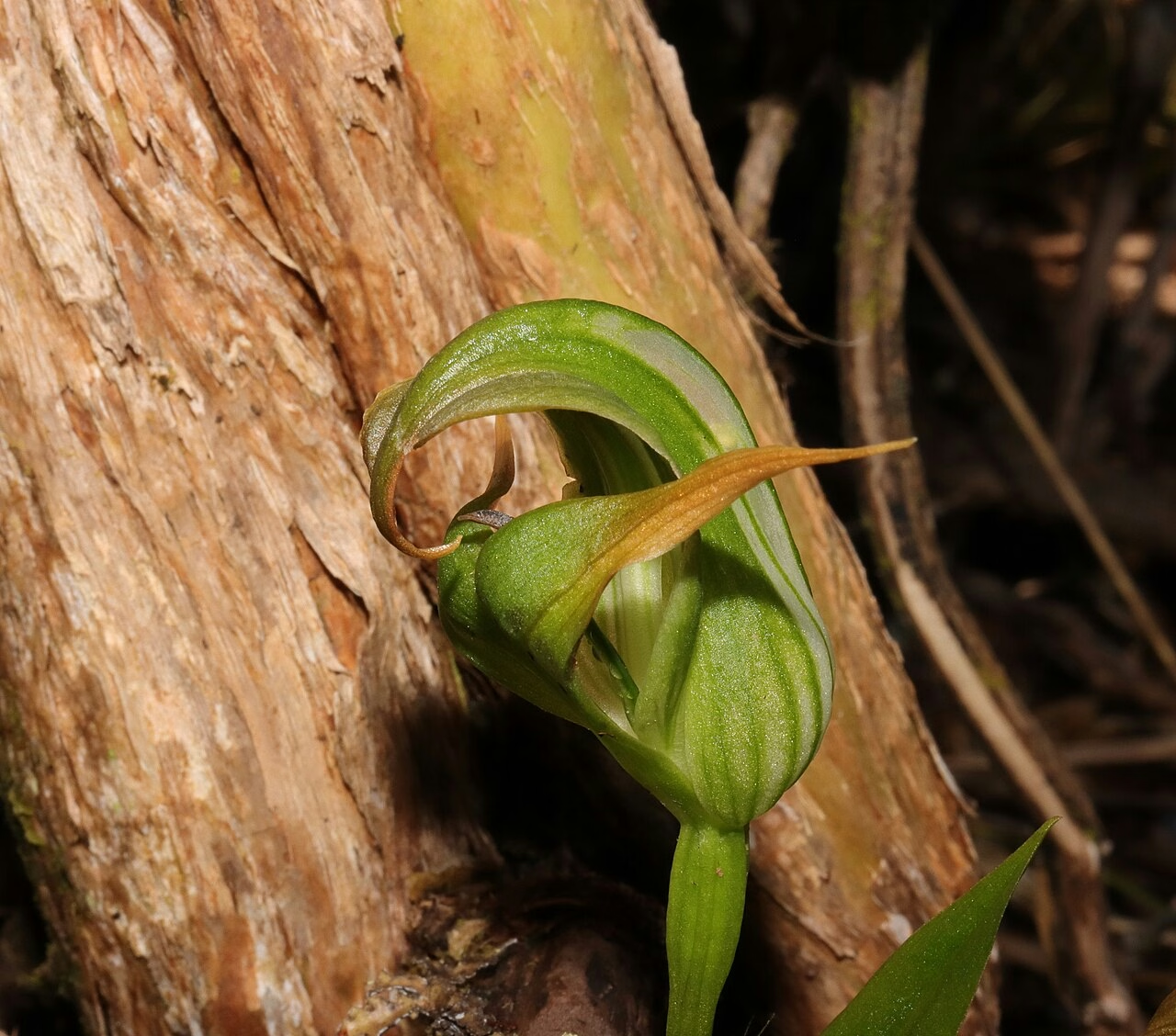
Pterostylis humilis is a dwarf greenhood orchid endemic to New Zealand, only 4.5-15 cm tall when flowering. It grows in montane to subalpine beech forest and subalpine scrub, often in deep drifts of leaf litter or among mosses, on the Central Volcanic Plateau and Mount Taranaki in the North Island and from North-west Nelson to about the Buller River in the South Island. It has dark green to blue-green leaves and an erect, single flower with dark green sepals striped with white, flowering from November to January. It forms colonies by vegetative spread. It is ranked At Risk - Naturally Uncommon because it is sparsely distributed. Explore more native flowering plants in our native plant guide.
Plant Description
Pterostylis humilis is a tuberous, hairless, spring to summer-green ground orchid that forms colonies through vegetative extension. At flowering it is only 45-150 mm tall. The leaves are dark green to blue-green, about 40-90 by 15-25 mm, forming a low rosette.
The flower is solitary and erect, with dark green sepals striped with white; Wikipedia also notes translucent white stripes and reddish-brown tones. The labellum is glabrous and shortly recurved. Inside the flower the stigma is prominent, upturned and heart-shaped, only a little longer than wide.
It is very close to Pterostylis venosa, another small greenhood of mountain forests, and the two can be hard to tell apart in the field. Check the stigma shape and the labellum surface: P. humilis has a heart-shaped, upturned stigma and a smooth labellum.
Quick Facts
| Scientific Name | Pterostylis humilis |
|---|---|
| Height | 0.045-0.15 m in flower |
| Spread | Forms colonies by vegetative extension |
| Water Needs | Constantly moist litter and moss |
| Light | Shade of beech forest and scrub |
| Frost Tolerance | High; montane to subalpine |
| Salt Tolerance | No information available |
| Growth Rate | Seasonal; summer-green |
| Lifespan | Perennial (tuberous) |
Climate Best Suited to
It is a plant of cool, wet mountain climates, growing in montane and subalpine forest on volcanic mountains and in the high-rainfall western South Island.
Regional Suitability
| City | Climate Suitability |
|---|---|
| Auckland | Low |
| Wellington | Low |
| Christchurch | Low |
| Dunedin | Medium |
Plant Habitat
Pterostylis humilis is endemic to New Zealand. In the North Island it is found on the Central Volcanic Plateau and on Mount Taranaki (Egmont National Park). In the South Island it occurs in the west, from North-west Nelson south to about the Buller River.
It grows at montane to subalpine elevations in beech (Nothofagus) forest and subalpine scrub, often in deep drifts of leaf litter or among mosses on the forest floor.
Growing Requirements
Soil Requirements
It roots in deep beech leaf litter and moss, which hold moisture and host the fungi it needs.
- Deep drifts of beech leaf litter
- Moss carpets on the forest floor
- Acidic, organic, undisturbed soils
Light Requirements
It grows beneath beech canopy and subalpine scrub.
- Shade to filtered light
- Cool, sheltered forest floor
- Not found in open grassland
Water Requirements
The high-rainfall mountain forests where it lives keep litter and moss moist through its growing season.
- Consistently moist while in leaf
- Frequent mist and rain in its habitat
- Tubers rest after fruiting
Planting and Establishing
This species is not commercially available, and NZPCN states that it is difficult and should not be removed from the wild. Its reliance on beech forest litter and fungi makes it unsuitable for gardens.
Trampers can help by keeping to tracks in mountain beech forest, where small colonies in the litter at track edges are easily crushed.
Ecological Role
Greenhood flowers commonly use a sensitive labellum to trap small insects, such as fungus gnats, which then pass the column and carry pollen. Pollination of this particular species has not been documented in the sources consulted.
It spreads into small colonies through vegetative extension of tubers, which helps it persist in the stable, moss-rich floor of beech forest. Its seed, like that of all orchids, depends on mycorrhizal fungi to germinate.
Uses & Significance
Garden Uses
It is not grown in gardens and should be appreciated in its natural habitat.
- Look for it on mountain forest walks in early summer
- Photograph without disturbing the litter
- Contribute sightings to iNaturalist NZ
Ecological Value
As a sparse endemic orchid, it is a distinctive part of mountain beech forest floors.
- Contributes to orchid diversity on Taranaki and in western Nelson
- Supports small pollinating insects
- A sign of intact, undisturbed beech forest floor
Landscaping Uses
Pterostylis humilis has no landscaping use. Its management concerns protecting existing colonies in national parks and conservation land.
Track maintenance in beech forest should avoid dumping spoil or gravel on mossy, litter-filled hollows where small orchids such as this may be growing.
Seasonal Care Calendar
Spring
Leaves emerge from tubers as the mountain forests warm.
- Low blue-green leaf rosettes appear
- Flower buds develop late in spring
Summer
Flowers appear from November to January, followed by capsules from December to March.
- Small erect dark green and white flowers
- Check the heart-shaped stigma to confirm identity
Autumn
Plants die back as capsules finish shedding seed.
- Leaves wither
- New tubers carry the plant through to next season
Winter
Dormant under litter and often snow at higher sites.
- Nothing visible above ground
- Avoid disturbing litter drifts
When to Prune and How Much
No pruning is involved. The plant is summer-green and its leaves and flower stem die off naturally after fruiting.
Leaving the litter and moss layer intact around colonies is far more important than any intervention.
How to Grow Greenhood
Pterostylis humilis is At Risk - Naturally Uncommon, and NZPCN states that it is difficult to propagate and should not be removed from the wild. It is not available from nurseries. NZPCN's general guidance for Pterostylis in cultivation is a basic orchid mix of coarse river sand, soil or leaf-mould, weathered sawdust or rotting wood and granulated bark, with about 50% shade and pots kept evenly moist. Any propagation of this species should be left to conservation programmes with the proper permits, and the cool, moist conditions of its montane habitat would be hard to reproduce at low altitude.
From Seed
Capsules ripen from December to March, releasing minute seeds that need a compatible fungus to germinate. Raising native orchids from seed is a specialist laboratory technique, and no method has been published for this species.
- Leave capsules on wild plants so seed can disperse
- Obtain DOC authorisation before any collection on conservation land
- Sow only in sterile or symbiotic culture with expert help
- Grow seedlings on in cool, shaded, humid conditions
By Tuber
Because it forms colonies through vegetative extension, a cultivated plant may produce additional tubers that can be separated while dormant, as is usual for greenhoods.
- Use only legally held cultivated stock
- Separate tubers in late summer while dormant
- Repot into a moist, leafy orchid mix with added beech litter
- Keep cool, evenly moist and under about 50% shade through the growing season
Pests & Diseases
Slugs and snails can eat leaves and flowers, and introduced browsers such as deer and goats may graze the forest floor where it grows.
NZPCN records no apparent threats. Its sparse distribution means that local damage, such as track works or trampling at popular sites, could affect a significant share of a population.
Cultural Significance
No Māori name or traditional use specific to Pterostylis humilis is recorded in the sources consulted; the name tutukiwi is recorded for greenhoods generally, notably Pterostylis banksii.
It was described in 1922 by Richard Sanders Rogers, an Australian physician and orchidologist, in the Transactions and Proceedings of the Royal Society of South Australia. The epithet humilis means low or dwarf.
Bonus Tip
On Mount Taranaki or in Nelson beech forest in early summer, scan the mossy hollows beside the track at ground level: P. humilis flowers are so short that they often sit almost at moss height and are easily overlooked.
Related Plants
Explore other native plants that share similar characteristics or habitats with Greenhood (Pterostylis humilis), offering further insights into New Zealand's diverse flora. These related species provide context and opportunities for complementary planting in your garden.
Ladder Brake
Pteris vittata
Kauri Greenhood
Pterostylis agathicola
Pterostylis areolata
Pterostylis areolata
Pterostylis cardiostigma
Pterostylis cardiostigma
Pterostylis irsoniana
Pterostylis irsoniana
Nodding Greenhood
Pterostylis nutans
Oliver's Greenhood
Pterostylis oliveri
Pterostylis patens
Pterostylis patens
Plant Conservation
Pterostylis humilis is ranked At Risk - Naturally Uncommon (2023) with the qualifier Sp (sparse), having been listed Not Threatened in 2004. It is not considered declining, but its populations are scattered.
Most of its habitat lies within national parks and conservation land. Controlling browsing animals, keeping walkers on tracks and avoiding disturbance of litter and moss in mountain beech forest help protect it.
Frequently Asked Questions
How is Pterostylis humilis different from Pterostylis venosa?
NZPCN says it is very close to P. venosa but differs in its prominent, upturned, heart-shaped stigma, which is little longer than wide, and its glabrous (hairless) labellum.
Is Pterostylis humilis threatened?
It is ranked At Risk - Naturally Uncommon (2023) with the qualifier Sparse. NZPCN notes no apparent threats but says it is not very common.
Where can you see Pterostylis humilis?
Look in montane beech forest and subalpine scrub on Mount Taranaki, the Central Volcanic Plateau, and in western South Island forests from North-west Nelson to around the Buller River.
What does humilis mean?
Humilis is Latin for low, dwarf or small, describing this greenhood's short stature of only 45-150 mm when in flower.
Sources and Further Reading
The botanical, growing, and conservation details for Greenhood (Pterostylis humilis) on this page draw on the New Zealand plant references below. Consult them for full technical records and the latest distribution data.