Antipodes Saltgrass
Puccinellia antipoda
Last updated:
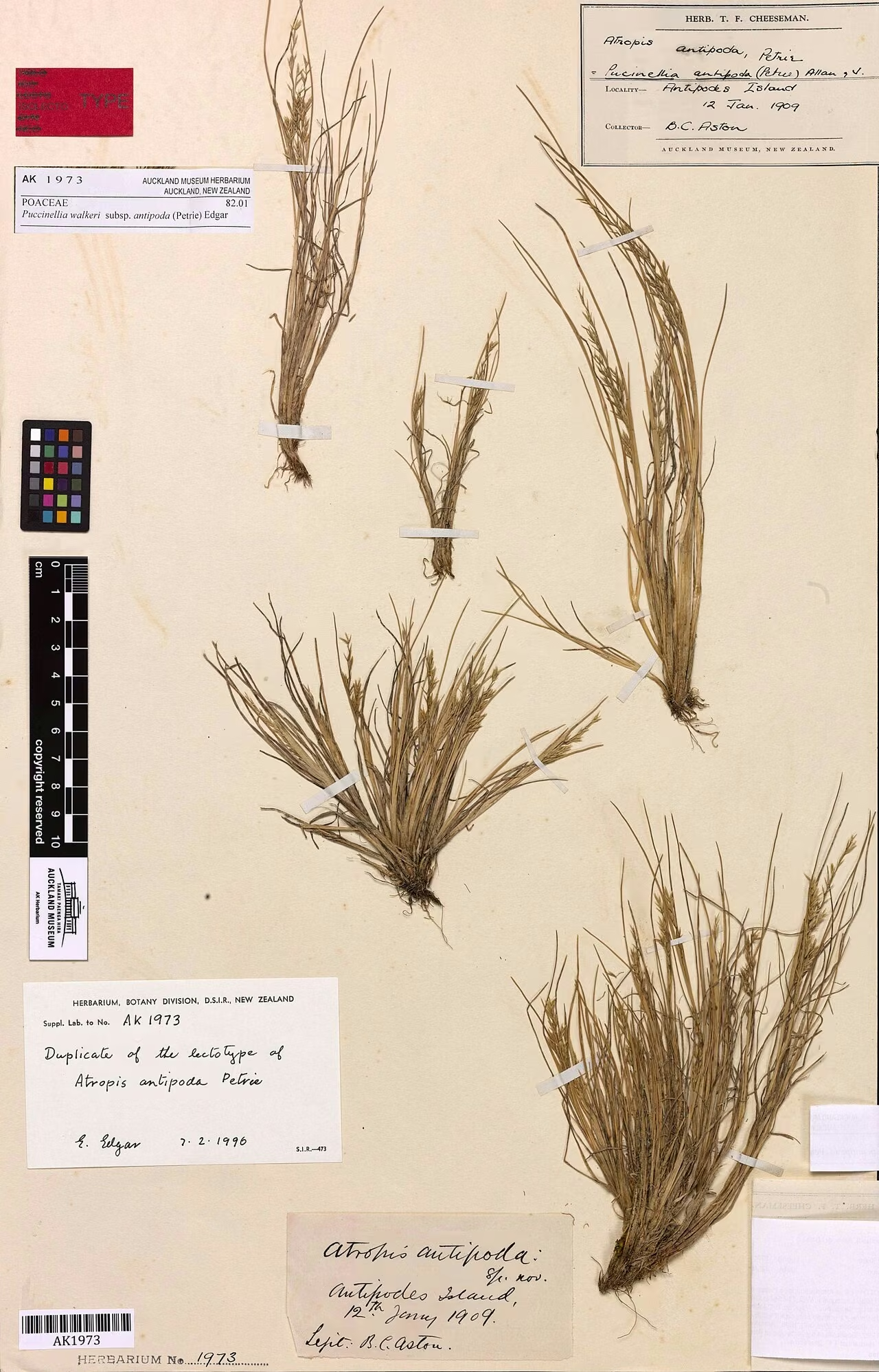
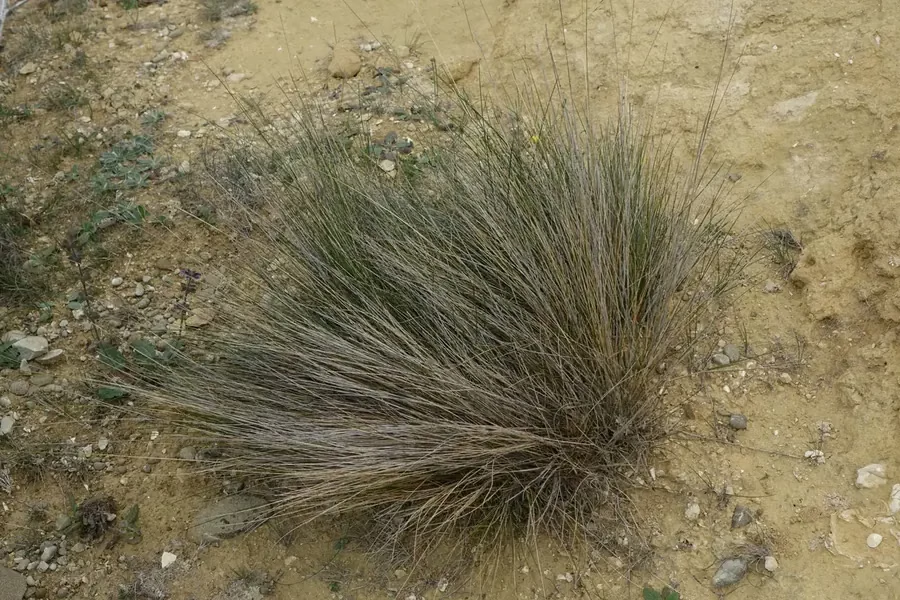
Antipodes saltgrass (Puccinellia antipoda) is a small tufted grass found nowhere in the world except the subantarctic Antipodes Islands, far to the south-east of the South Island. It forms dense, erect, bluish-green or pale tufts 6.5 to 25 cm tall on coastal boulders, in peaty turf behind beaches and on cliff faces, and occasionally inland near seabird nests and seal wallows. It is a salt-tolerant member of the saltgrass genus. It is ranked At Risk - Naturally Uncommon because it is confined to one island group, but it appears to be abundant there and faces no known threats. Explore more native grasses and flaxes in our native plant guide.
Plant Description
Puccinellia antipoda forms dense, erect tufts 6.5 to 25 cm tall that are bluish-green or pale. Its leaf-sheaths are straw-coloured to light grey-brown or greenish brown, and the leaf blades are 50 to 250 mm long and usually folded.
The flowering head is a narrow, linear-lanceolate panicle 25 to 80 mm long and 4 to 15 mm wide. Spikelets are 3 to 9 mm long and hold two to five florets, and the seeds are tiny, about 1.5 to 2.6 mm long.
It is separated from the related Puccinellia chathamica and P. walkeri by its smaller overall size, smaller panicles with sparsely scabrous (rough) branches, and pale lemma keels that are shortly excurrent, meaning the midrib extends just beyond the tip.
Quick Facts
| Scientific Name | Puccinellia antipoda |
|---|---|
| Height | 0.065-0.25 m |
| Spread | Dense small tufts |
| Water Needs | Moist; cool, wet maritime climate |
| Light | Full sun on open coastal ground |
| Frost Tolerance | High; subantarctic climate |
| Salt Tolerance | High; grows in the salt spray zone |
| Growth Rate | No information available |
| Lifespan | Perennial |
Climate Best Suited to
Lives in the cold, windy, cloudy and wet oceanic climate of the subantarctic Antipodes Islands. It would not suit mainland gardens.
Regional Suitability
| City | Climate Suitability |
|---|---|
| Auckland | Low |
| Wellington | Low |
| Christchurch | Low |
| Dunedin | Low |
Plant Habitat
Antipodes saltgrass is endemic to the Antipodes Islands, a remote subantarctic group south-east of the South Island. Herbarium collections come from places such as Reef Point on the main Antipodes Island and from Archway Island.
It is mostly coastal, growing on boulders, in peaty turf at the back of beaches and on cliff faces. It occasionally grows inland, where seabird nests and seal wallows enrich and salt the ground.
Growing Requirements
Soil Requirements
It roots into peaty turf, rock crevices and nutrient-rich ground influenced by salt spray and wildlife.
- Peaty coastal turf
- Crevices among boulders and on cliffs
- Ground enriched by seabirds and seals
Light Requirements
It grows on open, treeless coastal ground exposed to the sky.
- Full exposure on cliffs and shores
- No tall vegetation shading the tufts
Water Requirements
The Antipodes Islands are cool and frequently wet, and its coastal sites receive regular salt spray.
- Constant moisture from rain, mist and spray
- Tolerant of salt-laden water
Planting and Establishing
Antipodes saltgrass is not in cultivation, and the Antipodes Islands are a nature reserve with tightly controlled access. It is not available for planting.
Anyone wanting a coastal saltgrass for a mainland salt marsh restoration should use the locally native Puccinellia stricta instead.
Ecological Role
Like other grasses it is wind-pollinated. It forms part of the coastal turf and cliff vegetation around the Antipodes Islands, alongside seabird colonies and seal haul-outs.
A 1978 herbarium specimen collected at Reef Point records that the grass was being eaten by parakeets, which on the Antipodes Islands are the endemic Antipodes Island parakeet and Reischek's parakeet.
Uses & Significance
Garden Uses
It has no garden use because it is not cultivated and grows only on a protected subantarctic island group.
- Not available from nurseries
- Use Puccinellia stricta for mainland coastal plantings
- Of interest to botanists studying subantarctic grasses
Ecological Value
It is one of the endemic plants of the Antipodes Islands and a component of their coastal turf.
- Endemic to a single subantarctic island group
- Recorded as food for parakeets
- Binds peaty turf and rock crevices on exposed coasts
Landscaping Uses
It is not used in landscaping. On the Antipodes Islands its bluish tufts are part of the low coastal sward shaped by wind, salt and wildlife.
Its relatives in the saltgrass genus show the same pattern of small, salt-tolerant tufts suited to harsh shorelines.
Seasonal Care Calendar
Spring
Flowering and fruiting times are recorded as not known by NZPCN, so seasonal behaviour has not been documented.
- No management required
- Island access is restricted
Summer
The tufts persist through the cool subantarctic summer, when most botanical visits to the islands take place.
- Herbarium specimens have been collected in November
- No intervention needed
Autumn
The plant continues to grow in a climate with little seasonal change in temperature.
- No management required
Winter
As a perennial it remains in place through the cold, stormy subantarctic winter.
- Tolerant of frost, wind and salt spray
When to Prune and How Much
No pruning is needed or relevant, since the species is not grown in cultivation.
In the wild, grazing by birds is the only trimming the tufts receive.
How to Grow Antipodes Saltgrass
NZPCN records propagation of Puccinellia antipoda as not known, and it is not known in cultivation. It grows only on the Antipodes Islands, which are a protected nature reserve, so no material is available to the public and collection requires permits. The notes below outline how related saltgrasses are raised, since Puccinellia stricta is easily grown from seed and division and Puccinellia chathamica can be grown from fresh seed and rooted pieces. They are offered only as a guide for any future conservation programme, not as a tested method for this species.
From Seed
Grass seed of related saltgrasses is sown fresh. The seeds of this species are very small, about 1.5 to 2.6 mm long, so they should be sown shallowly.
- Collect ripe seed heads under permit as the panicles dry
- Sow fresh seed on the surface of a gritty, free-draining mix and lightly cover
- Keep cool, moist and in full light
- Prick out seedlings into individual pots once they have several leaves
By Division
Tufted saltgrasses can be split into rooted pieces. This method is recorded for the related Puccinellia chathamica and would be the way to bulk up any plants held in cultivation.
- Lift an established cultivated tuft
- Tease it apart into pieces each with roots and several shoots
- Pot the pieces into a gritty mix and keep cool and moist
- Grow on in an exposed, well-ventilated position
Pests & Diseases
NZPCN reports no known threats to this species. The Antipodes Islands were the subject of a mouse eradication programme, and introduced mammals have been the main conservation concern for island ecosystems there.
No specific pests or diseases of the grass are recorded.
Cultural Significance
No Māori name or traditional use is recorded for Antipodes saltgrass, which grows on islands far from historical Māori settlement.
The genus Puccinellia is named after the Italian botanist Benedetto Puccinelli (1808 to 1850), and the epithet antipoda refers to the Antipodes Islands. The species was originally described as Atropis antipoda by Donald Petrie.
Bonus Tip
If you are comparing saltgrass specimens from the subantarctic, check the lemma keels with a hand lens. Pale keels that run out into a short point, together with small, sparsely rough panicles, point to Puccinellia antipoda rather than its larger relatives.
Related Plants
Explore other native plants that share similar characteristics or habitats with Antipodes Saltgrass (Puccinellia antipoda), offering further insights into New Zealand's diverse flora. These related species provide context and opportunities for complementary planting in your garden.
Nodding Greenhood
Pterostylis nutans
Oliver's Greenhood
Pterostylis oliveri
Pterostylis patens
Pterostylis patens
Shrimp-Flowered Greenhood
Pterostylis porrecta
Chatham Islands Salt Grass
Puccinellia chathamica
Salt Grass
Puccinellia stricta
Walker's Saltgrass
Puccinellia walkeri
Petriei Grass
Achnatherum Petriei Grass
Plant Conservation
Puccinellia antipoda is ranked At Risk - Naturally Uncommon (2023) with the qualifiers IE (Island Endemic) and OL (One Location). NZPCN describes it as a range-restricted endemic that appears abundant on the islands, with no known threats.
The Antipodes Islands are a nature reserve and part of the New Zealand Subantarctic Islands World Heritage Area, so its habitat is strongly protected. Biosecurity to keep new pests and weeds off the islands is the most important safeguard.
Frequently Asked Questions
Where does Antipodes saltgrass grow?
It is endemic to the Antipodes Islands, where it grows mostly on the coast on boulders, cliff faces and in peaty turf at the back of beaches.
Is Puccinellia antipoda threatened?
It is ranked At Risk - Naturally Uncommon because it lives only on one island group, but NZPCN reports it as abundant there with no known threats.
How do you tell Puccinellia antipoda from Puccinellia chathamica?
NZPCN notes it is a smaller plant with smaller panicles whose branches are sparsely rough, and pale lemma keels that extend into a short point.
Sources and Further Reading
The botanical, growing, and conservation details for Antipodes Saltgrass (Puccinellia antipoda) on this page draw on the New Zealand plant references below. Consult them for full technical records and the latest distribution data.