Greenhood
Pterostylis cardiostigma
Last updated:
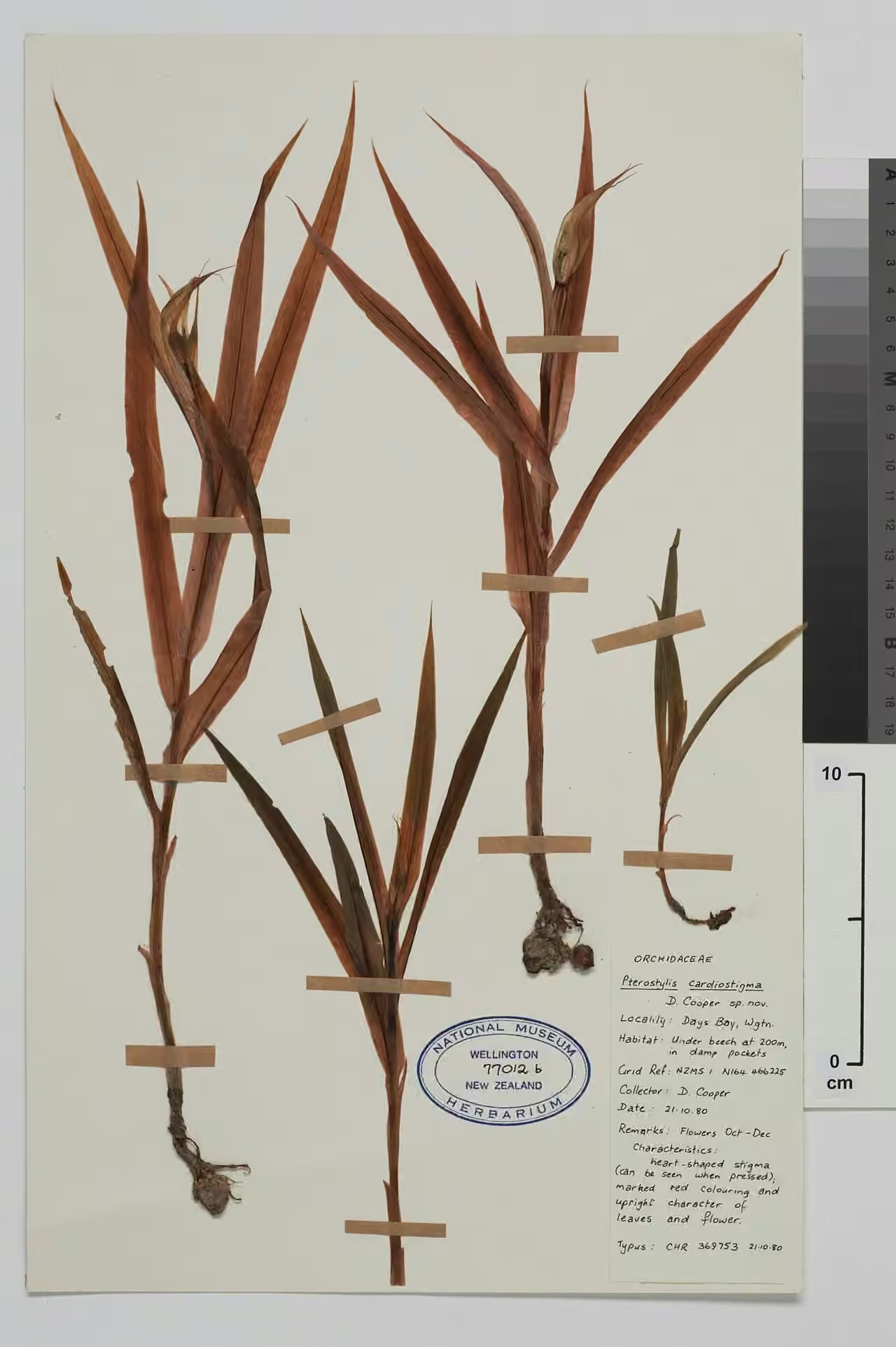
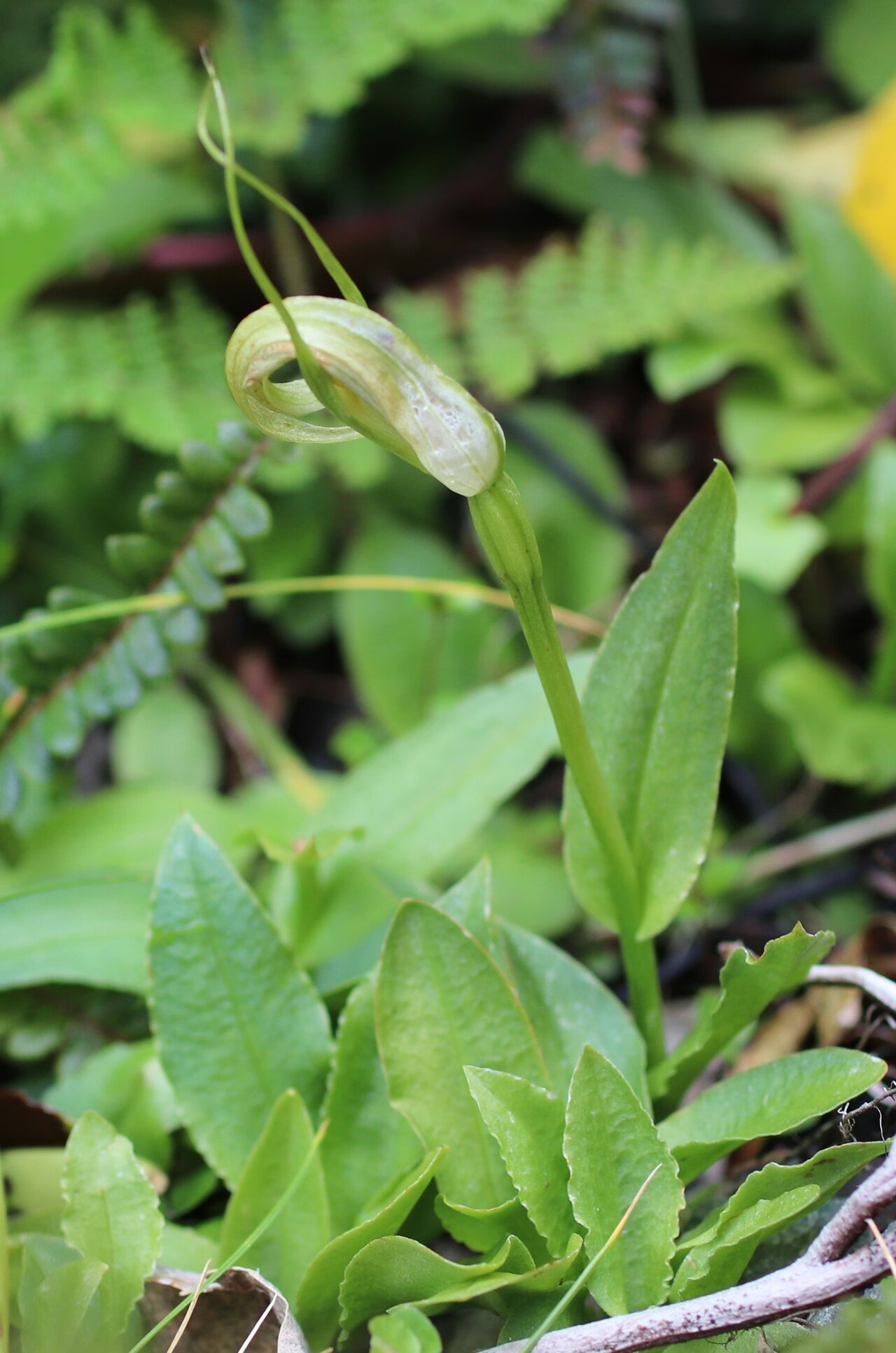
Pterostylis cardiostigma is a stout endemic greenhood orchid of the North and South Islands, growing up to 40 cm tall from a heart-shaped tuber. Its erect, dark green, deeply ribbed leaves have prominent red midribs and overtop the single flower, which is green finely striped with white and has pinkish-red tips and long, red, thread-like sepal points. The name means heart stigma, after the heart-shaped stigma hidden inside the flower. It grows in coastal to montane forest and shrubland, including exotic forest, flowering from October to December, and is often mistaken for Pterostylis banksii. It is Not Threatened nationally. Explore more native flowering plants in our native plant guide.
Plant Description
Pterostylis cardiostigma is a stout, terrestrial greenhood that grows up to 400 mm tall from a heart-shaped underground tuber. Its leaves are dark green, linear-lanceolate, erect and deeply ribbed, about 80-280 mm long, with prominent red midribs. The uppermost leaves rise above the flower.
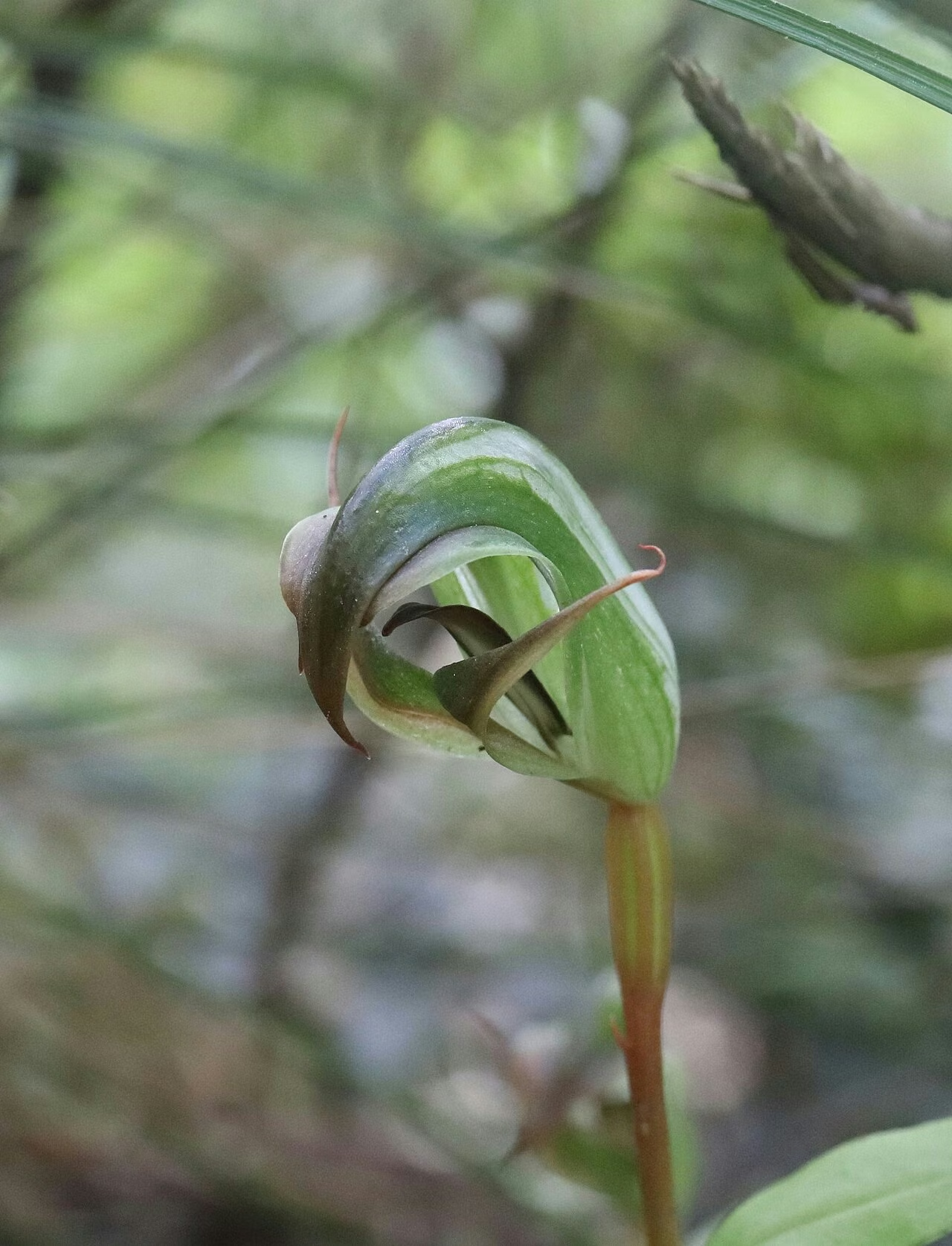
The flower is solitary, mostly green finely striped with white, with pinkish-red tips. It is narrow and rarely opens fully. The lateral sepals stand more or less erect, well above the galea, and end in long, narrow, red, thread-like tips. The heart-shaped stigma, which gives the species its name, is visible only when the flower is opened.
It is most often confused with Pterostylis banksii, with which it frequently grows. Its stouter habit, erect ribbed leaves overtopping the flower and the heart-shaped stigma separate it; the barely opened flowers can easily be mistaken for unopened P. banksii buds.
Quick Facts
| Scientific Name | Pterostylis cardiostigma |
|---|---|
| Height | Up to 0.4 m |
| Spread | Single plants or colonies of 4-6 |
| Water Needs | Evenly moist forest soils |
| Light | Shade to partial shade |
| Frost Tolerance | Moderate; coastal to montane |
| Salt Tolerance | No information available |
| Growth Rate | Seasonal; dies back to a tuber |
| Lifespan | Perennial (tuberous) |
Climate Best Suited to
It suits the mild to cool, moist forest climates of both main islands, from coastal sites to montane forest.
Regional Suitability
| City | Climate Suitability |
|---|---|
| Auckland | Medium |
| Wellington | High |
| Christchurch | Medium |
| Dunedin | Medium |
Plant Habitat
Pterostylis cardiostigma is endemic to New Zealand and is recorded from both the North and South Islands. The type was collected at Days Bay on the eastern shore of Wellington Harbour. In the Auckland region it is now very scarce and listed as Regionally Critical.
It grows from coastal to montane elevations in indigenous forest and shrubland and also in exotic forest. It usually occurs as single plants or as widely spaced colonies of four to six plants.
Growing Requirements
Soil Requirements
It roots in the humus-rich forest floor, where fungi essential to orchids are present.
- Moist, organic forest soils
- Leaf litter layer left undisturbed
- Dependent on soil fungi
Light Requirements
It is a plant of forest and shrubland shade.
- Shade to partial shade under canopy
- Found under exotic as well as native trees
- Not a plant for open grassland
Water Requirements
Growth and flowering happen in the moist months of spring and early summer.
- Evenly moist soil while in leaf
- Tuber rests after fruiting
- Drying of the forest floor ends the growing season
Planting and Establishing
Pterostylis cardiostigma is not available from nurseries, and NZPCN describes it as difficult to grow. Wild plants should be left where they are.
If it appears in your own bush block or even under exotic trees, leave the litter layer undisturbed, avoid spraying and control slugs and browsing animals nearby to give it the best chance of persisting.
Ecological Role
Pterostylis flowers typically trap small insects such as fungus gnats with a sensitive labellum, forcing them past the pollen. Wikipedia notes that in this species the pollinia often fall onto the stigma, so self-pollination also occurs, which may help explain why the flowers rarely open fully.
Its ability to grow in exotic forest as well as native forest and shrubland shows a degree of tolerance for modified habitats, provided the right mycorrhizal fungi are present in the soil.
Uses & Significance
Garden Uses
It is not grown in gardens and has no commercial availability.
- Observe in forest reserves in late spring
- Leave self-established plants in place
- Log observations to help clarify its distribution
Ecological Value
It contributes to the diverse ground orchid flora of New Zealand forests.
- Part of the forest floor herb layer
- Food for small invertebrates
- Shows how native orchids can persist in plantation forest
Landscaping Uses
This orchid has no role in landscape design. Where it occurs in plantation or native forest, retaining patches of undisturbed floor during harvesting or track work is the most useful management.
Because it often grows with Pterostylis banksii, protecting greenhood patches in general will also protect this less familiar species.
Seasonal Care Calendar
Spring
Flowering runs from October to December.
- Narrow green and white flowers with red thread-like tips
- Check for the heart-shaped stigma to confirm identity
Summer
Capsules ripen from December to March.
- Seed shed as capsules split
- Leaves gradually die back
Autumn
Plants rest as tubers underground.
- No growth visible
- Leave forest litter undisturbed
Winter
New shoots emerge from the tuber in the cool, moist season.
- Leaves develop ahead of spring flowering
- Slugs can damage emerging shoots
When to Prune and How Much
No pruning is needed. Foliage dies back naturally after the capsules ripen in late summer.
Avoid cutting or trampling the stems while they are still green, as the plant needs its leaves to rebuild the tuber for next year.
How to Grow Greenhood
NZPCN describes Pterostylis cardiostigma as difficult to propagate and not commercially available. Like other greenhoods it depends on mycorrhizal fungi throughout its life, so wild plants and tubers must not be dug up. For specialist growers working with legally sourced Pterostylis, NZPCN recommends a basic mix of coarse sand, soil or leaf-mould, weathered sawdust or rotting wood and granulated bark, with about 50% shade and evenly moist pots. Its frequent self-pollination means wild plants usually set plenty of seed naturally.
From Seed
Because pollinia often fall onto the stigma, many flowers set capsules, which ripen between December and March and release dust-fine seed. This seed contains no food store and germinates only with a compatible fungus or in sterile laboratory culture.
- Allow wild capsules to ripen and disperse naturally
- Only collect seed with the land manager's permission
- Pass seed to orchid specialists who can sow it on sterile or symbiotic media
- Expect several years before seedlings reach flowering size
By Tuber
Colonies of four to six plants suggest some vegetative increase by daughter tubers. Cultivated greenhoods are generally repotted while dormant, when tubers can be separated.
- Work only with legally cultivated stock
- Separate daughter tubers during summer dormancy
- Pot into a free-draining orchid mix under about 50% shade
- Begin regular watering when shoots appear in late autumn or winter
- Reduce watering as leaves yellow after fruiting so the new tubers can ripen and rest
Pests & Diseases
Slugs and snails eat the young shoots and flowers of greenhoods. Browsing by possums, deer, goats and pigs, and trampling, can also damage plants.
Disturbance of the forest floor, such as logging, track building or clearance, and competition from weeds are likely pressures, particularly where it is already scarce, as in the Auckland region.
Cultural Significance
No Māori name or traditional use specific to Pterostylis cardiostigma is recorded in the sources consulted, although the name tutukiwi is recorded for greenhoods such as Pterostylis banksii.
The species was described in 1983 by Dorothy Cooper, a New Zealand orchid researcher, from plants collected at Days Bay near Wellington.
Bonus Tip
If you see what looks like a Pterostylis banksii that never seems to open, look closer: tall, ribbed leaves standing above the flower and long red sepal threads suggest Pterostylis cardiostigma.
Related Plants
Explore other native plants that share similar characteristics or habitats with Greenhood (Pterostylis cardiostigma), offering further insights into New Zealand's diverse flora. These related species provide context and opportunities for complementary planting in your garden.
Pteris saxatilis
Pteris saxatilis
Ladder Brake
Pteris vittata
Kauri Greenhood
Pterostylis agathicola
Pterostylis areolata
Pterostylis areolata
Pterostylis humilis
Pterostylis humilis
Pterostylis irsoniana
Pterostylis irsoniana
Nodding Greenhood
Pterostylis nutans
Oliver's Greenhood
Pterostylis oliveri
Plant Conservation
Pterostylis cardiostigma is ranked Not Threatened nationally (2023). Regionally it is listed as Regionally Critical in Auckland but Regionally Not Threatened in Wellington (2025).
Protecting forest and shrubland floors from disturbance, controlling browsing animals and noting any colonies in plantation forest before harvest help conserve it, especially in the Auckland region.
Frequently Asked Questions
How do you distinguish Pterostylis cardiostigma from Pterostylis banksii?
NZPCN notes P. cardiostigma is stouter, with deeply ribbed erect leaves that overtop the flowers and a prominent heart-shaped stigma. Its narrow flowers rarely open fully and can look like unopened P. banksii buds.
What does cardiostigma mean?
The name combines Greek words for heart and stigma, referring to the heart-shaped stigma that can be seen only when the flower is opened.
Does Pterostylis cardiostigma self-pollinate?
Wikipedia reports that its pollinia often fall onto the stigma so that self-pollination occurs, alongside possible cross-pollination by insects.
Is Pterostylis cardiostigma rare?
It is ranked Not Threatened nationally, but the Auckland region lists it as Regionally Critical, and it usually grows as single plants or small, widely spaced colonies.
Sources and Further Reading
The botanical, growing, and conservation details for Greenhood (Pterostylis cardiostigma) on this page draw on the New Zealand plant references below. Consult them for full technical records and the latest distribution data.