Brake
Pteris saxatilis
Last updated:
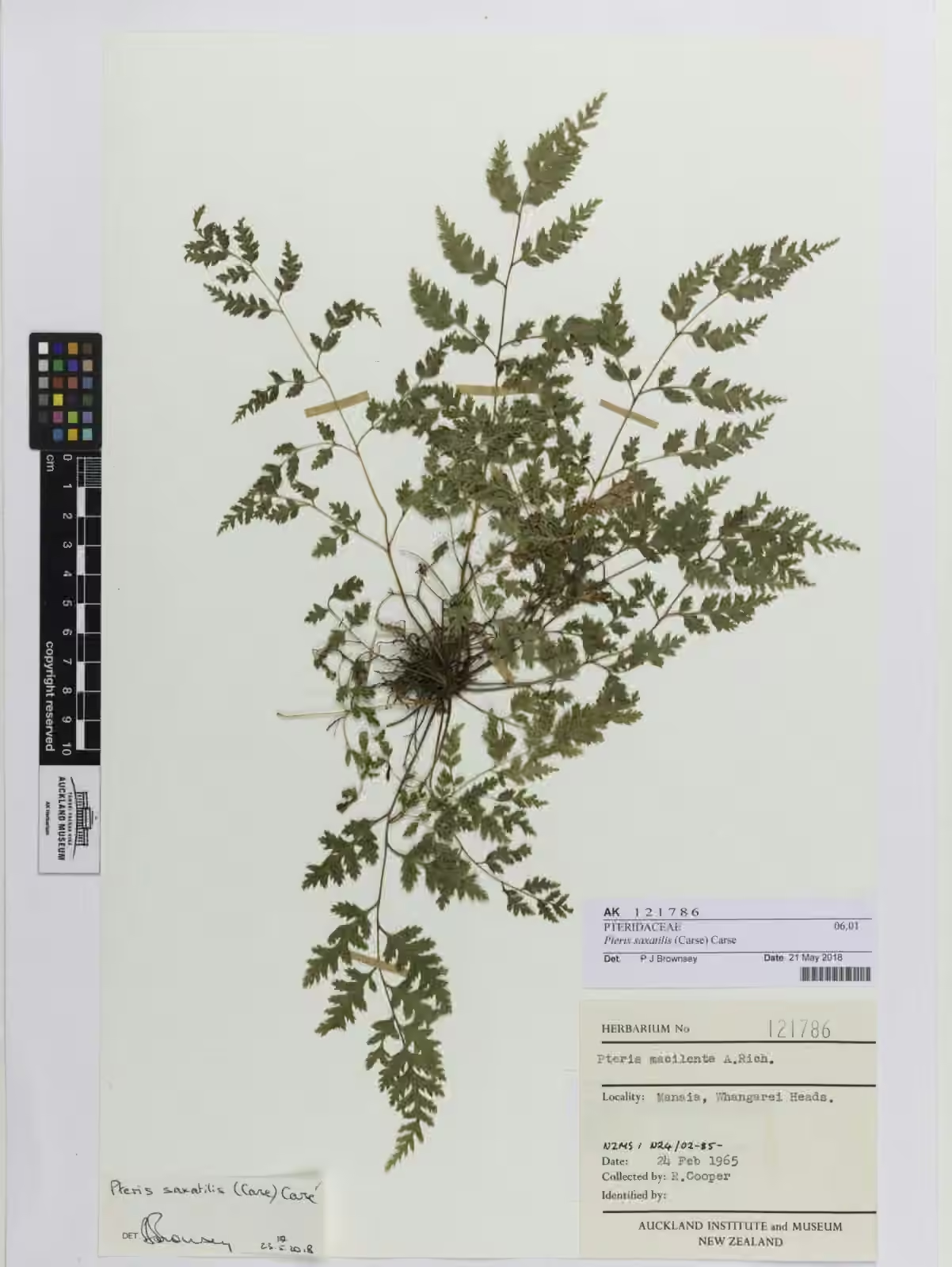
Pteris saxatilis is an endemic New Zealand brake fern with lacy, triangular to ovate fronds 15-70 cm long that rise from a short, erect, scaly rhizome. Its name means living in rocky places, and it is mostly coastal, growing on grassy or rubble-strewn slopes, cliffs, creek banks and amongst flax and sedges behind boulder beaches. It occurs from North Cape to East Cape and Taranaki, with outliers in Hawke's Bay, Wellington, North-west Nelson and the Marlborough Sounds. It is ranked Not Threatened nationally but is Regionally Critical in Wellington. It is closely related to and hybridises with Pteris macilenta and Pteris carsei. Explore more native ferns in our native plant guide.
Plant Description
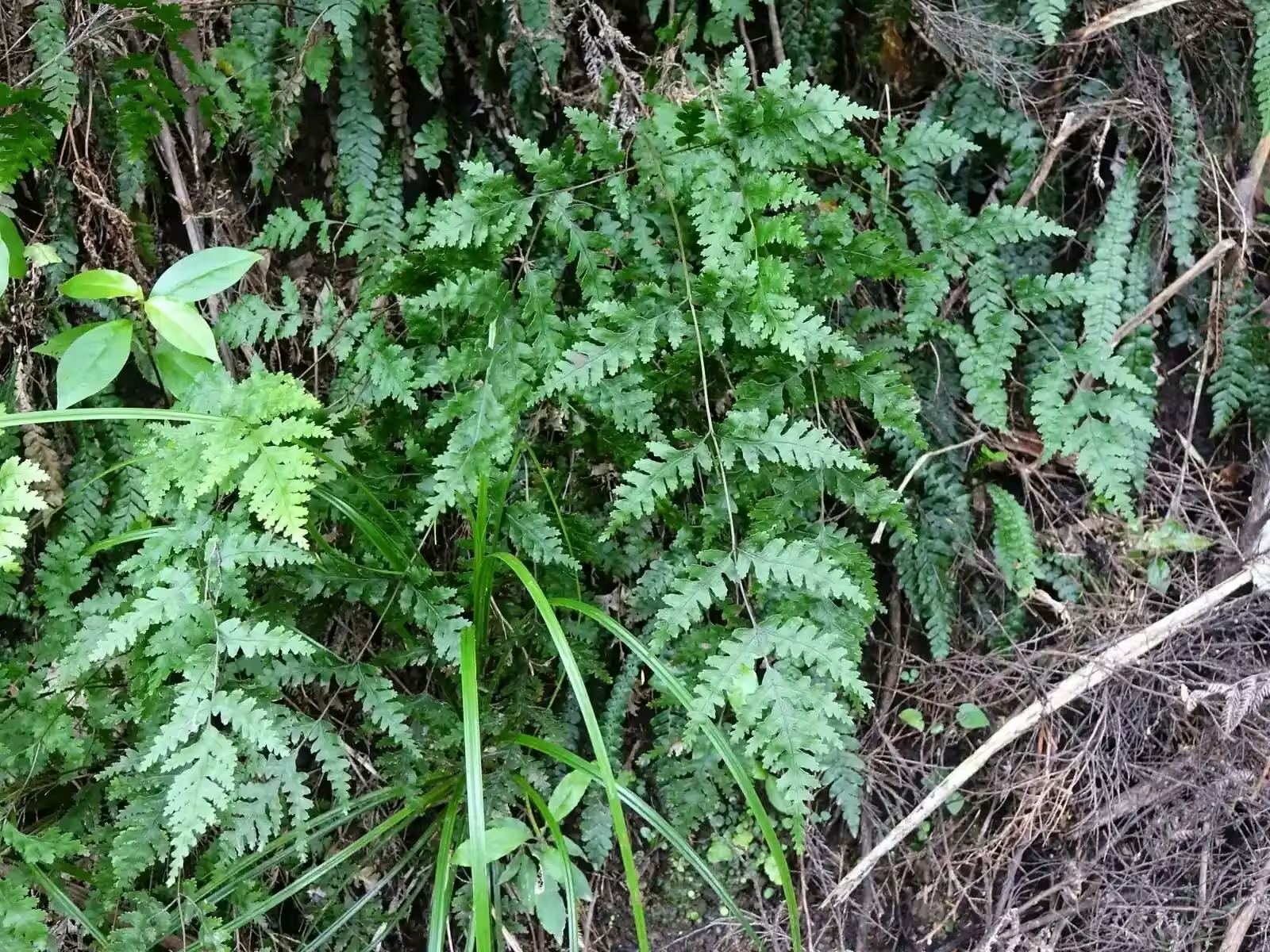
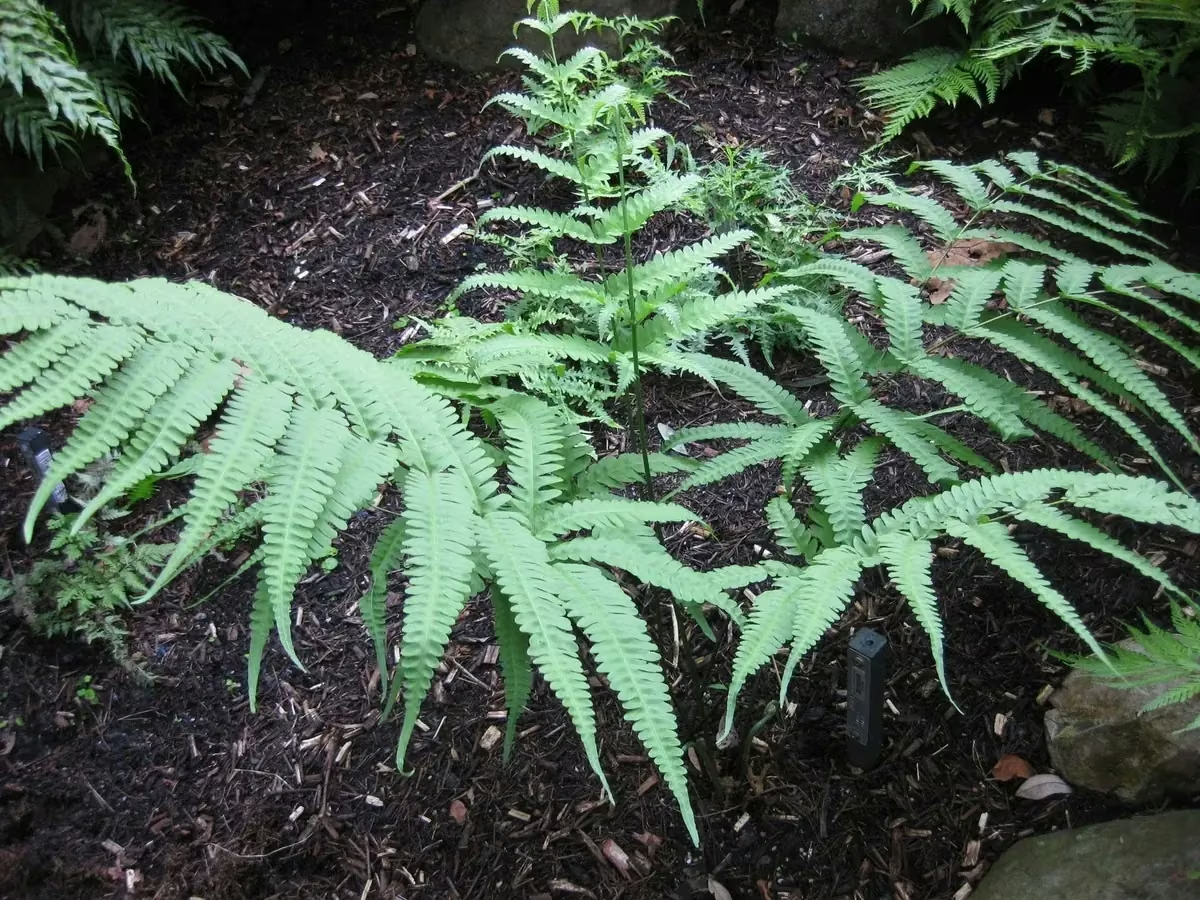
Pteris saxatilis is a terrestrial fern growing from a short, erect, scaly rhizome. The stipes are pale brown, 80-200 mm long and smooth or scaly only at the very base. Fronds are dark green to yellow-green, ovate and leathery to herbaceous, with laminae 2-pinnate-pinnatifid to 3-pinnate at the base. The ultimate segments are oblong, about 5-10 by 3-5 mm, with tapering or bluntly pointed tips and toothed margins. The veins join to form a network (reticulate or anastomosing venation).
As in all Pteris, the sori run along the margins of the ultimate segments and are protected by the inrolled leaf edge. A key feature of this species is that both the primary and secondary pinnae are very widely spaced, giving the frond an open, airy appearance.
It is most similar to Pteris macilenta, which is generally larger with a more robust lamina, closer pinnae and larger spores. Pteris carsei differs in having free (not netted) veins and overlapping pinnae. Because P. saxatilis hybridises with both, intermediate plants are common in coastal Northland and Auckland and can be hard to name.
Quick Facts
| Scientific Name | Pteris saxatilis |
|---|---|
| Height | Fronds 0.15-0.7 m long |
| Spread | Single clumps from a short erect rhizome |
| Water Needs | Moderate; prefers free-draining soil |
| Light | Semi-shade to open, bright sites |
| Frost Tolerance | Low to moderate; a coastal lowland fern |
| Salt Tolerance | Moderate; grows close to boulder beaches, though not in direct spray |
| Growth Rate | Moderate |
| Lifespan | Perennial |
Climate Best Suited to
It suits the mild, frost-light coastal climates of the northern and central North Island and the northern tip of the South Island. Colder inland and southern districts are outside its natural range.
Regional Suitability
| City | Climate Suitability |
|---|---|
| Auckland | High |
| Wellington | Medium |
| Christchurch | Low |
| Dunedin | Low |
Plant Habitat
Pteris saxatilis is endemic to New Zealand. Flora of New Zealand records it in coastal and lowland sites from Te Paki south to East Cape and the north Taranaki coast, with outlying populations in Hawke's Bay, Wellington and the north coast of the South Island in North-west Nelson and the Marlborough Sounds. It ranges from near sea level to about 360 m.
It is mostly coastal, though occasionally found well inland. It favours open habitats such as grassy or rubble-strewn slopes, open forest, and flax and sedge vegetation on the banks above boulder or cobble beaches. It also grows under coastal forest and scrub, in drier kauri and broadleaved forest and in mānuka and kānuka scrub, on cliffs, creek banks, damp gullies, clay banks, rocks and scree.
Growing Requirements
Soil Requirements
NZPCN advises a deep, free-draining, fertile but light soil, and notes that it often responds well to regular applications of lime.
- Deep, light, free-draining loam
- Rocky or gritty sites mimic its natural habitat
- Occasional lime dressings can improve growth
Light Requirements
In the wild it grows in fairly open sites, but in cultivation NZPCN says it seems to do best in semi-shade.
- Semi-shade or dappled light
- Tolerates brighter, open coastal banks
- Avoid deep, dark shade
Water Requirements
It grows on well-drained slopes and banks, so it dislikes waterlogging but needs some moisture in dry spells.
- Water during long dry periods while establishing
- Avoid heavy, wet soils
- Mulch with leaf litter to keep roots cool
Planting and Establishing
Plant in autumn or spring into a semi-shaded spot with deep, free-draining soil, such as a rocky bank, a gap between boulders or the edge of a coastal planting. Firm in gently around the short rhizome and water well.
Results are variable, so it is worth trying a few plants in slightly different positions. Because it hybridises with other Pteris, growers in Northland and Auckland wanting genetically clean stock for restoration should source plants from known local populations.
Ecological Role
Like all ferns, Pteris saxatilis reproduces by wind-dispersed spores rather than flowers or seed. Its ability to hybridise freely with P. carsei and P. macilenta means that in parts of the north it forms complex hybrid swarms, which makes it of interest to fern taxonomists.
It is a component of open coastal vegetation on slopes, cliffs and banks, where it grows with flax, sedges, mānuka and kānuka. It colonises disturbed rubble and scree, helping to clothe and stabilise these surfaces.
Uses & Significance
Garden Uses
A delicate, open-fronded fern for specialist native collections.
- Rocky banks and rock gardens in mild districts
- Coastal native plantings in its natural range
- Fern collections showing the variety of NZ Pteris
Ecological Value
As an endemic coastal fern it adds to the diversity of northern coastal plant communities.
- Ground cover on rubble slopes and banks
- Shelter for ground-dwelling invertebrates
- Contributes to hybrid zones of scientific interest
Landscaping Uses
The finely divided, widely spaced pinnae give this fern a light, lacy texture that contrasts well with the strap leaves of harakeke and coastal sedges, echoing the combinations in which it grows naturally.
Use it in small groups among rocks or at the base of a dry-stone wall in semi-shade. It is not a dense ground cover, so place it where its individual fronds can be appreciated.
Seasonal Care Calendar
Spring
New fronds unfurl as temperatures rise.
- Good time to plant
- Apply a light dressing of lime if growth is poor
Summer
Fronds are fully expanded and sori develop along the margins.
- Water in prolonged dry weather
- Mulch to keep roots cool
Autumn
Spores mature and are shed from the frond margins.
- Collect fertile fronds for spore sowing
- A good second planting window
Winter
Growth slows; fronds persist in mild coastal sites.
- Protect young plants from frost inland
- Avoid waterlogging in wet winters
When to Prune and How Much
Little pruning is required. Remove old, brown or damaged fronds at the base in late winter or early spring before new fronds emerge, which keeps the plant tidy and lets light reach the crown.
Do not cut back healthy green fronds, as the plant relies on them for energy and they protect the crown.
How to Grow Brake
Pteris saxatilis, like other ferns, is propagated from spores, and established clumps can sometimes be divided. NZPCN notes that it is very rarely available from specialist native plant nurseries and that results in cultivation are variable, so raising it yourself from a local source can be worthwhile. Because it hybridises freely with Pteris carsei and Pteris macilenta, collect spores from plants well away from other Pteris where possible if you want true-to-type offspring.
From Spores
Spores are produced in sori along the frond margins, protected by the inrolled leaf edge. Spore-raising takes patience: the first stage is a small green prothallus, from which young fronds develop over several months.
- Pick a fertile frond with ripe, dark sori and dry it on clean paper for a few days
- Sow the shed spores thinly on the surface of sterilised, fine, moist seed mix
- Cover the pot with glass or plastic to keep humidity high
- Keep in bright indirect light and mist when needed
- Prick out small clumps of young sporophytes once fronds appear
- Grow on in light, free-draining mix before planting out
By Division
Since the rhizome is short and erect, division is only possible on older plants that have formed more than one crown. Each piece needs its own roots and fronds.
- Lift the clump in spring
- Separate crowns carefully with a sharp knife
- Pot into deep, light, free-draining mix
- Keep shaded and lightly moist until new fronds form
Pests & Diseases
No serious pests specific to this fern are recorded. In cultivation, slugs and snails can damage emerging fronds, and scale insects or mealybugs occasionally infest ferns grown in sheltered, dry spots.
Poor drainage leading to crown rot is the most likely cause of failure. Planting into deep, light soil, as NZPCN recommends, avoids most problems.
Cultural Significance
No Māori name or traditional Māori use specific to Pteris saxatilis is recorded in the sources consulted.
The plant was described by the New Zealand botanist Harry Carse, first as a variety of Pteris macilenta and later as a species. The epithet saxatilis is Latin for living in rocky places, and the genus name Pteris comes from the ancient Greek name for a fern.
Bonus Tip
When identifying this fern, hold a frond up to the light and look at the veins: if they join up into a net and the pinnae are very widely spaced, you are probably looking at P. saxatilis rather than P. carsei, which has free veins and overlapping pinnae.
Related Plants
Explore other native plants that share similar characteristics or habitats with Brake (Pteris saxatilis), offering further insights into New Zealand's diverse flora. These related species provide context and opportunities for complementary planting in your garden.
Plant Conservation
Pteris saxatilis is ranked Not Threatened nationally (2023). Regionally it is considered Regionally Critical in Wellington, Regionally Naturally Uncommon in Northland and Not Threatened in Auckland, reflecting how scarce it becomes at the edges of its range.
Coastal development, weeds and grazing threaten the open coastal slopes it favours. Hybridisation with other Pteris may also blur pure populations. Protecting coastal scrub and rubble slopes, and controlling weeds on cliffs and banks, helps conserve it.
Frequently Asked Questions
How do you tell Pteris saxatilis from Pteris macilenta?
Flora of New Zealand describes P. saxatilis as generally smaller with a more delicate lamina, very widely spaced pinnae, more obviously sub-opposite secondary pinnae and smaller spores than P. macilenta.
Does Pteris saxatilis hybridise with other ferns?
Yes. It hybridises freely with Pteris carsei, with extensive hybrid swarms known in several places, and putative hybrids with P. macilenta occur, especially in coastal Northland and Auckland.
Where does Pteris saxatilis grow in New Zealand?
Mostly in coastal and lowland sites from Te Paki to East Cape and the north Taranaki coast, with outliers in Hawke's Bay, Wellington, North-west Nelson and the Marlborough Sounds, up to about 360 m.
Can you buy Pteris saxatilis for the garden?
NZPCN says it is very rarely available from specialist native plant nurseries and that results in cultivation are variable.
Sources and Further Reading
The botanical, growing, and conservation details for Brake (Pteris saxatilis) on this page draw on the New Zealand plant references below. Consult them for full technical records and the latest distribution data.