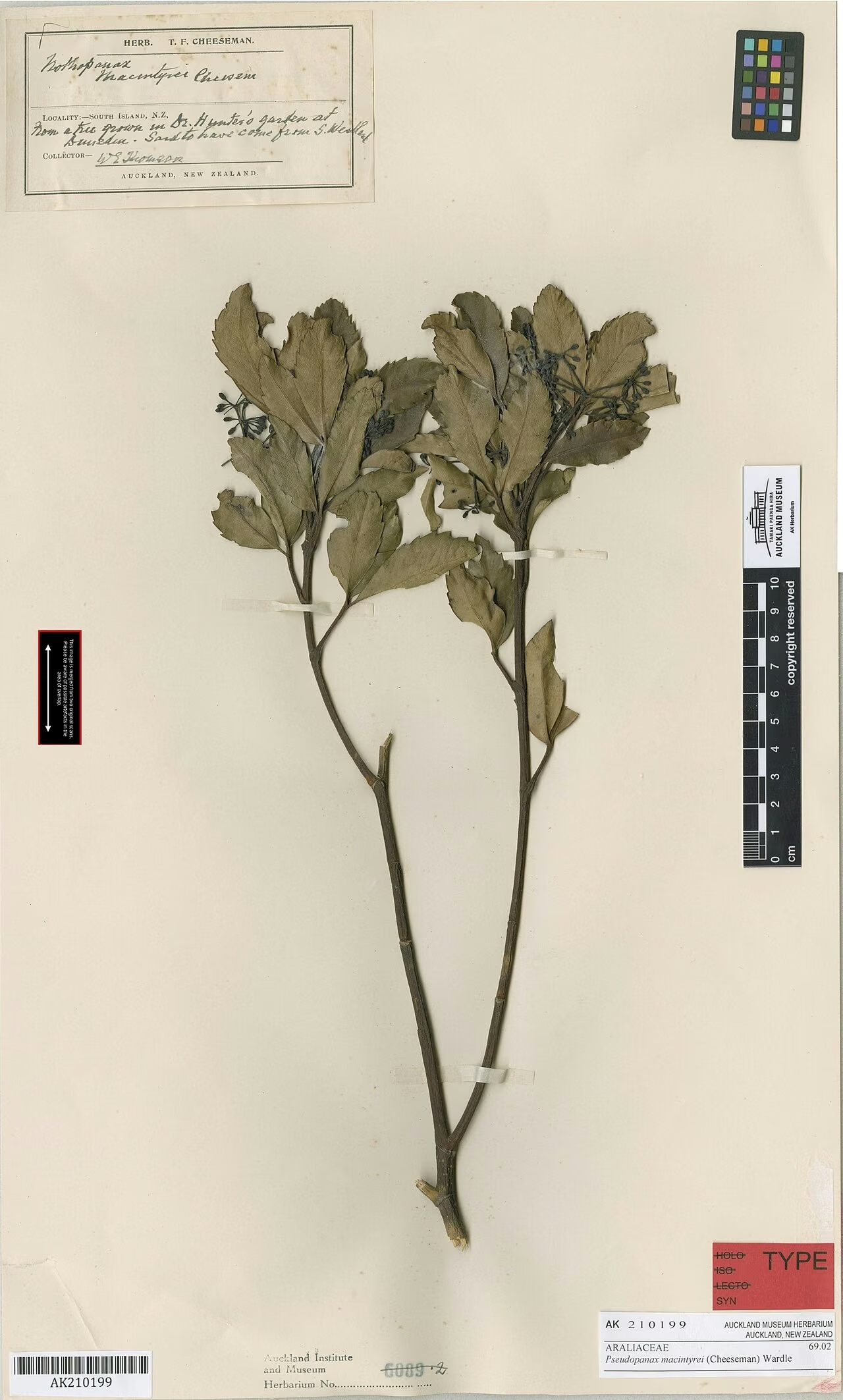
MacIntyre's Panax
Pseudopanax macintyrei
Last updated:
MacIntyre's panax (Pseudopanax macintyrei) is a shrub or small tree up to about 5 m tall with a broad, spreading crown, endemic to the north-west of the South Island. It is a lime lover, growing only on limestone, marble and dolomitic marble outcrops from north-west Nelson to just north of Greymouth. Its leaves have three to five narrow, dull dark green, sharply serrated leaflets, and male and female flowers are on separate plants. It is ranked At Risk - Naturally Uncommon because it is naturally localised, although no decline has been documented. It grows easily in gardens given lime-enriched, moist soil. Explore more native shrubs in our native plant guide.
Plant Description
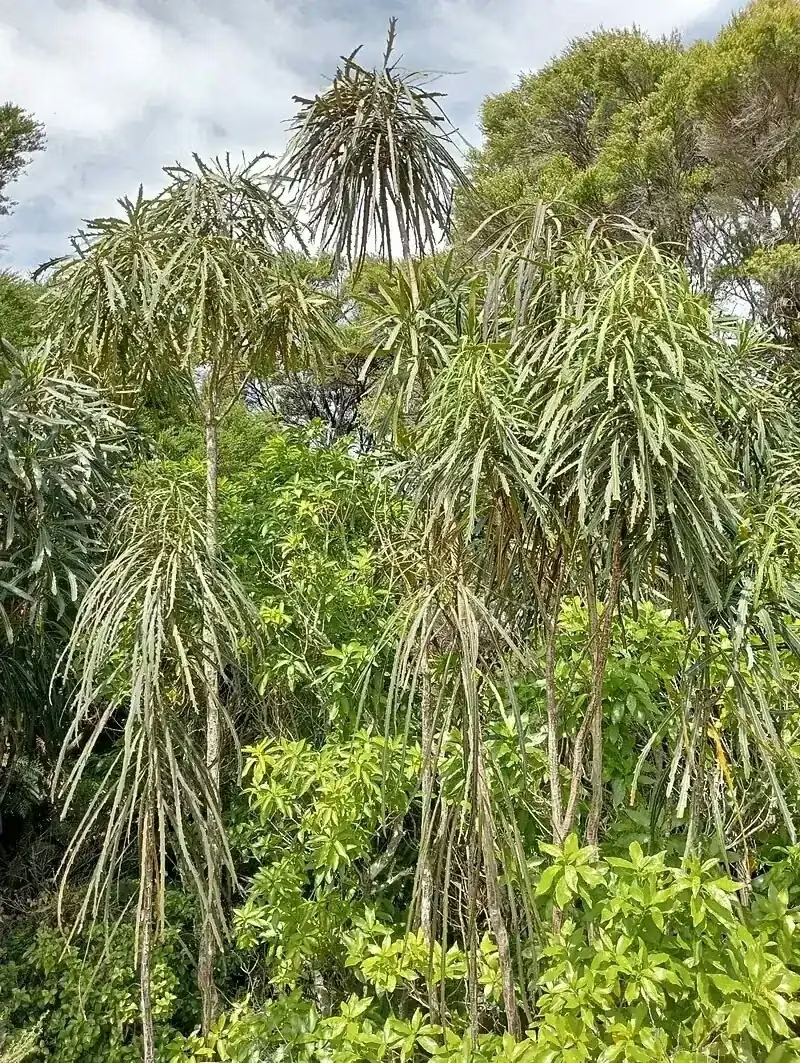
Pseudopanax macintyrei is a dioecious shrub or small tree to about 5 m tall with a broad, spreading crown. The leaves sit on stout petioles 20 to 100 mm long and are divided into 3 to 5 leaflets, each 30 to 80 mm long and 15 to 25 mm wide, dull dark green and sharply serrated along the margins.
Flowers are produced in compound umbels that are effectively unisexual, coloured dark green to brownish green. Female plants bear fruits that become purple-black when ripe.
It most resembles five finger (Pseudopanax arboreus) and three finger (P. colensoi var. ternatus). It differs in being restricted to calcareous rock, in its smaller stature, in its narrower, consistently dark green and deeply serrated leaflets, and in having fewer and more slender terminal umbels.
Quick Facts
| Scientific Name | Pseudopanax macintyrei |
|---|---|
| Height | Up to 5 m |
| Spread | 2-4 m; broad, spreading crown |
| Water Needs | Moderate to high; permanently moist but well drained |
| Light | Full sun to light shade |
| Frost Tolerance | Moderate; grows to montane elevations |
| Salt Tolerance | No information available |
| Growth Rate | Moderate |
| Lifespan | Long-lived perennial |
Climate Best Suited to
Suits the mild, wet climate of the West Coast and north-west Nelson, from coastal to montane elevations. It is reasonably hardy in most New Zealand gardens with adequate moisture.
Regional Suitability
| City | Climate Suitability |
|---|---|
| Auckland | Medium |
| Wellington | High |
| Christchurch | Medium |
| Dunedin | Medium |
Plant Habitat
MacIntyre's panax is endemic to the South Island, ranging from north-west Nelson south to just north of Greymouth. NZPCN notes that its distribution may not be fully known, so further populations may yet be found.
It grows in coastal to montane shrubland and low, often successional forest that overlies limestone, marble or dolomitic marble outcrops. Its strict restriction to these calcareous rocks is the main reason it is so localised.
Growing Requirements
Soil Requirements
It is a calcicole, growing on soils derived from limestone and marble. NZPCN recommends a permanently moist, well-draining fertile soil enriched with lime.
- Add garden lime or limestone chips to acidic soils
- Fertile, free-draining loam
- Keep consistently moist
Light Requirements
NZPCN advises full sun in cultivation, matching its natural shrubland and forest-margin habitat on open rock outcrops.
- Full sun is best
- Tolerates light shade from neighbouring shrubs
Water Requirements
It prefers soil that stays moist all year, reflecting the high rainfall of its West Coast and Nelson range.
- Water during dry periods, especially in eastern districts
- Mulch to keep the root zone cool and moist
Planting and Establishing
Plant in autumn or spring in a sunny position. Mix lime or crushed limestone into the planting hole if your soil is acidic, and add compost to improve fertility and moisture holding.
It works well near limestone rock features or on a lime-rich bank. Because it is dioecious, plant several to have both male and female plants if you want fruit.
Ecological Role
MacIntyre's panax is a component of the distinctive vegetation of north-west South Island limestone and marble country, a habitat known for its specialised and often local plant species.
Its fleshy purple-black fruits are likely eaten by native birds, as in other Pseudopanax, though specific dispersers are not documented in the sources consulted. Winter flowering from June to September provides a food source for insects at a time of year when few other plants are in flower.
Uses & Significance
Garden Uses
It is a tidy, hardy small tree for gardens with limestone soils or where lime can be added.
- Limestone and rock gardens
- Specimen shrub with dark, finely toothed foliage
- Native plant collections featuring South Island endemics
Ecological Value
It is a characteristic endemic of the calcareous outcrops of north-west Nelson and the northern West Coast.
- Restricted to limestone and marble habitats
- Winter flowers available to insects
- Fruit available to birds over a long season
Landscaping Uses
The dark, narrow, toothed leaflets give a finer texture than most five fingers, so it suits small gardens where a full-sized Pseudopanax arboreus would be too coarse. Its spreading crown makes a good backdrop for smaller limestone plants.
Pair it with pale limestone rock, which sets off the dark foliage, and with other lime-tolerant native shrubs and rock plants.
Seasonal Care Calendar
Spring
New growth begins and the last of the winter flowers fade, while fruit from winter flowers develops.
- Plant new shrubs
- Apply lime if soil is acidic
Summer
Fruit continues to ripen to purple-black through summer.
- Keep well watered
- Collect fresh fruit for sowing
Autumn
The last fruits ripen by March, and growth slows.
- Take semi-hardwood cuttings
- Top up mulch
Winter
Flowering takes place from June to September, an unusual time for the genus.
- Look for dark green flower clusters
- Little care required
When to Prune and How Much
Pruning is seldom needed. Lightly shape young plants after fruiting to encourage a balanced spreading crown.
Remove any dead or damaged wood as needed, cutting back to a healthy shoot.
How to Grow MacIntyre's Panax
NZPCN describes Pseudopanax macintyrei as easily grown from fresh seed and from semi-hardwood cuttings. Being dioecious, only female plants produce fruit, and seed will be viable only where a male plant is nearby. Because the species is naturally uncommon and confined to limestone and marble sites, wild collection should be limited and done only with permission from the landowner or the Department of Conservation where sites lie on conservation land. Seedlings and cuttings should be grown on in a potting mix with added lime to suit this calcicole.
From Seed
The fruit ripens purple-black between August and March. Sow seed fresh for the best germination.
Seed from an isolated female tree with no male nearby is unlikely to germinate, so check that the fruit contains well-formed seeds before sowing.
- Collect ripe purple-black fruit from a female plant
- Remove the flesh and rinse the seed
- Sow fresh on a free-draining mix with a little added lime
- Keep moist in a sheltered, bright spot
- Pot on seedlings into a fertile, lime-enriched mix
From Cuttings
Semi-hardwood cuttings root readily. Cuttings let you choose male or female plants of known sex.
Taking cuttings from both sexes means a home garden can have a fruiting pair within a few years.
- Take 10-15 cm semi-hardwood cuttings in late summer or autumn
- Strip the lower leaves and trim the remaining leaflets
- Dip in rooting hormone and insert into propagating mix
- Keep humid and shaded until roots develop
- Label each cutting with the sex of the parent plant
Pests & Diseases
No specific pests or diseases of this species are recorded in the sources consulted. Scale insects and sooty mould can occur on sheltered garden plants.
In the wild, no specific threats or range decline have been documented for this species, though NZPCN notes its full distribution may not yet be known.
Cultural Significance
No Māori name or traditional use specific to Pseudopanax macintyrei is recorded in the sources consulted.
It was first described by Thomas Cheeseman as Nothopanax macintyrei, later placed in Neopanax by Wardle and transferred to Pseudopanax by David Frodin. The person honoured by the epithet macintyrei was not identified in the sources consulted.
Bonus Tip
If your garden soil is acidic, plant this species next to a limestone rock or concrete path edge, or bury a handful of limestone chips around the roots. That small lime boost recreates the calcareous conditions it relies on in the wild.
Related Plants
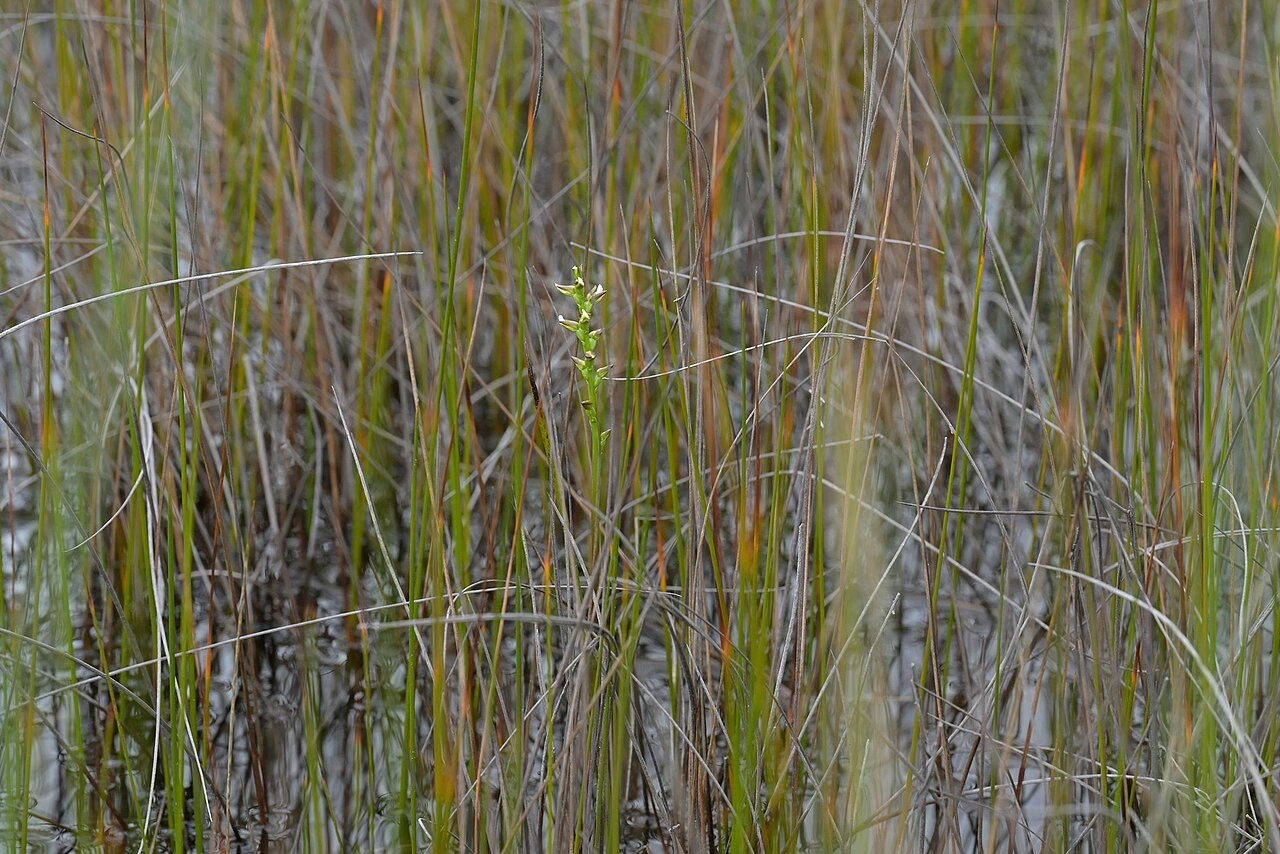
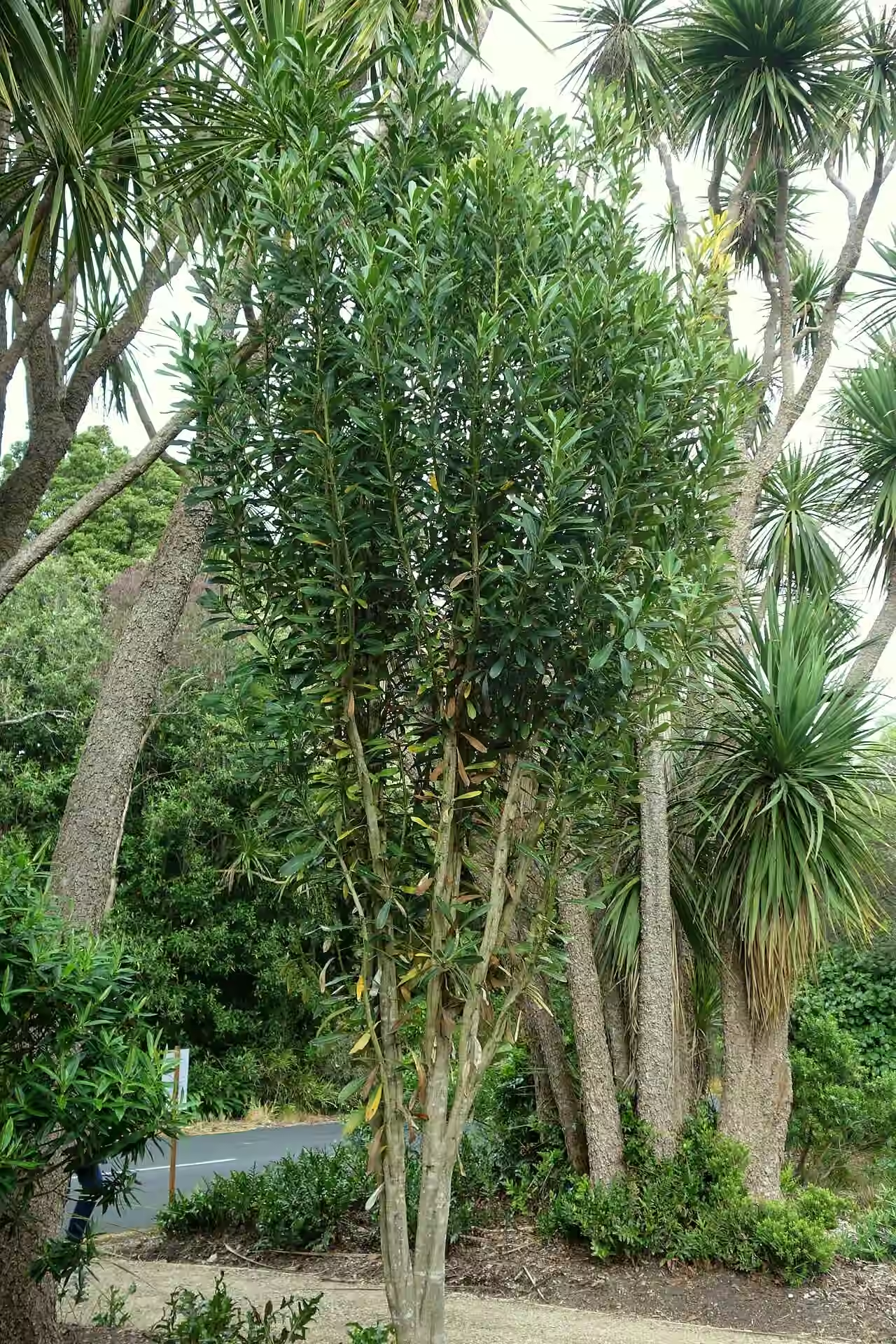
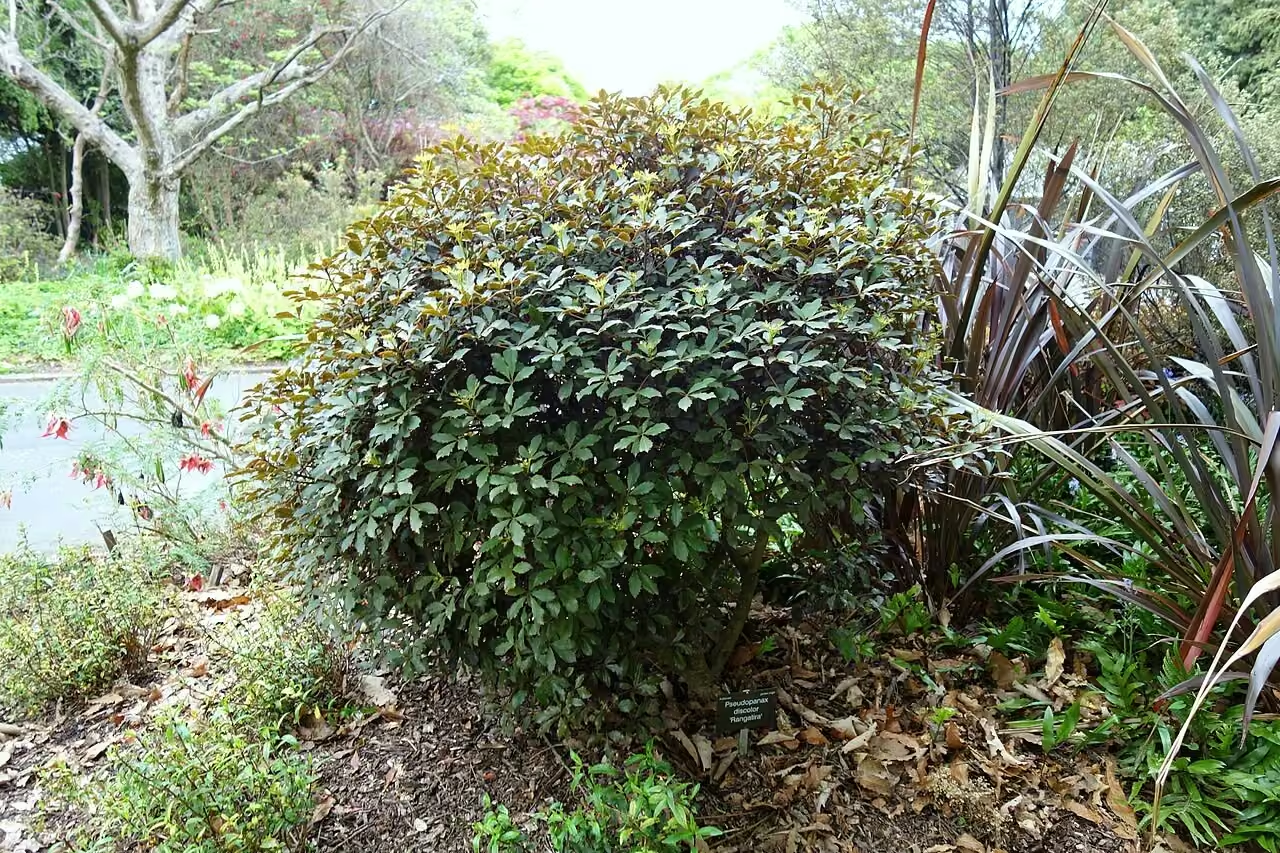
Explore other native plants that share similar characteristics or habitats with MacIntyre's Panax (Pseudopanax macintyrei), offering further insights into New Zealand's diverse flora. These related species provide context and opportunities for complementary planting in your garden.
Plant Conservation
Pseudopanax macintyrei is ranked At Risk - Naturally Uncommon (2023) with the qualifiers Sp (sparse), DPS (data poor: size), DPT (data poor: trend) and RR (range restricted). NZPCN describes it as naturally rather localised, with no documented decline in range.
Protecting the limestone and marble country of north-west Nelson and the West Coast, and recording new sightings to clarify its distribution, are the most helpful actions.
Frequently Asked Questions
Where does Pseudopanax macintyrei grow?
It is endemic to the South Island, from north-west Nelson to just north of Greymouth, always on limestone, marble or dolomitic marble outcrops in coastal to montane shrubland and low forest.
How do you identify MacIntyre's panax?
Look for a small shrubby tree on calcareous rock with 3 to 5 narrow, dull dark green, deeply serrated leaflets and fewer, more slender umbels than five finger or Pseudopanax colensoi var. ternatus.
Does MacIntyre's panax need lime?
Its natural habitat is limestone and marble, and NZPCN recommends a permanently moist, well-drained fertile soil enriched with lime when growing it.
When does Pseudopanax macintyrei flower?
It flowers in winter, from June to September, unusually early for a Pseudopanax, with purple-black fruit ripening between August and March.
Sources and Further Reading
The botanical, growing, and conservation details for MacIntyre's Panax (Pseudopanax macintyrei) on this page draw on the New Zealand plant references below. Consult them for full technical records and the latest distribution data.