Kermadec Nettle-Tree
Pouzolzia australis
Last updated:
Kermadec nettle-tree (Pouzolzia australis) is a soft-wooded shrub or small tree in the nettle family that grows up to about 8 m tall. Its toothed, pointed leaves are dark above and densely white-haired beneath, so the canopy flashes silver in the wind. In New Zealand it is found only on Raoul and Macauley Islands in the Kermadecs, although it also grows on Norfolk and Lord Howe Islands. Goats once reduced it to near extinction on Raoul, and it was not seen on Macauley for over a century until it was rediscovered in 2011. It is ranked Threatened - Nationally Endangered. Unlike its relatives it has no stinging hairs. Explore more native shrubs in our native plant guide.
Plant Description
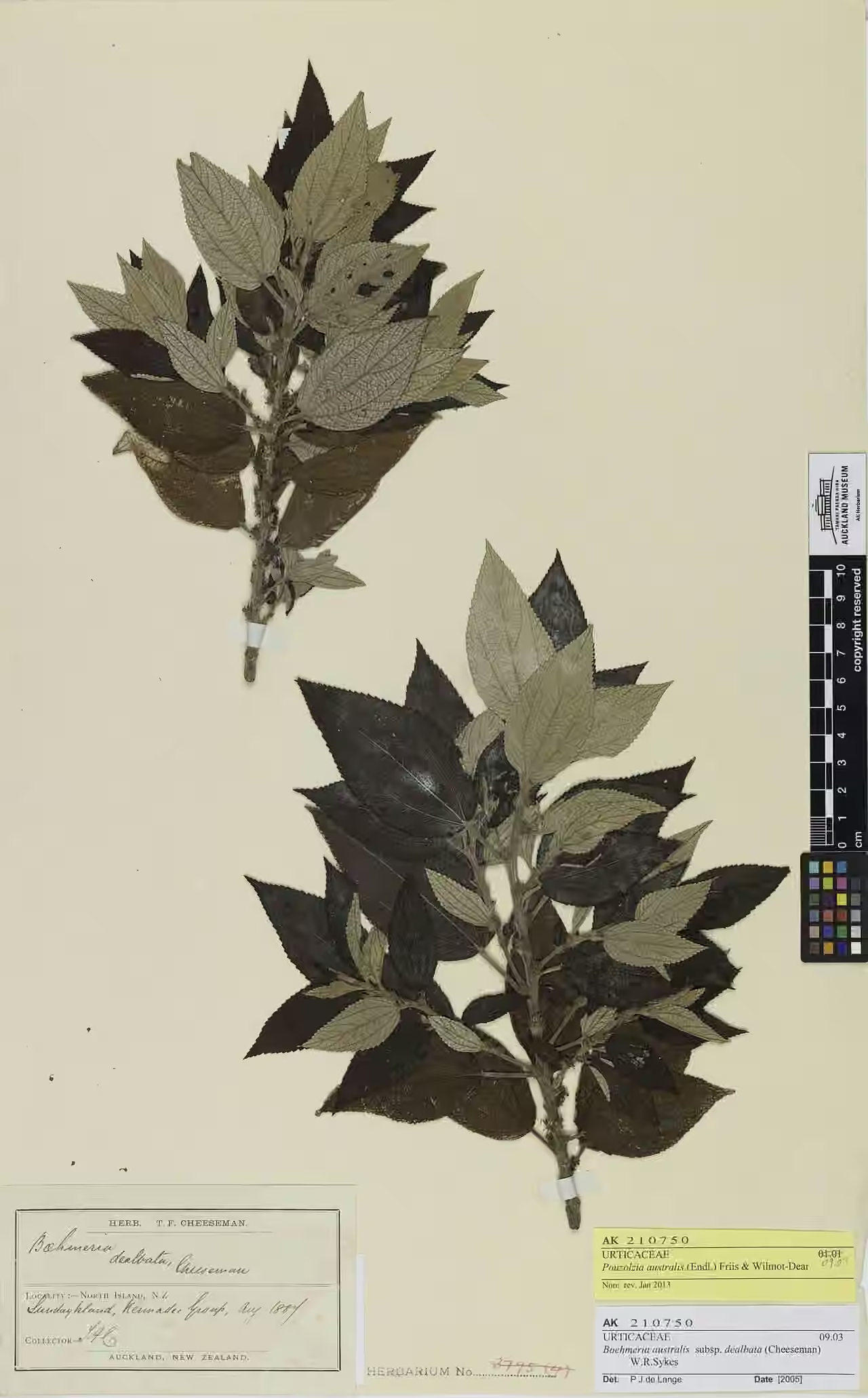
Pouzolzia australis is a shrub or small tree from 1 to about 8 m tall with soft, pithy wood. Its alternate leaves are triangular to ovate with a drawn-out pointed tip, 7 to 15 cm long, and have evenly toothed margins. The upper surface is slightly rough to almost smooth, while the underside is covered in dense white hairs that give it a strongly whitish look, crossed by prominent yellow-green midribs and veins.
The tiny brown and white flowers sit in small rounded clusters in the leaf axils, with each cluster containing male or female flowers. The fruits are small and flattened with winged margins. Plants flower and fruit throughout the year and produce abundant viable seed.
No other native plant in the New Zealand region closely resembles it. The combination of soft wood, toothed pointed leaves with white undersides and clustered axillary flowers is distinctive on Raoul Island. Norfolk Island plants tend to have broader leaves and larger flower clusters than those from Lord Howe Island.
Quick Facts
| Scientific Name | Pouzolzia australis |
|---|---|
| Height | 1-8 m |
| Spread | 1-3 m |
| Water Needs | Moderate; prefers moist but well-drained soil |
| Light | Full sun to light shade |
| Frost Tolerance | Very low; very cold sensitive |
| Salt Tolerance | Moderate; grows in coastal forest and on sea cliffs |
| Growth Rate | Fast |
| Lifespan | Perennial; a relatively short-lived woody plant |
Climate Best Suited to
Suits a warm, humid, frost-free subtropical oceanic climate like that of the Kermadec Islands. Outside that it needs a sheltered, frost-free spot in the far north.
Regional Suitability
| City | Climate Suitability |
|---|---|
| Auckland | Medium |
| Wellington | Low |
| Christchurch | Low |
| Dunedin | Low |
Plant Habitat
In the New Zealand region Pouzolzia australis is confined to the Kermadec Islands, where it occurs on Raoul Island and on Macauley Island. On Raoul it is now very localised on open ridgeline forest, slip scars and valley heads. Beyond New Zealand it grows on Norfolk Island, where only about 33 mature plants were known in 2003, and on Lord Howe Island, where it is locally abundant in moist forest in the south of the island.
Its habitats are coastal forest, cliff faces, recent and semi-stable slips and low scrub. It behaves as a pioneer of disturbed ground, colonising fresh slips and openings rather than growing under a closed canopy.
Growing Requirements
Soil Requirements
In the wild it grows on volcanic soils of slips, cliffs and forest margins. In cultivation it is undemanding as long as drainage is reasonable.
- Free-draining loam or volcanic soil
- Moderate fertility; responds well to compost
- Tolerates fresh, unstable ground such as slip faces
Light Requirements
As a coloniser of slips and open ridges it prefers good light, though it will grow at forest margins in partial shade.
- Full sun to light shade
- Grows poorly under a dense canopy
Water Requirements
The Kermadecs are warm and humid with regular rain, so the plant prefers steady moisture without waterlogging.
- Water young plants regularly in summer
- Avoid poorly drained, waterlogged sites
Planting and Establishing
Plant in spring once any risk of cold weather has passed, choosing a warm, sheltered, frost-free position. Prepare a wide hole in free-draining soil, add some compost and water in well.
Because NZPCN describes it as very cold sensitive, gardeners outside warm northern coastal areas should grow it in a large container that can be moved under cover in winter. Source plants only from specialist native nurseries; never collect from the Kermadec Islands, which are a nature reserve.
Ecological Role
Pouzolzia australis is an early coloniser of slips, cliffs and forest gaps on Raoul Island, helping to cover bare ground before slower trees establish. It produces abundant viable seed all year, and NZPCN notes that seedlings often appear spontaneously around established plants in cultivation.
Its decline on Raoul after goats were removed has been linked to competition from invasive weeds rather than browsing, showing how vulnerable a pioneer shrub is when weeds occupy the open ground it needs. Specific pollinators and seed dispersers are not documented in the sources consulted; many members of the nettle family are wind pollinated.
Uses & Significance
Garden Uses
In frost-free gardens it makes a quick-growing foliage shrub prized for the silvery undersides of its leaves.
- Specimen shrub in warm coastal gardens
- Large container plant that can be moved under cover
- Conservation and botanic garden collections of Kermadec flora
Ecological Value
It is one of the rarest woody plants in the New Zealand flora and a characteristic pioneer of disturbed sites on Raoul Island.
- Nationally Endangered and confined to two Kermadec islands
- Colonises slips and cliffs, helping to stabilise bare ground
- Cultivated stock is an insurance population for a species once thought lost from Macauley
Landscaping Uses
Use it where its white-backed foliage can be seen from below or move in the wind, such as on a bank or at the edge of a sheltered courtyard. It contrasts well with dark glossy foliage such as karaka or Kermadec pōhutukawa in a subtropical-themed planting.
Because it is soft-wooded and fast-growing, treat it as a filler or feature shrub that may need replacing over time, rather than a long-term structural tree.
Seasonal Care Calendar
Spring
Growth accelerates as temperatures rise, and this is the best time to plant and to take cuttings.
- Plant out after the last cold snap
- Take cuttings from new growth
Summer
Plants keep growing quickly and continue flowering, as they do year round.
- Water young plants in dry spells
- Collect fresh seed for sowing
Autumn
Flowers and fruit are still produced, and self-sown seedlings may appear near established plants.
- Pot up volunteer seedlings
- Lightly trim to shape if needed
Winter
This is the risky season, since the plant is very cold sensitive.
- Move potted plants under cover
- Protect garden plants from frost with cloth
When to Prune and How Much
Light pruning in late spring or summer keeps the plant bushy, and leggy stems can be shortened by up to a third. The soft wood regrows readily in warm weather.
Avoid hard pruning going into winter, as fresh growth is especially sensitive to cold.
How to Grow Kermadec Nettle-Tree
NZPCN describes Pouzolzia australis as very easily grown from fresh seed and cuttings, and established plants produce so much viable seed that seedlings often appear on their own beneath them. This ease of propagation is the main reason cultivated stock exists at all for such a rare plant, so growers holding it can play a real part in its conservation by keeping several plants of known origin. Never collect material from the Kermadec Islands Nature Reserve without permits; obtain plants or seed from specialist native nurseries or established cultivated specimens.
From Seed
Flowering and fruiting take place throughout the year, so fresh seed can be gathered from female plants in most months. Fresh seed germinates readily without pretreatment in warm conditions.
- Collect ripe fruiting clusters from cultivated plants
- Sow the small seed on the surface of a fine seed-raising mix and barely cover
- Keep warm, moist and in bright light without direct midday sun
- Prick out seedlings once they have two true leaves
- Grow on in a frost-free place before planting out
From Cuttings
Cuttings strike easily because of the soft wood. Take them in spring or summer when the plant is in active growth.
- Cut 10-15 cm lengths from healthy, firm new shoots
- Remove the lower leaves and halve large upper leaves to reduce moisture loss
- Insert into a free-draining mix of pumice and peat or bark
- Keep humid and warm, out of direct sun, until rooted
- Pot on when roots appear at the drainage holes
Pests & Diseases
No specific pests are recorded for this species in the sources consulted. In cultivation the main risk is cold damage; soft, frosted growth often then rots.
In the wild the historic threat was browsing by feral goats on Raoul Island, which have since been eradicated. Today the main pressure on Raoul appears to be competition from invasive weeds, and Norfolk Island populations are also under serious threat.
Cultural Significance
No traditional Māori name or use is recorded for Pouzolzia australis in the sources consulted. The Kermadec Islands lie far from mainland New Zealand and have no well-documented history of plant use.
The species epithet australis means southern. The plant was long known to New Zealand botanists as Boehmeria dealbata, named by Thomas Cheeseman, before the Norfolk, Lord Howe and Kermadec plants were united as Pouzolzia australis in 2006.
Bonus Tip
If you grow this plant, keep at least one young back-up in a pot under cover each winter. It is fast and easy to raise, so a single cold night is the main way to lose it, and a spare cutting rooted in late summer is cheap insurance.
Related Plants
Explore other native plants that share similar characteristics or habitats with Kermadec Nettle-Tree (Pouzolzia australis), offering further insights into New Zealand's diverse flora. These related species provide context and opportunities for complementary planting in your garden.
Pomaderris edgerleyi
Pomaderris edgerleyi
Small Poranthera
Poranthera microphylla
Mud Pondweed
Potamogeton suboblongus
Argentina anserinoides
Argentina anserinoides
Prasophyllum colensoi
Prasophyllum colensoi
Swamp Leek Orchid
Prasophyllum hectorii
Chatham Island Lancewood
Pseudopanax chathamicus
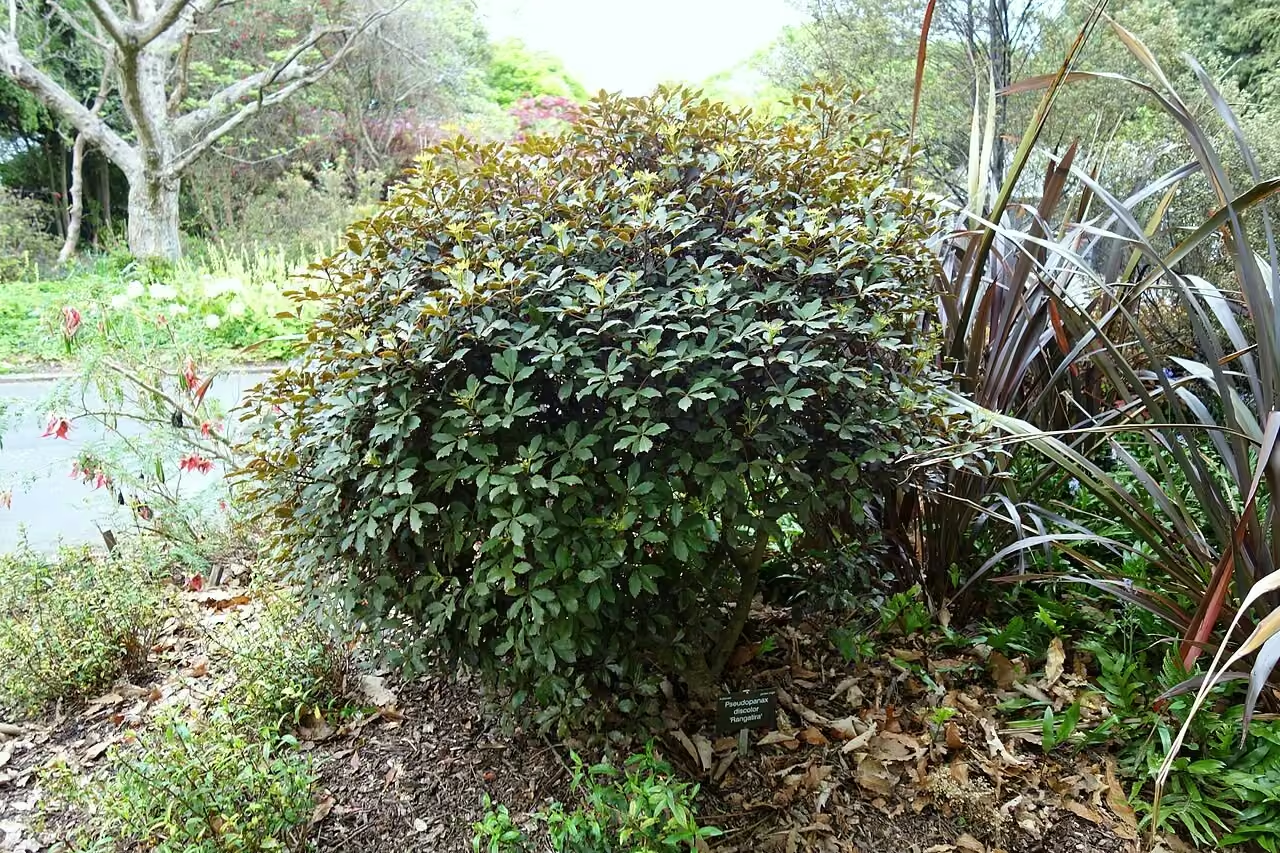
Pseudopanax discolor
Pseudopanax discolor
Plant Conservation
Pouzolzia australis is ranked Threatened - Nationally Endangered (2023) with the qualifiers Range Restricted and Threatened Overseas. Goat browsing nearly eliminated it on Raoul Island, and it did not recover after goats were removed, becoming scarce and very localised, possibly because of weed competition. It was presumed extinct on Macauley Island for more than a century until it was rediscovered there in 2011.
The Kermadec Islands are a nature reserve, and ongoing weed control on Raoul Island is the main help for wild plants. Cultivated plants of known Kermadec origin act as an insurance population.
Frequently Asked Questions
Where does Pouzolzia australis grow in New Zealand?
Only on the Kermadec Islands, on Raoul Island and Macauley Island. Outside New Zealand it also grows on Norfolk Island and Lord Howe Island.
Does the Kermadec nettle-tree sting?
No. Although it belongs to the nettle family Urticaceae, it has soft hairs rather than stinging hairs, and the white felt under the leaves is harmless.
What was Pouzolzia australis called before?
It was previously known as Boehmeria dealbata and later as Boehmeria australis subsp. dealbata. The island populations were combined under Pouzolzia australis in 2006.
Can I grow Kermadec nettle-tree in my garden?
Yes, in a frost-free garden. NZPCN notes it grows very easily from fresh seed and cuttings but is very cold sensitive, so it suits only warm northern coastal areas.
Sources and Further Reading
The botanical, growing, and conservation details for Kermadec Nettle-Tree (Pouzolzia australis) on this page draw on the New Zealand plant references below. Consult them for full technical records and the latest distribution data.