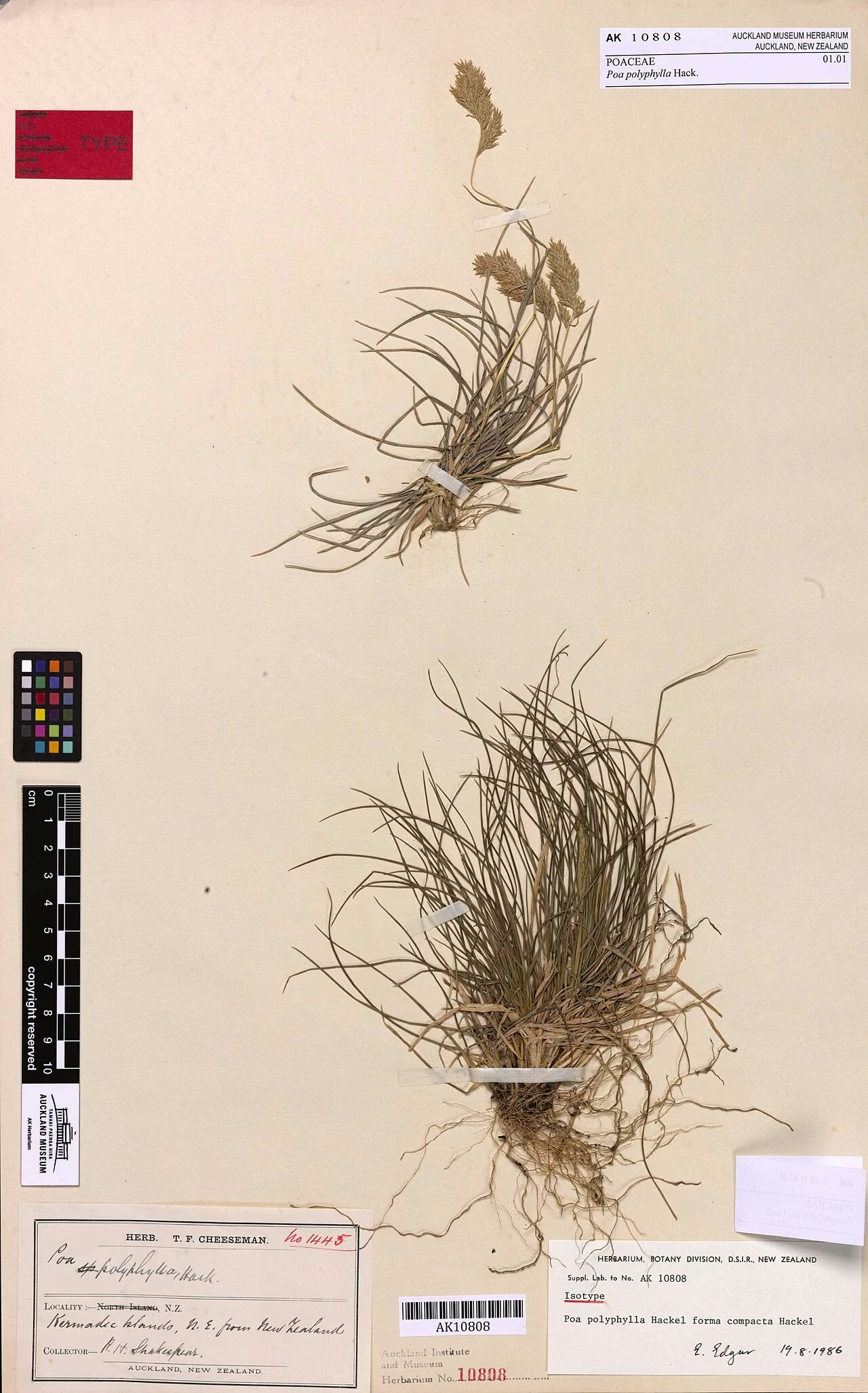
Kermadec Islands Poa
Poa polyphylla
Last updated:
Kermadec Islands poa (Poa polyphylla) is a loosely tufted, creeping grass found naturally only on Raoul and Macauley Islands in the subtropical Kermadec group. It spreads from thick stolons, with trailing stems up to 0.8 m long and dull green, drooping leaves. On Raoul Island it is abundant on coastal cliffs, around seepages, in exposed ground near petrel burrows and even on roadside banks. It is ranked At Risk - Naturally Uncommon because it is confined to these remote islands. NZPCN describes it as easily grown from seed or division and an attractive small grass for wet or dry sites in sun or semi-shade. Explore more native grasses and flaxes in our native plant guide.
Plant Description
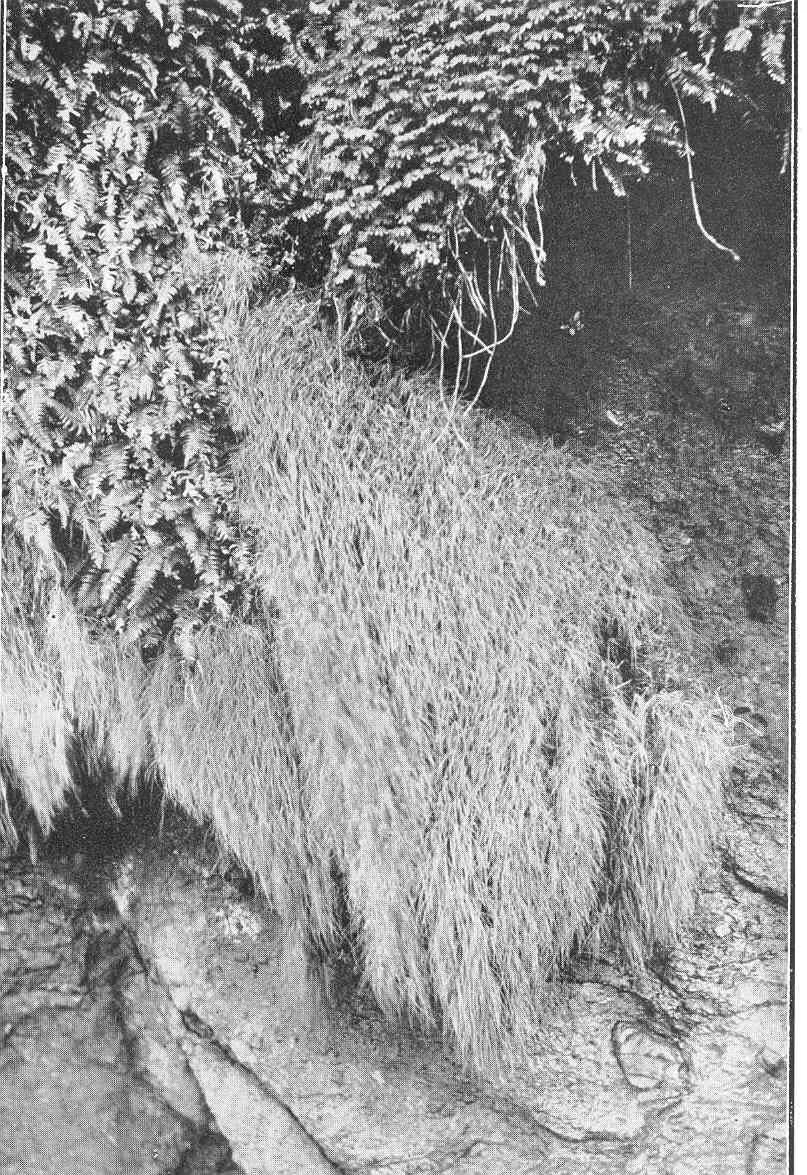
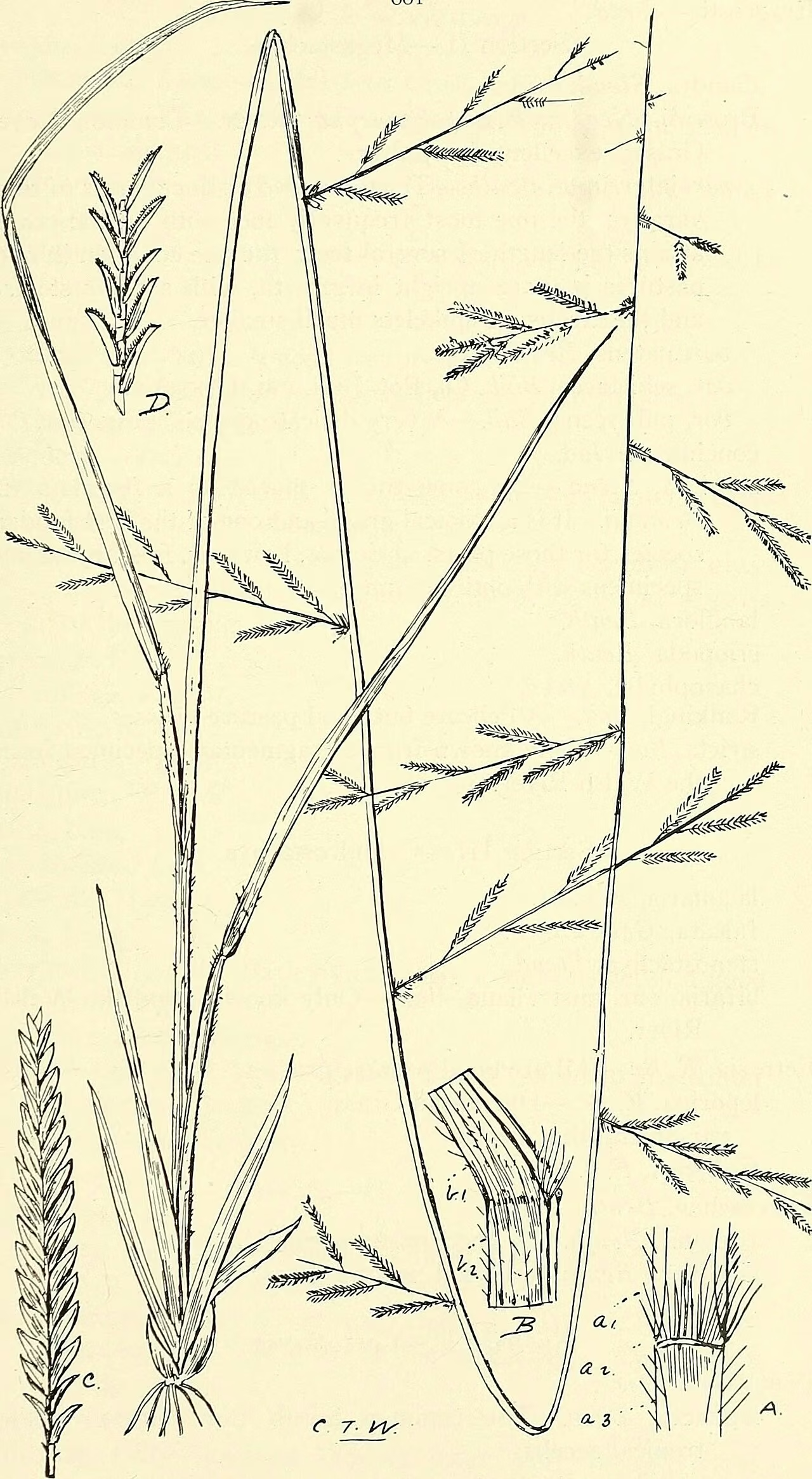
Poa polyphylla is a loosely tufted perennial that creeps widely from thick stolons. Its trailing flowering stems can reach 0.8 m in length and, together with the drooping leaves, give the plant a soft, cascading look on banks and cliffs. The whole plant is a dull green.
The leaf sheaths are light green to brown, tough and leathery in texture, and hairless. The leaf blades are 65 to 200 mm long and 1 to 2.5 mm wide, with distinct ribs. The flower head is a contracted, oblong panicle carrying spikelets 4.5 to 5.5 mm long, each with three or four florets.
Its closest relative is Poa anceps of mainland New Zealand. Kermadec Islands poa is smaller overall, has glabrous leaf sheaths and spikelets of different size, and is isolated geographically. As it is the only poa naturally found on the Kermadecs, location alone identifies wild plants.
Quick Facts
| Scientific Name | Poa polyphylla |
|---|---|
| Height | Low tufts; trailing stems to 0.8 m long |
| Spread | Creeps by thick stolons, forming loose patches |
| Water Needs | Adaptable; tolerates wet or dry sites |
| Light | Full sun to semi-shade |
| Frost Tolerance | Not recorded; from a frost-free subtropical climate, so protect from hard frost |
| Salt Tolerance | Good; grows on exposed coastal cliffs |
| Growth Rate | Moderate to fast |
| Lifespan | Perennial |
Climate Best Suited to
Comes from a warm, humid, subtropical oceanic climate with no real winter frost. It suits frost-free northern and coastal gardens best.
Regional Suitability
| City | Climate Suitability |
|---|---|
| Auckland | High |
| Wellington | Medium |
| Christchurch | Low |
| Dunedin | Low |
Plant Habitat
Kermadec Islands poa is endemic to Raoul Island (Rangitahua) and Macauley Island in the Kermadec Islands, New Zealand's northernmost territory. Herbarium specimens from Raoul Island have been collected since at least 1908, including from the Terraces and deep boulder ravines.
It grows on coastal cliffs, near seepages and on exposed ground near petrel burrows, where seabird activity enriches the soil. On Raoul Island it has also colonised roadside banks, showing that it copes well with disturbance.
Growing Requirements
Soil Requirements
In the wild it grows on volcanic soils, cliff ledges and bird-enriched ground, often near seepage water.
- Most garden soils with reasonable drainage
- Tolerates both damp seepage-type sites and drier banks
- Benefits from moderate fertility
Light Requirements
NZPCN notes it does well in full sun or semi-shade.
- Full sun on exposed banks
- Semi-shade under open shrubs or on south-facing slopes
Water Requirements
Its wild habitats range from seepages to exposed cliff faces, and it is recommended for wet or dry sites.
- Water during establishment
- Once established it tolerates short dry periods
Planting and Establishing
Plant in spring once the risk of frost has passed, especially in southern or inland districts. It looks best where its trailing stems can spill over a bank, wall or pot edge.
Space plants about 40 to 50 cm apart for a loose groundcover, as they will spread by stolons. In colder areas, plant against a warm wall or grow in a container that can be moved under cover in winter.
Ecological Role
Like other grasses it is wind-pollinated. It flowers from September to January and fruits from November to May.
Its association with petrel burrows reflects the importance of seabird colonies on the Kermadecs: guano and soil disturbance create the open, fertile ground it favours. On cliffs and banks its stolons help bind loose volcanic soil.
Uses & Significance
Garden Uses
NZPCN calls it a very attractive small grass, useful wherever a soft, trailing native grass is wanted.
- Spilling over walls, banks and containers
- Coastal gardens in frost-free areas
- Collections of island endemic plants
Ecological Value
As a range-restricted endemic it is a distinctive part of the Kermadec Islands flora.
- Stabilises cliff and bank soils on Raoul Island
- Part of seabird colony vegetation
- Cultivated plants act as an insurance population for the species
Landscaping Uses
Use it as a soft, flowing edging at the top of a retaining wall or along a raised bed, where the long stems can trail downward. It also works in large pots on a sheltered deck.
Combine it with other Kermadec or northern coastal natives that like similar frost-free conditions to create a themed island planting.
Seasonal Care Calendar
Spring
Flowering begins in September and new stolons extend.
- Plant or divide now
- Feed lightly if growth is poor
Summer
Flowering continues into January and seed starts ripening from November.
- Water container plants regularly
- Collect seed as panicles dry
Autumn
Fruiting continues until about May.
- Sow fresh seed
- Trim spent stems if untidy
Winter
Growth slows; in colder gardens the plant is at risk from frost.
- Protect from frost with cloth or move pots under cover
- Avoid waterlogged soil
When to Prune and How Much
Trim back old flowering stems after seed fall to keep plants neat. If the clump becomes straggly or brown in the centre, cut it back by about half in spring to encourage fresh growth.
Stray stolons can be cut off where they wander beyond their space, and rooted pieces potted up as new plants.
How to Grow Kermadec Islands Poa
Kermadec Islands poa is one of the easier New Zealand island grasses to propagate. NZPCN states that it is easily grown from fresh seed and by division of established plants. Because the wild population is confined to two small islands within a nature reserve, material should come from plants already in cultivation rather than from the islands, where collecting requires permits. Spring is the best time for division, and seed is best sown as soon as it is ripe, between November and May.
From Seed
Fresh seed germinates readily. Sow it soon after collection, as seed viability in many grasses declines with storage.
- Collect panicles once the spikelets dry and the seed falls freely
- Sow thinly on a free-draining seed raising mix and cover lightly
- Keep in a warm, bright, sheltered place and water so the mix stays just moist
- Prick out seedlings into individual pots once they are large enough to handle
- Plant out after a season of growth, or keep in pots under cover in cold districts
By Division
The thick stolons root as they creep, so established plants are easy to split into many rooted pieces. Each rooted piece can become a new plant within a season.
- In spring, lift a clump or sever rooted stolons from the parent
- Separate pieces with roots and a few shoots
- Pot into a general potting mix and water well
- Keep sheltered until new leaves grow, then plant out
Pests & Diseases
No particular pests or diseases are recorded for this grass. In cultivation, frost damage in cold districts and rotting in poorly drained, cold soils are the more likely problems.
On Raoul Island, introduced weeds have been a major conservation issue for the native flora generally, and an extensive weed control programme has operated there.
Cultural Significance
No Māori name or traditional use for Poa polyphylla is recorded in the sources consulted. The Kermadec Islands are known in Māori as Rangitahua, and Raoul Island holds archaeological evidence of early Polynesian occupation.
The epithet polyphylla means 'many-leaved', describing its leafy growth.
Bonus Tip
Try it in a hanging basket or tall pot in Auckland or Northland gardens. Its trailing stems up to 0.8 m long cascade over the edge, giving a native alternative to exotic trailing grasses.
Related Plants
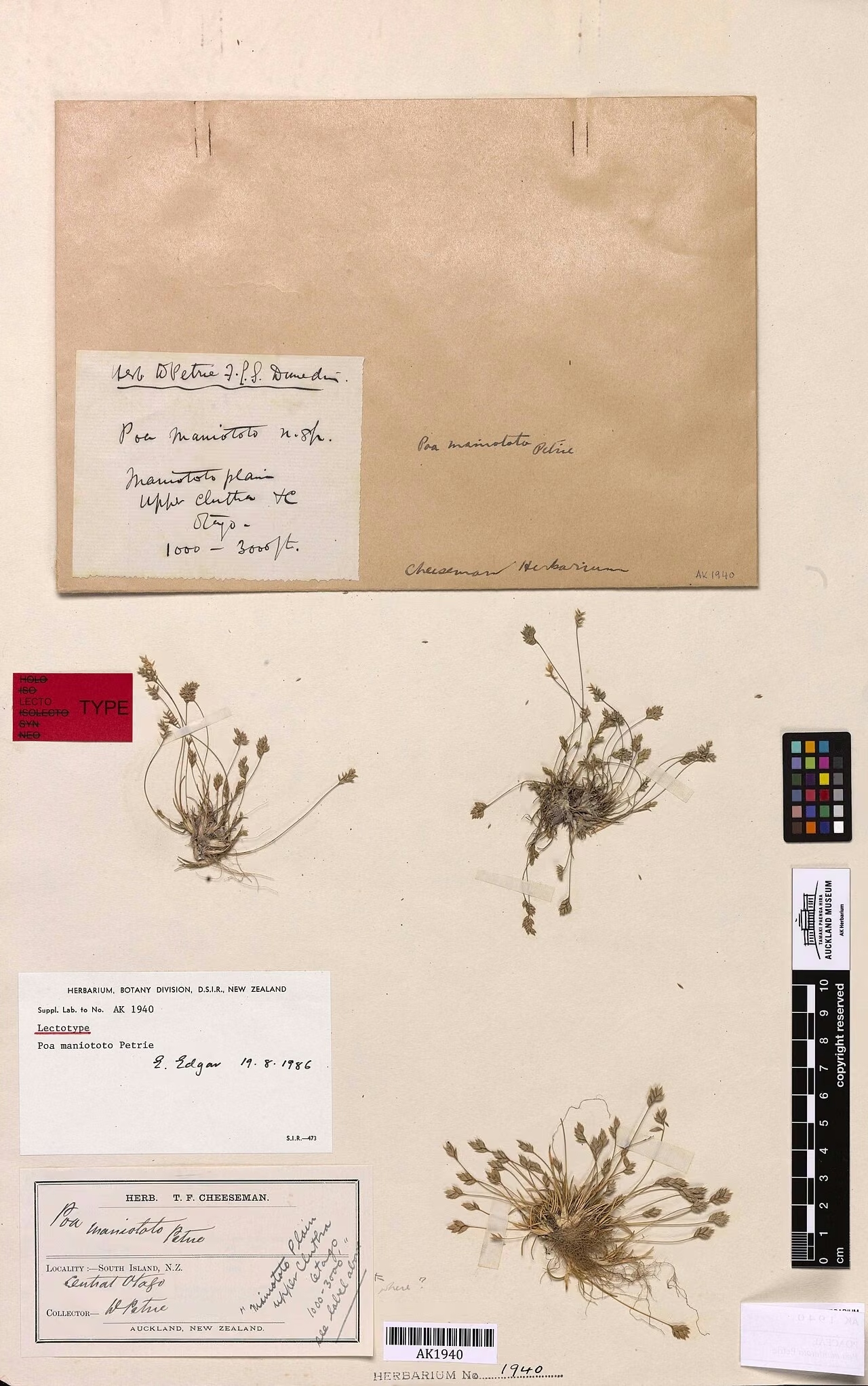
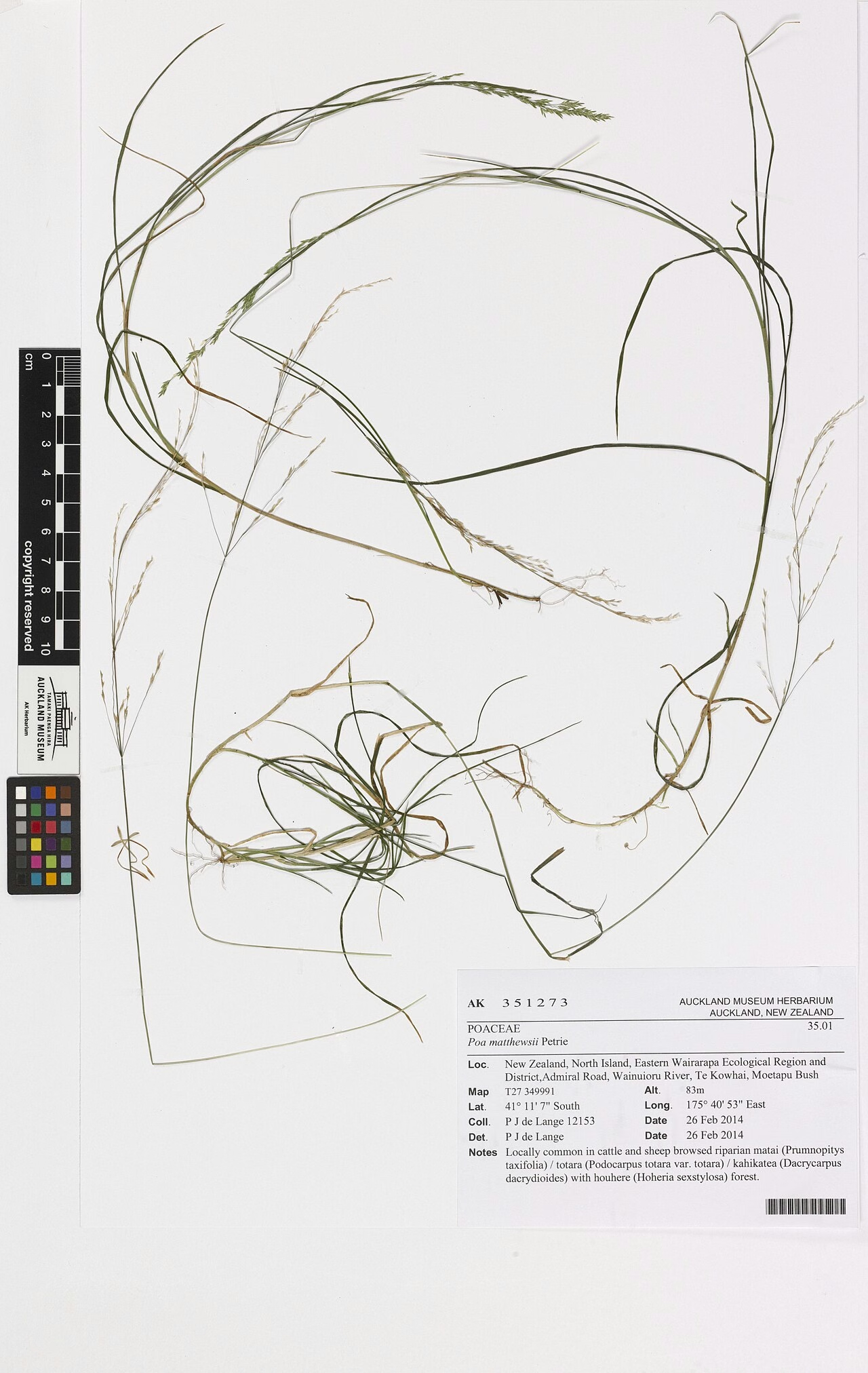
Explore other native plants that share similar characteristics or habitats with Kermadec Islands Poa (Poa polyphylla), offering further insights into New Zealand's diverse flora. These related species provide context and opportunities for complementary planting in your garden.
Plant Conservation
Poa polyphylla is ranked At Risk - Naturally Uncommon (2023) with the qualifiers IE (Island Endemic) and RR (Range Restricted). NZPCN notes that it is not actually threatened and is abundant on Raoul Island; it is listed because its entire range is so small.
The Kermadec Islands are a nature reserve, and the removal of goats and rats and ongoing weed control on Raoul Island have benefited native vegetation. Keeping cultivated stock in mainland gardens is a useful safeguard.
Frequently Asked Questions
Where is Poa polyphylla found?
It is endemic to the Kermadec Islands, where it grows only on Raoul Island and Macauley Island, roughly 1000 km north-east of the North Island.
How is Kermadec Islands poa related to Poa anceps?
It was once treated as a subspecies of the mainland Poa anceps. It differs in its geographic isolation, smaller overall size, hairless leaf sheaths and different spikelet dimensions.
Is Kermadec Islands poa easy to grow?
Yes. NZPCN says it is easily grown from fresh seed or by dividing established plants, and suits wet or dry sites in full sun or semi-shade.
Why is Poa polyphylla At Risk if it is common on Raoul Island?
It is abundant where it grows, but its whole natural range is limited to two small islands, so it is ranked Naturally Uncommon as a range-restricted island endemic.
Sources and Further Reading
The botanical, growing, and conservation details for Kermadec Islands Poa (Poa polyphylla) on this page draw on the New Zealand plant references below. Consult them for full technical records and the latest distribution data.