Poppelwell's Pimelea
Pimelea poppelwellii
Last updated:
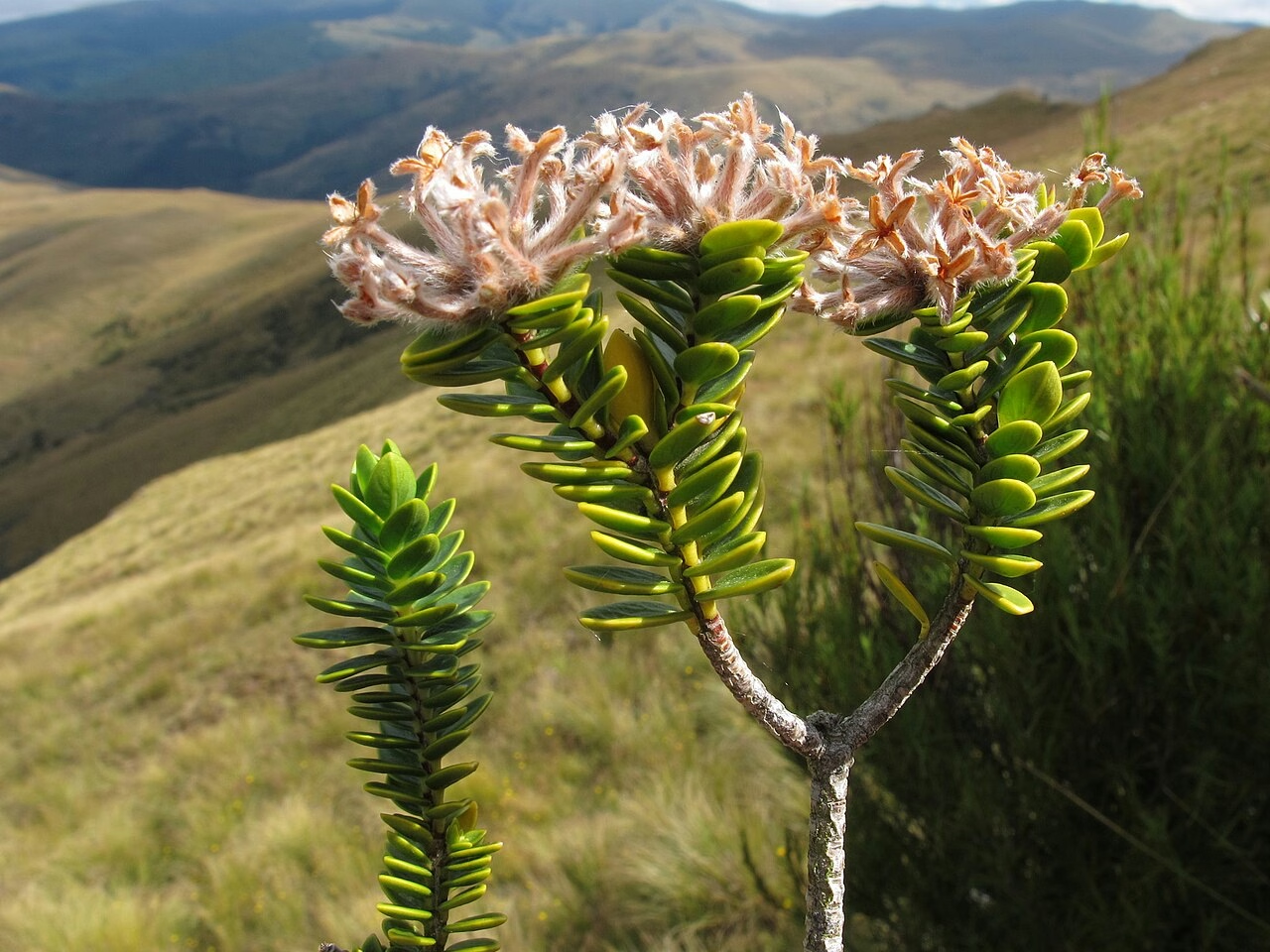
Poppelwell's pimelea (Pimelea poppelwellii) is an erect, much-branched shrub up to about 1 m tall, endemic to the mountains of Central Otago and northern Southland, where it is known mainly from the Garvie Range. It has dark red-brown bark, closely set fleshy leaves with a keel underneath, and clusters of silky-hairy white or pale pink flowers in summer. It grows in subalpine and alpine snow tussock grassland, low shrubland and rocky sites. Ranked At Risk - Naturally Uncommon, it is a poorly known species that is not available commercially. Explore more native shrubs in our native plant guide.
Plant Description
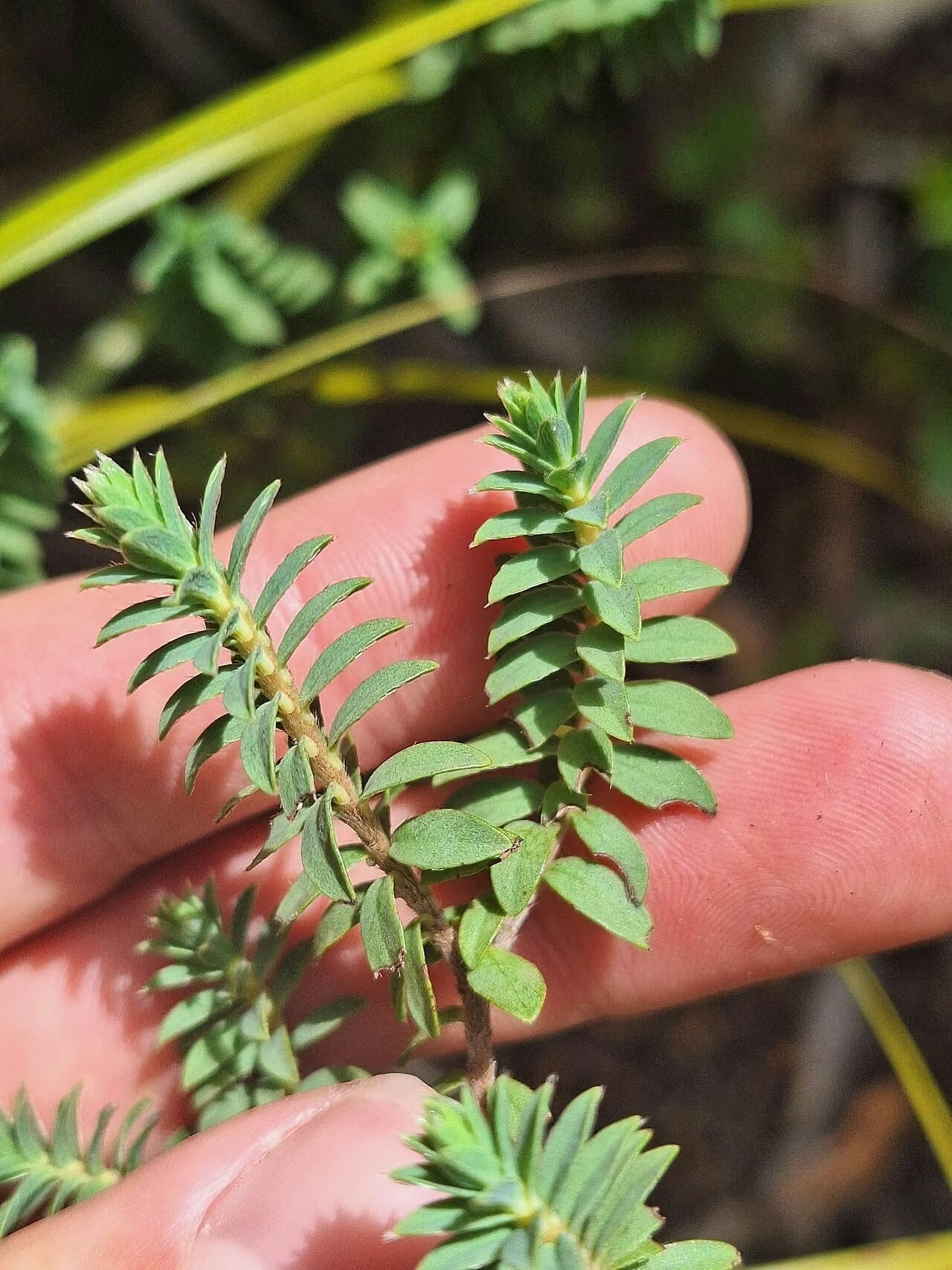
Pimelea poppelwellii is an erect, much-branched shrub up to 1 m or more tall with moderately stout branches and dark red-brown bark. The leaves are fleshy, closely set and borne on short stalks, broad-ovate to ovate-oblong, about 6-10 mm long by 4-6 mm wide, with a blunt or slightly pointed tip and a pronounced keel on the underside.
Flowers are produced in heads of 5 to 16 at the branch tips. They are white or pale rose and densely covered in silky hairs, with a slender tube 6-9 mm long and lobes 2-3 mm long. The fruit is small, ovoid, dark brown to black and hairy at the tip, and NZPCN describes it as a dry achene.
Its closest relative is Pimelea traversii, another stiff mountain pimelea of the southern South Island. Pimelea traversii has darker, almost black bark and stalkless leaves overlapping in four ranks, whereas Poppelwell's pimelea has red-brown bark and stalked, close-set leaves.
Quick Facts
| Scientific Name | Pimelea poppelwellii |
|---|---|
| Height | Up to 1 m |
| Spread | Up to about 1 m |
| Water Needs | Moderate; free-draining |
| Light | Full sun |
| Frost Tolerance | Very hardy; an alpine plant |
| Salt Tolerance | Low; an inland mountain species |
| Growth Rate | Slow |
| Lifespan | Perennial |
Climate Best Suited to
It is adapted to a cold, continental mountain climate with hard frosts, winter snow and dry, sunny summers. Humid lowland gardens are likely to be unsuitable.
Regional Suitability
| City | Climate Suitability |
|---|---|
| Auckland | Low |
| Wellington | Low |
| Christchurch | Medium |
| Dunedin | Medium |
Plant Habitat
Poppelwell's pimelea is endemic to the South Island, recorded from Central Otago and northern Southland and mainly from the Garvie Range, its type locality. NZPCN notes that the species is rather poorly known and that further fieldwork is needed to clarify its full range.
It grows in the subalpine and alpine zones, occasionally reaching lower elevations in suitable habitats. Typical sites are snow tussock grassland with herbs, low shrubland and rocky places.
Growing Requirements
Soil Requirements
Its natural habitat is stony, free-draining mountain soil under tussock, so drainage matters more than fertility.
- Gritty, stony, free-draining mix
- Low to moderate fertility
- Avoid heavy, wet clay
Light Requirements
It grows in open tussock and rock, where it receives full sun and strong mountain light.
- Full sun
- Open, airy position
Water Requirements
Mountain soils stay cool and moderately moist but rarely waterlogged, and it is likely to dislike both drought in hot lowland sun and wet feet.
- Keep evenly moist in summer if grown
- Ensure excess water drains away fast
Planting and Establishing
This species is not commercially available and is not established in cultivation, so most people will only see it in the wild. If material becomes available through a conservation programme, it would be best grown in a raised scree bed or alpine trough in a cool southern garden.
Never collect plants or cuttings from the wild without the necessary permissions; the Garvie populations are small and poorly surveyed.
Ecological Role
NZPCN records that the dry achenes are dispersed by wind and possibly by ants, unlike the fleshy, bird-dispersed fruit of many other pimeleas. The silky flowers are likely visited by native moths, flies and bees, as in related mountain pimeleas, though pollinators of this species have not been studied.
It is one of the small shrubs scattered through snow tussock grassland on the Garvie Range, where it shares rocky ground with herbs and other low shrubs.
Uses & Significance
Garden Uses
Its garden uses are limited by the fact that it is not commercially available.
- Specialist alpine collections in cool climates
- Scree beds or troughs
- Conservation and research collections
Ecological Value
As a narrow-range endemic, its value lies mainly in the biodiversity of the Garvie and Central Otago mountains.
- Part of the distinctive Garvie Range flora
- Flowers for alpine insects
- An indicator of intact tussock and shrubland
Landscaping Uses
In a specialist alpine garden it would sit naturally among snow tussocks, small hebes and cushion plants on a stony slope, echoing its Garvie Range setting.
It is not suited to general landscaping because plants are not available and its needs in cultivation are not known.
Seasonal Care Calendar
Spring
Growth resumes as snow melts off the tussock grasslands.
- Look for new shoots on the red-brown stems
- No garden tasks for wild plants
Summer
Flowering runs from November to March, with silky white or pinkish heads at the tips.
- Best season to see it on the Garvie Range
- Stay on routes and avoid trampling shrubs
Autumn
The dry dark fruit ripen between January and May.
- Seed is shed for wind and possibly ant dispersal
- Note locations to help improve distribution records
Winter
Plants are dormant under snow or hard frost.
- No action required
When to Prune and How Much
Wild plants need no pruning. On any cultivated plant, only remove dead twigs, since slow-growing mountain pimeleas recover poorly from hard cuts.
Keep surrounding grasses from smothering it rather than cutting the shrub itself.
How to Grow Poppelwell's Pimelea
NZPCN states that the propagation technique for Poppelwell's pimelea is not known, and that while it would probably grow from cuttings it would likely be difficult to maintain in cultivation. The approaches below are therefore the standard methods used for mountain pimeleas, not tested protocols for this species. Because it is rare, poorly known and not commercially available, any propagation should be done only from legally obtained material, for example through a conservation programme, and records kept of what works so that knowledge of the species can grow.
From Cuttings
Semi-hardwood cuttings are the most likely route, based on related species. Expect slow rooting and keep the cuttings cool rather than warm. Firm, current-season shoots with a little older wood at the base usually give the best results in mountain shrubs, and soft, sappy growth is prone to collapse.
- Take short semi-hardwood tips in late summer
- Strip the lowest leaves and insert into pure pumice or coarse grit
- Keep cool, lightly shaded and just moist
- Pot on into a very gritty alpine mix once rooted
From Seed
The fruit are dry achenes that ripen from January to May. Seed of mountain pimeleas often benefits from winter cold before germinating.
- Collect ripe achenes only with permission
- Sow on a gritty seed mix in autumn
- Leave the tray outdoors over winter for natural chilling
- Grow seedlings on slowly in cool, bright conditions with good air movement
Pests & Diseases
No specific pests or diseases are recorded for this species. In cultivation, alpine pimeleas usually fail from root rot or summer heat rather than from insect attack.
In the wild, potential pressures include browsing and pasture changes in tussock grassland, but NZPCN lists no confirmed threats beyond the need for better survey information.
Cultural Significance
No Māori name or traditional use is recorded for Pimelea poppelwellii in the sources consulted.
The species was described by the Otago botanist Donald Petrie in 1917 and named for Dugald L. Poppelwell, whose 1915 account of the plant cover of the Garvie Mountains was an early botanical record of the range.
Bonus Tip
If you photograph a stiff, red-barked pimelea with keeled fleshy leaves in Central Otago or northern Southland tussock land, post it to iNaturalist NZ with a location. NZPCN says the distribution of this species is unclear, so well-located observations are genuinely useful.
Related Plants
Explore other native plants that share similar characteristics or habitats with Poppelwell's Pimelea (Pimelea poppelwellii), offering further insights into New Zealand's diverse flora. These related species provide context and opportunities for complementary planting in your garden.
Plant Conservation
Pimelea poppelwellii is ranked At Risk - Naturally Uncommon (2023), with the qualifiers Sparse, Range Restricted, Data Poor Size and Data Poor Trend. Its rarity reflects a small natural range, but the lack of data means any decline could go unnoticed.
Further fieldwork to map populations is the main need identified by NZPCN. Protecting tussock grassland and shrubland on the Garvie Range and nearby mountains will also help secure it.
Frequently Asked Questions
Where does Poppelwell's pimelea grow?
It is endemic to Central Otago and northern Southland and has mostly been recorded from the Garvie Range, in subalpine to alpine tussock grassland, low shrubland and rocky places.
Who was Pimelea poppelwellii named after?
It honours Dugald L. Poppelwell, who collected the type specimen on the Garvie Range and published notes on the vegetation of the Garvie Mountains in 1915. Donald Petrie described the species in 1917.
How do you tell Pimelea poppelwellii from Pimelea traversii?
Poppelwell's pimelea has red-brown rather than dark brown or black bark, and its leaves have short stalks and are close-set rather than sessile and stacked in four neat rows.
Sources and Further Reading
The botanical, growing, and conservation details for Poppelwell's Pimelea (Pimelea poppelwellii) on this page draw on the New Zealand plant references below. Consult them for full technical records and the latest distribution data.