Oxtongue
Picris burbidgeae
Last updated:
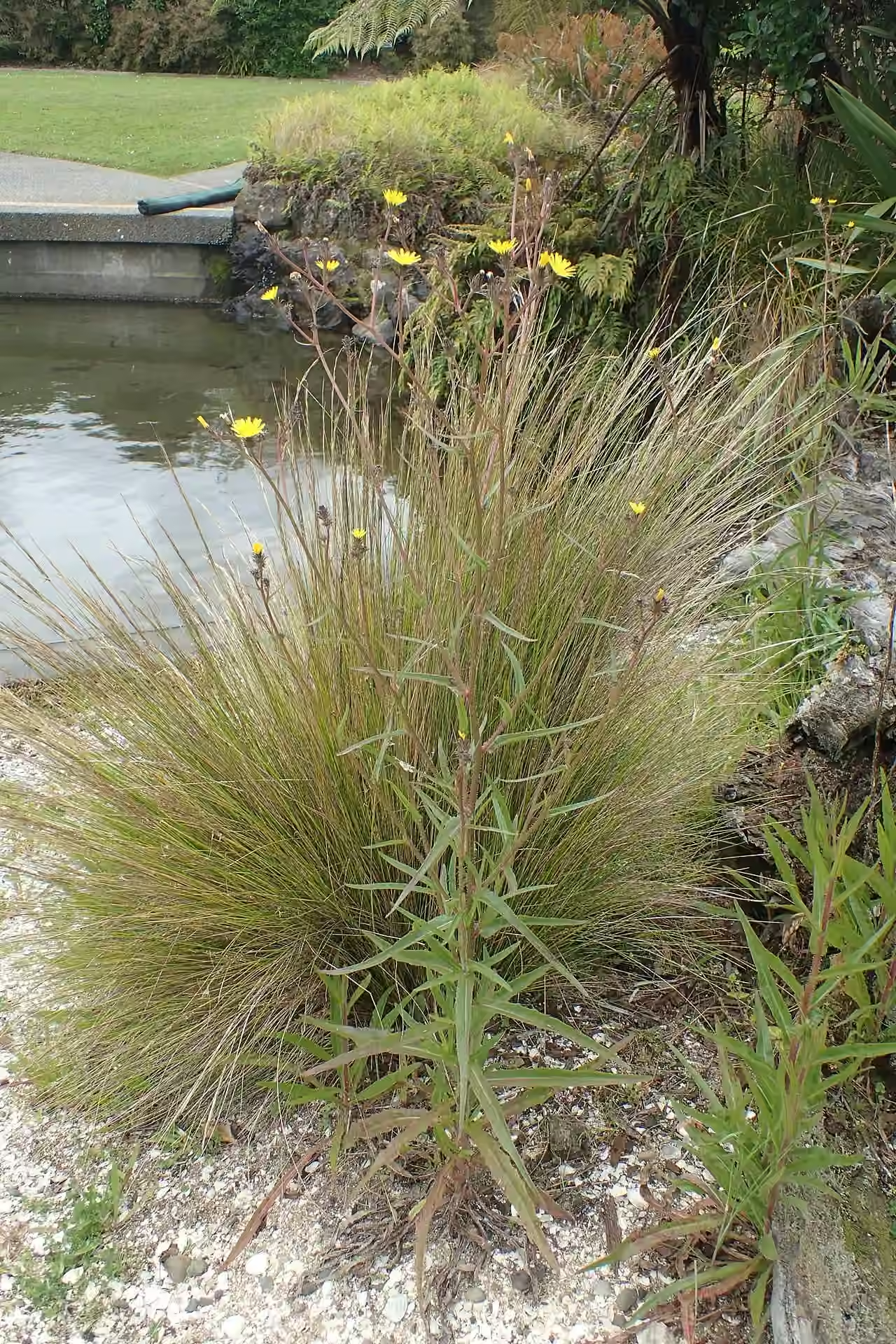
Picris burbidgeae is a native, yellow-flowered member of the daisy family that grows as a short-lived annual to perennial herb 0.5 to 2 m tall. It has bristly, branched stems covered in distinctive two-hooked hairs and produces many small, sulphur-yellow flower heads, peaking in October. In New Zealand it grows on open coastal and lowland ground from Manawatāwhi/Three Kings Islands through Northland, the Hauraki Gulf islands and parts of the Waikato and Bay of Plenty, and on Rēkohu/Chatham Island. Its weedy look means it is easily mistaken for introduced oxtongues and pulled out, and it is ranked Threatened - Nationally Vulnerable. Explore more native flowering plants in our native plant guide.
Plant Description
Picris burbidgeae is an erect herb 0.5 to 2 m tall, usually around 1.2 m, with stems that are woody at the base, dark green to purple-green, branched, and covered in abundant bristly hairs. Many of these hairs end in two tiny hooks, like an anchor, a key feature of the genus.
The leaves are yellow-green. Rosette leaves are narrowly lanceolate, 100 to 200 mm long and 10 to 25 mm wide, and the leaves become progressively smaller up the stem until the uppermost are thread-like. The plant carries numerous small flower heads 9 to 12 mm long, each with 30 to 45 sulphur-yellow florets, followed by narrowly spindle-shaped achenes 4 to 5 mm long topped by a feathery pappus of 50 to 80 rays.
It differs from the other native species, Picris angustifolia, in the arrangement of the involucral bracts and in achene size. From the introduced bristly oxtongue (Helminthotheca echioides) it is told by its hooked anchor hairs and its uniform achenes, and from the introduced hawkweed oxtongue (Picris hieracioides) by technical floral characters best checked with a flora.
Quick Facts
| Scientific Name | Picris burbidgeae |
|---|---|
| Height | 0.5-2 m |
| Spread | 0.3-0.6 m |
| Water Needs | Low to moderate; free-draining sites |
| Light | Full sun; will not tolerate heavy shade |
| Frost Tolerance | Low to moderate; a coastal and lowland plant |
| Salt Tolerance | Moderate; grows in coastal sites and on offshore islands |
| Growth Rate | Fast |
| Lifespan | Annual to short-lived perennial |
Climate Best Suited to
Suits the warm, mild, frost-light climate of northern coastal New Zealand, and also the cooler oceanic climate of Rēkohu/Chatham Island.
Regional Suitability
| City | Climate Suitability |
|---|---|
| Auckland | High |
| Wellington | Medium |
| Christchurch | Low |
| Dunedin | Low |
Plant Habitat
In New Zealand Picris burbidgeae occurs on Manawatāwhi/Three Kings Islands, in the North Island from Te Paki south to the Huntly Basin, Waihi and the Rotorua Lakes area, on most of the Hauraki Gulf islands, and on Rēkohu/Chatham Island. Beyond New Zealand it grows in eastern Australia, on Norfolk Island and on the main island of Hawaii.
It is a plant of open ground in coastal and lowland situations, and is particularly characteristic of offshore islands and talus slopes. It will not tolerate heavy shade and readily colonises gravelled roadsides and gravel pits, which is why it often turns up in places that look weedy and disturbed.
Growing Requirements
Soil Requirements
It favours open, disturbed, free-draining ground such as talus, gravel and coastal banks.
- Gravel, scree and rocky talus
- Disturbed open soil with little competition
- Free drainage rather than wet ground
Light Requirements
A full-sun plant that disappears once taller vegetation closes over it.
- Open sites with full sun
- Will not tolerate heavy shade
Water Requirements
It grows in exposed coastal and gravelly sites that dry out, so it copes with summer dryness once established.
- Water seedlings until established
- Avoid waterlogged soil
Planting and Establishing
Picris burbidgeae is grown mainly for conservation and has been grown at Auckland Botanic Gardens and Auckland Zoo. NZPCN notes that it is unlikely to prove popular in cultivation and can become invasive in some situations, because it seeds freely into open ground.
Restoration plantings on coastal sites within its natural range should use locally sourced seed. Plant into open, sunny gaps, and expect it to persist by reseeding into disturbed patches rather than as long-lived individual plants.
Ecological Role
It is an early-successional coloniser of bare, disturbed ground, appearing after slips, on talus and along gravel roads, and declining as shrubs grow up around it. Its achenes carry a feathery pappus, a structure suited to wind dispersal, and the hooked hairs on the stems help it cling to neighbouring vegetation.
The insects that pollinate its yellow flower heads in New Zealand are not documented in the sources consulted, though open daisy flower heads of this kind are typically visited by a range of generalist flies and bees.
Uses & Significance
Garden Uses
It is not an ornamental plant, but suits conservation and restoration plantings within its natural range.
- Coastal restoration on open banks and talus
- Conservation collections of threatened native flora
- Not recommended for small gardens because it self-seeds
Ecological Value
It is one of the few native members of the chicory tribe of daisies in New Zealand and a characteristic plant of disturbed island and coastal ground.
- Colonises bare ground after slips and disturbance
- Part of the native flora of many Hauraki Gulf islands
- Provides nectar and pollen over a long flowering season
Landscaping Uses
In landscape terms it is best treated as a short-lived pioneer in naturalistic coastal plantings, filling open gaps among low shrubs and tussocks until slower plants close in.
Where it appears on roadsides or in gravel pits within its range, leaving it in place is a simple contribution to its conservation, since many plants are lost when mistaken for weeds.
Seasonal Care Calendar
Spring
Peak flowering and fruiting, both centred on October.
- Look for sulphur-yellow flower heads
- Check for hooked anchor hairs before weeding any oxtongue-like plant
Summer
Flowering continues into January and seed is shed through the season.
- Collect ripe seed heads for sowing fresh
- Plants may begin to die back on dry sites
Autumn
Fruiting continues into autumn, and seedlings may appear in disturbed ground.
- Sow fresh seed
- Keep seedling sites free of competing weeds
Winter
Flowering can begin as early as July, with new rosettes developing.
- Rosettes are visible on open ground
- Protect rosettes from accidental weeding
When to Prune and How Much
Little pruning is needed for this short-lived herb. Cut flowering stems back after seed has been shed if a tidier look is wanted, or remove seed heads early where self-seeding is unwanted.
In conservation plantings it is better to leave plants to seed so the population can renew itself.
How to Grow Oxtongue
Picris burbidgeae is straightforward to raise from seed, and NZPCN describes it as easy from fresh seed, which usually germinates within one to two months. Because the plants are annual to short-lived perennials, seed is the natural and most practical way to maintain them, and populations persist in the wild by reseeding into newly disturbed ground. No published method for vegetative propagation was found, and given how readily it grows from seed there is little need for one. For restoration work, seed should be collected from the nearest wild population to retain local genetic character, and only with the landowner's or Department of Conservation's permission where plants grow on public conservation land.
From Seed
The achenes ripen over a long period, with fruiting from August to June and a peak in October. Collect the fluffy seed heads as they open, before the wind disperses the pappus-bearing achenes, and sow them fresh for the best germination.
Seedlings grow quickly and can flower within their first year. Because plants are short-lived, sowing a fresh batch every year or two keeps a conservation collection going.
- Collect seed heads as the pappus begins to fluff out
- Sow fresh seed on the surface of a free-draining seed mix
- Cover very lightly with fine grit and keep evenly moist
- Expect germination within one to two months
- Prick out seedlings into individual pots once they have a few true leaves
- Plant out into open, sunny sites while still small
Pests & Diseases
No particular pests or diseases are recorded for Picris burbidgeae. The greatest everyday hazard is people weeding it out in the belief that it is an introduced oxtongue or hawkweed.
In the wild, competition from weeds and the closing over of open sites by shrubs during succession are the main problems.
Cultural Significance
No Māori name or traditional use is recorded for Picris burbidgeae in the sources consulted.
The species was described by S. Holzapfel in the early 1990s as part of a revision of Australasian Picris (Holzapfel and Lack 1993), which separated it from other Picris in the region. The epithet appears to honour a person named Burbidge, but the sources consulted do not state who.
Bonus Tip
Before pulling out any yellow, bristly, dandelion-like plant on coastal ground in northern New Zealand, rub a stem between your fingers: if the hairs catch like tiny Velcro hooks, you may have the native Picris burbidgeae. Check the achenes too, as a single type of achene rules out the introduced bristly oxtongue.
Related Plants
Explore other native plants that share similar characteristics or habitats with Oxtongue (Picris burbidgeae), offering further insights into New Zealand's diverse flora. These related species provide context and opportunities for complementary planting in your garden.
Plant Conservation
Picris burbidgeae is ranked Threatened - Nationally Vulnerable (2023), with qualifiers including Sparse and Data Poor, after being listed as Nationally Endangered in 2008 and 2012. It is also ranked Regionally Vulnerable in both Northland and Auckland.
Threats include habitat loss to coastal development, succession on its open sites, weed invasion and accidental eradication because of its weedy appearance. Learning to recognise it, leaving it in place on roadsides and gravel areas, and reporting new records all help.
Frequently Asked Questions
Is Picris burbidgeae a weed?
No. It is a native New Zealand plant, though its weedy appearance and liking for disturbed ground mean it is often mistaken for introduced oxtongues and accidentally removed.
How do you tell Picris burbidgeae from bristly oxtongue?
The introduced bristly oxtongue (Helminthotheca echioides) lacks the two-hooked anchor hairs of Picris burbidgeae and has two kinds of achene in each head, whereas the native species has achenes all of one kind.
Where does Picris burbidgeae grow?
It grows from the Three Kings Islands south to the Huntly Basin, Waihi and the Rotorua Lakes, on most Hauraki Gulf islands and on Chatham Island, and also in eastern Australia, Norfolk Island and Hawaii.
Is Picris burbidgeae easy to grow from seed?
Yes. NZPCN reports it is easy from fresh seed, which usually germinates within one to two months.
Sources and Further Reading
The botanical, growing, and conservation details for Oxtongue (Picris burbidgeae) on this page draw on the New Zealand plant references below. Consult them for full technical records and the latest distribution data.