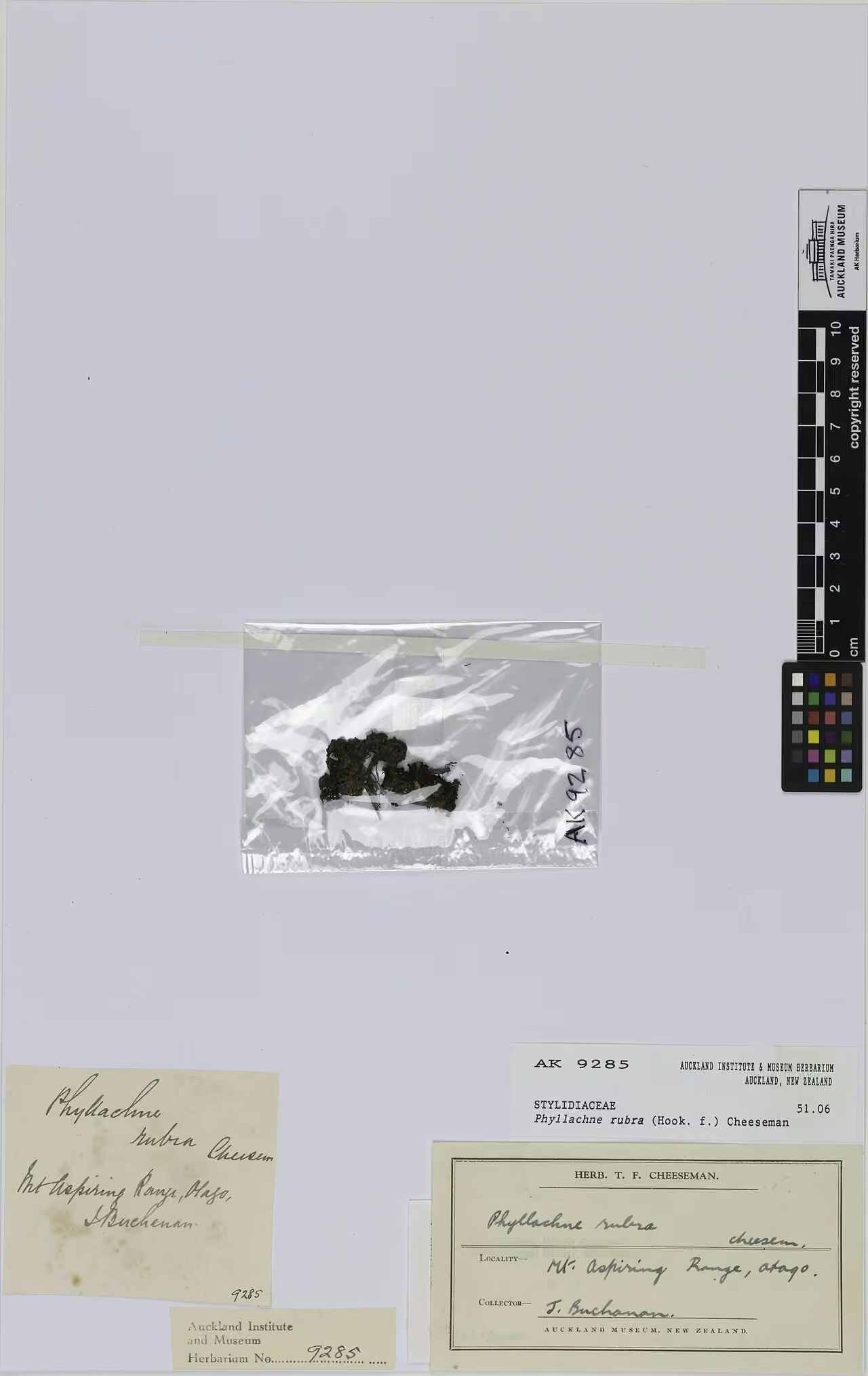
Phyllachne
Phyllachne rubra
Last updated:
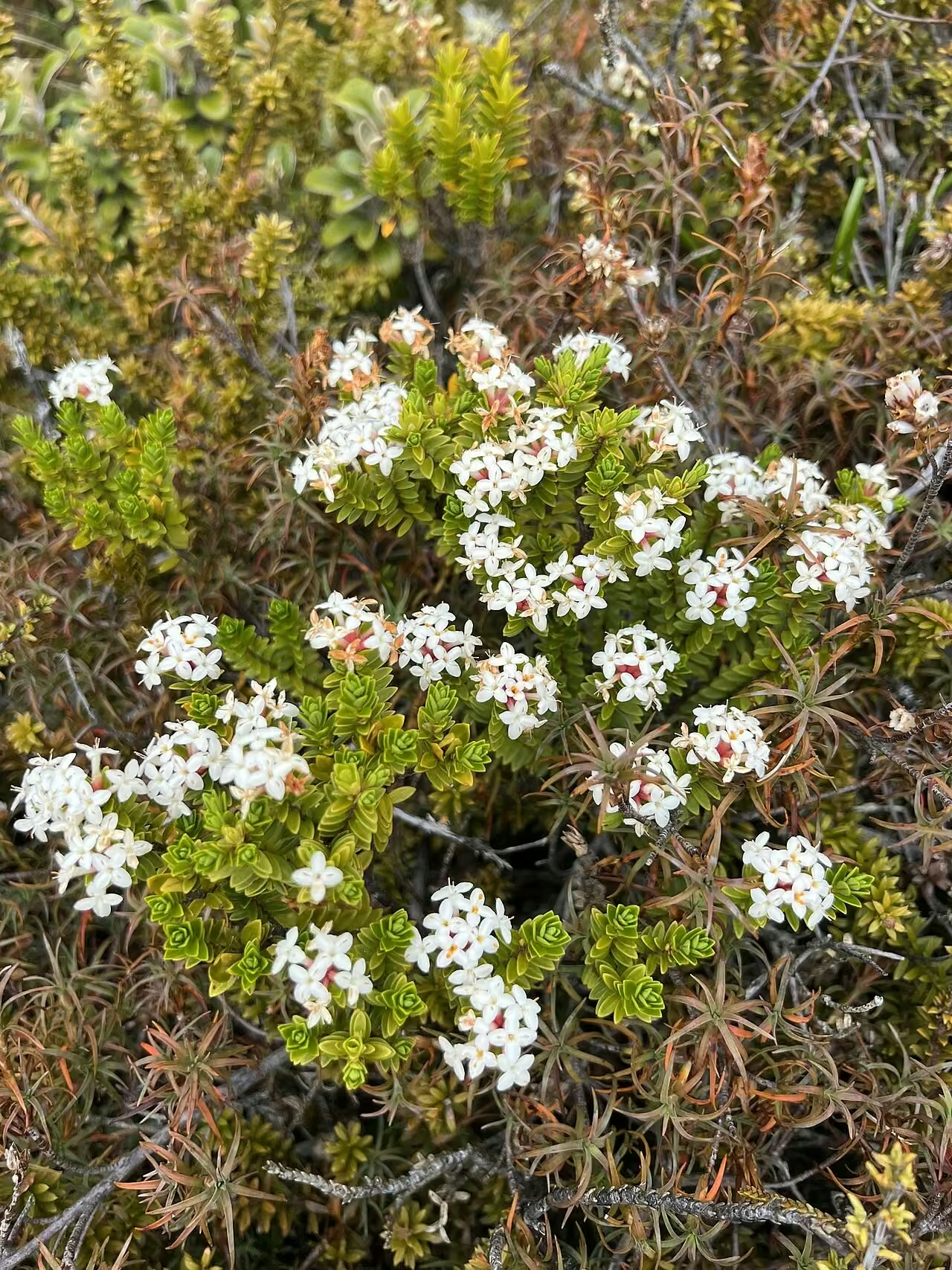
Phyllachne rubra is a small cushion or mat-forming plant endemic to the South Island, in the trigger plant family Stylidiaceae. Its cushions reach about 5 cm tall and are made of densely packed shoots of tiny linear leaves, about 4.5 mm long, each thickened at the tip into a distinct knob. From December to April it bears white flowers about 5 mm across that usually dry dark red, the feature behind the name rubra. It grows in higher montane to subalpine herbfield, fellfield and rock crevices between about latitudes 43 degrees 30 minutes and 45 degrees 30 minutes. It is ranked Not Threatened nationally. Explore more native ground covers in our native plant guide.
Plant Description
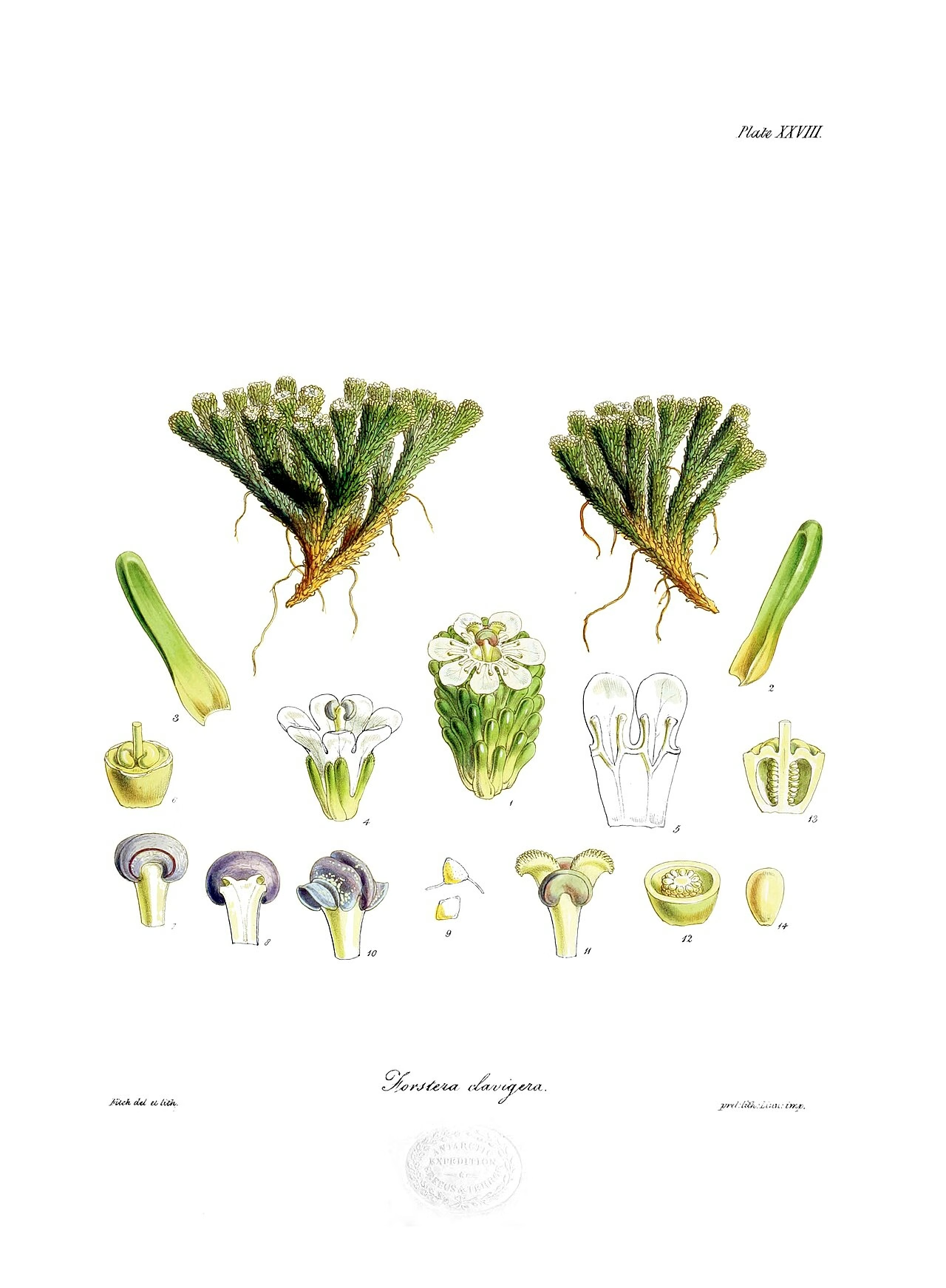
Phyllachne rubra forms cushions or mats up to about 5 cm tall. Its leaves are linear to linear-oblong, about 4.5 mm long and 1 mm wide, concavo-convex to plano-convex, not widened at the base, and thickened at the apex into a distinct knob. The bracts below the flowers have irregular teeth.
Flowers are about 5 mm in diameter and shortly tubular, with 5-7 unequal, obovate lobes. The corolla is white but usually dries dark red. The central column formed by the fused style and stamens, typical of the Stylidiaceae, is rather stout and not or only very slightly exserted from the flower. Flowering is from December to April.
Among New Zealand's three Phyllachne species, P. rubra shares knob-tipped leaves with P. clavigera, but has larger flowers that dry red and a different range in the central South Island. P. colensoi, the yellow cushion plant, is the most widespread species and forms the dominant cushions in many upland bogs.
Quick Facts
| Scientific Name | Phyllachne rubra |
|---|---|
| Height | Up to about 0.05 m |
| Spread | Cushions or mats; width not recorded in sources consulted |
| Water Needs | Moderate to high; moist but well drained |
| Light | Full sun, open sites |
| Frost Tolerance | Very high; montane to subalpine |
| Salt Tolerance | Not recorded; an inland mountain species, so assume none |
| Growth Rate | Very slow |
| Lifespan | Perennial |
Climate Best Suited to
Suited to the cold, snowy montane and subalpine climate of the central South Island mountains, with cool summers and long winters.
Regional Suitability
| City | Climate Suitability |
|---|---|
| Auckland | Low |
| Wellington | Low |
| Christchurch | Low |
| Dunedin | Medium |
Plant Habitat
Phyllachne rubra is endemic to the South Island, recorded from about latitude 43 degrees 30 minutes to 45 degrees 30 minutes. This band takes in the central and southern Southern Alps and includes the Lake Wanaka and Lake Hawea region of inland Otago.
It grows in higher montane to subalpine herbfield, fellfield and rock crevices. Crevices that hold moisture, particularly on eastern slopes, provide a reliable water supply in the drier eastern ranges, and the small cushions wedge themselves into these sheltered pockets.
Growing Requirements
Soil Requirements
It roots into thin mineral and peaty soils in herbfield and fellfield and into fine debris in rock crevices.
- Gritty, low-nutrient soil
- Constant moisture at the roots
- Good drainage around the crown
- No fertiliser
Light Requirements
Its habitats are open and treeless, so it grows in full light.
- Full sun in cool climates
- Rock crevices give partial shelter
- Does not tolerate competition from taller plants
Water Requirements
It favours sites with a dependable water supply, such as moist rock crevices and herbfields with snowmelt.
- Keep the root zone moist
- Avoid waterlogging around the cushion
- Rainwater is preferable for watering
Planting and Establishing
No cultivation records for Phyllachne rubra were found in the sources consulted, and it is not available from nurseries.
A specialist grower might try it in a crevice garden or trough in a cool southern climate, wedged between stones with a moist, gritty root run. Plants must not be dug from the wild.
Ecological Role
Phyllachne rubra is one of the small cushion plants that make up montane to subalpine herbfield and fellfield vegetation. Its compact cushions help trap fine soil and moisture in exposed rocky sites.
Its white flowers are presumably visited by insects, but no study of its pollination or seed dispersal was found. Molecular work groups it with P. colensoi and P. clavigera in a New Zealand clade, whose closest relative is P. uliginosa of southern South America.
Uses & Significance
Garden Uses
Not a garden plant. Its value is in its natural alpine habitats.
- Botanical and research collections only
- Specialist crevice or trough culture
- Best enjoyed in the wild
Ecological Value
It contributes to the diversity of endemic cushion plants in the central South Island mountains.
- Endemic South Island cushion plant
- Part of herbfield and fellfield communities
- Stabilises soil in rock crevices
Landscaping Uses
This species has no established place in landscaping. In the wild, its cushions form part of the fine-textured carpet of herbfield and fellfield.
Alpine walkers can help by keeping to tracks, since cushion plants grow slowly and are easily damaged by trampling.
Seasonal Care Calendar
Spring
New growth begins after snowmelt.
- Cushions green up as temperatures rise
Summer
Flowering starts in December, with white flowers on the cushion surface.
- Look for white flowers turning dark red as they age
Autumn
Flowering continues until April and seed is set.
- Capsules ripen among the leaves
Winter
Cushions are dormant under snow or frost.
- No growth
When to Prune and How Much
No pruning is needed. Cushion plants rely on their tightly packed shoots for protection, and cutting damages them.
If grown, only dead or rotting shoots should be removed carefully with tweezers.
How to Grow Phyllachne
No propagation information specific to Phyllachne rubra was found in the sources consulted, and it is not known in general cultivation. The approaches below are those generally used for small alpine cushion plants and are untested for this species. Seed collected after the December to April flowering season is the most practical starting point. Any collection from public conservation land would need permission from the Department of Conservation, and material should come only from abundant populations, especially in Otago, where the species is regionally uncommon.
From Seed
Seed from many alpine plants germinates better after a winter of cold. Sow it fresh in a gritty mix and leave the pot outdoors in a cool place over winter.
Expect slow progress: seedlings of cushion plants may take several years to form even a small cushion.
- Collect ripe capsules in autumn, with permission
- Sow on a mix of fine grit and a little peat substitute
- Cover very lightly or not at all
- Keep moist and exposed to winter cold outdoors
- Grow seedlings on slowly in a cool, bright frame
From Cuttings
Individual shoots from the edge of a cushion may root in cool, humid conditions. Take only a few from any cushion so the plant is not opened up to damage.
- Remove a few short shoots from the edge of a cultivated cushion in spring
- Insert into a moist mix of sand and pumice
- Keep cool, shaded and humid until rooted
- Pot into a gritty alpine mix
Pests & Diseases
No pests or diseases specific to Phyllachne rubra are recorded. In the wild, trampling and browsing animals can damage alpine cushions.
In cultivation, rot in warm, humid or poorly ventilated conditions would be the likely main problem, as with other alpine cushion plants.
Cultural Significance
No Māori name or traditional Māori use is recorded for Phyllachne rubra in the sources consulted.
Joseph Hooker first described it as Helophyllum rubrum, and Thomas Cheeseman later transferred it to Phyllachne. The genus name means chaff-like leaves, and the epithet rubra, meaning red, refers to the flowers that dry dark red.
Bonus Tip
When you find a small white-flowered cushion in a rock crevice in the central South Island mountains, look at older flowers. If they have dried a deep red, and the leaf tips are swollen into tiny knobs under a hand lens, you are probably looking at Phyllachne rubra.
Related Plants
Explore other native plants that share similar characteristics or habitats with Phyllachne (Phyllachne rubra), offering further insights into New Zealand's diverse flora. These related species provide context and opportunities for complementary planting in your garden.
Plant Conservation
Phyllachne rubra is ranked Not Threatened nationally (2023) and has held that ranking since 2004. In the 2025 Otago regional assessment it is ranked Regionally Naturally Uncommon.
Much of its habitat lies in high country and conservation land. Trampling, browsing and long-term climate warming are potential pressures on alpine cushion plant communities.
Frequently Asked Questions
Why is it called Phyllachne rubra when its flowers are white?
Rubra means red. The fresh petals are white, but the Flora of New Zealand notes they usually dry dark red, which gives the plant a reddish tinge as flowers age.
Where does Phyllachne rubra grow?
It is found in the South Island in higher montane to subalpine herbfield, fellfield and rock crevices, between about latitudes 43 degrees 30 minutes and 45 degrees 30 minutes, roughly the central Southern Alps to the southern lakes.
How does Phyllachne rubra differ from Phyllachne clavigera?
Both have tiny leaves with a knob at the tip. Phyllachne rubra has larger flowers, about 5 mm across, that usually dry dark red, while P. clavigera has flowers only 2-4 mm across.
Is Phyllachne rubra rare?
Nationally it is ranked Not Threatened (2023). In Otago, however, it is ranked Regionally Naturally Uncommon in the 2025 regional assessment.
Sources and Further Reading
The botanical, growing, and conservation details for Phyllachne (Phyllachne rubra) on this page draw on the New Zealand plant references below. Consult them for full technical records and the latest distribution data.