Scrobic
Paspalum orbiculare
Last updated:
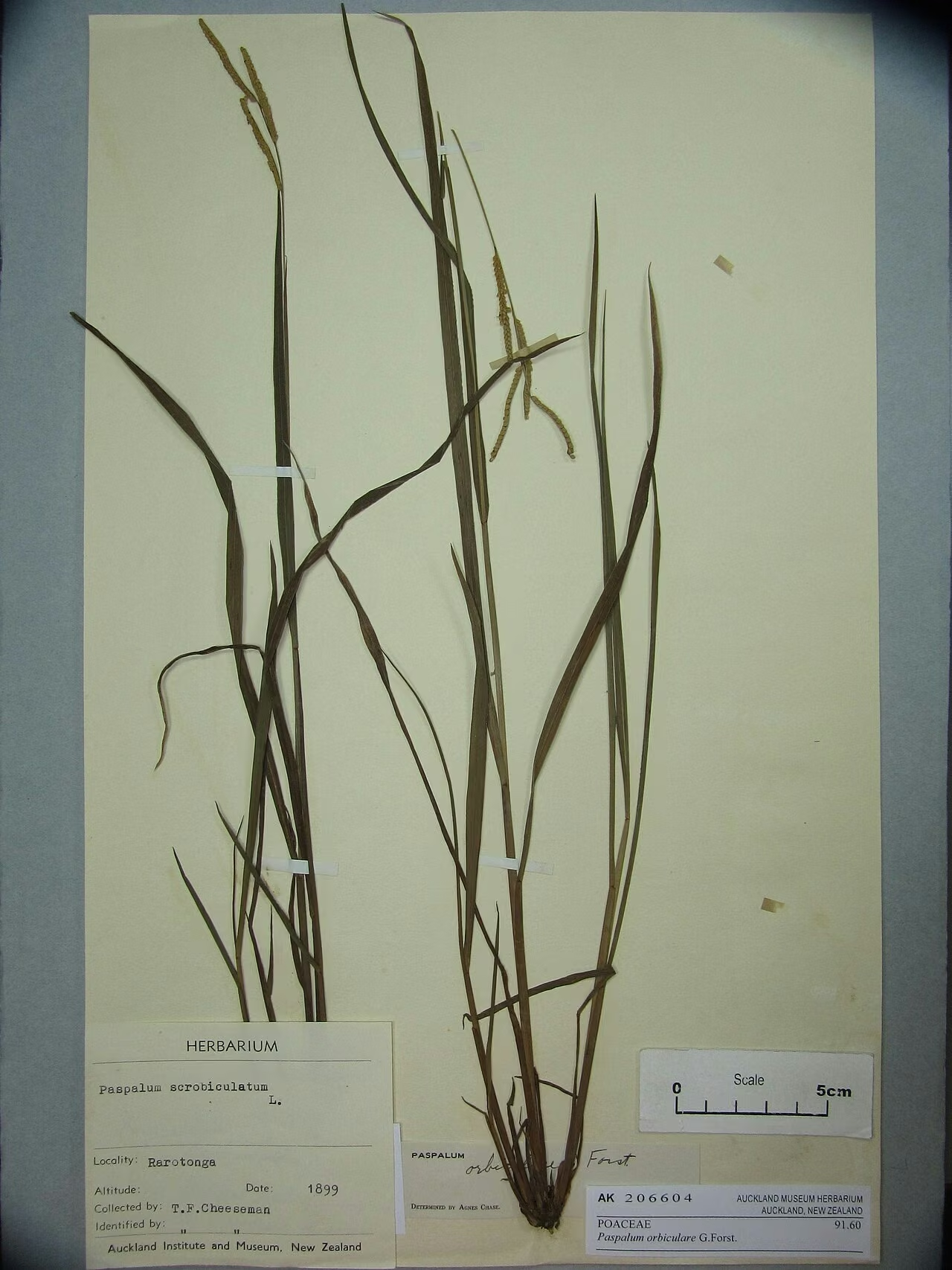
Scrobic (Paspalum orbiculare) is a tufted, stiffly erect perennial grass indigenous to the Kermadec Islands and the northern North Island, from Northland to Raglan Harbour and Whale Island in the Bay of Plenty. Its flowering stems reach 35-70 cm and carry an upright panicle of 3-8 short racemes of small, smooth, glossy brown spikelets. It grows in seasonal wetlands, lake margins, gumland scrub, track sides and around active geothermal vents. Once widespread, it is now scarce south of Auckland and is ranked Threatened - Nationally Vulnerable, partly because it is easily mistaken for the weedy introduced paspalum. Explore more native grasses and flaxes in our native plant guide.
Plant Description
Scrobic is a perennial grass with stiffly erect leaves. The leaf sheaths are subcoriaceous, striate and strongly keeled, brown to purple-brown in colour. Leaf blades are 10-30 cm long and 3.5-5 mm wide, flat and rigid with a distinct midrib. The flowering stems (culms) are erect and compressed, usually 35-70 cm tall but sometimes as short as 20 cm.
The flower head is an erect panicle 60-120 mm long with 3-8 erect to slightly spreading racemes. Spikelets are 2-2.5 mm long, ovoid-elliptic to almost round, smooth and light brown, and the upper floret is glossy brown. The name orbiculare, meaning circular, refers to these rounded spikelets. It may flower year round but mainly from August to April.
NZPCN notes that its smooth spikelets easily distinguish it from the naturalised Paspalum species in New Zealand. It is most likely to be confused with Paspalum dilatatum, the common pasture and roadside paspalum, which has larger drooping leaves, larger panicles and spikelets 3-3.5 mm long.
Quick Facts
| Scientific Name | Paspalum orbiculare |
|---|---|
| Height | 0.35-0.7 m in flower (culms 0.2-0.7 m) |
| Spread | Compact tufts; width not recorded in sources consulted |
| Water Needs | Adaptable; tolerates both waterlogging and drought |
| Light | Full sun; intolerant of shading |
| Frost Tolerance | Low to moderate; a northern, frost-sensitive range |
| Salt Tolerance | Not recorded; grows in coastal to lowland sites |
| Growth Rate | Moderate |
| Lifespan | Perennial |
Climate Best Suited to
A warm-temperate to subtropical grass suited to the frost-light climates of Northland, Auckland, the Kermadec Islands and the northern Bay of Plenty.
Regional Suitability
| City | Climate Suitability |
|---|---|
| Auckland | High |
| Wellington | Low |
| Christchurch | Low |
| Dunedin | Low |
Plant Habitat
Paspalum orbiculare is indigenous to the Kermadec Islands and the North Island, where it occurs from Northland south to Raglan Harbour in the west and Whale Island (Moutohorā) in the Bay of Plenty. It is also common in the wider Pacific and Australia. It was formerly widespread from Te Paki to the Bay of Plenty, but is now scarce south of Auckland City, with strongholds on Great Barrier Island and in the far north.
It grows in coastal to lowland habitats: seasonal wetlands (often with Baumea juncea), lake margins, gumland scrub, track sides, and near or around active geothermal vents. These are open, often infertile sites that alternate between wet and dry, where taller vegetation is held back.
Growing Requirements
Soil Requirements
NZPCN describes it as very tolerant of waterlogged or drought-prone, infertile soils, which matches its gumland and geothermal habitats.
- Thrives in poor, infertile soils
- Copes with clay, peaty gumland and geothermal ground
- Rich, fertile soils favour taller competitors
- No fertiliser needed
Light Requirements
Scrobic needs open, sunny ground. Shading by taller vegetation, including native revegetation plantings, is one of the reasons populations have been lost.
- Full sun
- Keep taller plants from overtopping it
- Not suitable for planting under trees
Water Requirements
Its seasonal wetland habitat is wet in winter and can dry out in summer, so it tolerates both extremes.
- Tolerates seasonal waterlogging
- Tolerates summer drought once established
- Suits rain gardens and damp hollows
Planting and Establishing
Plant in an open, sunny position where taller plants will not shade it, such as a seasonal wet hollow, the margin of a pond, or a low-fertility bank. Spring is a good time to plant in the north.
When restoring wetlands or gumland where scrobic occurs naturally, avoid planting tall shrubs or trees over existing patches. Use stock propagated from local wild populations where possible.
Ecological Role
Scrobic is wind-pollinated like most grasses. NZPCN notes that New Zealand plants are apomictic, setting seed without fertilisation, and produce little viable seed, with less than 10 percent viability.
It is a characteristic grass of low-stature northern wetland and gumland communities, and an unusual coloniser of geothermally heated ground. Its seeds may be eaten by seed-eating birds, though no specific study of its dispersal in New Zealand was found.
Uses & Significance
Garden Uses
NZPCN describes it as easy to grow but not especially ornamental. Its main value is in conservation and restoration plantings.
- Wetland and gumland restoration in Northland and Auckland
- Rain gardens and seasonal swales
- Conservation collections of threatened grasses
- Low, open native grassland plantings
Ecological Value
As a nationally threatened grass, every protected population matters. It contributes to the distinctive plant communities of northern seasonal wetlands and geothermal ground.
- Threatened indigenous grass
- Component of gumland and seasonal wetland vegetation
- Tolerant of harsh, infertile sites
Landscaping Uses
Use scrobic in naturalistic wetland or gumland-style plantings alongside low sedges and rushes, where its upright tufts and brown seed heads give vertical texture.
Label plantings clearly so that future maintenance crews do not mistake it for weedy paspalum and spray or dig it out.
Seasonal Care Calendar
Spring
Growth increases and the main flowering season gets under way from August.
- Plant or divide clumps
- Remove competing weeds
Summer
Flowering and seeding continue. Plants tolerate dry spells once established.
- Collect seed heads
- Water young plants in drought
Autumn
Flowering tapers off by April, though seed can be present at most times of year.
- Cut back overtopping vegetation
- Collect remaining seed
Winter
Seasonal wetlands fill with water; scrobic tolerates the waterlogging.
- Little care needed
- Check that taller plants are not shading clumps
When to Prune and How Much
Cut old flowering stems and tired leaves back to the base in late winter if the clump looks untidy. This also encourages fresh growth.
The most important management is keeping surrounding vegetation low so the clumps stay in full sun.
How to Grow Scrobic
NZPCN describes scrobic as easy to grow from plant division and seed. Because New Zealand plants are apomictic and usually produce less than 10 percent viable seed, division is the more dependable method, while seed is worth sowing generously to compensate for poor viability. Apomixis means seedlings are generally genetically identical to the parent, so sourcing material from several local plants helps maintain variety in restoration plantings.
By Division
Established clumps can be lifted and split into smaller pieces, each with roots and several shoots. This is the quickest way to produce plants for a restoration site.
Divisions establish quickly in damp, open ground. Planting them out in small groups rather than singly helps them hold their own against competing weeds while they settle in.
- Lift a healthy clump in spring or early autumn
- Split it into pieces with roots and three or more shoots
- Trim the leaves back by about half to reduce water loss
- Pot into a free-draining mix or plant directly into moist ground
- Keep moist until new growth appears
From Seed
Seed may be present on plants at almost any time, most often from September to July. Sow plenty, since viability is low.
- Collect seed heads when the spikelets turn glossy brown
- Sow thickly on the surface of a seed mix and cover lightly
- Keep moist and warm, in full light
- Prick out seedlings into small pots once they have a few leaves
- Grow on in full sun before planting out
Pests & Diseases
No significant pests are recorded. The main threat to scrobic is competition from taller grasses, shrubs and weeds that overtop it.
Accidental removal is a real risk: because it looks like a weedy paspalum, plants have been sprayed or dug out. Mark plantings and educate maintenance staff.
Cultural Significance
No Māori name or traditional Māori use for Paspalum orbiculare is recorded in the sources consulted. The Flora of New Zealand lists the vernacular names tarakoi, taranui and tuhui, but does not state their origin, and they may come from elsewhere in the species' Pacific range.
The species was named by Georg Forster, who sailed with Cook on his second voyage. The common name scrobic appears to be shared with the closely related Paspalum scrobiculatum, a widespread tropical grass; the precise origin of its use for the New Zealand plant was not confirmed in the sources consulted.
Bonus Tip
If you find a stiff, upright paspalum with small, smooth, glossy brown spikelets in a northern wetland or gumland, check it carefully before removing it. Measure the spikelets: if they are about 2 mm and hairless, it may be the threatened native scrobic rather than weedy Paspalum dilatatum, and the record would be valuable to NZPCN or iNaturalist.
Related Plants
Explore other native plants that share similar characteristics or habitats with Scrobic (Paspalum orbiculare), offering further insights into New Zealand's diverse flora. These related species provide context and opportunities for complementary planting in your garden.
Tarn Speedwell
Veronica lilliputiana
Veronica decora
Veronica decora
Veronica lanceolata
Veronica lanceolata
Veronica planopetiolata
Veronica planopetiolata
Peperomia leptostachya
Peperomia leptostachya
Tūtunāwai
Persicaria decipiens
Phyllachne clavigera
Phyllachne clavigera
Phyllachne rubra
Phyllachne rubra
Plant Conservation
Paspalum orbiculare is ranked Threatened - Nationally Vulnerable (2023). Its qualifiers indicate it is data poor for recognition, size and trend (DPR, DPS, DPT), in partial decline (PF) and secure overseas (SO).
Threats include competition from taller, faster-growing species, shading from revegetation projects using taller natives, drainage of seasonal wetlands, and destruction by people who mistake it for a weed. Keeping its habitats open and recognising it during weed control are the most important actions.
Frequently Asked Questions
Is scrobic a native grass or a weed?
Paspalum orbiculare is indigenous to New Zealand, though not endemic, as it also occurs in the Pacific and Australia. NZPCN notes some populations have been lost because people failed to recognise it as native rather than a weedy Paspalum.
How do you tell scrobic from common paspalum (Paspalum dilatatum)?
Scrobic has smooth, hairless spikelets 2-2.5 mm long and stiff erect leaves. Paspalum dilatatum has larger drooping leaves, larger panicles and bigger spikelets of 3-3.5 mm.
Why is Paspalum orbiculare threatened?
It is ranked Nationally Vulnerable. It is outcompeted by taller, faster-growing species, and some populations have been shaded out by revegetation plantings or destroyed by people who thought it was a weed.
Where does scrobic grow in New Zealand?
It occurs on the Kermadec Islands and in the North Island from Northland south to Raglan Harbour and Whale Island, with strongholds on Great Barrier Island and in the far north.
Sources and Further Reading
The botanical, growing, and conservation details for Scrobic (Paspalum orbiculare) on this page draw on the New Zealand plant references below. Consult them for full technical records and the latest distribution data.