Hairless Cress
Pachycladon fastigiatum
Last updated:
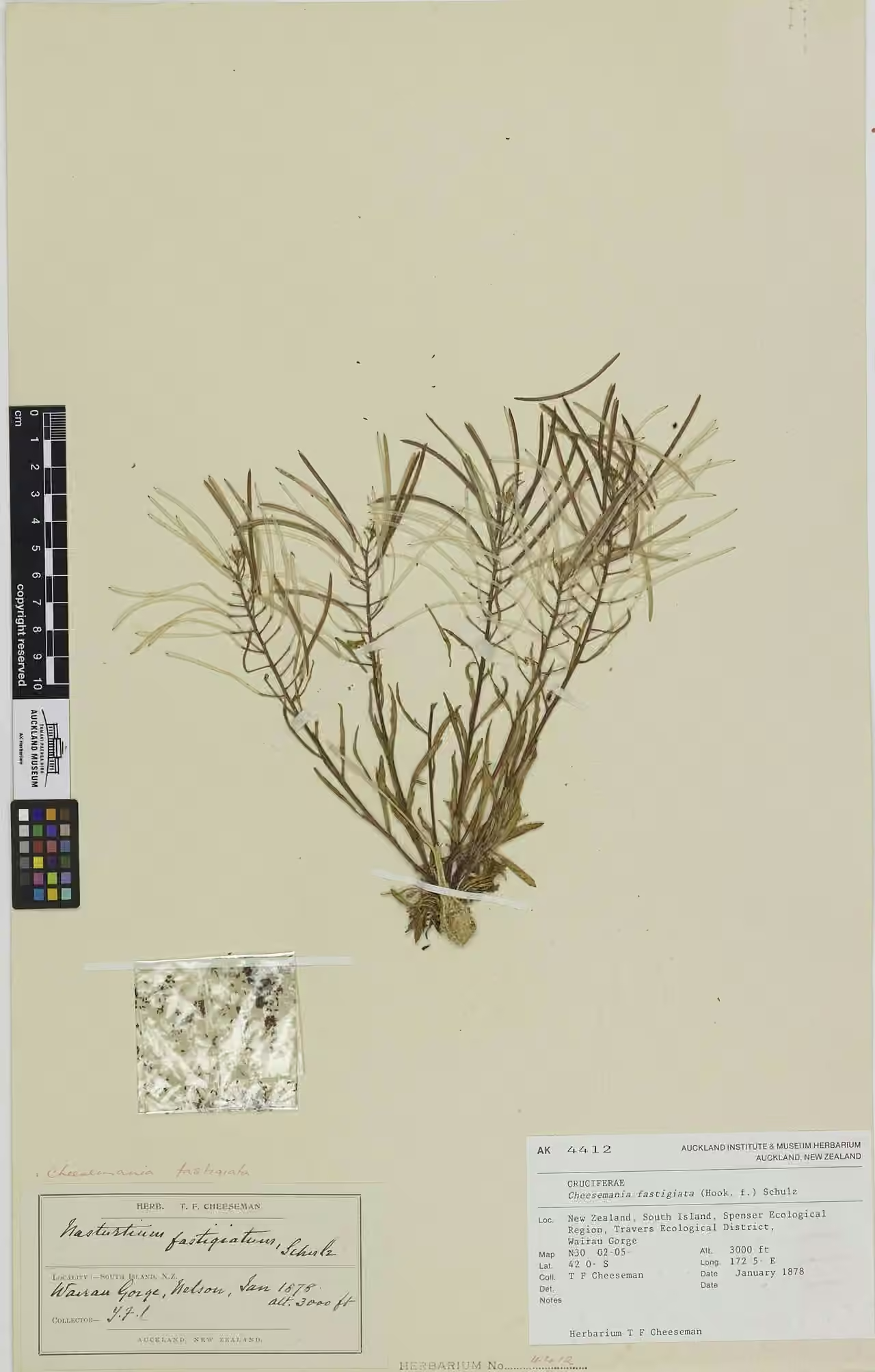
Hairless cress (Pachycladon fastigiatum) is an endemic perennial herb in the cabbage family that grows on upland and subalpine rocks in the drier interior mountains of the South Island, east of the Southern Alps from Marlborough to northern Southland. A stout woody base up to 1.8 cm across carries dense rosettes of hairless, fleshy, deeply toothed leaves, and in early summer it sends up flowering stems to 35 cm topped with white four-petalled flowers. It is ranked At Risk - Declining. NZPCN notes it is difficult to grow and should not be taken from the wild. Explore more native flowering plants in our native plant guide.
Plant Description
Pachycladon fastigiatum is a perennial herb with a stout base up to 1.8 cm in diameter, crowned by one or more dense rosettes of hairless, fleshy leaves. Each leaf is up to 7 cm long and deeply and sharply toothed. The thick, succulent texture helps the plant cope with the dry rock faces it grows on.
In December and January it produces flower stems up to 35 cm tall, either simple or branched. The white flowers have four petals in the cross pattern typical of the cabbage family and are up to 8 mm across. They are followed between January and March by narrow seed pods 4 cm or more long and 1.5 to 2 mm wide, straight to curved, holding seeds 1 to 1.5 mm long.
NZPCN separates it from its nearest relatives, Pachycladon enysii and Pachycladon stellatum, by its completely hairless leaves with sharp teeth and its tall flowering stems; both of those species have hairy leaves. The species name fastigiatum means fastigiate, with branches held close together, parallel and erect, which describes the upright branching of its flower stems.
Quick Facts
| Scientific Name | Pachycladon fastigiatum |
|---|---|
| Height | Rosette low; flowering stems to 35 cm |
| Spread | Clumps of rosettes on a stout base; width not recorded in sources consulted |
| Water Needs | Low; grows on rock in dry interior mountains |
| Light | Full sun to light shade on open rock |
| Frost Tolerance | High; an upland to subalpine species |
| Salt Tolerance | Not recorded; an inland mountain plant, so assume low |
| Growth Rate | Slow |
| Lifespan | Perennial |
Climate Best Suited to
Suited to the dry, continental climate of the South Island's eastern interior mountains, with cold snowy winters, hot dry summers and low humidity.
Regional Suitability
| City | Climate Suitability |
|---|---|
| Auckland | Low |
| Wellington | Low |
| Christchurch | Medium |
| Dunedin | Medium |
Plant Habitat
Hairless cress is endemic to the South Island, where it is found east of the Southern Alps from Marlborough south to northern Southland. This places it in the rain shadow of the main divide, in the drier inland ranges of Marlborough, Canterbury and Otago.
NZPCN describes its habitat as upland to subalpine rocks of the drier interior mountains. It roots into cracks and ledges on outcrops and bluffs, where competition from grasses and shrubs is limited and the fleshy leaves allow it to ride out long dry spells.
Growing Requirements
Soil Requirements
In the wild it grows in shallow crevice soils on rock outcrops rather than in deep soil.
- Very free-draining, stony or gritty mix
- Low fertility; rich garden soil encourages rot
- Deep root run into a rock crevice is ideal
Light Requirements
It grows on open rock faces in the mountains and needs bright light.
- Full sun or bright, open positions
- Good air movement around the rosettes
Water Requirements
Its home ranges are among the driest mountains in New Zealand, and the fleshy leaves store water.
- Water sparingly and never leave it sitting wet
- Keep the crown dry in winter
- Avoid humid, still conditions
Planting and Establishing
This is not a plant for general garden planting. NZPCN states that it is difficult to grow, should not be removed from the wild, and is not commercially available. Anyone working with it for conservation or research should source it from seed or plants already held legally in cultivation.
Specialist growers who do try it should treat it like other dry-country alpine crevice plants: plant into a deep pot or a vertical crevice in a rock garden or alpine house, packed with grit so the crown sits clear of moisture, and protect it from slugs and snails.
Ecological Role
Like other members of the cabbage family, its four-petalled white flowers are open to a range of small insects, but no study of its specific pollinators was found in the sources consulted. The seed pods split to release small seeds that fall into nearby rock crevices.
As a plant of rock outcrops, it is part of the specialised cliff and bluff flora of the eastern South Island mountains. These rock faces act as refuges from grazing and fire for many plants.
Uses & Significance
Garden Uses
Hairless cress has very limited garden use because it is difficult to cultivate and not available from nurseries.
- Alpine house or specialist crevice garden only
- Conservation and botanic garden collections
- Not suitable for general amenity planting
Ecological Value
It is a declining endemic species and part of a small New Zealand genus of rock-dwelling cresses.
- Contributes to the distinctive flora of dry inland rock outcrops
- Provides nectar and pollen for small insects in early summer
- Represents genetic diversity within the endemic Pachycladon group
Landscaping Uses
In landscape terms, hairless cress belongs on rock: its tight rosettes of fleshy toothed leaves and tall sprays of white flowers look natural tucked into a crevice or at the base of a boulder in a dry alpine scheme.
Because it is not sold and should not be collected, it is best appreciated in the wild on the drier ranges east of the Alps, or in botanic garden alpine collections where conservation material is held.
Seasonal Care Calendar
Spring
New leaves expand in the rosettes as the snow clears from the rocks.
- Check cultivated plants for slug damage
- Begin light watering as growth resumes
Summer
Flowering takes place in December and January, with white flowers on stems up to 35 cm tall, and seed pods start forming from January.
- Look for flowering plants on dry inland rock outcrops
- Do not pick flowering stems in the wild
Autumn
Fruiting continues until March, when the narrow pods ripen and release their small seeds.
- Collect seed only from cultivated plants
- Sow seed fresh
Winter
The rosettes sit dormant through cold, often snowy mountain winters.
- Keep cultivated plants dry at the crown
- Protect pots from prolonged wet
When to Prune and How Much
No pruning is needed. Once seed has been collected or shed, the old flowering stems can be cut back at their base to tidy a cultivated plant, taking care not to damage the rosettes.
Remove any yellowing or rotting leaves promptly from cultivated plants, as decay can spread into the crown in damp conditions.
How to Grow Hairless Cress
NZPCN describes Pachycladon fastigiatum as difficult to propagate and states that it should not be removed from the wild. No detailed published propagation protocol for this species was found in the sources consulted, so the methods below describe the general approach used for alpine members of the cabbage family rather than proven techniques for this species. Material should come only from plants already held legally in cultivation, or be collected under permit for a recognised conservation programme, and growers should expect slow growth and losses to rot in humid conditions.
From Seed
Seed is the most practical route. Pods ripen between January and March and the seeds are small, 1 to 1.5 mm long. Many alpine crucifers germinate best from fresh seed exposed to a period of winter cold.
- Collect pods from cultivated plants as they turn brown in late summer
- Sow fresh seed thinly on a gritty, free-draining seed mix
- Cover lightly with fine grit and leave the pot outside over winter
- Prick out seedlings individually into deep pots once they have a few true leaves
- Grow on in full light with careful watering
From Cuttings
Where a cultivated plant has several rosettes on its branched base, a side rosette can sometimes be detached and rooted, although success with this species has not been documented.
- Remove a small side rosette with a short piece of stem in spring
- Let the cut surface dry for a day
- Insert into pure pumice or coarse sand kept barely moist
- Keep in bright shade with good ventilation until roots form
Pests & Diseases
Slugs and snails are the main risk to cultivated plants, as they readily graze fleshy rosette leaves. In the wild, browsing by introduced animals such as hares, rabbits, goats and possums is a likely pressure on accessible plants, although specific records for this species were not found in the sources consulted.
In cultivation, rot of the crown and roots in wet or humid conditions is a more common cause of loss than insect pests. Cabbage white butterfly caterpillars, which feed on many plants in the cabbage family, may also attack cultivated plants.
Cultural Significance
No Māori name or traditional Māori use is recorded for Pachycladon fastigiatum in the sources consulted.
The species was first described by Joseph Hooker and later moved through several genera, including Cheesemania, before being placed in Pachycladon by Peter Heenan and Anthony Mitchell after molecular study of the group. Pachycladon has become of interest to scientists studying how plants of the cabbage family colonised and diversified in New Zealand.
Bonus Tip
To tell hairless cress from the other cresses on a dry inland bluff, run a finger over a leaf: Pachycladon fastigiatum is completely smooth with sharp teeth, whereas Pachycladon enysii and Pachycladon stellatum have hairy leaves. Look at the photos rather than picking, as this is a declining species.
Related Plants
Explore other native plants that share similar characteristics or habitats with Hairless Cress (Pachycladon fastigiatum), offering further insights into New Zealand's diverse flora. These related species provide context and opportunities for complementary planting in your garden.
Stylidium subulatum
Stylidium subulatum
White Oxalis
Oxalis magellanica
Thompson's Oxalis
Oxalis thompsoniae
Mountain Tauhinu
Ozothamnus vauvilliersii
Pachycladon latisiliquum
Pachycladon latisiliquum
Pachycladon novae zelandiae
Pachycladon novae zelandiae
Pachycladon wallii
Pachycladon wallii
Shawia minor
Shawia minor
Plant Conservation
Pachycladon fastigiatum is ranked At Risk - Declining in the 2023 New Zealand Threat Classification, with qualifiers noting that it is data poor for both population size and trend. This means it is still present across a wide arc of the eastern South Island but is thought to be decreasing.
Likely pressures include browsing animals, weed invasion of rock outcrops and disturbance of accessible sites. Protecting rock outcrop habitats from browsers, controlling weeds, recording populations so the trend can be measured, and leaving wild plants undisturbed all help.
Frequently Asked Questions
Why is Pachycladon fastigiatum called hairless cress?
Unlike its close relatives Pachycladon enysii and Pachycladon stellatum, which have hairy leaves, its fleshy rosette leaves are completely hairless, and it belongs to the cress or mustard family Brassicaceae.
Where does hairless cress grow in New Zealand?
It grows only in the South Island, east of the Southern Alps from Marlborough to northern Southland, on upland to subalpine rock outcrops in the drier interior mountains.
Is Pachycladon fastigiatum threatened?
Yes. The 2023 New Zealand Threat Classification ranks it At Risk - Declining, meaning its populations are thought to be shrinking even though it is not yet classed as Threatened.
Can you buy hairless cress for the garden?
No. NZPCN records it as not commercially available, difficult to cultivate, and a plant that should not be removed from the wild.
Sources and Further Reading
The botanical, growing, and conservation details for Hairless Cress (Pachycladon fastigiatum) on this page draw on the New Zealand plant references below. Consult them for full technical records and the latest distribution data.