Ladder Fern
Nephrolepis flexuosa
Last updated:
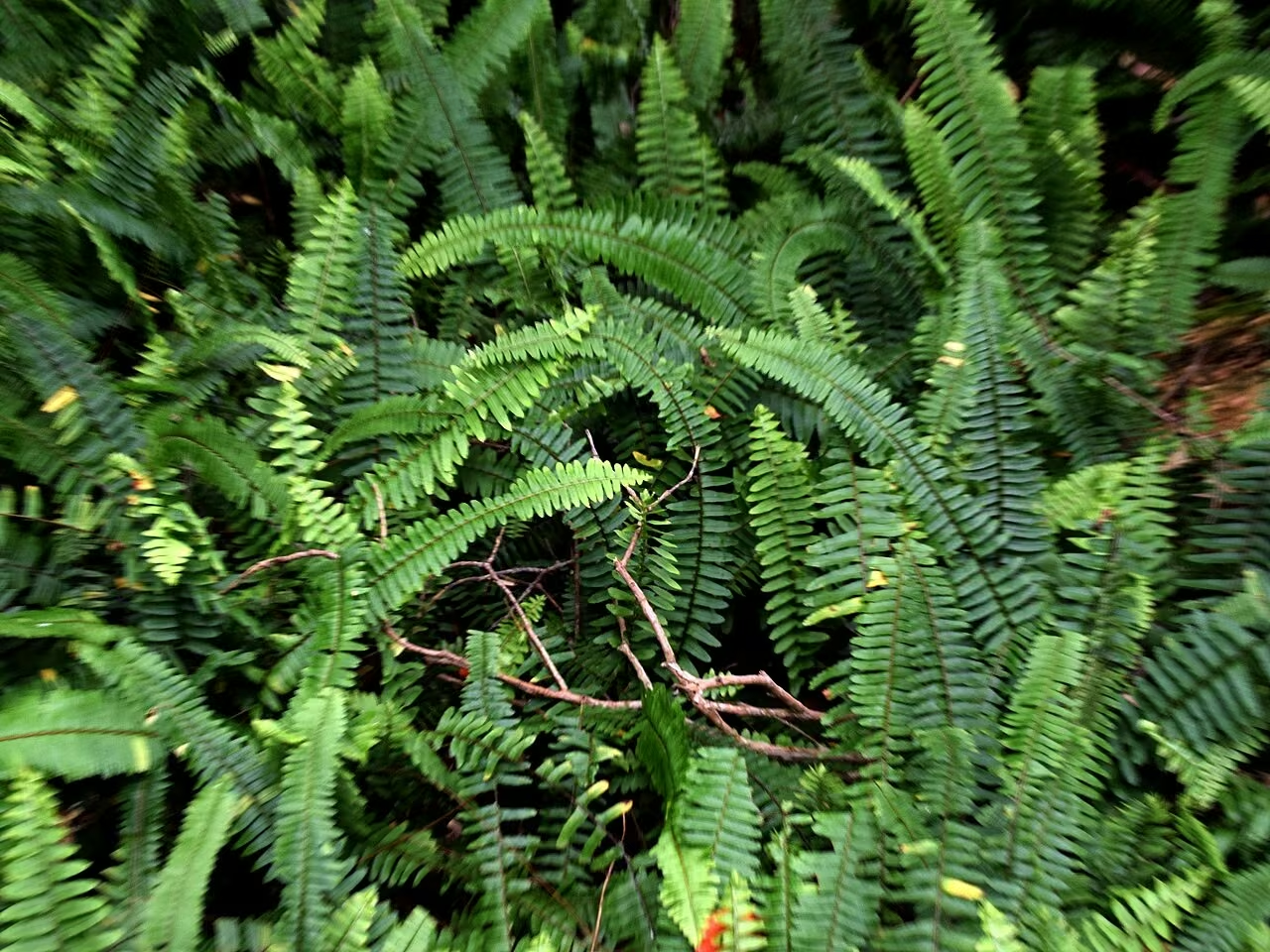
Nephrolepis flexuosa is an indigenous ladder fern with narrow, once-divided fronds that grow erect at first and then droop, usually 0.2-0.8 m long. On mainland New Zealand it grows only on thermally heated ground in the central North Island, from Kawerau south to Tokaanu near Lake Taupō, beside hot streams and springs and on steaming cliffs. It is also abundant in forest and shrubland on Raoul Island in the Kermadecs, and occurs on several Pacific islands. It is ranked At Risk - Naturally Uncommon and is threatened locally by the weedy, tuber-forming Nephrolepis cordifolia. Explore more native ferns in our native plant guide.
Plant Description
Nephrolepis flexuosa is a terrestrial fern with short, erect, densely scaly rhizomes that send out long-creeping runners bearing buds, from which new plants arise. Unlike the closely related N. cordifolia, these runners never produce round water-storing tubers.
The fronds are once-pinnate, narrowly elliptic to linear and taper to the tip. They are at first erect but tend to droop with age, usually 0.2-0.8 m long and 10-50 mm wide, and yellow-green on both surfaces. Each frond has many pairs of small, closely set pinnae, typically 35-85 pairs, giving the ladder-like appearance typical of the genus.
The round sori sit closer to the pinna margin than to the midrib and are covered by crescent-shaped or occasionally kidney-shaped indusia that open toward the pinna tip. Compared with N. cordifolia, the fronds are narrower and more gracefully drooping, and the plant is tetraploid (2n = 164). The Kermadec N. brownii has longer, sickle-shaped pinnae with fringed scales beneath.
Quick Facts
| Scientific Name | Nephrolepis flexuosa |
|---|---|
| Height | Fronds usually 0.2-0.8 m, rarely to 1.5 m |
| Spread | Spreads by long creeping runners |
| Water Needs | Moist; grows on warm, damp ground |
| Light | Partial shade to sun |
| Frost Tolerance | Low; confined to heated ground on the mainland |
| Salt Tolerance | No reliable information available |
| Growth Rate | Moderate to fast in warmth |
| Lifespan | Perennial |
Climate Best Suited to
A subtropical fern that on mainland New Zealand survives only on geothermally heated ground. It does not tolerate frost and needs warmth year-round.
Regional Suitability
| City | Climate Suitability |
|---|---|
| Auckland | Medium |
| Wellington | Low |
| Christchurch | Low |
| Dunedin | Low |
Plant Habitat
In New Zealand Nephrolepis flexuosa is indigenous to the Kermadec Islands (Raoul Island) and the North Island volcanic plateau, from Kawerau south to Lake Taupō, with its southern limit at Tokaanu near Tūrangi. It occurs from 20-760 m altitude. Overseas it is known from Norfolk Island, Lord Howe Island, Fiji and the Cook Islands, and perhaps further afield.
On the mainland it grows only on thermally heated ground, beside hot streams and springs and on steaming cliffs. On Raoul Island it is abundant throughout the main forest types and shrubland and also grows as an epiphyte, including on planted Pinus radiata.
Growing Requirements
Soil Requirements
In the wild it grows on warm, often acidic geothermal soils and rock.
- Free-draining, humus-rich mix in cultivation
- Tolerates thin soils on banks and cliffs
- Keep evenly moist
Light Requirements
It grows in both open geothermal scrub and forest, so it tolerates a range of light.
- Bright filtered light or partial shade
- Tolerates sun where moisture and humidity are good
- Avoid deep shade, which makes fronds sparse
Water Requirements
Its geothermal habitats are steamy and humid, so it does best with steady moisture.
- Keep the soil moist but not waterlogged
- High humidity is beneficial
- Water more in warm weather
Planting and Establishing
Outside its geothermal range it is best grown in a pot in a frost-free, humid spot such as a sheltered courtyard, conservatory or bathroom, or outdoors in frost-free northern gardens.
Because the naturalised N. cordifolia is a weed, make sure you have true N. flexuosa, which never forms tubers, before planting, and never plant ladder ferns near geothermal sites where wild populations grow.
Ecological Role
On geothermal fields it is part of a specialised plant community of heat-tolerant ferns, mosses and shrubs that survive only where warm ground allows subtropical species to persist far south of their usual range.
It spreads vegetatively by runners and sexually by spores. NZPCN notes that the tuber-forming N. cordifolia and invasive blackberry compete with it, and some geothermal populations have been lost.
Uses & Significance
Garden Uses
It is a graceful fern for warm, humid conditions and specialist collections.
- Pot or hanging basket plant in frost-free areas
- Conservatory or indoor fern
- Geothermal garden restoration using local stock
Ecological Value
Its mainland populations are a key part of New Zealand's rare geothermal vegetation.
- Characteristic of heated ground and hot stream margins
- Range-restricted indigenous fern
- Indicator of intact geothermal habitat
Landscaping Uses
Its narrow, drooping yellow-green fronds look best spilling from a raised pot, a basket or the top of a wall where the arching habit can be appreciated.
In a frost-free garden it can be massed in a sheltered, humid corner, though its runners need to be kept in check.
Seasonal Care Calendar
Spring
New fronds unfurl as temperatures rise.
- Divide crowded clumps
- Repot container plants
Summer
Active growth and runner production.
- Keep moist and humid
- Remove runners that stray
Autumn
Fronds mature and spores ripen.
- Collect fertile fronds for spores
- Tidy old fronds
Winter
Growth slows; frost will damage it.
- Move pots under cover
- Water sparingly
When to Prune and How Much
Cut old, brown or damaged fronds at the base in spring to keep the plant fresh.
Trim back runners that escape from pots or beds, and dispose of them carefully.
How to Grow Ladder Fern
NZPCN describes Nephrolepis flexuosa as easy to propagate from division of whole plants and also from fresh spores, which take about six to eight months to produce young plants. Division of the runner-borne plantlets is the quickest method. Raise plants from cultivated stock rather than wild geothermal populations, which are small and naturally uncommon, and never plant cultivated ladder ferns near those sites.
By Division
Runners produce young plants along their length, and established clumps can be split. Division is fastest in spring when growth resumes.
Each plantlet usually establishes quickly once it has its own roots.
- Lift the clump or locate a plantlet that has rooted along a runner
- Cut the runner or separate the clump into sections with roots and fronds
- Pot into a moist, free-draining fern mix
- Keep warm, humid and out of direct sun
- Grow on until new fronds appear, then plant out or repot
From Spores
Spores are produced in sori under crescent-shaped indusia near the pinna margins. Collect them when the sori turn brown and sow fresh.
Spores are slow, so division is the better choice if you only need a few plants.
- Place a fertile frond on clean paper for a day or two to drop spores
- Sow the spores thinly on sterilised, moist fern mix
- Cover with clear plastic or glass to keep humidity high
- Keep warm and in indirect light; expect young plants in 6-8 months
- Prick out small clumps of sporelings once they have true fronds
Pests & Diseases
No specific pests are recorded in the sources consulted. In cultivation, cold, frost and dry air are the main causes of browning fronds.
In the wild, competition from the naturalised N. cordifolia and invasive blackberry are the main threats NZPCN identifies on geothermal sites.
Cultural Significance
No Māori name or traditional use specific to Nephrolepis flexuosa is recorded in the sources consulted.
It has a complicated naming history: mainland plants were long confused with N. cordifolia, and the name N. flexuosa was formally reinstated for them in 2005, though that same revision treated it as part of N. cordifolia. NZPCN and the New Zealand Flora continue to recognise it as a distinct species.
Bonus Tip
To check whether a ladder fern is N. flexuosa or the weedy N. cordifolia, gently dig around the runners: N. cordifolia forms rounded underground tubers, while N. flexuosa has none.
Related Plants
Explore other native plants that share similar characteristics or habitats with Ladder Fern (Nephrolepis flexuosa), offering further insights into New Zealand's diverse flora. These related species provide context and opportunities for complementary planting in your garden.
Plant Conservation
Nephrolepis flexuosa is ranked At Risk - Naturally Uncommon because on the mainland it is confined to a small number of geothermal fields. NZPCN reports that some populations have become extinct.
Protecting geothermal vegetation, removing N. cordifolia and blackberry, and preventing garden ladder ferns from escaping into these sites all help the species.
Frequently Asked Questions
Where does Nephrolepis flexuosa grow in New Zealand?
It grows on geothermal ground in the North Island from Kawerau south to Lake Taupō, with its southern limit at Tokaanu, and in forest and shrubland on Raoul Island in the Kermadec Islands.
How is Nephrolepis flexuosa different from Nephrolepis cordifolia?
N. flexuosa never forms the round underground tubers of the naturalised N. cordifolia, has narrower, more graceful drooping fronds, and has twice the chromosome number (2n = 164 versus 82).
Why does this fern grow around hot springs?
It is a subtropical fern, and on the mainland it survives only where geothermal heat keeps the ground warm, beside hot streams and springs and on steaming cliffs.
Is Nephrolepis flexuosa threatened?
It is ranked At Risk - Naturally Uncommon. Some populations have been lost, and spreading N. cordifolia and blackberry compete with it on geothermal sites.
Sources and Further Reading
The botanical, growing, and conservation details for Ladder Fern (Nephrolepis flexuosa) on this page draw on the New Zealand plant references below. Consult them for full technical records and the latest distribution data.