Swamp Mapou
Myrsine coxii
Last updated:
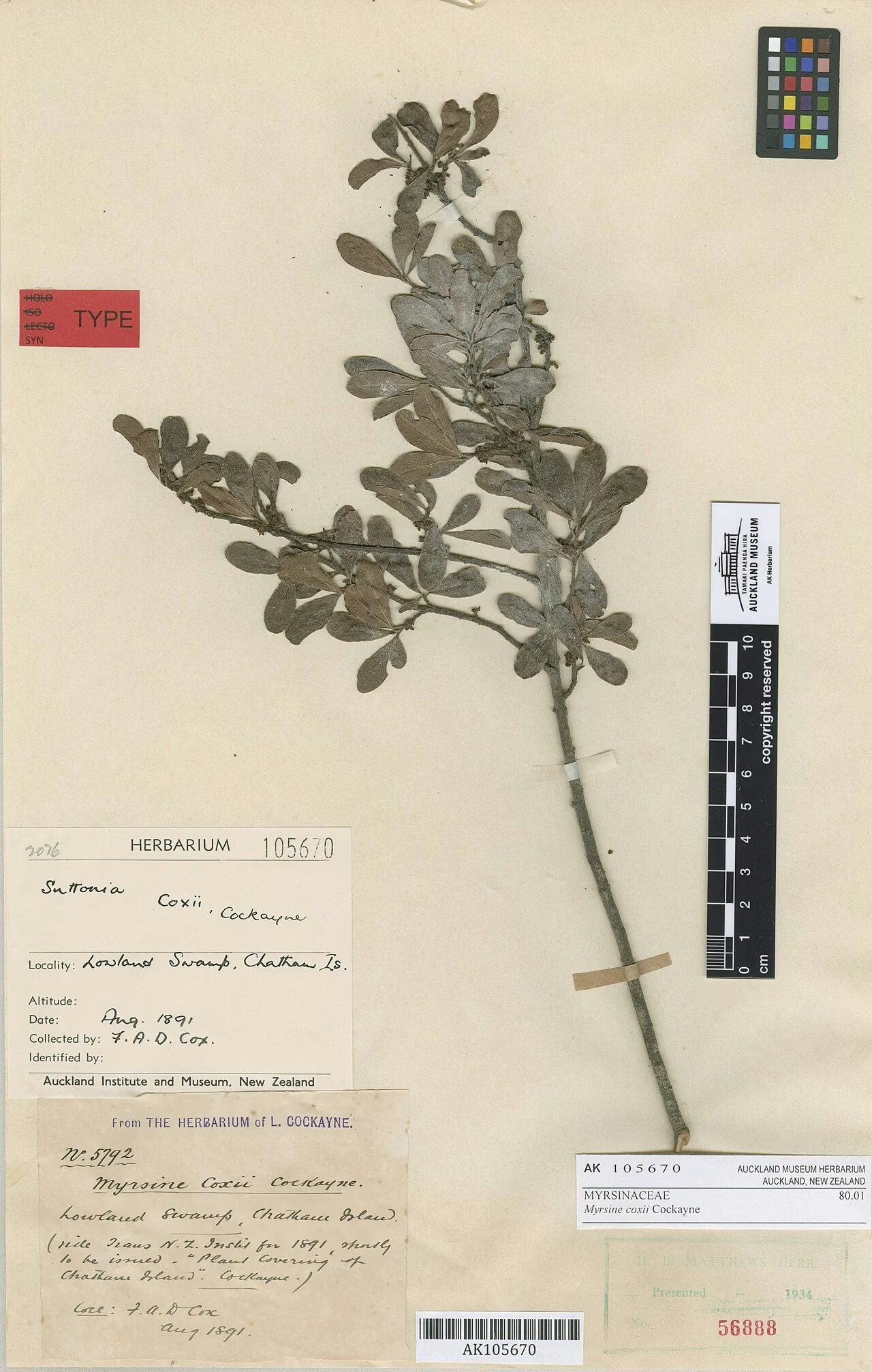
Swamp mapou (Myrsine coxii), also called Cox's matipo, is a shrub or small tree endemic to the Chatham Islands. It grows on waterlogged peat in bogs, at forest and lake margins and along streams, mainly in southern Rekohu/Chatham Island, with smaller numbers on Rangiauria/Pitt Island and Rangatira/South East Island. It is unusual among New Zealand Myrsine in spreading by creeping underground stems that send up new plants as far as 10 m away, forming dense stands of upright, multi-trunked plants. It is ranked At Risk - Declining because seedlings are scarce and recruitment appears to be failing. Explore more native shrubs in our native plant guide.
Plant Description
Swamp mapou is a shrub or small gynodioecious tree, with plants bearing either female or bisexual flowers. NZPCN gives a height up to 12 m while the older Flora of New Zealand gives about 4 m. Plants are multi-trunked with red-brown to dark brown bark and numerous fastigiate, pitchfork-like branches, and young branchlets carry stiff white hairs. Creeping underground stems produce offset plants up to 10 m from the parent.
The leaves are leathery, densely clustered along the branchlets, 8-20 mm long and 5-12 mm wide, obovate to oval with entire, thickened margins. Flowers appear from May to September and are cream, pale yellow or wine-red, sometimes spotted purple-black, borne singly or in small clusters.
The fruit is a globose drupe 6-8 mm across, dark violet to purple-black, recorded from June through to November. It differs from the other Chatham Islands species, Myrsine chathamica, in its columnar habit, fastigiate branching, smaller inrolled leaves and its habit of root-suckering.
Quick Facts
| Scientific Name | Myrsine coxii |
|---|---|
| Height | About 4 m, reported up to 12 m |
| Spread | Forms stands; suckers up to 10 m from parent |
| Water Needs | High; grows on waterlogged peat |
| Light | Partial shade to sun; prefers shade in cultivation |
| Frost Tolerance | Light frosts; from a mild oceanic climate |
| Salt Tolerance | No reliable information available |
| Growth Rate | Slow |
| Lifespan | Perennial; long-lived woody plant |
Climate Best Suited to
It comes from the cool, windy, humid oceanic climate of the Chatham Islands. In cultivation it needs constant moisture and shelter rather than heat.
Regional Suitability
| City | Climate Suitability |
|---|---|
| Auckland | Low |
| Wellington | Medium |
| Christchurch | Low |
| Dunedin | Medium |
Plant Habitat
Myrsine coxii is endemic to the Chatham Islands, recorded from Rekohu/Chatham Island, Rangiauria/Pitt Island and Rangatira/South East Island. It is most common in the south of Rekohu and very uncommon on Rangiauria.
It grows on waterlogged peaty ground in forest and at lake margins and is prominent in restiad bogs. It also forms dense stands along stream sides and around the margins of forest clearings. NZPCN rates it a facultative wetland plant.
Growing Requirements
Soil Requirements
It is a plant of deep, wet, acidic peat, and NZPCN notes it prefers peaty, damp soils in cultivation.
- Peaty, acidic, permanently moist soil
- Tolerates waterlogging
- Mulch heavily to keep roots cool and wet
Light Requirements
In cultivation NZPCN recommends shaded sites, although in the wild it also grows in open bogs.
- Partial shade is safest in gardens
- Shelter from drying wind
- Tolerates sun where soil stays wet
Water Requirements
Constant moisture is essential, reflecting its bog and swamp habitat.
- Never allow the soil to dry
- Suits pond margins and boggy hollows
- Water generously in summer
Planting and Establishing
Choose a damp, sheltered, partly shaded spot with peaty soil, such as the edge of a pond or a bog garden. Dig in plenty of peat-rich organic matter if the soil is mineral.
Plant suckered pieces or seedlings in autumn or spring and keep them well watered while they establish.
Ecological Role
Its dark fleshy fruits are likely eaten by birds, though no specific dispersers are documented in the sources consulted. The species relies heavily on clonal spread through root suckers, which allows stands to persist even where seedlings are scarce.
NZPCN notes that plants flower frequently but set little fruit, and that the reasons for its poor recruitment are not known and need research.
Uses & Significance
Garden Uses
It is a specialist plant for wet ground and conservation collections.
- Bog gardens and pond margins
- Chatham Islands plant collections
- Wetland restoration on the Chathams
Ecological Value
It is a characteristic shrub of Chatham Islands peat bogs and swamp forest margins.
- Forms dense stands in restiad bogs
- Fruit is a likely food for birds
- Part of the distinctive endemic Chatham flora
Landscaping Uses
Its upright, columnar shape and pitchfork-like branching give a distinctive vertical accent in a wet corner of a native garden.
Because it suckers, allow room for it to form a small colony rather than placing it in a tight border.
Seasonal Care Calendar
Spring
Late flowers finish and fruit continues to develop.
- Plant out new stock
- Check soil moisture
Summer
Active growth and sucker production.
- Keep well watered
- Top up mulch
Autumn
Flowering begins in May.
- Pot up rooted suckers
- Good time to plant
Winter
Flowers continue and fruit ripens from June onwards.
- Collect ripe purple-black fruit
- Protect young plants from hard frost
When to Prune and How Much
Pruning is rarely needed. Remove dead branches and any suckers growing where they are not wanted.
Its natural fastigiate shape is best left untrimmed.
How to Grow Swamp Mapou
NZPCN describes swamp mapou as difficult to propagate. It has been grown successfully from root suckers, which take advantage of the plant's natural habit of sending up new shoots from creeping underground stems. Fresh seed germinates easily but is rarely available, because the plants set little fruit. Only collect from cultivated plants or with permission from the Department of Conservation and landowners on the Chatham Islands.
From Root Suckers (Division)
Suckers arise from creeping underground stems and can be separated from the parent once they have their own roots. This is the method NZPCN reports as successful.
Suckers that are lifted with only a short length of underground stem and few roots often fail, so it is better to wait a season until the sucker has developed a good root system of its own before separating it.
- Locate a sucker growing some distance from the parent plant
- Dig carefully around it to find the connecting underground stem
- Sever the stem and lift the sucker with as much root as possible
- Pot into a damp, peaty mix and keep in shade
- Keep constantly moist until new growth shows it has established
From Seed
When fresh fruit can be obtained it germinates easily. Fruits ripen over winter and spring.
Because so little fruit is set, gather every ripe fruit available and sow it straight away rather than storing it.
- Collect fully ripe purple-black fruit
- Remove the flesh and sow fresh
- Use a moist, peat-based seed mix
- Keep the tray damp in a shaded, sheltered place
- Pot on seedlings into peaty mix when large enough to handle
Pests & Diseases
No specific garden pests are recorded. The greatest problem is drying out, which this bog plant does not tolerate.
In the wild the main concern is the lack of seedlings. Much Chatham Islands forest and peatland has also been cleared, burned or drained for farming, reducing the wetland habitat this species depends on.
Cultural Significance
NZPCN lists the name karupuru mataire for this species, but its origin and meaning could not be confirmed from the sources consulted, and no traditional Moriori or Māori use is documented there.
The names Cox's matipo and Myrsine coxii honour a person named Cox, but who this was could not be confirmed from the sources consulted. The species was previously known as Suttonia coxii and Rapanea coxii.
Bonus Tip
If you have a plant, look for suckers appearing some distance away: potting these up is the most reliable way to multiply swamp mapou, far easier than waiting for its scarce fruit.
Related Plants
Explore other native plants that share similar characteristics or habitats with Swamp Mapou (Myrsine coxii), offering further insights into New Zealand's diverse flora. These related species provide context and opportunities for complementary planting in your garden.
Stout Water Milfoil
Myriophyllum robustum

Myriophyllum triphyllum
Myriophyllum triphyllum
Small Water Milfoil
Myriophyllum votschii
Mt Burnett Matipo
Myrsine argentea
Neomyrtus pedunculata
Neomyrtus pedunculata
Nephrolepis flexuosa
Nephrolepis flexuosa
Rough Sword Fern
Nephrolepis brownii
Nertera balfouriana
Nertera balfouriana
Plant Conservation
Myrsine coxii is ranked At Risk - Declining (2023), with qualifiers including DPS, DPT, IE and RF. Plants flower frequently but produce limited fruit and seedlings are scarce.
Protecting the remaining Chatham Islands peat bogs and forest margins from drainage, fire and stock, and research into why recruitment is failing, as NZPCN urges, would help this species.
Frequently Asked Questions
Where is Myrsine coxii found?
Only in the Chatham Islands, on Rekohu/Chatham Island, Rangiauria/Pitt Island and Rangatira/South East Island. It is most common in southern Rekohu and very uncommon on Rangiauria.
How do you tell swamp mapou from Chatham Island matipo?
Myrsine coxii has a columnar habit, fastigiate branching and smaller inrolled leaves than Myrsine chathamica, and it is the only one of the two that suckers extensively from its roots.
Why is swamp mapou declining?
It flowers often but produces little fruit, and seedlings are scarce in the wild. NZPCN says this recruitment failure urgently needs further research.
Is Myrsine coxii easy to grow?
NZPCN describes it as difficult. It has been grown successfully from root suckers, and fresh seed germinates easily but is rarely available.
Sources and Further Reading
The botanical, growing, and conservation details for Swamp Mapou (Myrsine coxii) on this page draw on the New Zealand plant references below. Consult them for full technical records and the latest distribution data.