Mt Burnett Matipo
Myrsine argentea
Last updated:
Mt Burnett matipo (Myrsine argentea) is a rare endemic shrub or small tree found only on Mt Burnett in north-west Nelson, where it grows on dolomite karrenfield and in the surrounding cloud forest. It can reach 9 m but is often shrubby, with smooth grey bark and small notched leaves that are silver-green to cream-green with a dark blotch at the base. Its white fruits ripen in autumn. Described only in 1998, it belongs to the Myrsine divaricata complex and is ranked At Risk - Declining because of dolomite mining, weeds, possums and trampling. Explore more native shrubs in our native plant guide.
Plant Description
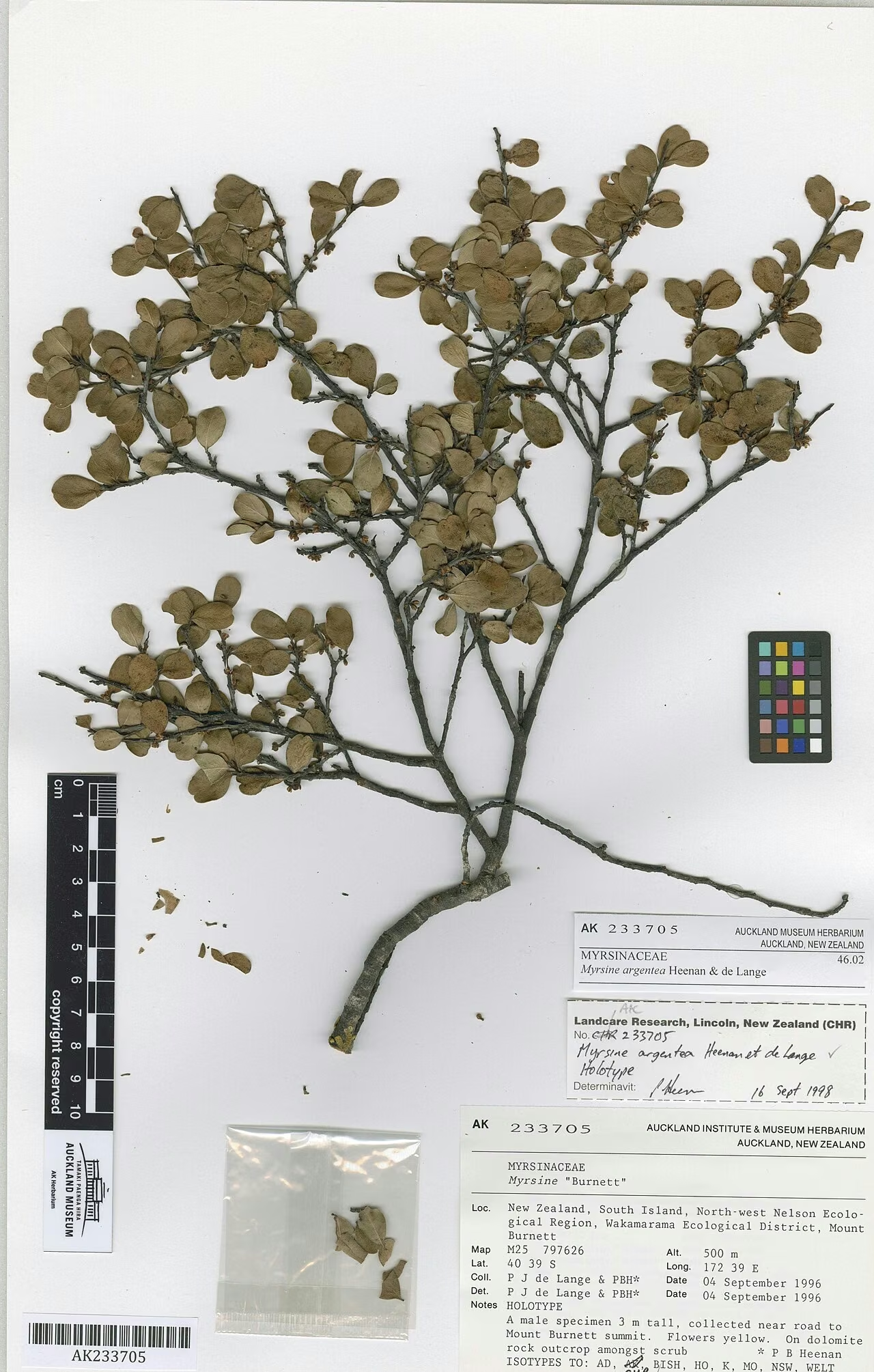
Mt Burnett matipo is a shrub or small tree up to 9 m tall with smooth grey bark that sometimes shows ring-like constrictions. The leaves are alternate, small at 5-20 mm long and 5-15 mm wide, obovate to obcordate with a notched (retuse) tip.
The foliage is the plant's most distinctive feature: silver-green to pale green or cream-green, with a dark blotch at the base of the leaf where it joins the stalk. The species name argentea means silvery.
Female flowers are solitary or in bunches of two to four, and male flowers in bunches of three to four. Flowering runs from August to October, peaking in September, and the round fruits are white, very rarely flushed pink at the base, ripening in April and May. It belongs to the Myrsine divaricata complex and is most likely to be confused with weeping matipo (M. divaricata), which has purple fruit.
Quick Facts
| Scientific Name | Myrsine argentea |
|---|---|
| Height | Shrub, or small tree up to 9 m |
| Spread | No reliable figure available |
| Water Needs | Moderate; from a moist cloud-forest site |
| Light | Full sun to partial shade |
| Frost Tolerance | Likely moderate; grows on an exposed upland site |
| Salt Tolerance | No information available |
| Growth Rate | Slow |
| Lifespan | Perennial; long-lived woody plant |
Climate Best Suited to
It grows in a wet, cloudy upland climate in north-west Nelson. In cultivation it is best in cool, moist conditions.
Regional Suitability
| City | Climate Suitability |
|---|---|
| Auckland | Low |
| Wellington | Medium |
| Christchurch | Medium |
| Dunedin | Medium |
Plant Habitat
Myrsine argentea is endemic to the South Island and known only from Mt Burnett, in the Burnett Range north-west of Collingwood in north-west Nelson. Its type specimen was collected there among scrub on dolomite rock outcrop.
NZPCN describes its habitat as dolomite karrenfield, a fluted and pitted rock surface formed by dissolution of the carbonate rock, and the cloud forest associated with it. This unusual substrate supports several other plants found nowhere else.
Growing Requirements
Soil Requirements
In the wild it roots into crevices and thin soils over dolomite, a magnesium-rich carbonate rock.
- Free-draining, stony soil in cultivation
- Wild plants grow on carbonate rock
- Avoid waterlogged heavy clay
Light Requirements
It grows in both open rock outcrops and cloud forest, so it tolerates a range of light.
- Full sun to partial shade
- Good light keeps the silvery foliage colour
- Shelter from hot drying winds
Water Requirements
Its natural site is frequently cloudy and wet, though water drains quickly through the rock.
- Keep evenly moist
- Water young plants in dry spells
- Good drainage is essential
Planting and Establishing
Plant in a sheltered, well-drained spot in spring or autumn, in a free-draining stony mix. A rock garden or raised bed suits its natural rocky habitat.
Because the species has one tiny wild range, buy plants raised from cultivated or authorised sources and never collect from Mt Burnett.
Ecological Role
Like other Myrsine species it has small separate-sex flowers, and its fleshy white fruits are likely eaten by native birds, though specific dispersers are not documented for this species.
It is one of a group of plants restricted to the north-west Nelson dolomite and marble country, and its survival depends on protecting that habitat.
Uses & Significance
Garden Uses
It is a collector's plant valued for its unusual silvery foliage and white fruit.
- Rock garden or specimen shrub
- Conservation collection of rare natives
- Contrast foliage among green-leaved shrubs
Ecological Value
As a local endemic it is an important part of the unique dolomite ecosystem of Mt Burnett.
- Part of a nationally distinctive limestone and dolomite flora
- Fruit is a likely food for native birds
- Cultivated plants act as insurance populations
Landscaping Uses
Use Mt Burnett matipo as a feature shrub where its silver-green leaves can be seen against darker foliage, or among rocks in a native rock garden.
Its slow, compact growth suits small gardens and containers while young.
Seasonal Care Calendar
Spring
Flowering runs from August to October, peaking in September.
- Plant out new stock
- Mulch to conserve moisture
Summer
New growth develops and fruit begins forming on female plants.
- Water in dry spells
- Shelter from hot wind
Autumn
White fruits ripen in April and May.
- Collect fresh fruit for sowing
- A good time to plant
Winter
The plant is largely dormant.
- Little care needed
- Check drainage after heavy rain
When to Prune and How Much
Little pruning is needed. Light trimming after flowering can keep the plant compact, but avoid heavy cuts on such a slow-growing species.
Remove any dead or damaged branches in late winter.
How to Grow Mt Burnett Matipo
NZPCN notes that Mt Burnett matipo is easily grown from fresh fruit and can also be grown from semi-hardwood cuttings, which can be slow to strike. Seed is the most reliable approach, but because the plants have separate male and female flowers, fruit is only produced on female plants. Use cultivated plants as the source of material, as the wild population is small and declining.
From Seed
Fresh fruit ripens in April and May. Sow promptly, as Myrsine seed generally germinates best fresh, and expect germination to take some months.
Grow seedlings on slowly in a cool, sheltered position. Young plants put on little height in their first year, and they should be hardened off gradually before planting out into a well-drained site.
- Collect ripe white fruit from a cultivated female plant
- Remove the flesh and rinse the seed
- Sow on the surface of a free-draining seed mix and cover lightly
- Keep moist in a sheltered, shaded spot
- Pot on seedlings once they have several true leaves
From Cuttings
Semi-hardwood cuttings will root but are slow, so patience and good hygiene are needed.
Taking a larger batch than you need allows for losses, and cuttings from vigorous young shoots usually root more readily than those from old, woody stems.
- Take 8-10 cm semi-hardwood cuttings in late summer or autumn
- Strip lower leaves and dip in rooting hormone
- Insert into a free-draining propagating mix
- Keep humid with bottom heat if possible
- Allow several months for roots to form before potting up
Pests & Diseases
No specific pests are recorded in cultivation. In the wild, possum browsing damages plants, and weeds, especially Mexican daisy (Erigeron karvinskianus), invade the rock habitat.
Trampling of the fragile karrenfield and dolomite mining are further threats listed by NZPCN.
Cultural Significance
No Māori name or traditional use specific to Myrsine argentea is recorded in the sources consulted. It was only recognised as a distinct species in 1998, when Peter Heenan and Peter de Lange described it as a new and remarkably local species.
The common name refers to Mt Burnett, its only known location, and to matipo, a name applied to several New Zealand Myrsine species.
Bonus Tip
Look at the base of each leaf: the dark blotch where the blade meets the stalk, combined with silver-green foliage and white fruit, is the quickest way to separate Mt Burnett matipo from the common weeping matipo.
Related Plants
Explore other native plants that share similar characteristics or habitats with Mt Burnett Matipo (Myrsine argentea), offering further insights into New Zealand's diverse flora. These related species provide context and opportunities for complementary planting in your garden.
Common Water Milfoil
Myriophyllum propinquum
Stout Water Milfoil
Myriophyllum robustum
Myriophyllum triphyllum
Myriophyllum triphyllum
Small Water Milfoil
Myriophyllum votschii
Swamp Mapou
Myrsine coxii
Neomyrtus pedunculata
Neomyrtus pedunculata
Nephrolepis flexuosa
Nephrolepis flexuosa
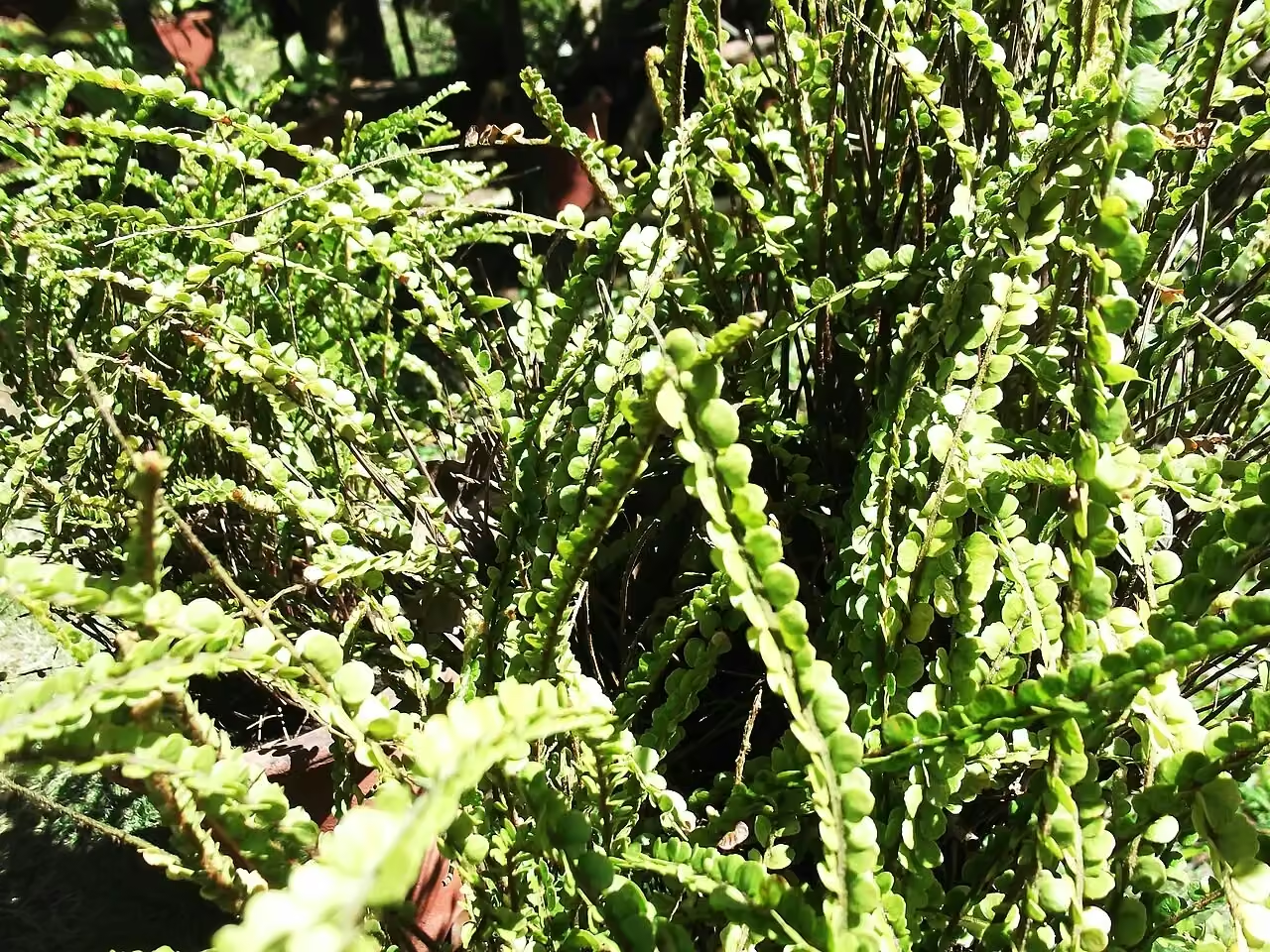
Rough Sword Fern
Nephrolepis brownii
Plant Conservation
Myrsine argentea is ranked At Risk - Declining (2023), with the qualifiers CD (conservation dependent) and OL (one location). Its entire wild population is on Mt Burnett.
NZPCN lists dolomite mining, weed invasion, possum browsing and trampling as threats. Protecting the dolomite habitat, controlling weeds and possums, and keeping cultivated insurance populations all help.
Frequently Asked Questions
Where does Myrsine argentea grow?
It is known only from Mt Burnett in the Burnett Range north-west of Collingwood, in north-west Nelson, growing on dolomite karrenfield and in nearby cloud forest.
How is Mt Burnett matipo different from weeping matipo?
It is closely related to Myrsine divaricata, but its leaves are silver-green to cream-green with a dark blotch where the leaf meets the stalk, and its fruit is white rather than purple.
Why is Myrsine argentea at risk?
NZPCN lists dolomite mining, weed invasion especially by Mexican daisy, possum browsing and trampling as threats to its single small natural range.
Can you grow Mt Burnett matipo from seed?
Yes. NZPCN says it is easily grown from fresh fruit, and semi-hardwood cuttings also work although they can be slow to strike.
Sources and Further Reading
The botanical, growing, and conservation details for Mt Burnett Matipo (Myrsine argentea) on this page draw on the New Zealand plant references below. Consult them for full technical records and the latest distribution data.