Stout Water Milfoil
Myriophyllum robustum
Last updated:
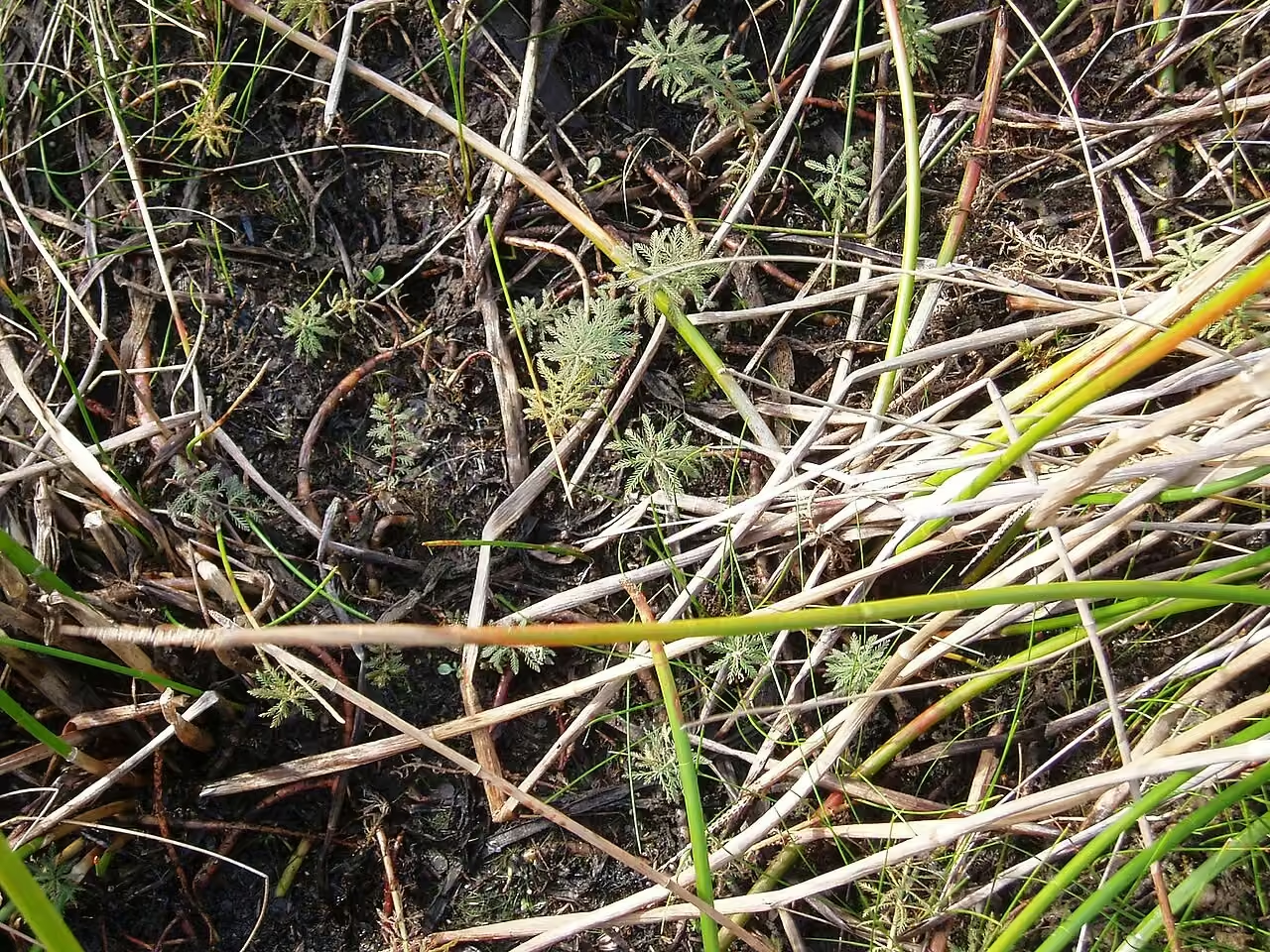
Stout water milfoil (Myriophyllum robustum) is an endemic perennial aquatic herb with thick, spongy stems and whorls of finely divided, feathery leaves. Emergent shoots carry glaucous, often red-tinged foliage, while submerged leaves are brown and soon decay. It grows in shallow peaty lakes, slow streams, dune ponds and muddy, seasonally flooded ground in alluvial forest, from Northland to Taranaki and on the West Coast of the South Island to Fiordland. It is ranked At Risk - Naturally Uncommon and is threatened by wetland drainage and weeds, yet NZPCN considers it an attractive pond plant that should be grown more widely. Explore more native flowering plants in our native plant guide.
Plant Description
Myriophyllum robustum is a perennial aquatic herb with stout, spongy, inflated stems that may be prostrate or upright. NZPCN gives stem lengths of up to 1.5 m, while the Flora of New Zealand describes stems to about 30 cm, probably reflecting the emergent portion. All leaves are in whorls. Submerged leaves, in whorls of 4-7, are finely divided into 26-32 hair-like segments, brown, and often decay early.
The emergent leaves are crowded towards the stem tips, glaucous or yellow-green and tinged red, narrowly ovate to oblong in outline and also finely divided. The flowers are small and bisexual, each with four sepals and four petals, borne in the leaf axils from about September to March. The fruits are small and almost globular, 1.5-2 mm long, with tubercles on the four segments, ripening from October to April.
It is most likely to be confused with parrot's feather (Myriophyllum aquaticum), a South American weed widespread in New Zealand waterways. Stout water milfoil usually has pink exposed stems and acute leaf tips, whereas parrot's feather has blunter leaf tips; NZPCN also notes the native is monoecious.
Quick Facts
| Scientific Name | Myriophyllum robustum |
|---|---|
| Height | Emergent shoots up to about 30 cm above water |
| Spread | Stems up to 1.5 m long |
| Water Needs | Aquatic; shallow water or permanently wet soil |
| Light | Full sun to part shade |
| Frost Tolerance | Moderate; lowland to montane |
| Salt Tolerance | Low; a freshwater plant |
| Growth Rate | Moderate to fast in suitable water |
| Lifespan | Perennial |
Climate Best Suited to
It suits mild, wet lowland climates of the northern North Island and the high-rainfall west of the South Island.
Regional Suitability
| City | Climate Suitability |
|---|---|
| Auckland | High |
| Wellington | Medium |
| Christchurch | Medium |
| Dunedin | Low |
Plant Habitat
Stout water milfoil is endemic to New Zealand. In the North Island it ranges from Northland to Taranaki and northern Rangitikei, and in the South Island it occurs in north-west Nelson, the West Coast and Fiordland. It is Regionally Declining in Northland and Regionally Critically Endangered in Auckland.
It grows in shallow peaty lakes, slow-flowing streams, dune ponds, and muddy or seasonally flooded ground in alluvial forest. It is an obligate wetland plant, found almost always in wetlands.
Growing Requirements
Soil Requirements
It roots into soft, peaty or muddy substrates under shallow water or in permanently wet ground.
- Peat and organic mud
- Permanently saturated or shallowly flooded soil
- Low-nutrient water is best; eutrophication harms it
Light Requirements
It grows in open water and in clearings and margins within swampy alluvial forest.
- Full sun to part shade
- Emergent shoots colour best in good light
Water Requirements
It is an obligate wetland plant that needs permanent water or saturated soil.
- Shallow standing or slow-moving water
- Never allow to dry out
- Clean, low-nutrient water
Planting and Establishing
Plant in the shallow margins of a pond or in permanently wet soil, setting rooted pieces into the mud so the shoot tips can grow above the water. A pot of peaty soil topped with gravel and sunk into the shallows also works and keeps the plant contained.
Choose plants from a nursery or a reliable cultivated source, and make sure you are not buying parrot's feather, which is a declared pest. Avoid adding fertiliser to the water, as nutrient enrichment is one of the threats to this species.
Ecological Role
Stout water milfoil forms part of the plant community of shallow peat lakes, dune lakes and swampy forest. Its spongy stems and submerged foliage provide shelter for aquatic invertebrates and small fish, as dense water plants generally do.
Specific information on its pollinators and seed dispersal was not found in the sources consulted. Like other water milfoils it can spread vegetatively when stem fragments root.
Uses & Significance
Garden Uses
NZPCN describes it as an attractive plant that should be more widely grown, and it is popular for ponds and aquaria.
- Shallow margins of garden ponds
- Bog gardens with permanently wet soil
- Aquaria
- Wetland restoration within its natural range
Ecological Value
It is an endemic, uncommon wetland plant that contributes to native aquatic habitat.
- Obligate wetland species
- Cover for aquatic invertebrates and fish
- Native alternative to the weed parrot's feather
Landscaping Uses
Its feathery, glaucous, red-tinged shoot tips and pink stems give a soft, textured edge to a pond. Plant it in drifts along shallow margins where the emergent shoots catch the light, contrasting with broad-leaved or upright wetland plants.
In wetland restoration it is best used in the shallow, peaty water it naturally favours, in regions where it occurs naturally.
Seasonal Care Calendar
Spring
Growth resumes and flowering begins from about September.
- Plant or divide rooted pieces
- Remove weeds from the pond margin
Summer
Flowering continues and fruits develop from October onwards.
- Keep water levels up during dry spells
- Thin growth if it crowds other plants
Autumn
Fruiting continues until about April as growth slows.
- Collect fruit for sowing
- Take cuttings while stems are still active
Winter
Growth slows and some submerged foliage decays, while the plant persists in the mud.
- No action needed
- Leave the stems in place to regrow
When to Prune and How Much
Trim back stems that spread too far, and remove decaying foliage to keep the water clear. Cut pieces can be used as cuttings.
Do not discard trimmings into natural waterways, and dispose of any plants you are unsure about, such as suspected parrot's feather, responsibly.
How to Grow Stout Water Milfoil
NZPCN describes stout water milfoil as easy to grow in a pond or in permanently damp soil, and notes it can be raised from division of rooted pieces, from cuttings and from seed. Vegetative methods are the quickest and most reliable, because the spongy stems root readily when kept wet. Seed is useful for conservation work where genetic diversity matters. Always start from cultivated or legitimately sourced material, as the species is uncommon in the wild and regionally critically endangered in Auckland. Be careful to confirm you are propagating the native species, not the similar-looking pest parrot's feather.
By Division
Established clumps produce rooted stems that can be separated in spring or summer. This gives sizeable plants quickly.
- Lift a clump from the pond margin
- Separate pieces that each have roots and shoots
- Replant into peaty mud in shallow water
- Keep the shoot tips at or just above the water surface
From Cuttings
Stem cuttings root easily in water or saturated soil, making this a simple way to increase plants during the growing season.
- Cut healthy stem tips about 10-15 cm long
- Remove the lowest leaves
- Insert into a pot of wet, peaty soil
- Stand the pot in a tray of water so the mix stays saturated
- Plant out once new roots and shoots have formed
From Seed
Fruits ripen from October to April. Seed can be sown on wet, peaty mix, though no specific germination data was found in the sources consulted.
- Collect ripe fruits in late summer or autumn
- Sow on the surface of saturated peaty mix
- Keep the tray standing in shallow water in good light
- Pot on seedlings once established
Pests & Diseases
No specific pests of stout water milfoil are recorded in the sources consulted. In ponds, algal growth driven by excess nutrients can smother it.
In the wild, NZPCN lists wetland drainage, eutrophication and the spread of naturalised wetland weeds as its main threats.
Cultural Significance
No Māori name or traditional use of stout water milfoil was found in the sources consulted. The genus name Myriophyllum means many leaves, and robustum means sturdy, referring to its stout stems.
Its main significance today is as an uncommon endemic of New Zealand's wetlands, most of which have been drained since European settlement.
Bonus Tip
Before planting any water milfoil, check the stems and leaf tips: stout water milfoil usually has pink exposed stems and pointed leaf tips. If you have the pest parrot's feather, remove it completely and replace it with the native, which gives a similar feathery look without the risk of choking waterways.
Related Plants
Explore other native plants that share similar characteristics or habitats with Stout Water Milfoil (Myriophyllum robustum), offering further insights into New Zealand's diverse flora. These related species provide context and opportunities for complementary planting in your garden.




Plant Conservation
Myriophyllum robustum was ranked At Risk - Declining in 2009, 2012 and 2017 and is now At Risk - Naturally Uncommon (2023), with qualifiers for sparse populations and climate impact. Regionally it is Declining in Northland, Critically Endangered in Auckland and Data Deficient in Wellington.
Protecting and restoring shallow peat lakes, dune lakes and swampy forest, reducing nutrient runoff, and controlling wetland weeds are the main ways to help it.
Frequently Asked Questions
How do you tell stout water milfoil from parrot's feather?
NZPCN notes it resembles the weed Myriophyllum aquaticum but has usually pink exposed stems, acute rather than blunt leaf tips, and plants that produce bisexual flowers.
Can I grow Myriophyllum robustum in a pond?
Yes. NZPCN says it is easy in a pond or in permanently damp soil, and is already grown as an aquarium and pond plant.
Where is stout water milfoil found in New Zealand?
In the North Island from Northland to Taranaki and northern Rangitikei, and in the South Island in north-west Nelson, the West Coast and Fiordland.
Why is stout water milfoil at risk?
It has a sparse natural distribution, and NZPCN lists wetland drainage, nutrient enrichment of waterways and the spread of naturalised wetland weeds as threats.
Sources and Further Reading
The botanical, growing, and conservation details for Stout Water Milfoil (Myriophyllum robustum) on this page draw on the New Zealand plant references below. Consult them for full technical records and the latest distribution data.