Nohi
Luzuriaga parviflora
Last updated:
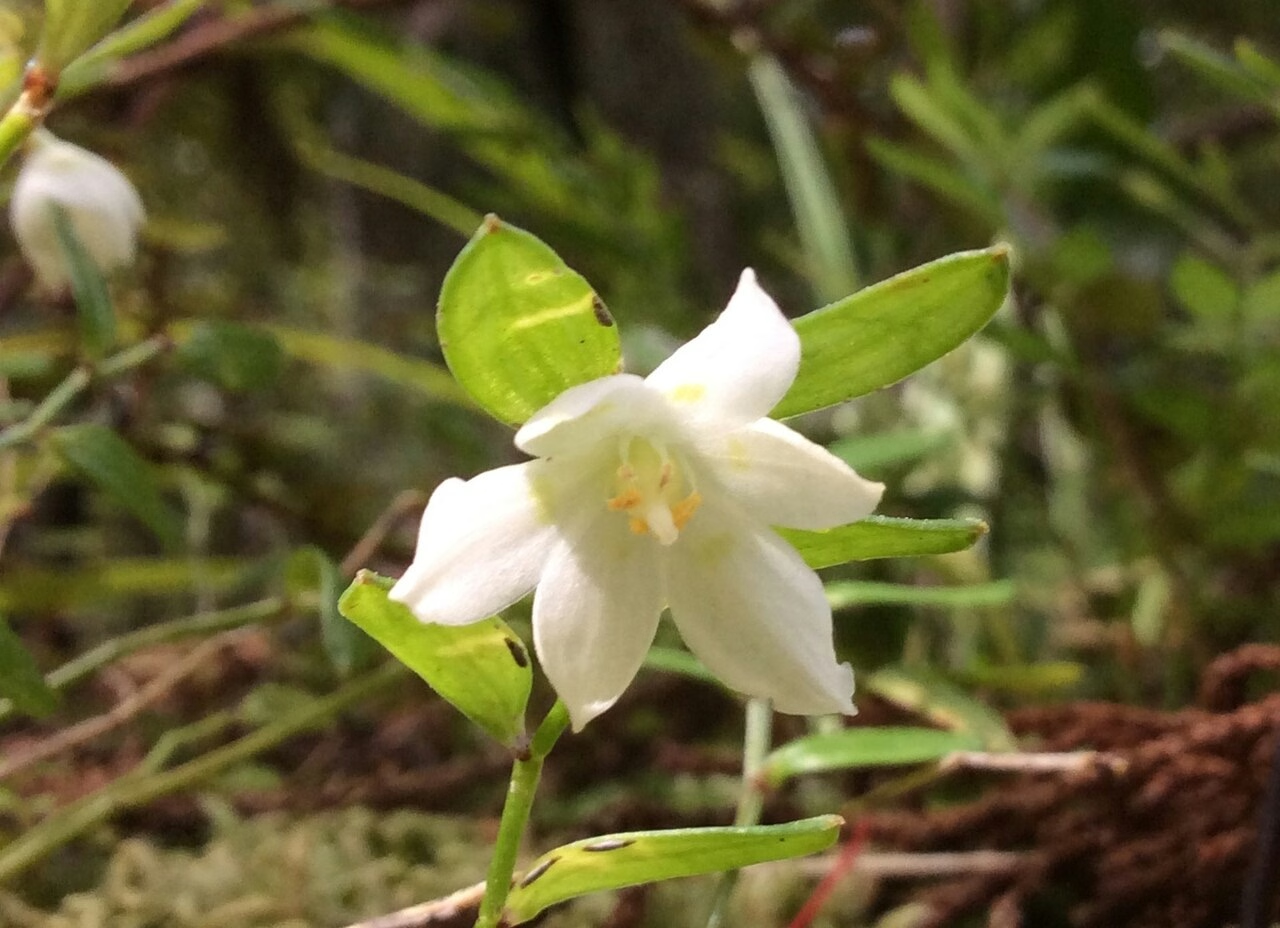
Nohi, also called pūwatawata or lantern berry (Luzuriaga parviflora), is a wiry, low-growing, semi-herbaceous perennial endemic to New Zealand. Its four-angled stems creep up to about 50 cm across mossy forest floors, sending up short twigs of glossy, oblong leaves. From December to March it bears solitary, nodding white flowers 8 to 18 mm long, followed by white, fleshy berries about 1 cm across. It grows in shady, mossy forest from the mountains of the Coromandel Peninsula south through the North and South Islands to Stewart Island/Rakiura, often climbing a little way up tree bases. It is ranked Not Threatened and is the only New Zealand member of the Alstroemeriaceae. Explore more native ground covers in our native plant guide.
Plant Description
Luzuriaga parviflora is a wiry, low-growing, semi-herbaceous perennial. Its four-angled stems, up to about 50 cm long, creep at the base and give rise to short aerial branching twigs up to 25 cm long. Each twig carries 4 to 12 leaves arranged alternately in two rows, in a zigzag pattern.
The leaves are glossy, oblong with a very short point, 7 to 27 mm long and 3 to 6 mm wide, with parallel veins and very short petioles. The petioles twist so that the leaf is resupinate: the lower surface faces upwards towards the light. The uppermost two leaves often appear opposite.
The flowers are solitary at the tips of the twigs, nodding, with six white tepals 8 to 18 mm long, giving a small lantern shape. They appear from December to March. The fruit is a sub-globose, white, fleshy berry about 1 cm across with a short point, containing pale, very hard seeds about 2.5 mm long. With its creeping wiry stems, two-ranked glossy leaves and white flowers and berries, it is unlike any other New Zealand forest-floor plant.
Quick Facts
| Scientific Name | Luzuriaga parviflora |
|---|---|
| Height | Twigs up to 0.25 m |
| Spread | Creeping stems to about 0.5 m |
| Water Needs | Constantly moist, humid conditions |
| Light | Shade to deep shade |
| Frost Tolerance | Good; grows to montane forest |
| Salt Tolerance | No information available; a forest-floor plant |
| Growth Rate | Slow |
| Lifespan | Long-lived perennial |
Climate Best Suited to
Suits cool, humid, high-rainfall forest climates, especially montane forest in the north and lowland to montane forest further south.
Regional Suitability
| City | Climate Suitability |
|---|---|
| Auckland | Low |
| Wellington | Medium |
| Christchurch | Low |
| Dunedin | Medium |
Plant Habitat
Nohi is endemic to New Zealand. It ranges from the mountains of the Coromandel Peninsula south through the North Island and the South Island to Stewart Island/Rakiura. Its altitude depends on latitude: in the Remutaka, Akatarawa and Tararua Ranges it is typically found at about 550 to 800 m, while further south it descends lower. Auckland lists it as Regionally Naturally Uncommon.
It grows on shady, mossy forest floors, slightly up the bases of trees and over roots, where the air is cool and humid and moss holds moisture around its creeping stems.
Growing Requirements
Soil Requirements
It roots into moss, leaf litter and humus on the forest floor and on tree bases.
- Humus-rich, acidic, moisture-retentive material
- A moss layer over roots and logs
- Never compacted or heavy clay
Light Requirements
It grows under the forest canopy in permanently shaded, humid places.
- Shade to deep shade
- No direct afternoon sun
Water Requirements
It depends on the constant moisture and humidity of mossy forest.
- Keep the growing medium moist at all times
- High air humidity is as important as soil moisture
Planting and Establishing
Nohi is rarely offered by nurseries and is difficult to keep in ordinary gardens. It is most likely to succeed in a cool, shaded, humid fernery or under established native forest in a wetter part of the country.
Plant it into a mix of leaf mould and moss against a mossy log or tree base, keep it moist and sheltered from drying winds, and leave it undisturbed. Do not collect plants from the wild.
Ecological Role
Its white, fleshy berries suggest dispersal by animals, but the sources consulted do not record which birds or other animals eat them. The nodding white flowers are likely visited by small insects, although its pollinators are also not documented in those sources.
It is a characteristic component of the mossy ground layer of cool, wet forest, growing alongside filmy ferns, mosses and liverworts on logs and tree bases.
Uses & Significance
Garden Uses
It is a choice plant for shaded, humid native fern gardens rather than general planting.
- Mossy log or tree-base planting in a fernery
- Shaded terrarium or cool glasshouse collection
- Forest-floor restoration in wet districts
Ecological Value
It adds diversity to the forest-floor flora and produces fleshy fruit in the understorey.
- Only New Zealand member of the Alstroemeriaceae
- Part of the mossy ground and tree-base community
Landscaping Uses
In a shaded native garden, nohi can be trained to wander over a mossy log or the buttress of a tree fern, where its glossy zigzag leaves, white flowers and white berries are seen at close range.
Combine it with small ferns and mosses in permanently shaded, humid spots. It is too small and slow to serve as a ground cover over any large area.
Seasonal Care Calendar
Spring
New shoots grow from the creeping stems and the glossy leaves expand.
- Top up moss and leaf litter around plants
- Keep moist as temperatures rise
Summer
Nodding white lantern-like flowers appear from December into March.
- Peak flowering time
- Water in dry spells to keep humidity up
Autumn
Flowering finishes in March and white berries are prominent among the leaves.
- Collect ripe berries for seed
- Remove fallen leaves only if they smother the plant
Winter
Growth slows, but the evergreen leaves and some berries remain, as fruit has been recorded in every month.
- Protect from drying winds
- Little care needed
When to Prune and How Much
No regular pruning is needed. The plant is small and slow growing, and its creeping stems should be left intact to root along the ground.
Trim only dead or damaged twigs, cutting back to a healthy leaf.
How to Grow Nohi
No detailed propagation protocol for Luzuriaga parviflora was found in the sources consulted, and it is uncommon in cultivation. The guidance below draws on its known biology: it produces fleshy berries with pale, very hard seeds, and its stems creep and root along the ground. Hard seeds often germinate slowly and unevenly, so patience is essential, while division of rooted stems is likely to be faster. Work only with cultivated plants or material collected with permission, and keep all propagation material cool, shaded and constantly humid.
From Seed
The white berries are about 1 cm across and contain very hard seeds around 2.5 mm long. Fresh seed cleaned from ripe berries is most likely to succeed.
- Collect fully white, soft, ripe berries
- Squash the berries and wash the seed free of pulp
- Sow on a moist mix of fine bark, leaf mould and sand
- Cover lightly and keep in a shaded, humid place
- Be prepared to wait many months for germination
- Grow seedlings on under shade until they have several twigs
By Division of Rooted Stems
The creeping stems root as they wander through moss. Separating a rooted section from a cultivated plant gives a new plant without the long wait for seed.
- In spring, find a stem section with its own roots
- Cut it free from the parent with clean secateurs
- Pot into moist leaf mould and moss
- Keep in deep shade and high humidity until new shoots form
Pests & Diseases
No specific pests or diseases are recorded for this species. In cultivation, drying out, low humidity and exposure to sun are the usual causes of decline.
In the wild, browsing animals and loss of mossy forest floor through disturbance may affect plants, but no specific threats are documented.
Cultural Significance
The Māori names nohi and pūwatawata are recorded for this plant, but no traditional Māori use was found in the sources consulted, and the Tararua Tramping Club notes that no uses are known.
The genus is named after the Spanish botanist Ignacio María Ruiz de Luzuriaga (1763-1822), and parviflora means small-flowered. Its presence in New Zealand, with relatives in southern South America, is a reminder of the shared Gondwanan history of the two regions.
Bonus Tip
To find nohi in the bush, look closely at the mossy bases of trees and the roots crossing tracks in high-rainfall forest between December and March. The white lantern flowers hang below glossy leaves that seem to grow upside down, since the twisted stalks turn the lower leaf surface upwards.
Related Plants
Explore other native plants that share similar characteristics or habitats with Nohi (Luzuriaga parviflora), offering further insights into New Zealand's diverse flora. These related species provide context and opportunities for complementary planting in your garden.

Plant Conservation
Luzuriaga parviflora is ranked Not Threatened in the 2023 national assessment. Regionally it is At Risk - Regionally Naturally Uncommon in Auckland and Not Threatened in Wellington and Otago (2025).
Its main requirement is intact, humid forest with a healthy moss layer. Protecting forest remnants from stock, controlling browsing animals, and staying on tracks so the mossy forest floor is not trampled all help.
Frequently Asked Questions
Why is Luzuriaga parviflora called lantern berry?
Its small white flowers hang downwards from the tips of the twigs like little lanterns, and they are followed by round white fleshy berries about 1 cm across.
Where does nohi grow in New Zealand?
It grows on shady, mossy forest floors and over roots and tree bases, from the Coromandel Peninsula ranges south through the North and South Islands to Stewart Island/Rakiura.
Are lantern berry fruits edible?
No reliable record of the berries being eaten by people was found. The Tararua Tramping Club notes that it is not known whether the berries are edible, so they should not be eaten.
What family is Luzuriaga parviflora in?
It belongs to the Alstroemeriaceae, the family of the garden Peruvian lily. The genus Luzuriaga otherwise grows in Chile, Argentina and the Falkland Islands, reflecting an old Gondwanan link.
Sources and Further Reading
The botanical, growing, and conservation details for Nohi (Luzuriaga parviflora) on this page draw on the New Zealand plant references below. Consult them for full technical records and the latest distribution data.