Loxsoma
Loxsoma cunninghamii
Last updated:
Loxsoma (Loxsoma cunninghamii) is a ground fern found only in the northern North Island, from near Kaitaia to the Coromandel Peninsula, with an outlying population on Maungatautari. A long-creeping rhizome sends up oval, finely divided fronds 0.4 to 1.27 m long whose undersides are strikingly white or bluish-grey. It is the only species in its genus, and its family, Loxsomataceae, has just one other living member, in Central and South America. Once common on clay banks around kauri forest, it has declined in Northland and was ranked At Risk - Declining in 2023. Explore more native ferns in our native plant guide.
Plant Description
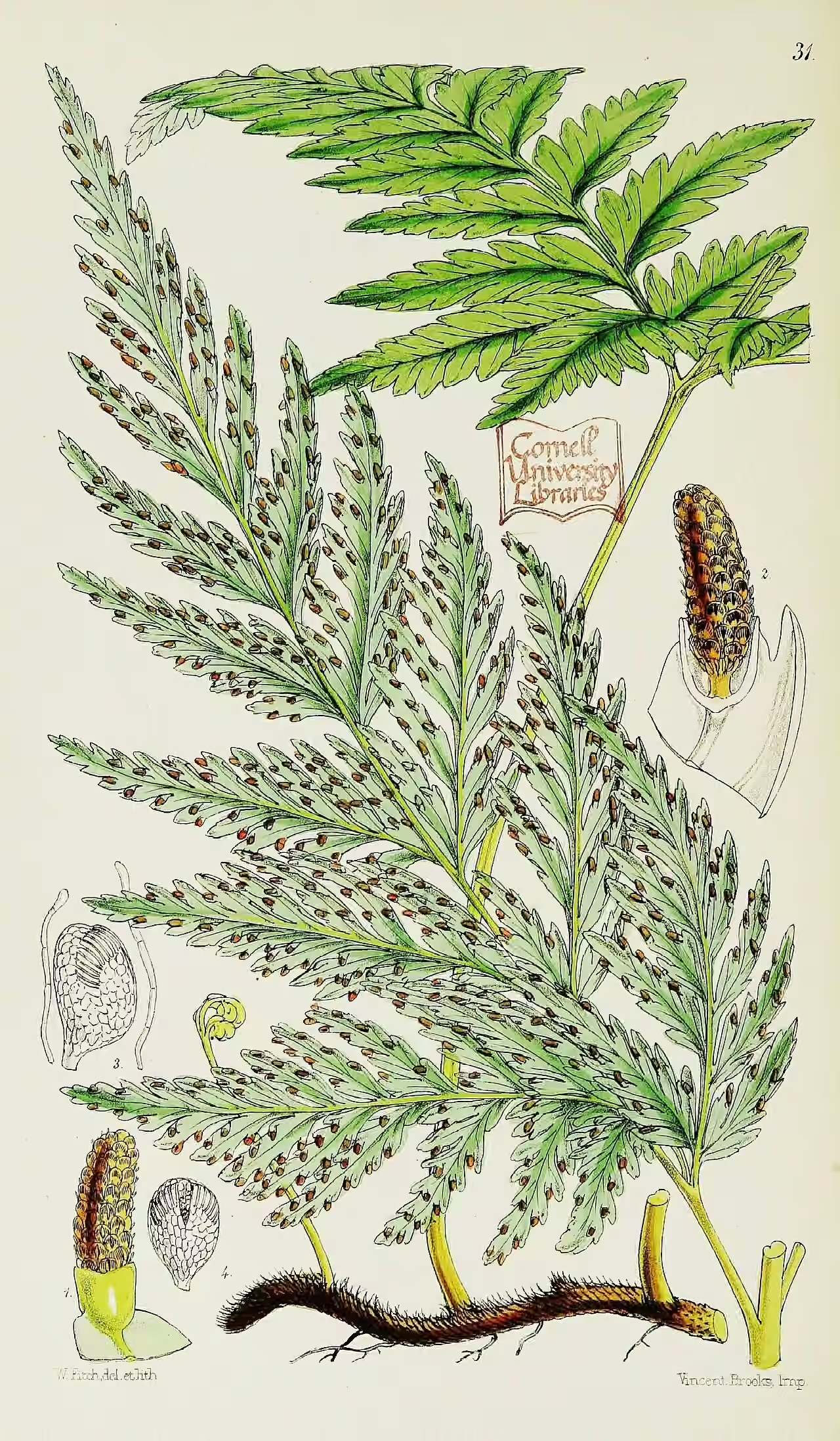
Loxsoma cunninghamii is a terrestrial fern with a long-creeping rhizome clothed in stiff, dark hairs 2.5 to 5 mm long. Fronds arise singly along the rhizome and are 370 to 1270 mm long overall, on chestnut-brown stipes. The blade is ovate to broadly ovate, 180 to 570 mm long and 160 to 425 mm wide, and is divided from pinnate-pinnatifid up to 4-pinnate, with 7 to 15 pairs of primary pinnae that become progressively smaller toward the tip.
The leaflets are oblong with irregular margins, yellow-green above and white or glaucous beneath, a contrast that is easy to see when the fronds move in the wind. The spore-bearing sori are unusual: each one sits at the end of a vein in a notch on the leaflet margin, enclosed in an urn-shaped (urceolate) indusium, and at maturity the receptacle projects 1 to 3 mm beyond it like a small bristle.
Flora of New Zealand notes it is easily recognised by the combination of creeping rhizome, ovate fronds with white undersides, marginal sori and urceolate indusia with exserted receptacles. Bracken (Pteridium esculentum) shares its banks and scrubby habitats but has much coarser, harsher fronds without white undersides and with sori in continuous lines along the margins.
Quick Facts
| Scientific Name | Loxsoma cunninghamii |
|---|---|
| Height | About 0.4-0.6 m (fronds arching, up to 1.27 m long) |
| Spread | Spreads by long-creeping rhizomes to form colonies |
| Water Needs | Moist but well-drained soil |
| Light | Light shade to partial sun |
| Frost Tolerance | Low; needs protection from frost |
| Salt Tolerance | No information available; not a coastal-exposure plant |
| Growth Rate | Slow to establish |
| Lifespan | Long-lived perennial |
Climate Best Suited to
Loxsoma suits the mild, humid, largely frost-free climate of the northern North Island. It is a warm-temperate fern and struggles where hard frosts are regular.
Regional Suitability
| City | Climate Suitability |
|---|---|
| Auckland | High |
| Wellington | Medium |
| Christchurch | Low |
| Dunedin | Low |
Plant Habitat
Loxsoma is endemic to the North Island, where it occurs in Northland, Auckland and the Coromandel Peninsula, in lowland country from near Kaitaia south to Whangamatā. There is an outlying population on Maungatautari in the Waikato. It ranges from sea level to about 550 m, the upper limit being recorded on Great Barrier Island.
It typically grows on poor clay soils in light shade, most often at the edge of kauri forest. It is found under tall mānuka and kānuka scrub, on scrub margins and in clearings, and in open tawa, podocarp, kauri and broadleaved forest, usually on banks, track edges, roadsides and stream sides where its rhizomes can spread through the soil.
Growing Requirements
Soil Requirements
In the wild Loxsoma grows on infertile, often leached clay soils of the kind found around kauri forest. Growers report it does best in poor soil with excellent drainage rather than in rich garden loam.
- Low-fertility soil, ideally a free-draining clay-based or gritty mix
- Good drainage is essential; it dislikes waterlogging
- Add leaf litter or bark rather than rich compost
- Avoid fertiliser, which does not match its natural conditions
Light Requirements
Its natural sites are bright but sheltered: scrub margins, clearings and open forest edges rather than deep forest shade.
- Light shade or dappled light under taller shrubs is ideal
- Tolerates some sun where roots stay cool and moist
- Avoid dark, dense shade and hot, exposed sites
Water Requirements
Loxsoma needs soil that stays moist without becoming sodden, a balance it finds naturally on sloping banks and track edges.
- Keep the soil evenly moist, especially in the first summers
- Plant on a bank or slope to shed excess water
- Mulch with leaf litter to reduce drying out
Planting and Establishing
Loxsoma is rarely available and is best attempted only by keen fern growers. Choose a sheltered, frost-free bank in light shade with poor, free-draining soil, and plant a pot-grown specimen raised from spore in autumn or spring when the soil is moist. Set the rhizome at the same depth it was growing in the pot and avoid disturbing the root ball, as it transplants poorly.
Water regularly through the first summer and mulch lightly with leaf litter. Give the rhizomes room to creep; a slow-spreading colony on a bank is the goal rather than a single clump. In colder districts it is probably best kept in a dedicated fernery or shade house.
Ecological Role
As a fern Loxsoma has no flowers and does not depend on pollinators or seed dispersers; it reproduces by wind-borne spores released from its marginal sori, and spreads locally by its creeping rhizomes. This vegetative spread lets it form colonies along banks, tracksides and stream edges.
It is part of the early to mid-successional vegetation on infertile northern soils, growing among mānuka, kānuka and young kauri forest. No specific invertebrate associations for this species were found in the sources consulted.
Uses & Significance
Garden Uses
Loxsoma is a collector's fern rather than a general garden plant, but it is a striking one, with lacy fronds that flash white underneath.
- Specimen fern for a fernery or shade house
- Clay banks in a sheltered northern native garden
- Restoration plantings around kauri forest remnants within its natural range
- Educational plantings showcasing ancient endemic lineages
Ecological Value
Its main value is as a unique piece of New Zealand biodiversity: an endemic monotypic genus in a relict family.
- Helps bind clay banks and track cuttings with its rhizomes
- Part of the natural flora of northern scrub and kauri forest margins
- Conserves an evolutionary lineage found nowhere else
Landscaping Uses
In a garden, Loxsoma looks best spilling down a shaded bank where its arching fronds can be seen from below and the white undersides catch the light. Pair it with mānuka, kānuka or young kauri to echo its natural setting.
Because it spreads by rhizome rather than forming a crown, give it a patch of undisturbed ground rather than a tidy border, and avoid digging around it once established.
Seasonal Care Calendar
Spring
New fronds begin to unfurl from the rhizome as the soil warms.
- Watch for new croziers and protect them from slugs
- Plant new specimens if the soil is moist
Summer
Fronds are fully expanded and sori develop along the leaflet margins.
- Keep the soil moist during dry spells
- Check for ripening sori if you plan to collect spores from cultivated plants
Autumn
A good time for planting in northern districts while the soil is warm and moist.
- Mulch with leaf litter
- Remove only fronds that have fully died
Winter
Growth slows; the evergreen fronds remain but can be damaged by frost.
- Protect from frost in cooler areas
- Avoid waterlogging during wet spells
When to Prune and How Much
Loxsoma needs no regular pruning. Simply cut away old fronds at ground level once they have browned completely, which keeps the colony tidy and lets light reach new growth.
Do not cut back green fronds or dig around the rhizomes, as the plant is slow to recover from disturbance.
How to Grow Loxsoma
Loxsoma is propagated from spore, and sources agree that it is difficult to raise and does not transplant well, which is why it is seldom available. Plants should never be dug from the wild: it has declined in Northland and wild colonies are better left to spread. Spores should only be collected from cultivated plants or with permission for a conservation project. Patience is essential, because the gametophyte and young sporophyte stages are slow and losses are common. Division of a cultivated colony is possible in principle but risky given how badly the species resents root disturbance.
From Spores
The sori sit on the leaflet margins and the protruding receptacle makes ripe ones easy to spot. Collect a fertile frond section when the sporangia are mature, dry it on clean paper and sow the dust-like spores onto a sterile surface. Kept humid and in gentle light, prothalli form first, and the first tiny fronds appear months later.
- Cut a fertile frond portion from a cultivated plant when the marginal sori are ripe
- Place it in a paper envelope for a few days to release the spores
- Sterilise a fine, sieved mix by pouring boiling water through it, then let it cool
- Dust the spores thinly over the surface
- Cover with glass or plastic and keep humid in bright indirect light
- Mist with boiled, cooled water to keep the prothalli moist
- Prick out small sporelings in clumps once true fronds appear
- Grow on in individual pots in a shade house before planting out
By Rhizome Division
A well-established colony in cultivation can sometimes be divided by severing a length of rhizome that already carries fronds and roots. Because Loxsoma transplants poorly, take a generous piece with plenty of soil attached and expect some to fail.
- Choose a vigorous section of rhizome with several healthy fronds in spring
- Cut the rhizome cleanly and lift the section with as much soil as possible
- Pot into a free-draining, low-fertility mix without disturbing the roots
- Keep shaded, sheltered and evenly moist until new fronds appear
Pests & Diseases
No serious pests or diseases specific to Loxsoma were recorded in the sources consulted. As with most ferns, slugs and snails can damage young croziers, and sporelings in a propagation tray are vulnerable to damping off if kept too wet.
Frost, waterlogging and root disturbance are more likely to kill a cultivated plant than any insect.
Cultural Significance
No Māori name or traditional Māori use for Loxsoma was found in the sources consulted. The species name honours Allan Cunningham (1791-1839), the English botanist and explorer who collected plants in New South Wales and New Zealand, and the genus was first published as Loxoma before the spelling Loxsoma was conserved.
Its significance is chiefly scientific. Loxsomataceae has only two living genera, Loxsoma in New Zealand and Loxsomopsis in Costa Rica and South America, while fossils of the family dating back to the Jurassic are known from North America, India and Japan, making Loxsoma a relict of a once widespread lineage.
Bonus Tip
To confirm you have Loxsoma rather than another lacy ground fern, turn a fertile frond over and look at the leaflet edges with a hand lens: the urn-shaped indusia, each with a small bristle-like receptacle sticking out, are unlike anything else in the New Zealand fern flora, and the bright white underside is a good first clue from a distance.
Related Plants
Explore other native plants that share similar characteristics or habitats with Loxsoma (Loxsoma cunninghamii), offering further insights into New Zealand's diverse flora. These related species provide context and opportunities for complementary planting in your garden.

Plant Conservation
Loxsoma cunninghamii was ranked At Risk - Declining in the 2023 assessment, with qualifiers DPS, DPT and PF, having previously been Not Threatened in 2017. It is also listed as Regionally Declining in Northland and Regionally Naturally Uncommon in Auckland. It was once common in lowland areas from Kaitaia to Coromandel but has been much reduced in Northland by land development, although it remains abundant on the Coromandel.
Protecting scrub and kauri forest margins, banks and track edges within its range is what helps most, along with care during roadside and track maintenance. Gardeners can help by never taking plants from the wild and sourcing only spore-raised plants.
Frequently Asked Questions
How do you identify Loxsoma cunninghamii?
Look for a creeping rhizome with stiff dark hairs, chestnut-brown stalks and ovate, much-divided fronds that are white or glaucous underneath. Its sori sit right on the leaflet margins in cup-shaped indusia, with the receptacle poking out 1 to 3 mm like a tiny bristle.
Where does Loxsoma grow in New Zealand?
It is restricted to the northern North Island, from near Kaitaia to Whangamatā, including Auckland, Great Barrier Island and Coromandel, with an outlying population on Maungatautari. It grows from sea level to about 550 m.
Why is Loxsoma botanically special?
It is the sole species of an endemic New Zealand genus, and its family Loxsomataceae contains only one other living genus, Loxsomopsis, found in Costa Rica and South America. Fossils of the family go back to the Jurassic.
Can I dig up Loxsoma for my garden?
No. It transplants poorly, has declined in Northland, and growers advise that it should never be taken from the wild. Plants raised from spore are the only responsible source.
Sources and Further Reading
The botanical, growing, and conservation details for Loxsoma (Loxsoma cunninghamii) on this page draw on the New Zealand plant references below. Consult them for full technical records and the latest distribution data.