Shore Lobelia
Lobelia anceps
Last updated:
Shore lobelia (Lobelia anceps) is a small, hairless perennial herb that forms loose to compact patches up to about 40 cm long on coastal rocks, cobble beaches and seepages. Its small two-lipped flowers are white or pale blue, often deeper blue on the lower lip, and appear over a very long season from late winter to autumn. It grows throughout New Zealand from the Kermadec and Three Kings Islands south through the North and South Islands to the Chatham Islands, and also occurs in Australia, Chile and South Africa. It is not threatened, grows easily from seed or cuttings, and makes a pretty filler for damp coastal gardens. Explore more native ground covers in our native plant guide.
Plant Description
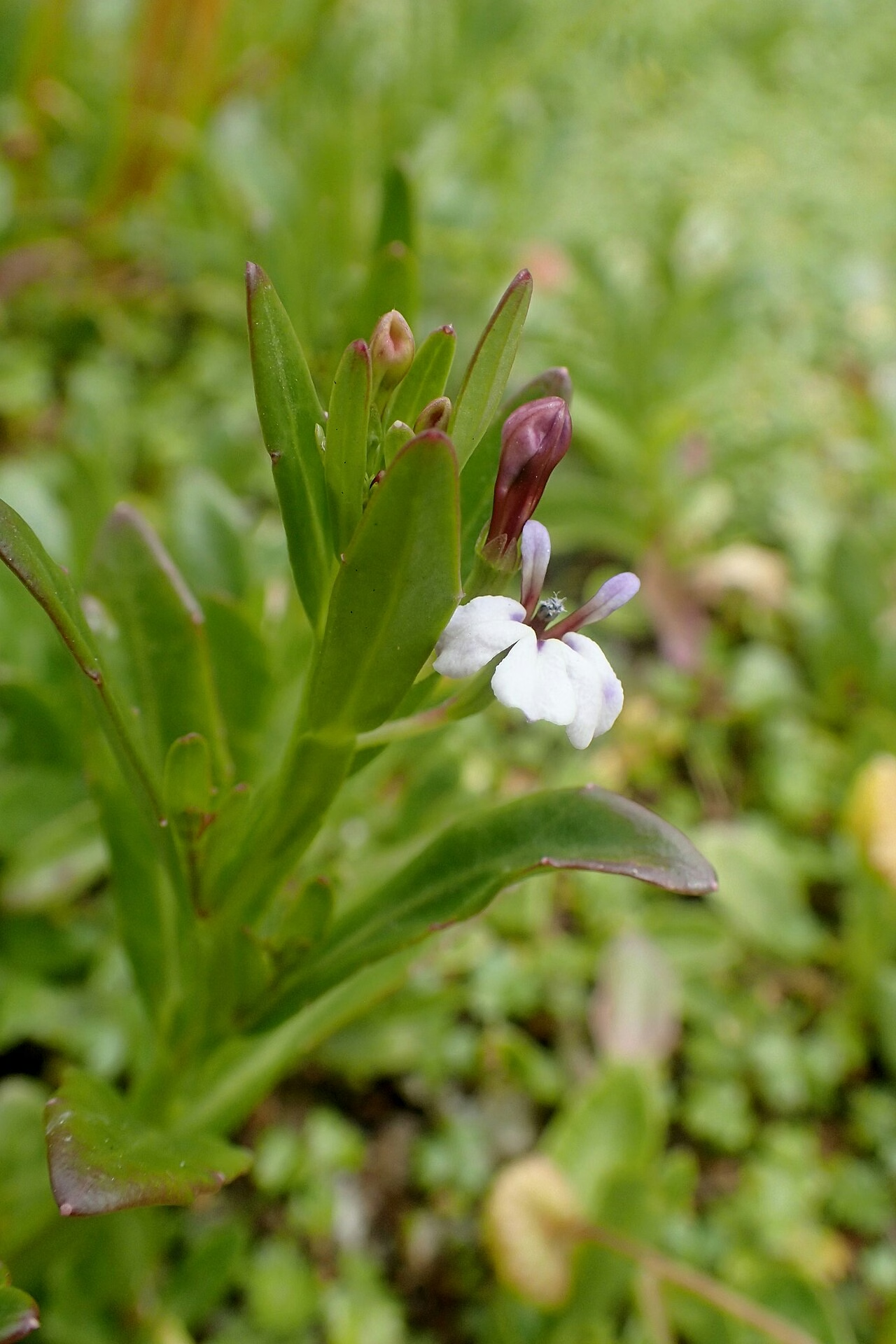
Lobelia anceps is a hairless herb with clear sap that forms diffuse to compact patches up to about 400 mm long. Its branchlets are grooved and narrowly winged, which is the origin of the name anceps, meaning two-edged. The leaves vary a great deal along the stem: the lower leaves are broad and ovate, about 10 to 50 mm long and 5 to 20 mm wide, while the upper leaves become narrow, linear to lanceolate.
The flowers are small and two-lipped, with a corolla 6 to 10 mm long. They are usually white or pale blue, often with a deeper blue lower lip, and less commonly pale pink. The fruit is a narrow, club-shaped to cylindrical capsule 6 to 12 mm long that splits by two valves to release many tiny seeds. Plants from the Kermadec Islands have noticeably wider leaves than mainland forms.
It differs from the creeping, mat-forming New Zealand lobelias formerly placed in Pratia, such as panakenake (Lobelia angulata), which root along the ground and bear solitary flowers on stalks from the leaf bases. Shore lobelia instead has more upright or sprawling leafy stems and fruit that is a dry capsule rather than a fleshy berry.
Quick Facts
| Scientific Name | Lobelia anceps |
|---|---|
| Height | Low, sprawling; stems up to about 0.4 m long |
| Spread | Patches up to about 0.4 m |
| Water Needs | Moist to wet; suits seepages |
| Light | Full sun to light shade |
| Frost Tolerance | Moderate; mainly a coastal and lowland plant |
| Salt Tolerance | High; grows on rocky shores and saltmarsh margins |
| Growth Rate | Fast |
| Lifespan | Perennial |
Climate Best Suited to
Suits mild, frost-light coastal and lowland climates throughout New Zealand, from the subtropical Kermadec Islands to the cool, windy Chatham Islands, provided it has moisture at the roots.
Regional Suitability
| City | Climate Suitability |
|---|---|
| Auckland | High |
| Wellington | High |
| Christchurch | Medium |
| Dunedin | Medium |
Plant Habitat
Shore lobelia occurs on the Kermadec Islands, Three Kings Islands, North Island, South Island and Chatham Islands. Outside New Zealand it is native to Australia, Chile and South Africa.
It is a plant of coastal to lowland country, usually in exposed sites: rocky shores, cobble beaches, cliff faces and seepages around saltmarsh. It also turns up on riversides, around inland lakes and in seepages within lowland forest, and is classed as a facultative wetland plant, meaning it usually grows in wet ground.
Growing Requirements
Soil Requirements
In the wild it roots into wet crevices, gravel and thin soil where fresh water seeps over rock, so it needs a soil that stays moist without being smothered by taller plants.
- Gritty, gravelly or sandy soil that stays damp
- Tolerates poor, thin soils on rock and cliff faces
- Copes with brackish seepage at saltmarsh edges
Light Requirements
Most wild populations grow in open, exposed coastal sites, though it also persists in lightly shaded seepages within lowland forest.
- Full sun gives the most compact plants and best flowering
- Light shade is tolerated if the soil stays moist
Water Requirements
Water is the key requirement. The plant is usually found where fresh water trickles over rock or soaks the ground, so it struggles in dry garden beds.
- Keep the root zone moist all year
- Ideal beside ponds, rills or dripping rock faces
- Water during dry summer spells
Planting and Establishing
Plant shore lobelia in spring or autumn into a permanently damp, open site such as a pond margin, the edge of a bog garden or a gap in a wet rock wall. Space plants about 20 to 30 cm apart so the sprawling stems can knit together.
Because it is low and easily overrun, keep it clear of vigorous grasses and groundcovers. Coastal gardeners can use it in seepages on banks where few other plants will grow.
Ecological Role
Shore lobelia is a pioneer of open, wet coastal ground, colonising rock faces, cobble and seepage zones where competition from taller plants is limited. Its long flowering season, from August to May, provides small blue and white flowers for much of the year, and its capsules release many tiny seeds from October to August.
The specific insects that pollinate it in New Zealand are not documented in the sources consulted. Its wide natural range across the southern oceans suggests it is well suited to dispersal along coastlines, but the mechanism is not recorded in the sources used here.
Uses & Significance
Garden Uses
A useful small native for wet, sunny corners and coastal gardens where its long flowering season can be enjoyed close up.
- Pond and stream margins
- Damp rock gardens and wet stone walls
- Coastal seepages and banks
- Containers kept standing in a saucer of water
Ecological Value
It is part of the natural plant community of rocky coasts, cobble beaches and saltmarsh seepages throughout the country.
- Suitable for coastal and wetland restoration plantings on appropriate sites
- Colonises bare, wet rock and gravel
- Flowers over most of the year
Landscaping Uses
Use shore lobelia as a soft, low filler between rocks at the edge of a pond or along a rill, where the pale blue and white flowers sit just above the water. It combines naturally with other small coastal and wetland natives that like the same wet, open conditions.
In a coastal garden it can be tucked into the base of a damp retaining wall or a seepage on a bank, giving a natural look that echoes the plant's wild cliff and shoreline habitat.
Seasonal Care Calendar
Spring
Growth picks up and flowering, which can begin as early as August, becomes more abundant.
- Plant or divide patches now
- Take stem cuttings as new growth firms
Summer
Plants are in full flower and capsules begin to ripen.
- Keep the soil moist through dry spells
- Collect ripe capsules for fresh seed
Autumn
Flowering continues into May while seed is still being shed.
- Tidy straggly stems
- Autumn is another good time to plant
Winter
Growth slows and plants may look sparse in cold inland gardens.
- Avoid letting pots freeze solid
- Pull out weeds that invade the patch
When to Prune and How Much
Shore lobelia needs little pruning. Trim back long, straggly stems after the main flowering flush to keep the patch compact and encourage fresh shoots.
Old patches can become thin in the centre; lift and replant the vigorous outer pieces rather than cutting hard.
How to Grow Shore Lobelia
NZPCN describes Lobelia anceps as easily grown from fresh seed, stem cuttings and rooted pieces, making it one of the simplest native lobelias to multiply. Because it flowers from August to May and fruits from October to August, there is ripe seed available for much of the year, and its sprawling stems root readily wherever they touch damp ground. Use fresh material, a moist, free-draining mix and good light, and do not let the young plants dry out at any stage.
From Seed
The seed is very fine and is released from narrow capsules that split into two valves. Fresh seed germinates most reliably.
- Collect capsules as they turn brown and begin to split
- Shake the tiny seed onto the surface of a fine, moist seed-raising mix
- Do not cover the seed; mist gently to settle it
- Stand the tray in a saucer of water in bright light
- Prick out seedlings into small pots once they have a few true leaves
From Cuttings
Short lengths of stem root quickly, especially in spring and summer when the plant is in active growth.
- Cut 5 to 8 cm lengths of healthy, non-flowering stem
- Remove the lowest leaves and insert into a moist mix of sand and peat or fine bark
- Keep in light shade and humid conditions until new growth appears
- Pot on once roots fill the cell
By Division
Rooted pieces can simply be separated from an established patch and replanted directly where they are wanted.
- Lift a section from the edge of the patch with roots attached
- Replant at once into damp soil and water well
Pests & Diseases
No significant pests or diseases are recorded for shore lobelia. Slugs and snails may graze young seedlings and cuttings, so protect them while small.
The main problem in gardens is drought: plants in dry soil quickly become straggly and die back. Competition from aggressive grasses can also smother patches.
Cultural Significance
Flora of New Zealand records two Māori names for this plant, punakuru and pūrao. No traditional Māori use of the plant is described in the sources consulted.
The genus is named after Matthias de l'Obel (Lobel), a sixteenth century Flemish pioneer botanist. The epithet anceps means two-edged, describing the narrowly winged, grooved branchlets. Its presence on several southern landmasses makes it an example of a plant shared between New Zealand, Australia, South America and southern Africa.
Bonus Tip
If you have a dripping rock face, a leaky tap area or a seep on a coastal bank, shore lobelia is one of the few natives that will happily colonise it. Tuck a few rooted pieces into cracks and let the stems spread; in a dry bed the same plants will sulk.
Related Plants
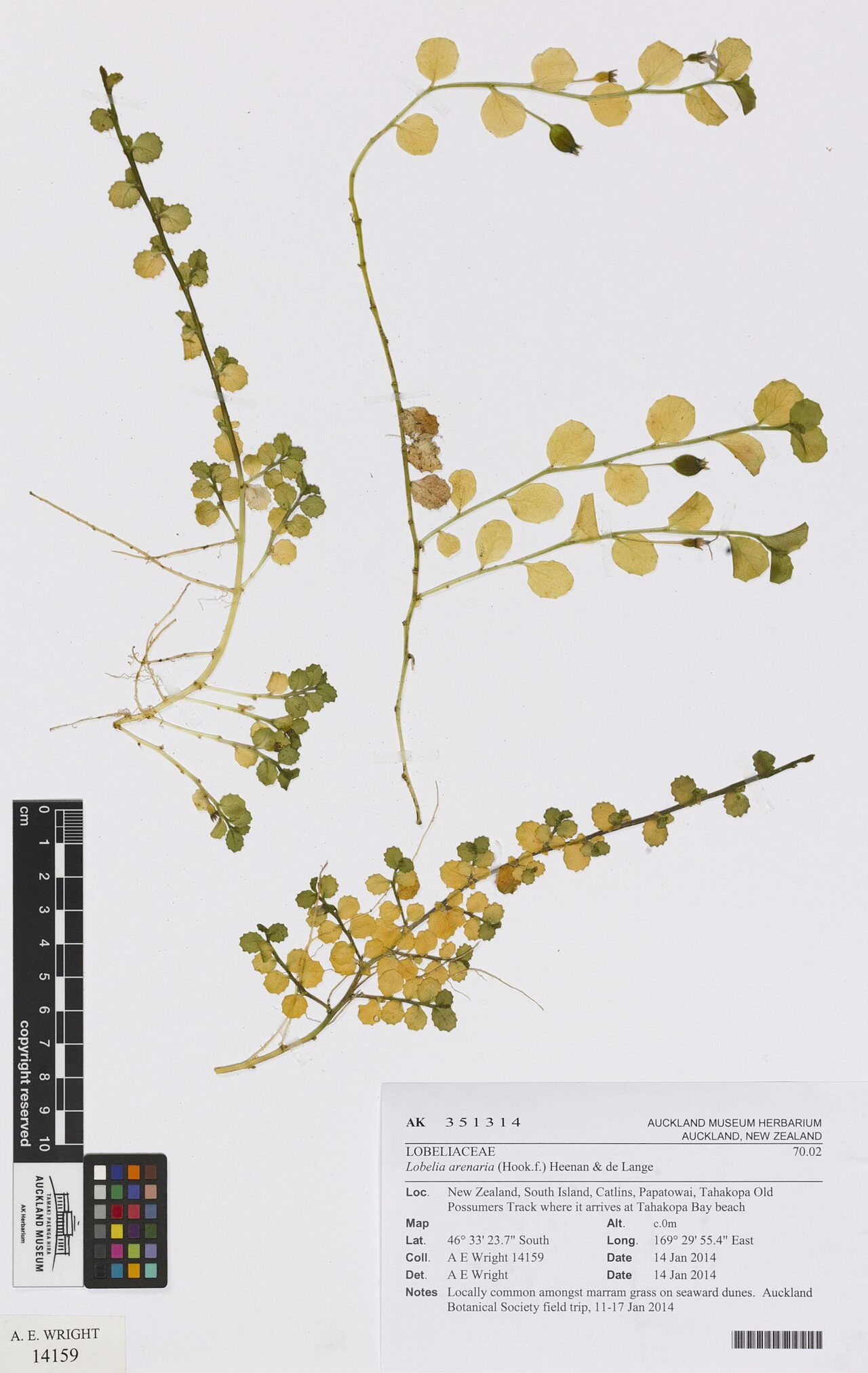
Explore other native plants that share similar characteristics or habitats with Shore Lobelia (Lobelia anceps), offering further insights into New Zealand's diverse flora. These related species provide context and opportunities for complementary planting in your garden.
Plant Conservation
Lobelia anceps is ranked Not Threatened in the 2023 New Zealand Threat Classification, with the qualifier Secure Overseas because it is also widespread outside New Zealand.
Locally, its coastal and saltmarsh seepage habitats can be lost to coastal development, drainage and weed invasion. Protecting natural shorelines and seepages, and using locally sourced plants in restoration, helps keep it common.
Frequently Asked Questions
Is shore lobelia native to New Zealand?
Yes. Lobelia anceps, known in Māori as punakuru or pūrao, is indigenous to New Zealand from the Kermadec Islands to the Chatham Islands, but it is not endemic because it is also native to Australia, Chile and South Africa.
What does Lobelia anceps look like?
It is a sprawling, hairless herb with broad lower leaves and narrow upper leaves on angled stems, bearing small white, pale blue or occasionally pale pink flowers 6 to 10 mm long.
Where does shore lobelia grow?
It grows mainly in exposed coastal and lowland sites such as rocky shores, cobble beaches, cliff faces and seepages at the edge of saltmarsh, and less often by rivers, inland lakes and seepages in lowland forest.
How do you propagate shore lobelia?
NZPCN notes that it is easily grown from fresh seed, from stem cuttings and from rooted pieces pulled from the edge of an established patch.
Sources and Further Reading
The botanical, growing, and conservation details for Shore Lobelia (Lobelia anceps) on this page draw on the New Zealand plant references below. Consult them for full technical records and the latest distribution data.