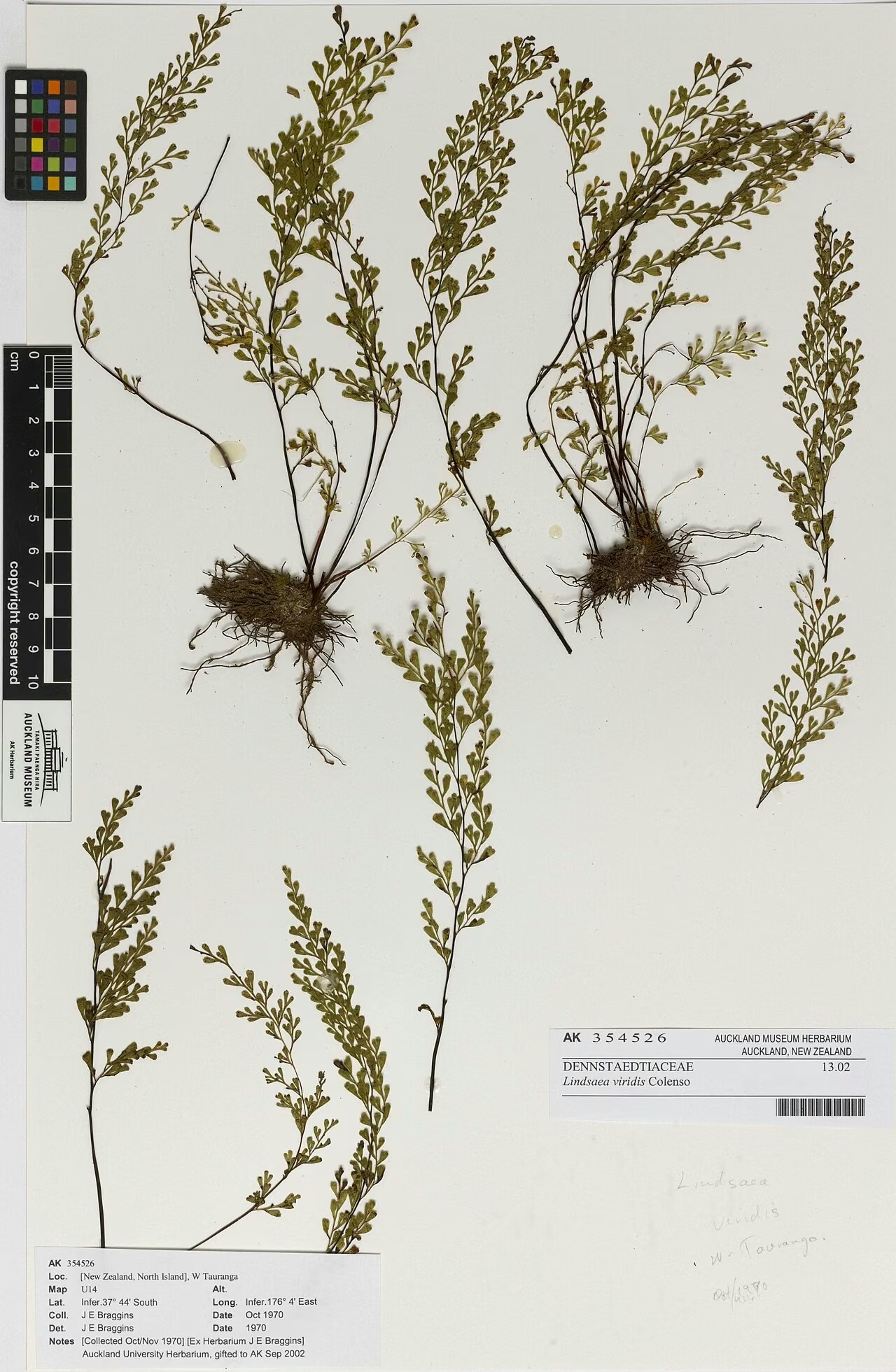
Lindsaea
Lindsaea viridis
Last updated:
Lindsaea viridis is a small, bright green fern found only in New Zealand, forming solitary tufts or large patches of drooping, finely divided fronds 4 to 40 cm long on purple-brown stems. It is a rheophyte, a plant of the flood zone: it clings to wet rock in steep-sided stream and river gorges, beside waterfalls, on dripping seepages and in the spray zone of the ignimbrite cliffs around Lake Taupō. It occurs from Great Barrier Island to Taranaki and northern Hawke's Bay, and from north-west Nelson to Jacksons Bay. It is ranked At Risk - Naturally Uncommon because its specialised habitat is sparse. Explore more native ferns in our native plant guide.
Plant Description
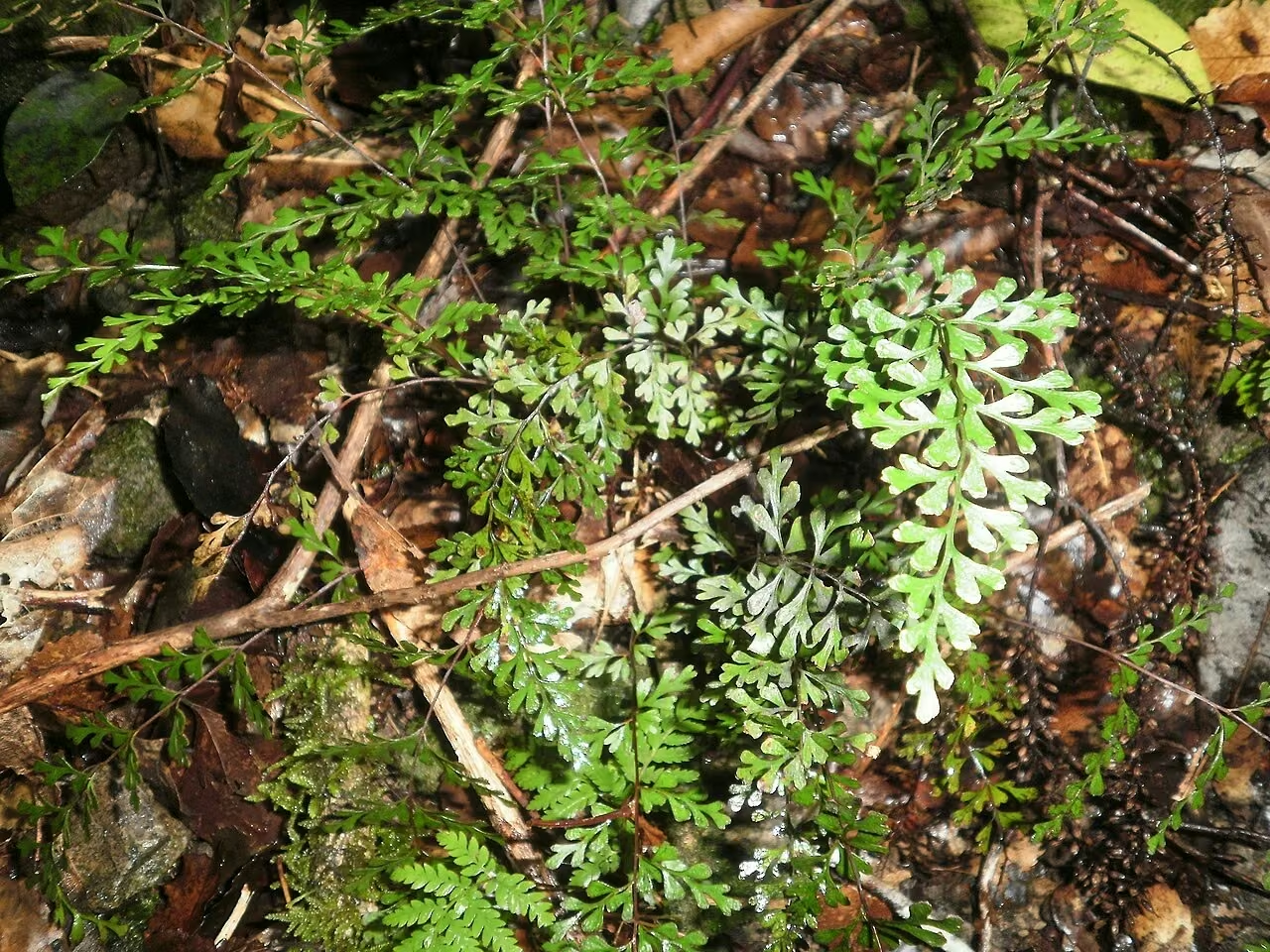
Lindsaea viridis is a tufted fern with erect to short-creeping, ascending rhizomes bearing red-brown or golden-brown scales. The fronds are all alike and usually hang downwards. The stipes and rachises are purple-brown, with stipes about 3 to 12 cm long, and the blades are narrowly elliptic to narrowly ovate or lance-shaped, 2-pinnate to 3-pinnate-pinnatifid and bright green and soft in texture.
The primary pinnae arise at a narrow angle to the rachis and often overlap, giving the frond a narrow, crowded look. The ultimate segments are narrowly obovate with truncate, squared-off tips. Sori sit at the ends of the ultimate segments and are nearly round to broader than long, covered by straight, oblong, cream to light green indusia.
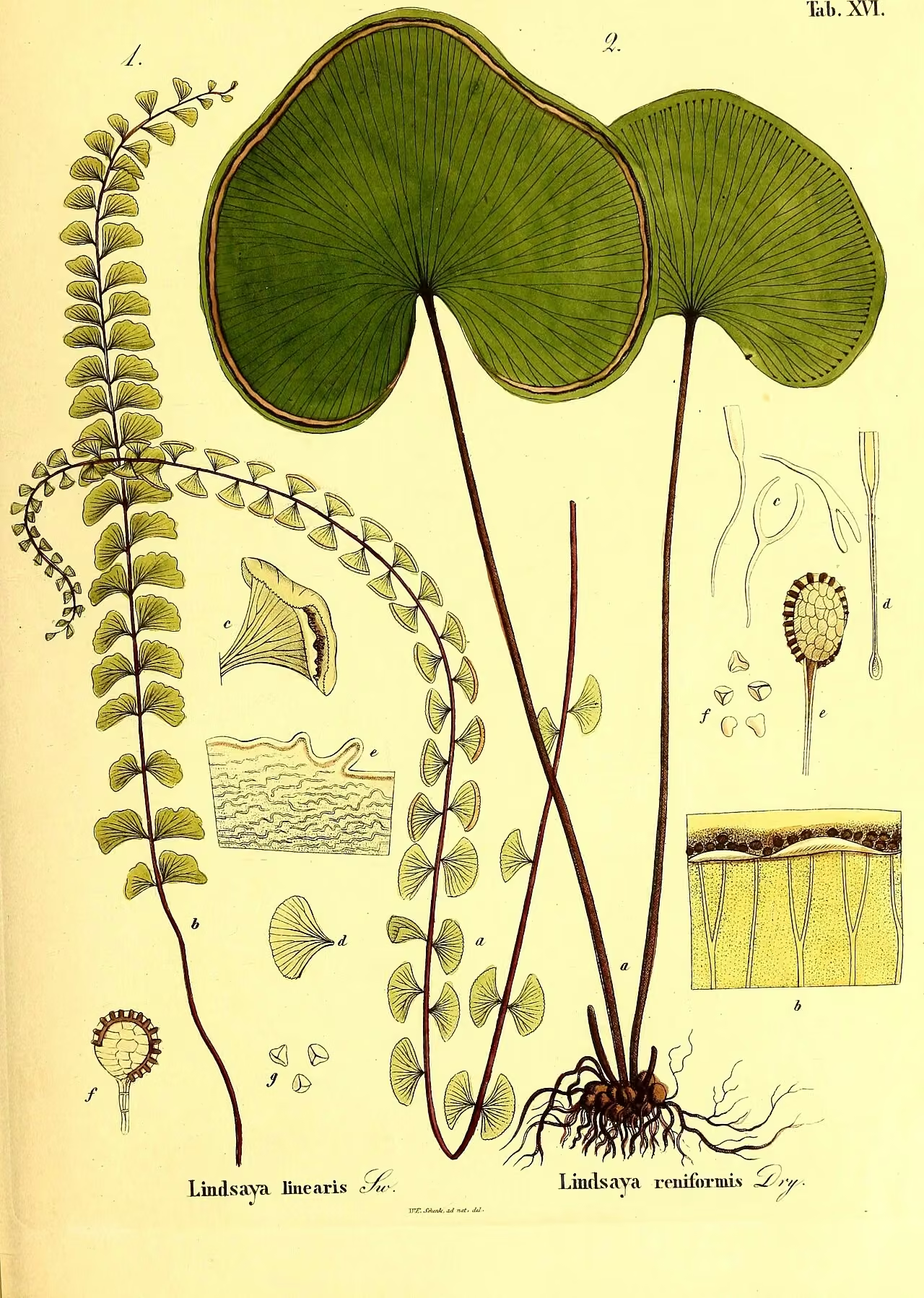
NZPCN describes it as rather distinctive and unlikely to be confused with any other New Zealand fern. The nearest lookalike is Lindsaea trichomanoides, a forest-floor fern with upright, wider, less divided fronds, fewer pinnules, rounded segment tips and much longer creeping rhizomes. Lindsaea linearis, the third New Zealand species, has narrow once-pinnate fronds and grows in open gumland and pakihi.
Quick Facts
| Scientific Name | Lindsaea viridis |
|---|---|
| Height | Fronds 0.04-0.4 m, usually drooping |
| Spread | Single tufts to large patches on wet rock |
| Water Needs | Constantly wet; roots often in flowing water or seepage |
| Light | Deep to moderate shade |
| Frost Tolerance | Low to moderate; recorded to about 850 m |
| Salt Tolerance | No reliable information available |
| Growth Rate | Slow |
| Lifespan | Perennial |
Climate Best Suited to
It relies on a permanently wet, humid microclimate in shaded gorges rather than on regional climate, and is found mostly in mild, high-rainfall western and northern districts below about 450 m.
Regional Suitability
| City | Climate Suitability |
|---|---|
| Auckland | Medium |
| Wellington | Low |
| Christchurch | Low |
| Dunedin | Low |
Plant Habitat
Lindsaea viridis is endemic. In the North Island it ranges from Little Barrier and Great Barrier Islands through Auckland, the Volcanic Plateau, Gisborne and Taranaki to northern Hawke's Bay, but it is absent south of the central Ruahine Range. In the South Island it occurs from north-west Nelson south to Charleston, with isolated populations near Jacksons Bay, and Flora of New Zealand notes a record from Banks Peninsula suggesting it was once more widespread there. It grows from sea level to about 850 m, though it is rare above 450 m and most often met above 100 m.
It is a rheophyte of the flood zone of steep-sided streams, rivers and deep gorges in dark podocarp and broadleaved forest, typically with its roots in flowing water, wet seepages or on permanently damp cliff faces, rocks and boulders, often among mosses. It also grows near waterfalls, on damp road cuttings and within the spray zone of the ignimbrite cliffs around Lake Taupō.
Growing Requirements
Soil Requirements
It roots into thin films of moss, silt and organic matter on rock rather than true soil.
- Wet rock, moss mats and seepage silt
- Very low fertility; no fertiliser
- Constant moisture matters more than soil type
Light Requirements
Its sites are dark, shaded gorges and forest-lined streams.
- Deep to moderate shade
- Never exposed to direct sun, which quickly dries and scorches the fronds
Water Requirements
This is one of the most water-dependent New Zealand ferns: it grows where water constantly flows, seeps or sprays.
- Roots often immersed in running water
- Tolerates periodic flooding and scouring
- Cannot tolerate drying out
Planting and Establishing
NZPCN lists it as difficult to propagate and states it should not be removed from the wild, and it is not a plant for general cultivation. It is best enjoyed and protected where it grows naturally.
A specialist grower working with spore-raised plants would need to mimic its habitat: a shaded, constantly wet rock face or a moss-covered stone kept wet by a recirculating trickle of water in a humid shade house or terrarium.
Ecological Role
As a fern it produces wind-dispersed spores and needs no pollinators. Its spores and gametophytes need the constantly wet rock surfaces of its gorge habitat to establish, which helps explain its patchy distribution.
It is part of a specialised streamside rock community with mosses, liverworts and filmy ferns that withstand periodic flooding. Being adapted to flood scour, it can persist where other ferns are washed away. No specific insect associations are documented.
Uses & Significance
Garden Uses
It has little place in ordinary gardens because of its exacting needs and protected status in practice.
- Specialist wet-rock or waterfall feature in a humid shade house
- Sealed terrarium with constant moisture
- Best appreciated in the wild on bush walks along gorges
Ecological Value
It is a characteristic plant of shaded, flood-prone stream gorges and an endemic member of New Zealand's small Lindsaeaceae flora.
- Indicator of intact, permanently wet, shaded gorge habitat
- Helps stabilise moss and silt on wet rock
- Endemic and Naturally Uncommon, so each population matters
Landscaping Uses
Lindsaea viridis is not suited to landscape planting. The best way to support it is to protect shade-giving forest along streams where it grows, since clearing the canopy or diverting water would dry out its rock faces.
Where track or road works pass near known populations on damp cuttings, keep drainage patterns and shade intact.
Seasonal Care Calendar
Spring
New bright green fronds emerge as stream flows remain high.
- Spring floods are part of its normal habitat
- New fronds are soft and easily damaged by handling
Summer
Fronds are fully expanded and sori form at the segment tips.
- Relies on shade and seepage to stay wet through dry spells
- Low stream levels expose plants to drying
Autumn
Mature sori release spores onto nearby wet surfaces.
- Spore release coincides with rising humidity
- Avoid collecting fronds from wild plants
Winter
Fronds remain green in sheltered gorges.
- Winter floods may scour plants
- Frost seldom reaches its sheltered sites
When to Prune and How Much
No pruning is needed. On a cultivated plant, snip off only fully dead fronds at the base, as the rhizome is short and easily damaged.
In the wild, leave plants entirely untouched; old fronds help trap moisture and silt around the rhizome.
How to Grow Lindsaea
Lindsaea viridis is rated difficult to propagate by NZPCN, and it should not be removed from the wild because some populations are already vulnerable to over-collection. Spores are the only appropriate method for starting new plants, and they should come only from cultivated plants or from collection authorised for a recovery or research project. Division is possible on a well-grown cultivated clump but carries a high risk of losing the plant, because the rhizome is short and the plant depends on a stable, wet root environment.
From Spores
Sori form at the ends of the ultimate segments. Spores need sterile, constantly wet and humid conditions, similar to the dripping rock of the plant's natural sites.
- Collect a fertile frond from a cultivated plant when the sori have darkened
- Dry it in a paper envelope for a few days to shed the spores
- Sterilise a fine mix or a piece of porous stone or sphagnum with boiling water and let it cool
- Sow spores thinly on the surface without covering them
- Seal in a clear container and keep in shade with the base constantly wet
- Wait for prothalli and then sporelings, which may take several months
- Move young plants onto a wet rock or moss substrate and keep humidity very high
By Division
A large patch of a cultivated plant with several crowns can be split in spring, keeping each piece attached to its moss or rock substrate where possible.
- Separate a crown with its roots and attached moss intact
- Place it on a constantly wet, shaded substrate
- Keep humidity high until new fronds appear
Pests & Diseases
No specific pests or diseases are recorded for Lindsaea viridis. In the wild the greater dangers are physical: removal by collectors, trampling at popular waterfalls and gorges, and drying of habitat where forest cover is lost.
In cultivation, drying out is the usual cause of failure, and slugs may graze young fronds in a shade house.
Cultural Significance
No Māori name or traditional Māori use is recorded for Lindsaea viridis in the sources consulted, and it has no established English common name.
It was described by the missionary botanist William Colenso, and the epithet viridis is Latin for green, referring to its bright green fronds. It has at times been placed in the genera Sphenomeris and Odontosoria before being returned to Lindsaea.
Bonus Tip
If you are looking for this fern on a bush walk, check the shaded walls of gorges right at the water line and the rock around waterfalls rather than the forest floor: its drooping, bright green fronds hang from wet rock, and a population on the Lake Taupō cliffs grows within the spray zone of the lake.
Related Plants
Explore other native plants that share similar characteristics or habitats with Lindsaea (Lindsaea viridis), offering further insights into New Zealand's diverse flora. These related species provide context and opportunities for complementary planting in your garden.
Plant Conservation
Lindsaea viridis is ranked At Risk - Naturally Uncommon in the 2023 New Zealand Threat Classification System assessment, with the qualifiers Sparse (Sp), Data Poor Size and Data Poor Trend. In Auckland it is ranked Regionally Critical (2025). It is naturally uncommon and sparsely distributed, though locally abundant at some sites, and NZPCN warns it is extremely vulnerable to over-collection at some sites.
It benefits from protecting forest cover along streams and gorges, keeping natural water flows and seepages intact, and not removing plants. Records suggest it was once more widespread, for example on Banks Peninsula, so reporting new sightings to iNaturalist NZ helps clarify its status.
Frequently Asked Questions
Where can you see Lindsaea viridis?
Look on permanently wet rock faces in shaded stream gorges, beside waterfalls and seepages in the North Island from Great Barrier Island southwards, in north-west Nelson and Westland, and on the cliffs of Lake Taupō.
Why is Lindsaea viridis classed as At Risk?
It is Naturally Uncommon because its flood-zone rock habitat is scattered and sparse, and NZPCN notes some populations are extremely vulnerable to over-collection.
How do you tell Lindsaea viridis from Lindsaea trichomanoides?
L. viridis has pendulous, narrow, more finely divided fronds with squared-off segment tips on short rhizomes, while L. trichomanoides has upright, wider, less divided fronds and much longer creeping rhizomes.
Sources and Further Reading
The botanical, growing, and conservation details for Lindsaea (Lindsaea viridis) on this page draw on the New Zealand plant references below. Consult them for full technical records and the latest distribution data.