Lignocarpa
Lignocarpa diversifolia
Last updated:
Lignocarpa diversifolia is a small, fleshy, grey alpine herb in the carrot family that grows on screes of fine sediment in the mountains of the northern South Island, including Nelson Lakes National Park. It forms a low grey plant with stiff, spreading branches and finely divided succulent leaves, and carries umbels of white, sometimes pink-flushed, flowers framed by long narrow bracts. It is one of only two species in Lignocarpa, a genus found only in New Zealand, and is the northern counterpart of L. carnosula. Because it is sparse and patchily distributed, it is ranked At Risk - Naturally Uncommon. Explore more native flowering plants in our native plant guide.
Plant Description
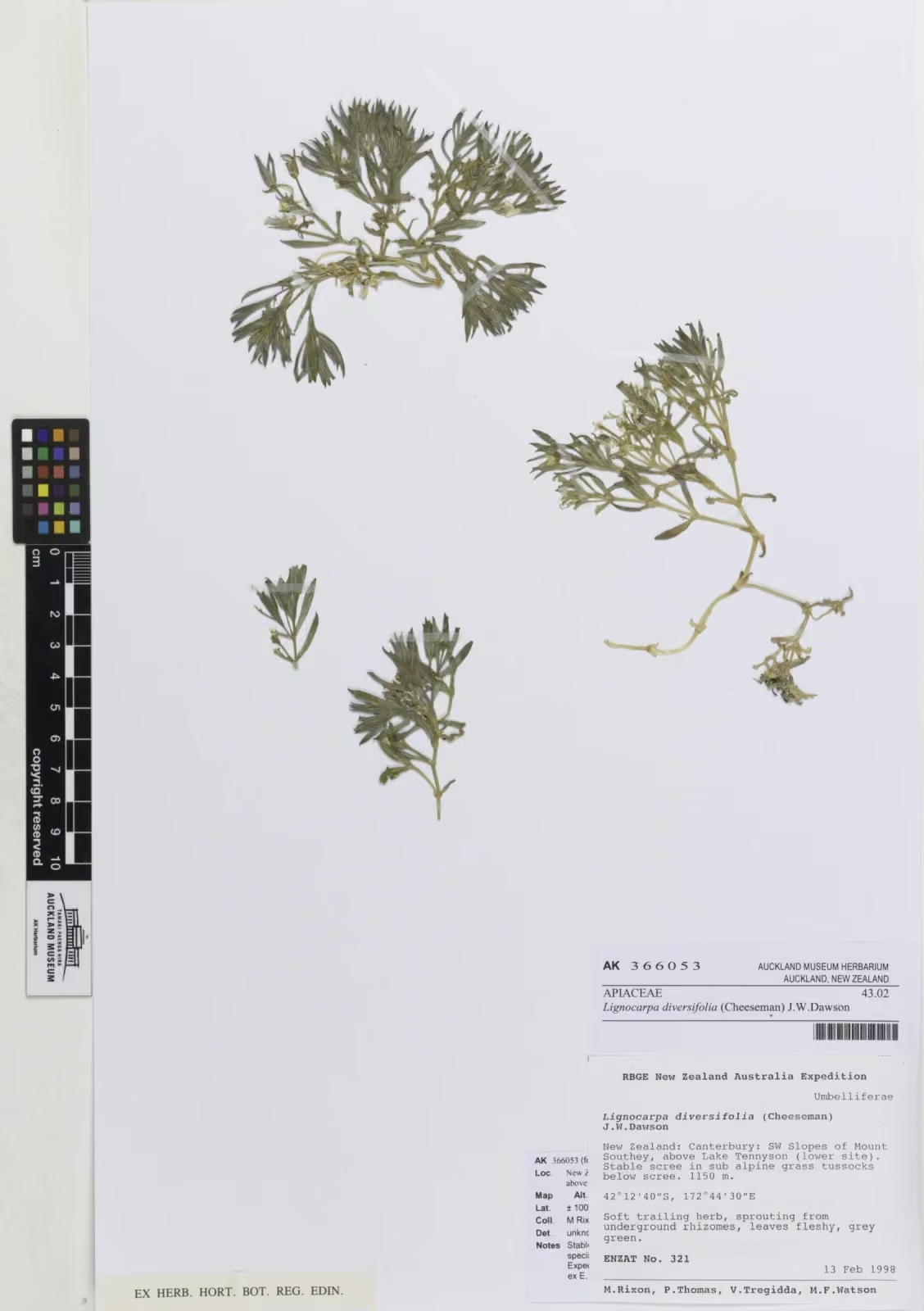
Lignocarpa diversifolia closely resembles L. carnosula in its size, colour and fleshy texture, appearing as a small grey plant with stiff, widely spreading (divaricating) branches. Like the rest of the genus it is hairless, with a branching taproot, a waxy bloom and leaves divided several times into threes with narrow-linear segments. It has several basal leaves and usually one to three leaves or leafy bracts on the flowering stem, the variation in leaf form presumably inspiring the name diversifolia.
The umbels are solitary and compound, 2 to 8 cm across, and contain bisexual flowers. They are carried on 6 to 12 notably stout, stiff primary rays, beneath which sit 4 to 6 linear involucral bracts that distinctly exceed the umbel. Each small secondary umbel is surrounded by 8 to 12 linear bracts. The petals are white, occasionally flushed pink, and the calyx teeth are prominent. The Flora of New Zealand notes that the fruit has not yet been described.
The two Lignocarpa species are best separated by range and by the bracts: Wikipedia notes that L. diversifolia has simple secondary bracts, unlike its relative in the southern Southern Alps.
Quick Facts
| Scientific Name | Lignocarpa diversifolia |
|---|---|
| Height | Low; similar in size to L. carnosula (about 0.15 m) |
| Spread | Small clump; width not documented |
| Water Needs | Cool moisture deep in the scree |
| Light | Full sun |
| Frost Tolerance | High; an alpine species |
| Salt Tolerance | No information available; an alpine species |
| Growth Rate | Slow |
| Lifespan | Perennial |
Climate Best Suited to
Suits the cold, snowy, high-light alpine climate of the northern South Island ranges, with cool summers and hard frosts. Lowland and warm climates are unsuitable.
Regional Suitability
| City | Climate Suitability |
|---|---|
| Auckland | Low |
| Wellington | Low |
| Christchurch | Low |
| Dunedin | Low |
Plant Habitat
This species is endemic to the South Island, where it occurs in the more northerly ranges, including Nelson Lakes National Park and mountains further north. Its sparse, patchy distribution is reflected in the Sp (sparse) qualifier of its threat ranking. Detailed altitude limits were not available in the sources consulted.
Its habitat is scree slopes with fine sediment. On these slopes the loose surface stones overlie finer, moisture-holding material into which its taproot penetrates, while the fleshy grey shoots sit exposed among the rocks.
Growing Requirements
Soil Requirements
It grows in scree where fine sediment is mixed with the stones, giving a moisture-holding but freely draining root run.
- Coarse stony scree with silt and fine grit
- Almost no organic matter
- Deep root run for the taproot
Light Requirements
Mountain screes are fully exposed, and it receives strong alpine light.
- Full sun
- Open sites without competition
Water Requirements
Snowmelt and mountain rain soak into the fine sediment, keeping roots cool and damp while the surface stones dry quickly after rain.
- Steady moisture at depth
- Dry surface around the crown
Planting and Establishing
Lignocarpa diversifolia is not in commercial cultivation and is only suitable for very experienced alpine growers. A deep pot or raised scree bed made from coarse stone with a proportion of fine silt and sand would best match its fine-sediment screes.
Its taproot means young plants should be placed in their final position early and not moved. Do not remove plants from the wild, particularly as the species is Naturally Uncommon and its habitat lies largely within conservation land.
Ecological Role
Specific pollinators have not been recorded, but its open white umbels are the type visited by small flies, native bees and other alpine insects. Its bisexual flowers mean a single plant can potentially set seed.
Wikipedia records the native rust fungus Puccinia whakatipu on this plant, showing that even rare scree herbs support their own associated organisms. The species forms part of the specialised scree flora of the northern South Island.
Uses & Significance
Garden Uses
It has no general garden use and is of interest mainly to botanists and alpine plant specialists.
- Alpine house collections
- Scree beds in cool climates
- Research and ex-situ conservation
Ecological Value
As a sparse endemic in an endemic genus, it contributes to the distinctiveness of the Nelson mountain flora.
- Host of the native rust Puccinia whakatipu
- Nectar and pollen for alpine insects
- Member of the specialised scree community
Landscaping Uses
In a scree garden it would look most at home among grey, fine-grained rubble that echoes its natural slopes, with nothing taller nearby to shade it.
Its stiff bracts and grey colour give it a sculptural look up close, but it is too rare and difficult to be used as a landscaping plant.
Seasonal Care Calendar
Spring
New fleshy leaves appear as the scree thaws.
- Growth begins after snowmelt
- Avoid disturbing the root zone
Summer
Umbels of white or pink-tinged flowers with long bracts appear on the high screes; exact flowering months are not documented.
- Flowering in the alpine summer
- Keep roots cool
Autumn
Fruit develops after flowering, although it has not yet been formally described.
- Collect fruit for study or sowing where permitted
- Clear debris from the crown
Winter
The plant lies dormant under snow on its scree slopes.
- Keep cultivated plants dry at the crown
- No frost protection needed
When to Prune and How Much
Pruning is not needed for this small herb. Spent flowering stems can be cut off once any seed has been gathered.
Remove any yellowing or rotting leaves at the base of cultivated plants to keep the crown clean and dry.
How to Grow Lignocarpa
There is no published propagation record for Lignocarpa diversifolia, and even its fruit has not been formally described, which shows how rarely it has been studied or grown. Any attempt at propagation would draw on methods used for other New Zealand alpine umbellifers. Seed should only be gathered with DOC authorisation, because the species is Naturally Uncommon and its known populations are on conservation land.
From Seed
Seed is the logical method for a taprooted herb. Alpine Apiaceae generally germinate best from seed sown fresh and exposed to winter cold.
Because the fruit has never been formally described, anyone who succeeds in collecting and germinating seed should lodge a voucher specimen with a herbarium, which would add real knowledge about this poorly known plant.
- Gather mature, dry fruits in autumn under an appropriate permit
- Record the source and date so the material has conservation value
- Sow straight away into deep pots of gritty mix containing some fine silt
- Top with a layer of fine grit and leave outside over winter for natural cold
- Keep evenly moist and protect from slugs as seedlings emerge in spring
- Move each seedling into its own deep pot while the taproot is still short
Division and Cuttings
Division and cuttings are not practical for this species because it grows from a single branching taproot. Damaging the taproot during lifting is likely to kill the plant, so established plants are best left undisturbed.
- Do not lift wild or established plants
- Rely on seed for any propagation work
Pests & Diseases
The native rust fungus Puccinia whakatipu has been recorded on this plant; it is a natural association rather than a pest problem. No other pests or diseases are documented.
In cultivation, slugs and winter rot would be the main risks to such a fleshy alpine herb.
Cultural Significance
No Māori name or customary use is recorded for this rare scree plant in the sources consulted.
Thomas Cheeseman described it in 1906 as Ligusticum diversifolium. It was later moved to Anisotome by Cockayne and finally to Lignocarpa by J.W. Dawson in 1967, when he recognised that it and L. carnosula formed a distinct New Zealand genus.
Bonus Tip
When checking whether a scree umbellifer in the Nelson ranges is this species, look below the umbel: 4 to 6 narrow involucral bracts that extend clearly past the flowers, on stout stiff rays, are one of its most obvious field features.
Related Plants
Explore other native plants that share similar characteristics or habitats with Lignocarpa (Lignocarpa diversifolia), offering further insights into New Zealand's diverse flora. These related species provide context and opportunities for complementary planting in your garden.
Styphelia nana
Styphelia nana
Surville Cliffs Mingimingi
Leucopogon xerampelinus
Lignocarpa carnosula
Lignocarpa carnosula
Lilaeopsis ruthiana
Lilaeopsis ruthiana
Lindsaea linearis
Lindsaea linearis
Oval Wedge Fern
Lindsaea trichomanoides
Lindsaea viridis
Lindsaea viridis
Cushion Daisy
Cushion Daisy
Plant Conservation
Lignocarpa diversifolia is ranked At Risk - Naturally Uncommon (2023) with the qualifiers Sp (sparse), DPS (data poor: size) and DPT (data poor: trend). It was listed as Range Restricted in 2004 and has been Naturally Uncommon since 2009.
Its rarity is natural rather than caused by human pressures, but because its population size and trend are poorly known, field surveys of northern South Island screes would help confirm its security. Leaving wild plants untouched protects the small populations that exist.
Frequently Asked Questions
Where is Lignocarpa diversifolia found?
It grows on screes with fine sediment in the mountains of the northern South Island, from Nelson Lakes National Park northwards, according to the Wikipedia account of the species.
Why is Lignocarpa diversifolia classed as Naturally Uncommon?
It has a small, sparse natural distribution on specialised scree habitat, so it was ranked Range Restricted in 2004 and At Risk - Naturally Uncommon in every assessment since.
How do you identify Lignocarpa diversifolia?
Look for a fleshy blue-grey herb on scree with umbels 2 to 8 cm across, 6 to 12 stout stiff rays and 4 to 6 linear bracts that clearly extend beyond the umbel.
Does any fungus live on Lignocarpa diversifolia?
Yes. Wikipedia records that it is visited by the rust fungus Puccinia whakatipu, one of the native rusts associated with New Zealand Apiaceae.
Sources and Further Reading
The botanical, growing, and conservation details for Lignocarpa (Lignocarpa diversifolia) on this page draw on the New Zealand plant references below. Consult them for full technical records and the latest distribution data.