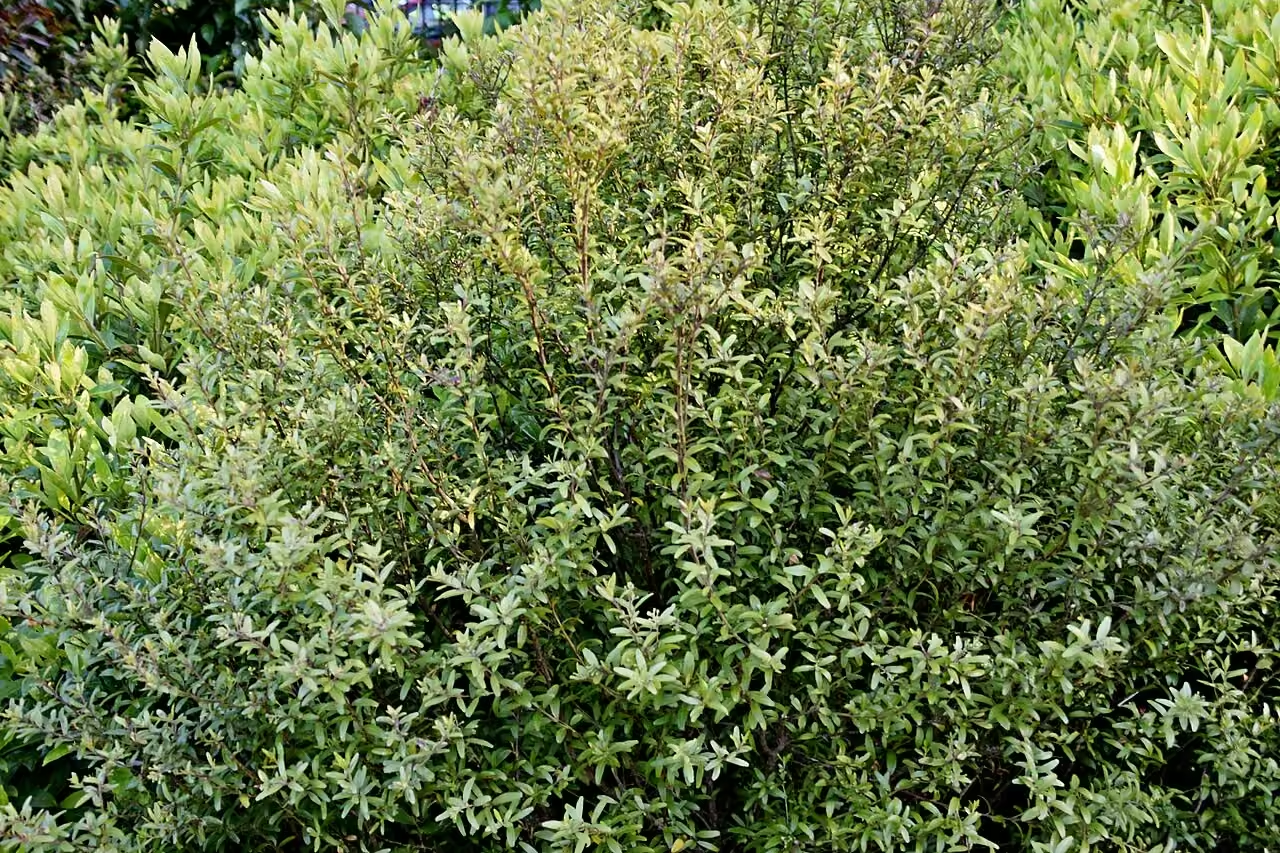
Mairehau
Leionema nudum
Last updated:
Mairehau (Leionema nudum) is an aromatic shrub or small tree endemic to the northern North Island, growing to about 3 or 4 m. Its narrow, bronze-green, finely notched leaves are dotted with oil glands and release a strong scent when crushed, and in early summer it bears clusters of fragrant white flowers with prominent stamens. It occurs in lowland forest and scrub from Te Paki south to Kawhia and the northern Kaimai Range. Māori used it for its scent. It is ranked At Risk - Declining, partly because goats browse it heavily. Explore more native shrubs in our native plant guide.
Plant Description
Mairehau is a much-branched, bushy shrub or small tree up to about 3 to 4 m tall, with slender, ascending branchlets and reddish bark. The alternate leaves are 20 to 45 mm long and 3 to 10 mm wide, narrow-oblong to elliptic, blunt and often brownish or bronze-green, with many tiny nicks along the margins. They are dotted with oil glands and strongly aromatic when crushed.
The fragrant white flowers, about 8 to 13 mm across, are borne in terminal clusters up to 5 cm wide. Each has five sepals, five petals and ten stamens whose long filaments project beyond the petals. The fruit is dry, splitting into compartments (cocci) about 4 mm long, each holding one or two seeds, which are ejected when the inner fruit wall separates.
It is the only New Zealand member of Leionema, a genus of more than 20 species otherwise found mainly in eastern Australia. In northern forest, its combination of small, notched, scented, gland-dotted leaves and white starry flowers makes it distinctive.
Quick Facts
| Scientific Name | Leionema nudum |
|---|---|
| Height | Up to 3-4 m |
| Spread | 1-2 m |
| Water Needs | Moderate; prefers good drainage |
| Light | Partial shade |
| Frost Tolerance | Low when young; hardier once established |
| Salt Tolerance | No information available |
| Growth Rate | Slow to moderate |
| Lifespan | Long-lived perennial |
Climate Best Suited to
Suits the warm, humid, mostly frost-free climate of Northland, Auckland, Coromandel and the northern Waikato. NZPCN notes it is cold sensitive, though quite hardy once established.
Regional Suitability
| City | Climate Suitability |
|---|---|
| Auckland | High |
| Wellington | Medium |
| Christchurch | Low |
| Dunedin | Low |
Plant Habitat
Mairehau is endemic to the North Island, where it is locally distributed from Te Paki in the Far North south to Pukenui Hill, to Kawhia in the west and to the northern Kaimai Range in the east. It is rather uncommon south of Auckland and Thames, and is described as uncommon in the Waitākere Ranges.
It grows in lowland forest and scrub, and is particularly associated with kauri forest in Northland, Auckland, Waikato, Coromandel and on Great Barrier Island. It typically grows on sloping, well-drained ground.
Growing Requirements
Soil Requirements
In the wild it grows on the infertile, often clay soils of northern kauri forest and scrub, usually on slopes where water drains away.
- Well-drained soil, including clay on a slope
- Low to moderate fertility
- Leaf-litter mulch to keep roots cool
Light Requirements
It grows under the light canopy of kauri forest and scrub, and nurseries recommend partial shade over its root system.
- Partial shade or dappled light
- Shaded, cool root zone
Water Requirements
It needs moisture but does not tolerate stagnant, waterlogged roots.
- Water regularly while establishing
- Ensure drainage, especially on clay
Planting and Establishing
Plant mairehau in spring in a sheltered, semi-shaded spot with free-draining soil, ideally on a slope or raised bed. Young plants are cold sensitive, so in cooler districts give them frost protection for the first winters.
Mulch with leaf litter, water through the first summer and plant it near a path where passers-by can enjoy the scent of the flowers and foliage. NZPCN describes it as a beautiful shrub that should be more widely grown; it is occasionally sold by specialist native nurseries.
Ecological Role
Mairehau's fruits are dry capsules that split and eject their seeds ballistically, and the seeds may also be moved by ants. It is a component of the understorey of northern kauri forest and scrub.
Its fragrant white flowers attract insects, although the specific pollinators are not documented in the sources consulted.
Uses & Significance
Garden Uses
It is a fragrant, attractive shrub for northern gardens, valued for its scented foliage and white flowers.
- Scented shrub near paths and outdoor seating
- Woodland and kauri forest restoration plantings in its natural range
- Semi-shaded borders on well-drained slopes
Ecological Value
As a declining endemic of northern forests, mairehau is a worthwhile species for restoration within its range.
- The only native New Zealand Leionema
- Characteristic of northern kauri forest understorey
- Ranked At Risk - Declining
Landscaping Uses
Use mairehau as a fine-leaved, bronze-toned shrub in a semi-shaded native border, where its white flower clusters stand out in early summer. Its narrow, upright habit suits planting between larger trees.
Because the leaf oil can cause burns in sunlight, avoid placing it where children will play among the foliage, and consider gloves when pruning.
Seasonal Care Calendar
Spring
New growth begins; a good time to plant in sheltered spots.
- Plant out after frosts
- Mulch with leaf litter
Summer
Clusters of fragrant white flowers appear in early summer, followed by developing fruit.
- Water during dry spells
- Enjoy the scent
Autumn
Dry fruits ripen and eject their seeds.
- Collect fruit as it turns brown
- Sow seed fresh
Winter
Young plants are sensitive to frost.
- Protect young plants from frost
- Check drainage after heavy rain
When to Prune and How Much
Mairehau needs little pruning. Lightly tip prune after flowering to encourage a bushier shape, and remove any dead or crossing branches.
Wear gloves and long sleeves when pruning, and wash skin afterwards, since the leaf oil can cause severe burns if skin is then exposed to strong sun.
How to Grow Mairehau
NZPCN notes that mairehau can be grown from semi-hardwood cuttings and seed, but warns that cuttings are often hard to strike and seed can be slow to germinate. Nelson Natives reports that seed germinates without pre-treatment if sown and kept moist until germination is complete. Patience is the key: expect slow results by either method. Because the species is At Risk - Declining, source seed or cutting material from cultivated plants or, within its natural range, from local plants with the landowner's permission.
From Seed
The fruit splits into small compartments that eject the seeds when ripe, so seed must be collected just before the fruits open. Enclosing a few fruit clusters in a fine mesh bag will catch seeds as they are released.
- Collect fruit clusters as they turn brown in late summer or autumn
- Dry in a paper bag so the seeds are released
- Sow fresh on a free-draining seed mix without pre-treatment
- Cover lightly and keep consistently moist
- Be patient, as germination can be slow and uneven
- Pot seedlings individually once large enough to handle
From Semi-Hardwood Cuttings
Cuttings are often difficult to strike, so take more than you need and give them good conditions.
- Take semi-hardwood cuttings 8 to 10 cm long in late summer or autumn
- Remove lower leaves and dip the base in rooting hormone
- Insert into a free-draining mix of bark and pumice or perlite
- Keep in a humid, shaded environment with bottom heat if possible
- Pot on only once a good root system has formed
Pests & Diseases
NZPCN notes that mairehau is heavily browsed by goats over parts of its range, which damages wild populations.
In gardens, few pests are recorded, but poor drainage and cold winters can cause root problems and losses, especially in young plants.
Cultural Significance
Mairehau is the established Māori name, and Ngā Tipu Whakaoranga also records māireire. It records that the plant was used for scent (Best 1942), and its essential oil and other chemistry have been studied since the 1920s.
The name mairehau has been linked to the Proto-Polynesian maile, a name for fragrant plants such as the Alyxia vines. Hooker originally described the species as Phebalium nudum; the epithet nudum means bare.
Bonus Tip
Plant mairehau near a path or doorway so you can brush or crush a leaf to enjoy its strong aromatic scent, but always wash your hands afterwards and avoid rubbing the oil on skin that will be in the sun, as it can cause severe burns in sensitive people.
Related Plants
Explore other native plants that share similar characteristics or habitats with Mairehau (Leionema nudum), offering further insights into New Zealand's diverse flora. These related species provide context and opportunities for complementary planting in your garden.
Plant Conservation
Leionema nudum was ranked At Risk - Declining in 2023, with qualifiers for data poor information and partial decline, having previously been ranked Not Threatened. It is Regionally Declining in Northland and Regionally Vulnerable in Auckland.
Browsing by goats is a key threat in parts of its range. Goat control in northern forests, protection of kauri forest remnants and planting nursery-raised stock in restoration projects all help.
Frequently Asked Questions
What is mairehau used for?
Ngā Tipu Whakaoranga records that Māori used mairehau for its scent (Best 1942); the leaves and flowers are both fragrant because of oil glands in the foliage.
Is mairehau toxic or harmful?
NZPCN warns that oil from the crushed leaves can cause severe burns in some people if the affected skin is then exposed to strong sunlight, so wash hands after handling it.
Where does Leionema nudum grow naturally?
It is confined to the North Island, from Te Paki south to Pukenui Hill, Kawhia in the west and the northern Kaimai Range in the east, and is rather uncommon south of Auckland and Thames.
Why is mairehau At Risk - Declining?
It was reclassified from Not Threatened to At Risk - Declining in 2023, and NZPCN notes it is heavily browsed by goats over parts of its range.
Sources and Further Reading
The botanical, growing, and conservation details for Mairehau (Leionema nudum) on this page draw on the New Zealand plant references below. Consult them for full technical records and the latest distribution data.