Wind Grass
Lachnagrostis elata
Last updated:
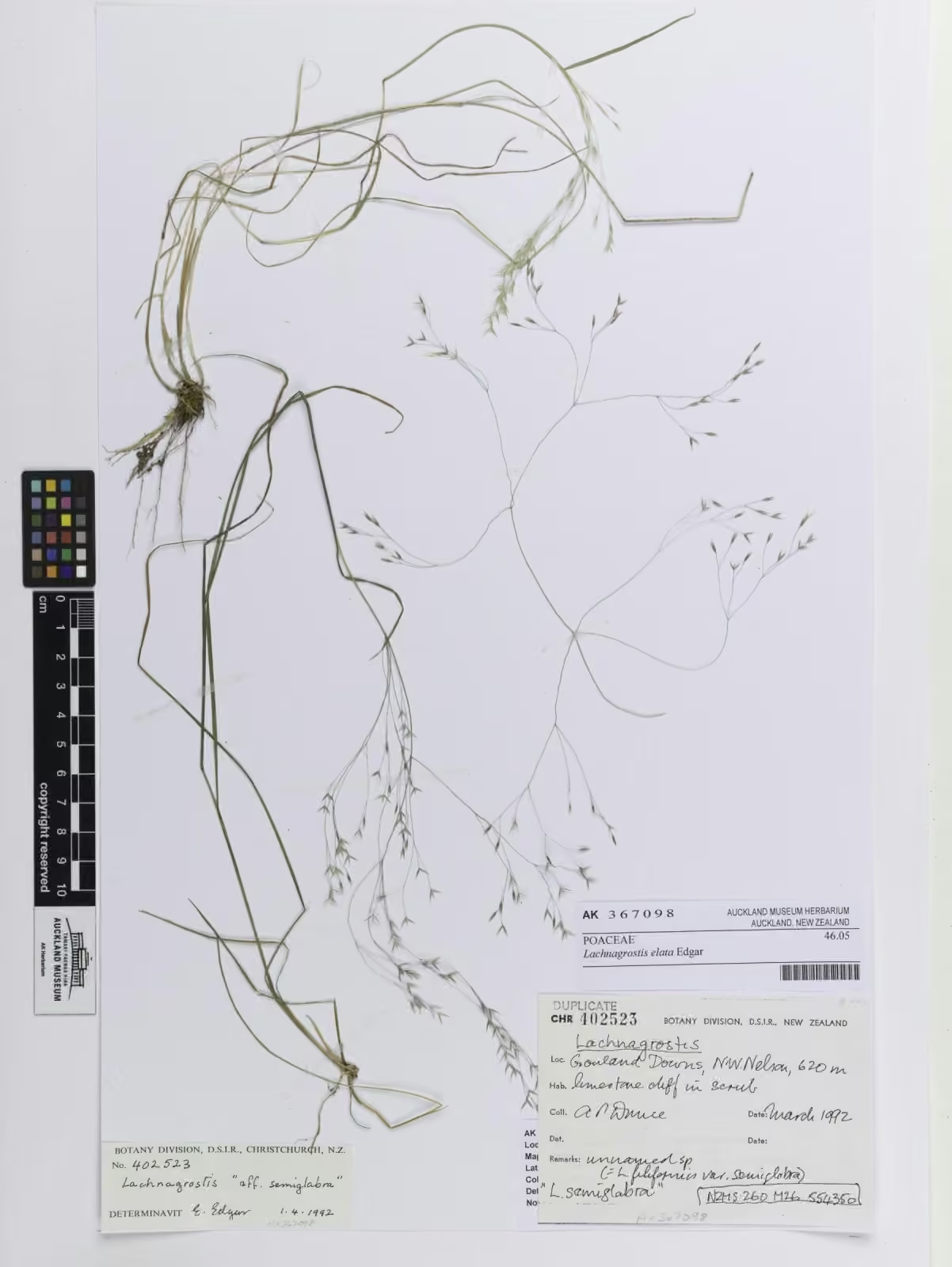
Wind grass (Lachnagrostis elata) is a slender, tufted endemic perennial grass with flaccid, semi-scrambling stems up to 80 cm long that often push up through divaricating shrubs. At maturity its very large, lax panicles spread up to 30 cm across; the group name wind grass comes from the way Lachnagrostis heads are blown about by wind. It grows in lowland forest to subalpine seepages and mires in the central North Island, north-west Nelson and the Chatham Islands. It is ranked At Risk - Naturally Uncommon because it is sparse throughout its range. Explore more native grasses and flaxes in our native plant guide.
Plant Description
Lachnagrostis elata forms slender, rather loose perennial tufts, grey-green to grass green, with branching from outside the leaf sheaths (extravaginal). The leaf blades are narrow-linear, 30 to 250 mm long and 0.4 to 2.5 mm wide. The culms are 60 to 800 mm long, bent at the base, weakly erect to flaccid and often semi-scandent, so they lean on or grow up through surrounding vegetation.
The panicles are 40 to 300 mm long and up to 300 mm wide, with few branches, becoming very lax and widely spreading at maturity. Spikelets are 3 to 8 mm long, light green to purplish. The lemma usually carries a short dorsal awn 0.3 to 5 mm long, and like all Lachnagrostis it has a tuft of hairs on the callus, the feature behind the genus name meaning woolly grass. Seeds are 1.5 to 1.8 mm long.
Its semi-scandent, flaccid, etiolated culms and large, widely spreading lax panicles make it easy to tell from other New Zealand wind grasses. The most similar is L. ammobia of coastal sand dunes, which is smaller, up to 350 mm, with hairier lemmas.
Quick Facts
| Scientific Name | Lachnagrostis elata |
|---|---|
| Height | 0.3-0.8 m |
| Spread | Loose tufts with sprawling stems |
| Water Needs | Wet; seepages and mire margins |
| Light | Full sun to light shade |
| Frost Tolerance | Good; reaches subalpine sites |
| Salt Tolerance | Low; not a coastal species |
| Growth Rate | Fast |
| Lifespan | Short-lived perennial |
Climate Best Suited to
Suits mild to cool, wet climates, from lowland to subalpine, where seepages and mires stay wet for much of the year.
Regional Suitability
| City | Climate Suitability |
|---|---|
| Auckland | Medium |
| Wellington | Medium |
| Christchurch | Medium |
| Dunedin | Medium |
Plant Habitat
Lachnagrostis elata is endemic to New Zealand. In the North Island it ranges from Opuatia in the Huntly Basin south to Taihape. In the South Island it is confined to north-west Nelson, and it also occurs on the Chatham Islands.
It grows from lowland forest to subalpine seepages and mires, usually in tussock grassland or in wet depressions within forest. It often protrudes through divaricating shrubs and occasionally forms dense patches on the margins of ephemeral ponds.
Growing Requirements
Soil Requirements
Grows in wet, often peaty soils of seepages, mires and pond margins.
- Moist to wet peaty or silty soil
- Tolerates seasonally saturated ground
Light Requirements
Found in open tussock grassland and forest depressions, often among shrubs.
- Full sun to light shade
- Benefits from shrubs to lean on
Water Requirements
A wetland plant that needs constant moisture.
- Keep soil wet or damp year round
- Suits seasonal pond margins
Planting and Establishing
Plant in spring at the margin of a pond, swale or seep, ideally among low shrubs that its floppy stems can lean through. Spacing of about 30 to 50 cm suits its loose habit.
Because cultivated plants tend to be short-lived, allow it to self-seed or replant from fresh seed every few years in restoration sites.
Ecological Role
Wind grass is wind pollinated. In many Lachnagrostis the mature, airy panicles break off and are blown across the ground, scattering seed as they go, which is the origin of the name wind grass; whether this happens regularly in L. elata is not specifically documented.
It is part of the grass flora of seepages, mires and ephemeral pond margins, habitats that are naturally patchy, which helps explain why it is sparse.
Uses & Significance
Garden Uses
Best used in wetland restoration rather than ornamental gardens.
- Seepage and mire restoration
- Ephemeral pond margins
- Native grass collections
Ecological Value
Growing it from local seed in restoration projects helps support a Naturally Uncommon endemic grass.
- Endemic to New Zealand
- Adds diversity to wetland margins
- Grows in ephemeral pond margins and seepages
Landscaping Uses
Its huge, misty panicles look attractive drifting through low shrubs at the edge of a wetland in late spring and summer, but the plant is too floppy for formal planting.
Combine it with sedges, rushes and small-leaved Coprosma at a pond margin, letting it scramble through them as it does in the wild.
Seasonal Care Calendar
Spring
Flowering begins in September and continues into summer.
- Plant out
- Keep soil wet
Summer
Panicles expand and become very lax as they mature; flowering ends by January and seed ripens.
- Collect seed from November
- Water in dry spells
Autumn
Fruiting continues until about May as the lax panicles shed seed.
- Collect the last seed
- Let some seed fall to self-sow
Winter
Old stems die back and the tufts rest.
- Tidy dead stems
- Check for seedlings
When to Prune and How Much
Cut old, collapsed stems back to the base in late winter to tidy the tuft and encourage fresh growth.
There is little point in trimming to stop flopping; the semi-scandent habit is natural.
How to Grow Wind Grass
NZPCN describes Lachnagrostis elata as easy to propagate from fresh seed and rooted pieces. The catch is that cultivated plants tend to be lanky and flop over, and they are short-lived, so it is best treated as a plant to raise repeatedly from seed. Because it is At Risk - Naturally Uncommon, use seed from a local population and collect only with permission.
From Seed
Seed ripens from November to May. Fresh seed germinates readily.
Keep seedlings constantly moist, as young wetland grasses wilt quickly if the mix dries. Collect seed from several plants rather than one, so that new plantings carry a good share of the population's genetic variation.
- Collect ripe panicles as soon as the seed has matured.
- Shake or rub them over paper to release the seed.
- Sow on the surface of a moist seed mix and press lightly.
- Keep the mix wet, standing the tray in a saucer of water.
- Prick out seedlings when they have a few leaves.
- Plant out within the first season, as plants are short-lived.
By Division of Rooted Pieces
Rooted pieces separated from a tuft establish quickly in wet ground.
Division is useful for bulking up a plant that is already growing well, but because tufts are short-lived, divisions should be treated as a stopgap until seed is available.
- Lift the tuft in spring.
- Pull away pieces that each have their own roots.
- Cut back long floppy stems to reduce stress.
- Pot into a moist mix or plant straight into damp ground.
- Keep wet until new growth appears.
Pests & Diseases
No specific pests or diseases are recorded. In cultivation, drought is the main cause of failure, and plants naturally decline after a few years.
In the wild, drainage of seepages and mires, weed invasion and trampling or grazing by stock are likely pressures on the wet habitats it depends on.
Cultural Significance
No Māori name or traditional use is recorded for Lachnagrostis elata in the sources consulted.
Elizabeth Edgar formally described the species in 1995. The genus name combines the Greek lachne, wool, and agrostis, grass, referring to the hairs on the callus; elata means tall, apt for one of the larger wind grasses.
Bonus Tip
Plant wind grass next to a divaricating shrub such as Coprosma propinqua rather than in the open. In the wild its weak stems climb through such shrubs, and given a support it stays upright and shows off its panicles instead of collapsing on the ground.
Related Plants
Explore other native plants that share similar characteristics or habitats with Wind Grass (Lachnagrostis elata), offering further insights into New Zealand's diverse flora. These related species provide context and opportunities for complementary planting in your garden.
Kelleria laxa
Kelleria laxa
Kelleria multiflora
Kelleria multiflora
Kelleria tessellata
Kelleria tessellata
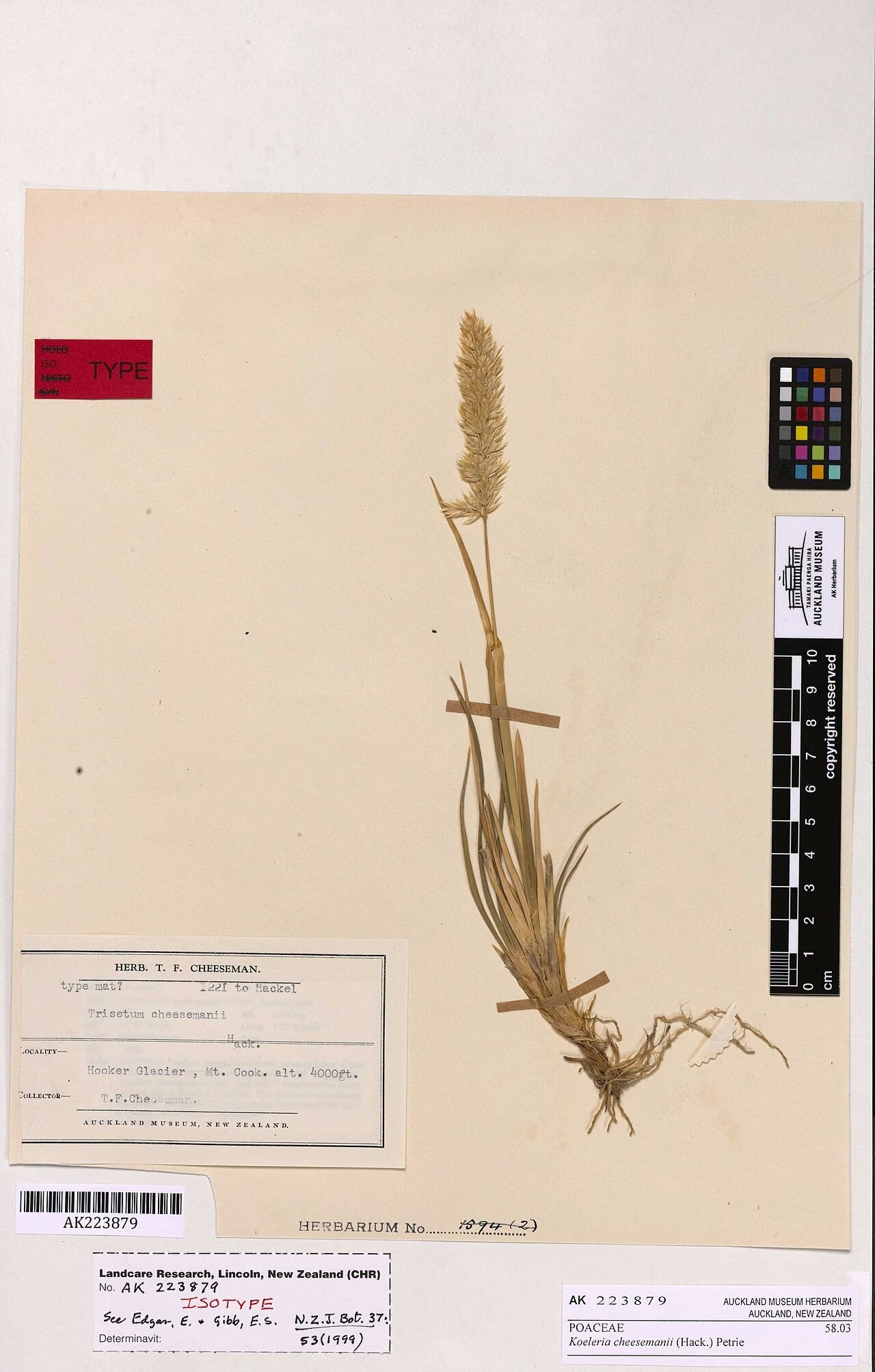
Koeleria cheesemanii
Koeleria cheesemanii
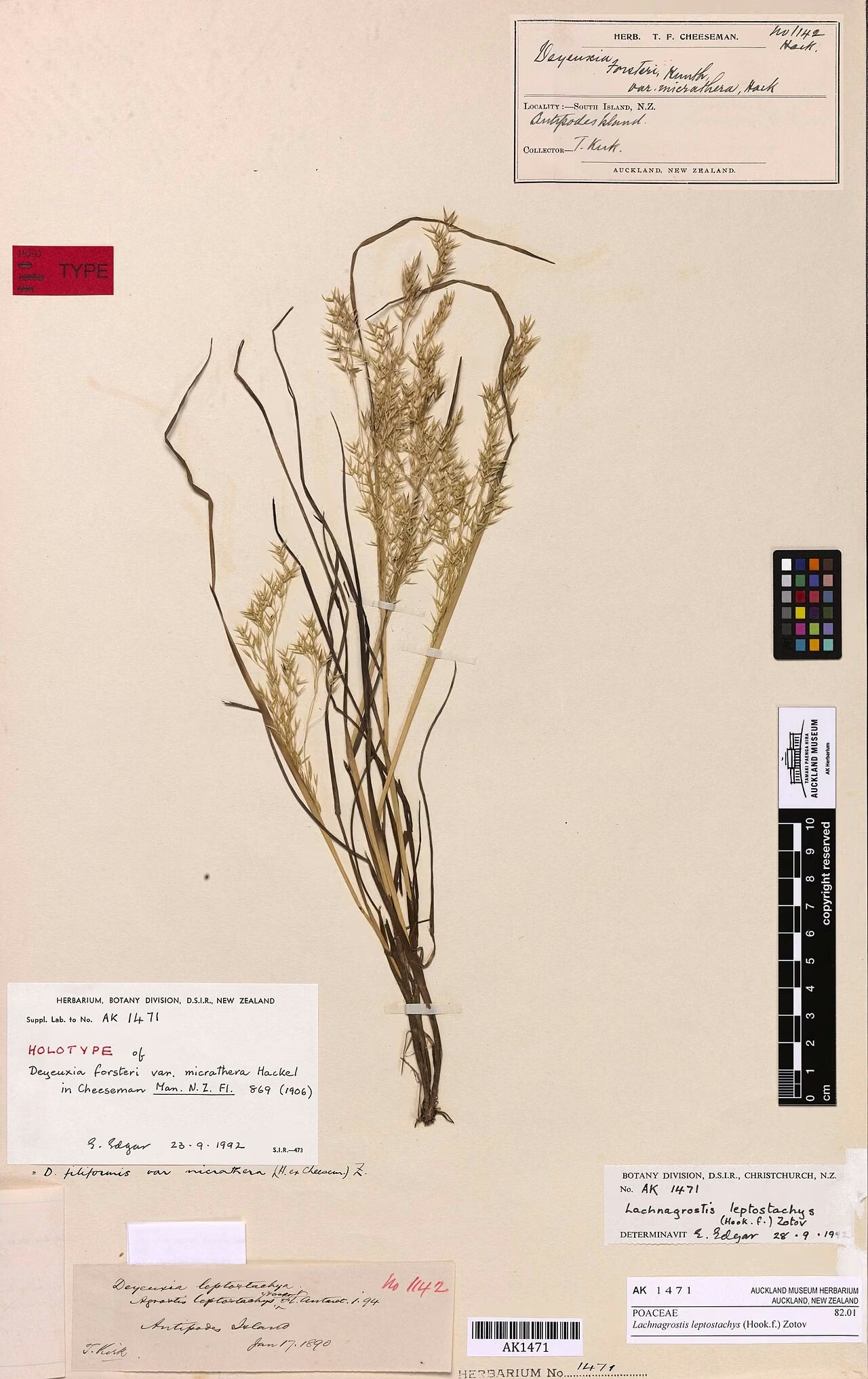
Lachnagrostis leptostachys
Lachnagrostis leptostachys
Coastal Wind Grass
Lachnagrostis littoralis subsp. littoralis
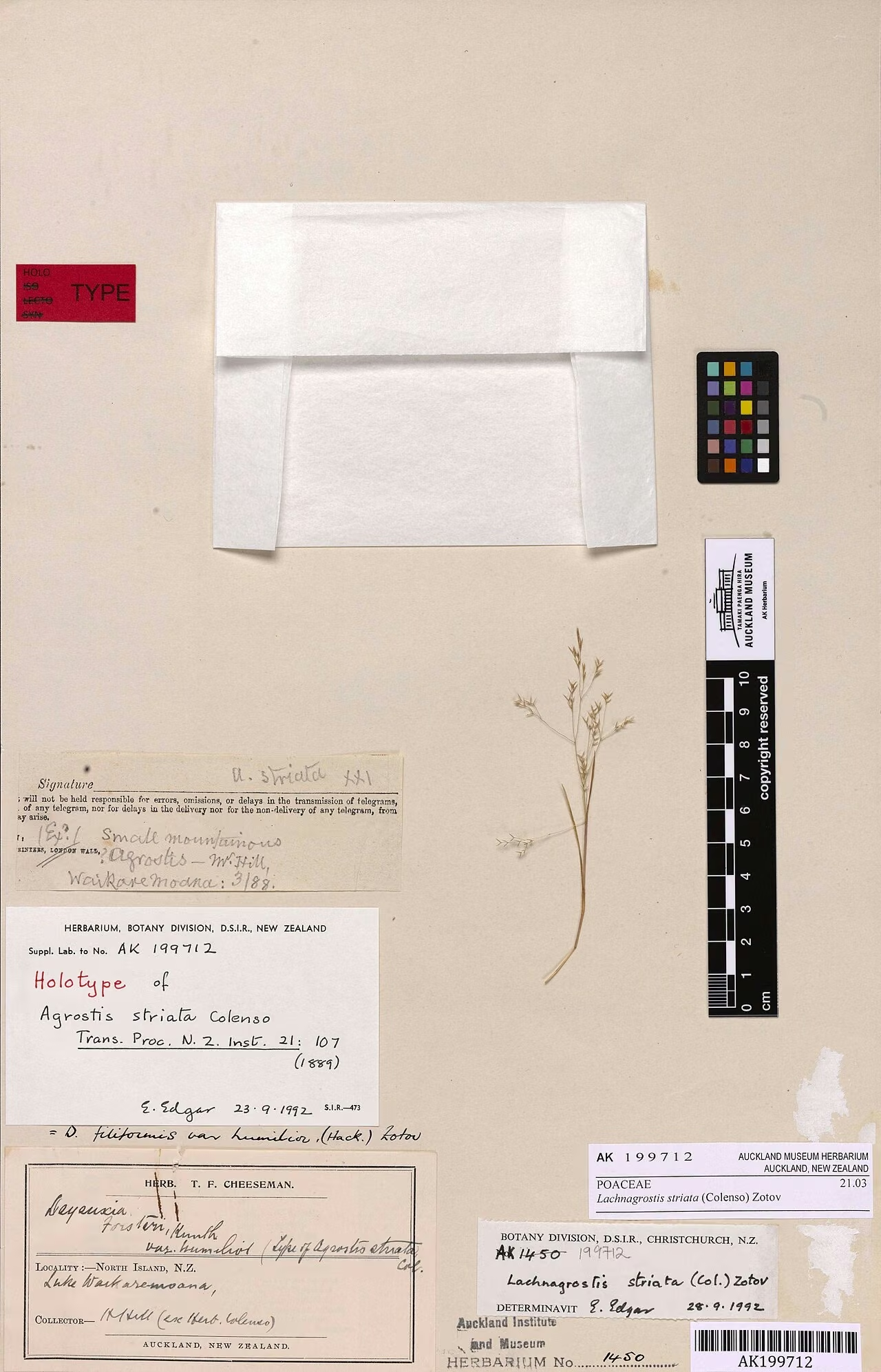
Purple Wind Grass
Lachnagrostis striata
Lagenophora cuneata
Lagenophora cuneata
Plant Conservation
Lachnagrostis elata is ranked At Risk - Naturally Uncommon (2023), with qualifiers for sparse populations and data poor knowledge of its range, size and trend. It was listed Not Threatened in earlier assessments, and the change reflects better knowledge of how sparse it is.
Protecting seepages, mires and ephemeral wetlands from drainage, weeds and stock, and surveying for further populations, are the main conservation needs.
Frequently Asked Questions
How do you identify Lachnagrostis elata?
Look for semi-scrambling, flaccid, pale stems leaning through shrubs and very large, lax, widely spreading panicles up to 300 mm long and wide. These features separate it from other wind grasses.
What is the difference between Lachnagrostis elata and Lachnagrostis ammobia?
L. ammobia is a coastal sand dune species that is smaller, up to 350 mm tall, with hairier lemmas. L. elata grows inland in seepages and mires and is much taller and laxer.
Where is Lachnagrostis elata found?
In the North Island from Opuatia in the Huntly Basin south to Taihape, in the South Island only in north-west Nelson, and on the Chatham Islands.
Is Lachnagrostis elata easy to grow?
It is easy from fresh seed and rooted pieces, but NZPCN notes cultivated plants become lanky, flop over and are short-lived.
Sources and Further Reading
The botanical, growing, and conservation details for Wind Grass (Lachnagrostis elata) on this page draw on the New Zealand plant references below. Consult them for full technical records and the latest distribution data.