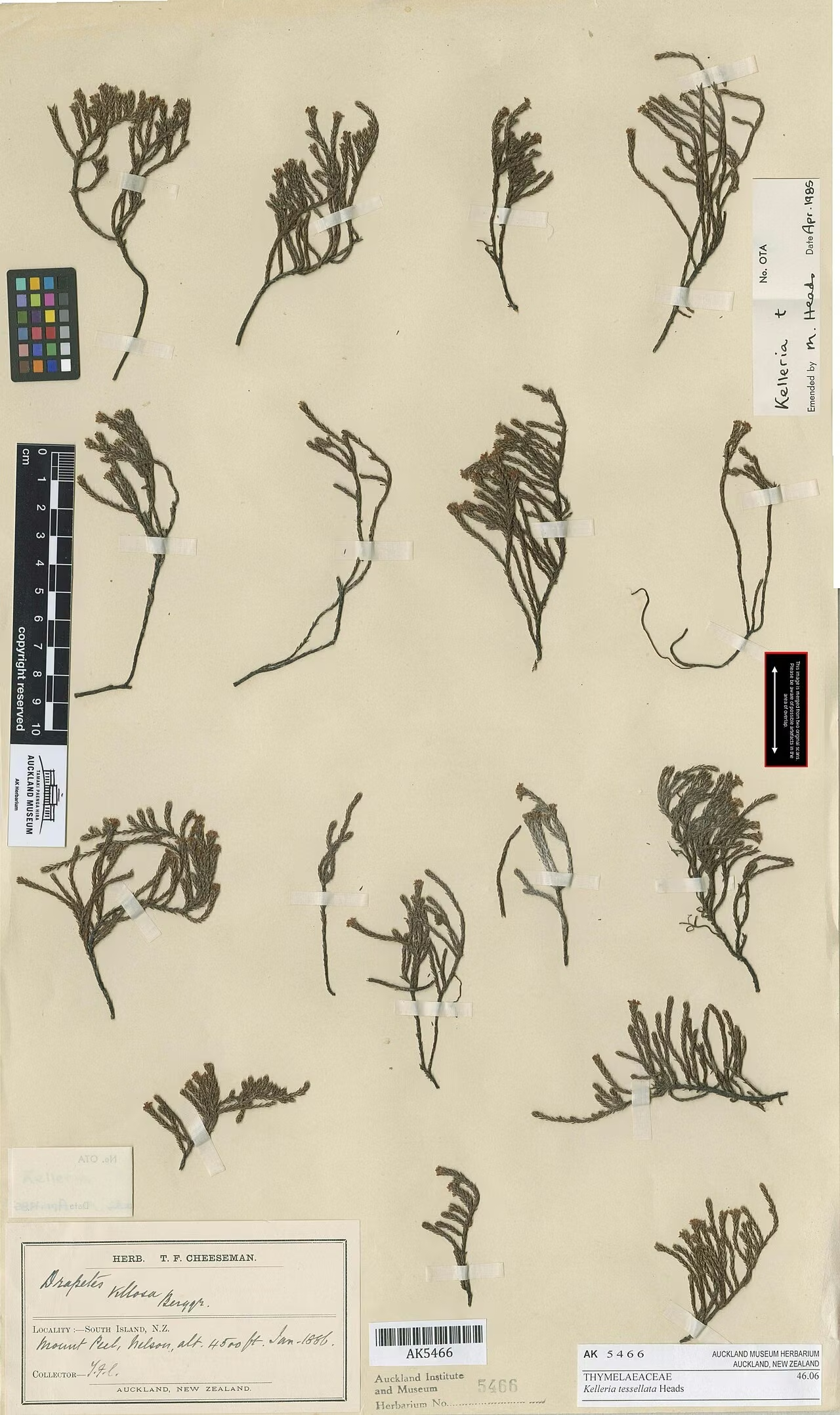
Kelleria
Kelleria tessellata
Last updated:
Kelleria tessellata is a rare, low-growing alpine subshrub in the daphne family (Thymelaeaceae), endemic to New Zealand and known mainly from the mountains of north-west Nelson, including Kahurangi National Park. It was named by Michael Heads in 1990, and its epithet refers to a pattern like a tessellated pavement of small squares. Records come from alpine tussock grassland and herbfield at roughly 1200 to 1550 m, including marble country and slip debris. Because it is confined to a small area and is sparse within it, it is ranked At Risk - Naturally Uncommon. Explore more native ground covers in our native plant guide.
Plant Description
Kelleria tessellata is one of about nine Kelleria species in New Zealand, all small woody mat-forming or cushion-like subshrubs with tiny overlapping leaves and heads of small white flowers. It was recognised as a new species by Michael Heads in his 1990 revision of Kelleria and Drapetes, based partly on an 1866 Mt Peel specimen collected by Thomas Cheeseman.
A detailed published description of its leaves and flowers is not available in the online sources consulted, so its exact measurements cannot be given here. Its name refers to a tessellated, mosaic-like appearance. Like other Kelleria it has a chromosome number of 2n = 18, and its small fruits are possibly wind dispersed.
Several Kelleria species, including K. multiflora and K. laxa, also grow in the north-west Nelson mountains. Identification to species usually needs close examination of leaf shape, hairiness and flower number, and expert confirmation is advisable.
Quick Facts
| Scientific Name | Kelleria tessellata |
|---|---|
| Height | Low-growing; exact dimensions not published online |
| Spread | Not documented in available sources |
| Water Needs | Moist alpine conditions |
| Light | Open, sunny alpine sites |
| Frost Tolerance | High; grows at about 1200-1550 m |
| Salt Tolerance | Low; an alpine plant |
| Growth Rate | Slow |
| Lifespan | Perennial |
Climate Best Suited to
Cold, wet alpine climate of the north-west Nelson ranges, with heavy rainfall, frequent cloud, snow and hard frosts.
Regional Suitability
| City | Climate Suitability |
|---|---|
| Auckland | Low |
| Wellington | Low |
| Christchurch | Low |
| Dunedin | Low |
Plant Habitat
Kelleria tessellata is endemic to the north-west of the South Island. The type locality is Mt Peel in north-west Nelson at about 1370 m (4500 feet). Herbarium and observation records come from Mt Arthur, near Lake Sylvester west of the Cobb Reservoir, Mt Williams and other sites in Kahurangi National Park, with a 1967 specimen from Mt Murchison in Buller District.
Recorded habitats include alpine tussock grassland, herbfield and species-rich short tussock vegetation at about 1200 to 1550 m. One collection was growing in fine debris at the edge of a slip, and an iNaturalist observer described it as uncommon in alpine herb and tussock field in marble country.
Growing Requirements
Soil Requirements
Recorded from fine debris, stony slopes and alpine herbfield soils, including marble country.
- Thin, stony alpine soils
- Some sites are on marble (calcium-rich) ground
Light Requirements
Grows in open alpine tussock and herbfield with full exposure to light.
- Full sun in an open alpine setting
Water Requirements
Its north-west Nelson mountain habitat is very wet, with frequent rain and cloud, but the stony soils drain freely.
- Constant moisture with free drainage
Planting and Establishing
Kelleria tessellata is not in general cultivation, and no information on growing it is available. It should not be dug from the wild.
Anyone wishing to grow it for conservation or study should work with the Department of Conservation or a botanic garden. Growing conditions would likely need to mimic other alpine Kelleria: a gritty, free-draining mix, cool roots and protection from heat.
Ecological Role
Pollinators of Kelleria tessellata have not been studied. Its small white flowers, like those of related species, are likely visited by small alpine insects. NZPCN notes that Kelleria fruits are possibly wind dispersed.
It is a component of species-rich alpine herbfield and short tussock grassland in north-west Nelson, a region known for many plants found nowhere else.
Uses & Significance
Garden Uses
Not a garden plant; its value lies in conserving it where it grows.
- Conservation collections only
- Not available commercially
Ecological Value
One of the many narrowly distributed endemic plants that make the north-west Nelson mountains a botanical hotspot.
- Endemic to north-west Nelson
- Part of species-rich alpine herbfield
Landscaping Uses
Kelleria tessellata has no place in landscaping because it is rare, not cultivated and adapted to a specialised alpine environment.
Gardeners interested in Kelleria can grow more widespread species such as K. dieffenbachii in troughs and leave this species in the wild.
Seasonal Care Calendar
Spring
Snow melts from its alpine habitat later in spring and growth begins.
- Plants emerge from snow cover
Summer
Flowering times have not been published, but specimens and observations are mostly dated from November to April, the alpine growing season.
- Main season for field observation
Autumn
Growth slows as temperatures fall; observations continue into April.
- Fruits presumably ripen late in the season
Winter
Plants lie dormant, often under snow, in the north-west Nelson ranges.
- No activity
When to Prune and How Much
Not applicable; the species is not cultivated.
In the wild, avoid trampling plants, as small mat plants recover slowly from damage.
How to Grow Kelleria
No propagation information has been published for Kelleria tessellata, and it is not in general cultivation. Because it is ranked At Risk - Naturally Uncommon, any collection of seed or cuttings from the wild should be done only by, or with the permission of, the Department of Conservation. The methods below are those used for other alpine Kelleria and would be the starting point for a conservation propagation trial, not a tested protocol for this species.
From Seed
Related Kelleria are sown fresh as soon as fruit is ripe. A cold period over winter is likely to be beneficial for an alpine plant from this altitude, but this is untested.
- Collect a small number of ripe fruits under permit.
- Sow immediately on a gritty alpine seed mix.
- Cover lightly with fine grit and keep moist.
- Leave the tray outdoors in a cool place over winter.
- Record germination results to help future conservation work.
From Cuttings
Other Kelleria root from late summer cuttings, and their prostrate stems often root naturally, which suggests cuttings or rooted pieces may also work for this species.
Rooted pieces would also allow a plant to be held in an alpine house as an insurance population without taking much material from a wild site.
- Take a few short non-flowering shoot tips in late summer.
- Insert into a pumice-based mix in a cool, shaded, humid frame.
- Pot on once roots form.
- Keep plants in a cool alpine house with good air movement.
Pests & Diseases
No pests or diseases have been recorded for Kelleria tessellata.
Potential pressures in its alpine habitat include trampling at popular sites, browsing by introduced animals such as deer and goats, and weed invasion, though none are specifically documented for this species.
Cultural Significance
No Māori name or traditional use is recorded for Kelleria tessellata in the sources consulted.
Its history is botanical: Thomas Cheeseman collected it on Mt Peel in 1866, but it was not recognised as a distinct species until Michael Heads described it in 1990.
Bonus Tip
If you think you have found Kelleria tessellata in north-west Nelson, photograph the leaves and flower heads closely and post the observation to iNaturalist NZ with an accurate location. With only a few dozen observations on iNaturalist so far, every confirmed observation helps clarify its range.
Related Plants
Explore other native plants that share similar characteristics or habitats with Kelleria (Kelleria tessellata), offering further insights into New Zealand's diverse flora. These related species provide context and opportunities for complementary planting in your garden.
Leafless Rush
Juncus pauciflorus
Alpine Kelleria
Kelleria dieffenbachii
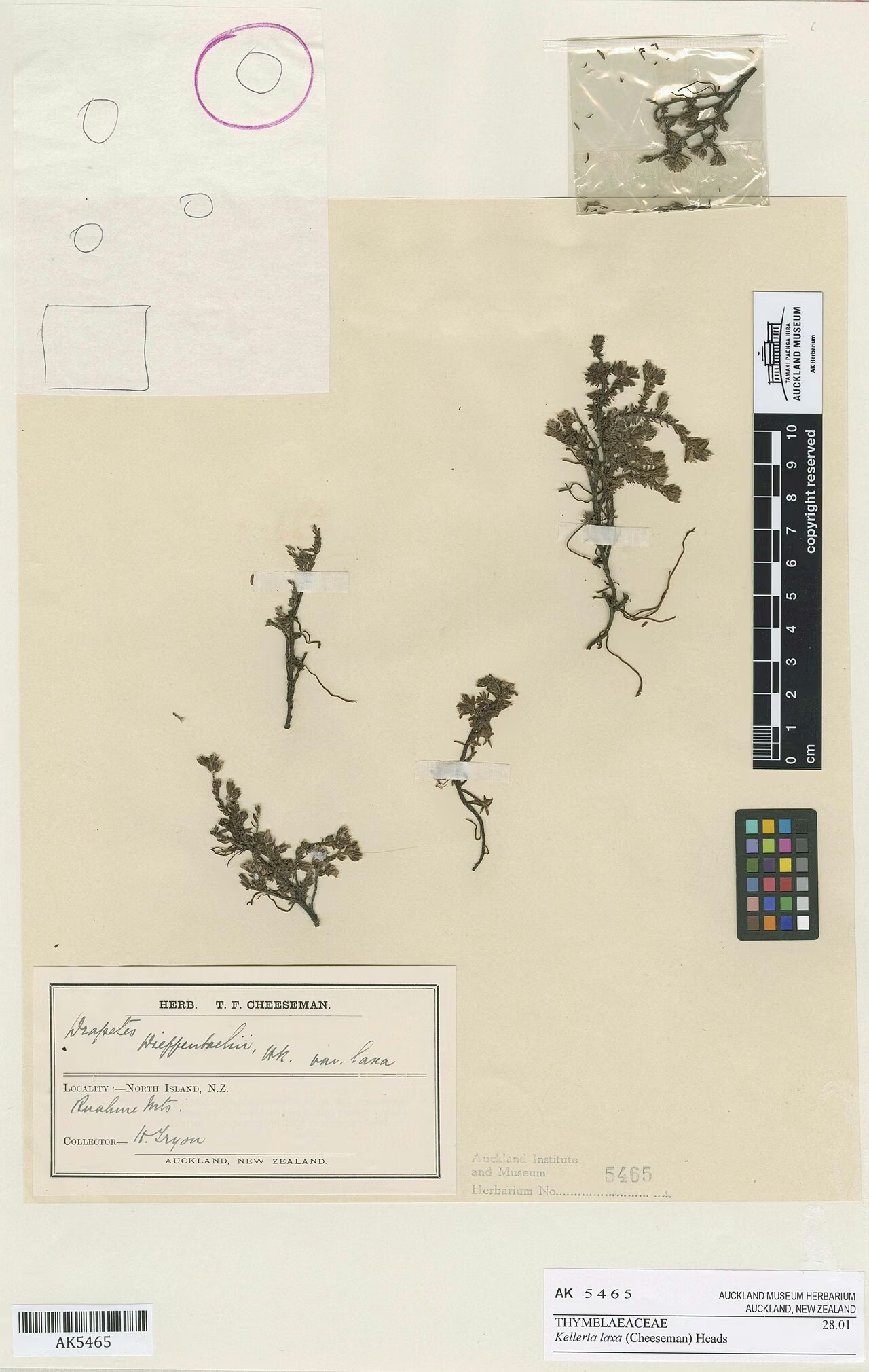
Kelleria laxa
Kelleria laxa
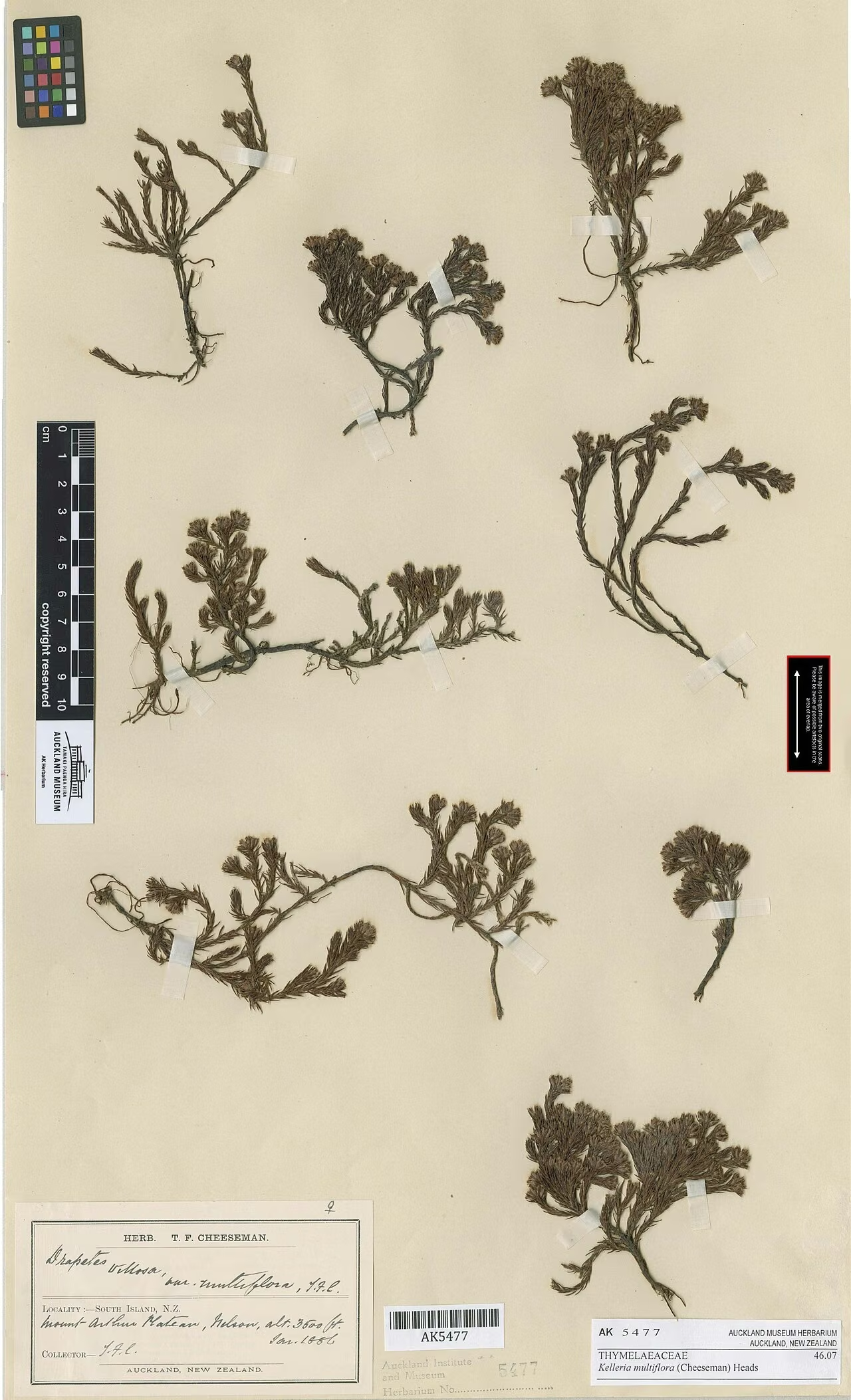
Kelleria multiflora
Kelleria multiflora
Koeleria cheesemanii
Koeleria cheesemanii
Lachnagrostis elata
Lachnagrostis elata
Lachnagrostis leptostachys
Lachnagrostis leptostachys
Coastal Wind Grass
Lachnagrostis littoralis subsp. littoralis
Plant Conservation
Kelleria tessellata is ranked At Risk - Naturally Uncommon (2023), with qualifiers indicating it is sparse (Sp) and that there are data poor elements in its size (DPS) and trend (DPT) assessment. It was listed as Not Threatened in 2004 and 2009 before being reassessed as Naturally Uncommon in 2012.
Most known sites are within Kahurangi National Park. Better survey of its distribution and population size is the main need, along with protecting alpine herbfields from browsing animals and weeds.
Frequently Asked Questions
Where does Kelleria tessellata grow?
Specimen and iNaturalist records are concentrated in north-west Nelson, including Mt Peel, Mt Arthur, the Cobb area near Lake Sylvester, Mt Williams and other parts of Kahurangi National Park, with an older record from Mt Murchison in Buller.
What does tessellata mean?
It comes from the Latin tessellatus, meaning arranged in small squares like a mosaic or tessellated pavement, a reference to the patterned look of the plant.
Is Kelleria tessellata threatened?
It is ranked At Risk - Naturally Uncommon (2023). It is sparse and most of its habitat is in conservation land, but its small range makes it vulnerable.
Sources and Further Reading
The botanical, growing, and conservation details for Kelleria (Kelleria tessellata) on this page draw on the New Zealand plant references below. Consult them for full technical records and the latest distribution data.