Kelleria
Kelleria laxa
Last updated:
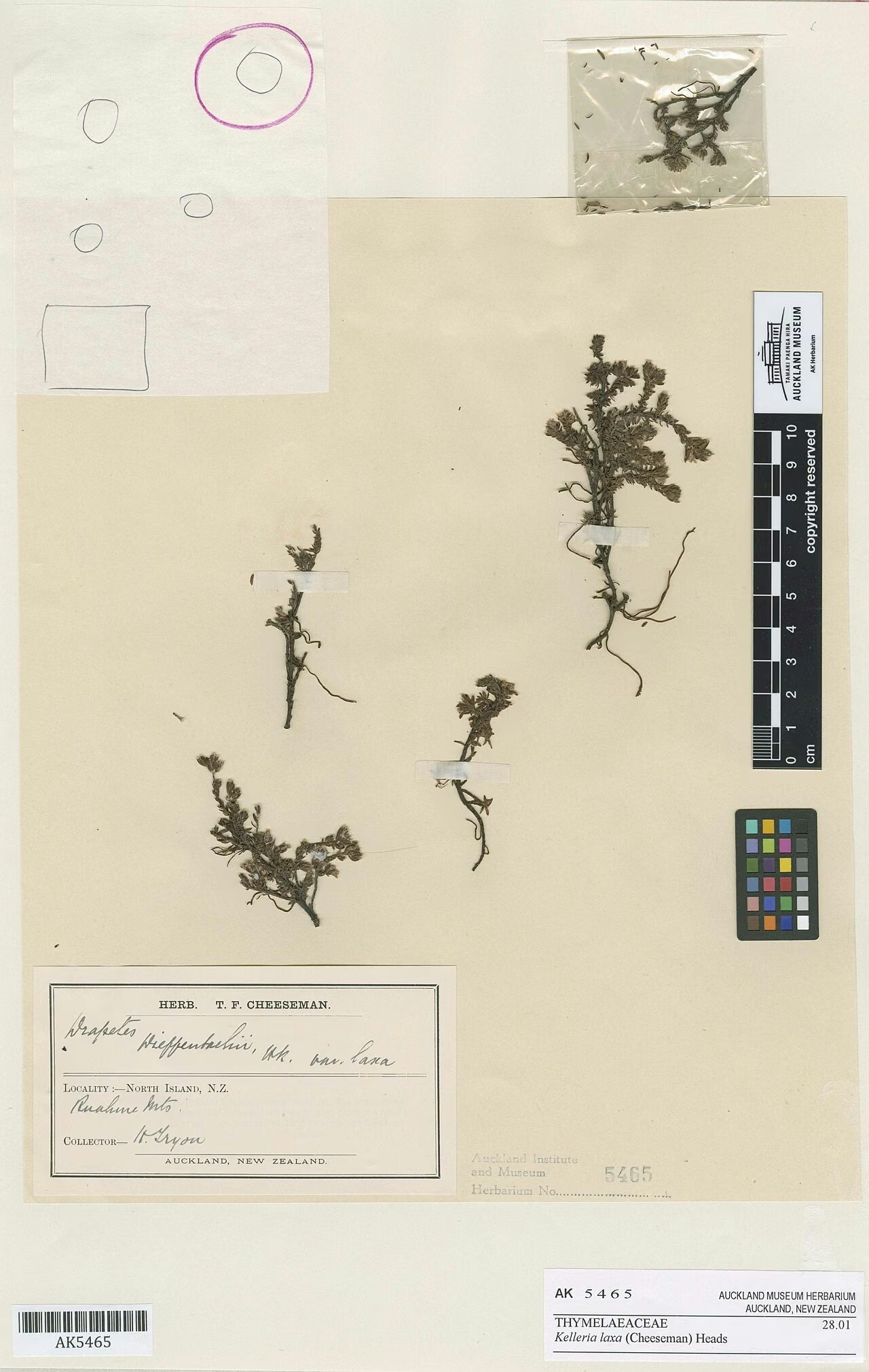
Kelleria laxa is a small, prostrate woody subshrub in the daphne family (Thymelaeaceae), endemic to New Zealand. It forms lax, open patches 30 cm or more across, with rooting stems, spreading branchlets up to 5 cm long and narrow leaves 4 to 5 mm long tipped with a tuft of hairs. Clusters of three to eight tiny white flowers appear in summer. It grows in subalpine grassland and mountain sites in both the North and South Islands, from the Ruahine Range, where it was first collected, south to Otago. It is ranked Not Threatened. Explore more native ground covers in our native plant guide.
Plant Description
Kelleria laxa forms lax patches up to 30 cm or more across, usually 5 to 10 cm tall. Its stems and branches are prostrate and rooting, up to 4 mm in diameter, and the branchlets spread or rise slightly and reach up to 5 cm long.
The leaves are densely packed along the branchlets, 4 to 5 mm long and 1 to 1.5 mm wide, linear to elliptic-oblong, rounded at the tip, with fringed (ciliate) margins and a small tuft of hairs at the apex. Flowers are carried in heads of three to eight at the ends of branchlets. Each white flower has a villous (softly hairy) perianth tube 1.75 to 2 mm long, and the fruit is about 2 mm long.
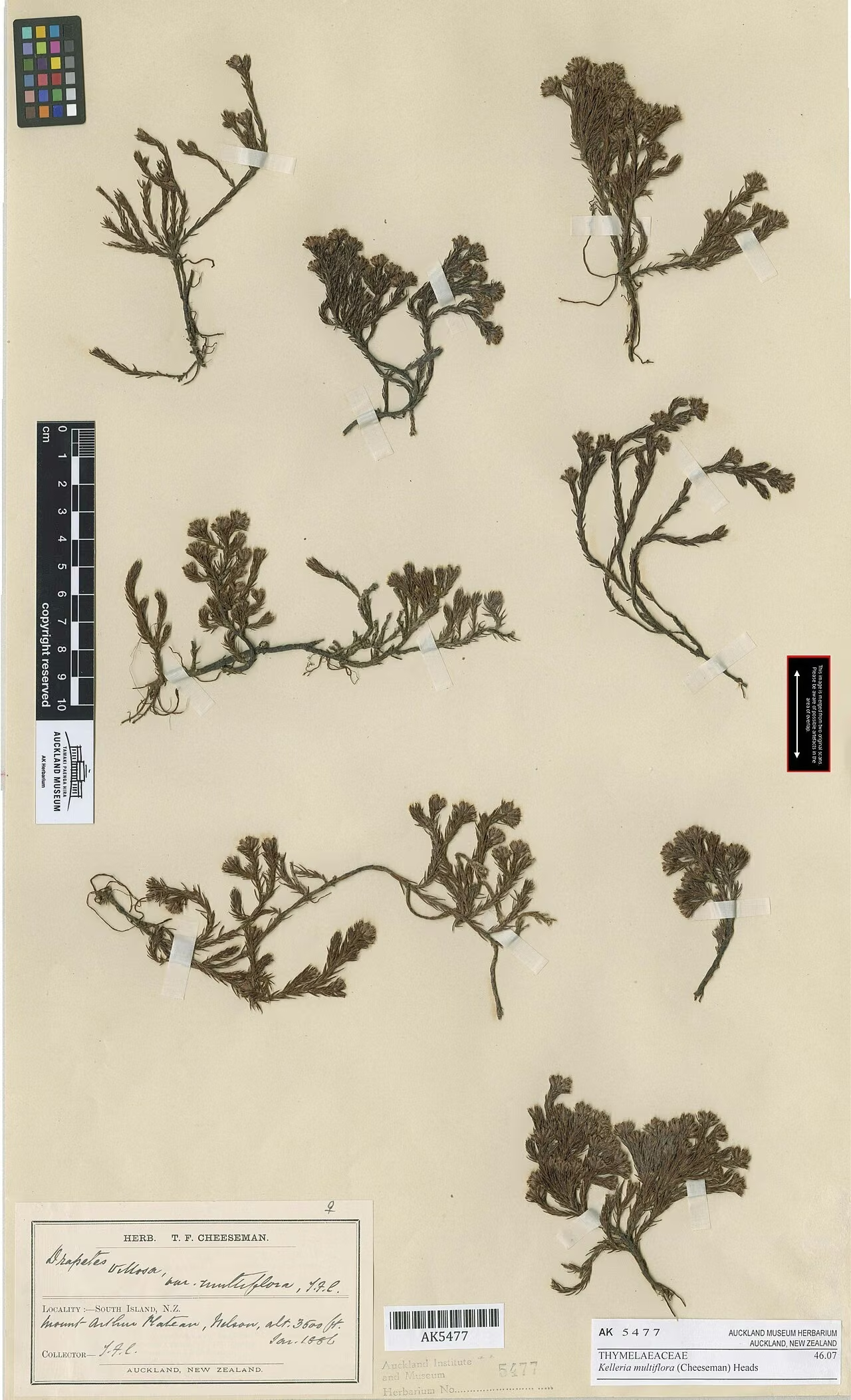
It sits between its relatives in leaf size: K. dieffenbachii has shorter leaves under 3.5 mm, while K. multiflora has narrower, linear-lanceolate leaves up to 7 mm, densely white or grey hairy branchlets and up to fifteen flowers per head. The loose habit and rounded, hair-tipped leaves help pick K. laxa.
Quick Facts
| Scientific Name | Kelleria laxa |
|---|---|
| Height | 5-10 cm |
| Spread | Lax patches 30 cm or more across |
| Water Needs | Moist, drier in winter |
| Light | Full sun to part shade |
| Frost Tolerance | High; subalpine species |
| Salt Tolerance | Low; a mountain plant |
| Growth Rate | Slow |
| Lifespan | Long-lived perennial |
Climate Best Suited to
A plant of cool, moist mountain climates with cold winters; it suits southern and inland gardens far better than warm northern ones.
Regional Suitability
| City | Climate Suitability |
|---|---|
| Auckland | Low |
| Wellington | Low |
| Christchurch | Medium |
| Dunedin | Medium |
Plant Habitat
Kelleria laxa is endemic to the North and South Islands. Its type comes from the Ruahine Range, and iNaturalist records include Pureora Forest Park in the central North Island and many South Island sites in Nelson, Kahurangi and Nelson Lakes, Marlborough, Lewis Pass, Hanmer, Arthur's Pass, Otago (including the Skippers Range area) and Southland.
It is described as a plant of subalpine grassland, and specimen records come from montane and subalpine tussock country, tablelands such as the Arthur and Cobb areas, and open ground near scrub.
Growing Requirements
Soil Requirements
Grows in humus-rich, stony mountain soils that are moist in the growing season.
- Humus-rich but gritty mix
- Good drainage, especially in winter
- No fertiliser needed
Light Requirements
In the wild it grows among tussocks and low herbs that give it partial shelter.
- Full sun in cool districts
- Semi-shade where summers are warm
Water Requirements
Rock-garden growers recommend soil that is moist in summer but drier in winter.
- Water during dry summer spells
- Keep on the dry side over winter
Planting and Establishing
Plant into a rock garden pocket, trough or raised bed with humus-rich but gritty soil, or keep it in an alpine house with shading in summer. Position it where its prostrate stems can root over cool stones or between small tussocks.
Spring planting gives it a full season to settle before winter. Top-dress around the crown with fine gravel to keep it dry.
Ecological Role
Its small white tubular flowers bloom in summer and are probably visited by small native insects, though specific pollinators are not recorded. NZPCN notes that Kelleria fruits are possibly wind dispersed.
The low, rooting stems form part of the ground layer between tussocks in subalpine grassland, helping hold soil on exposed slopes.
Uses & Significance
Garden Uses
Best suited to specialist alpine and rock gardens.
- Trough gardens
- Rock garden pockets in cool regions
- Alpine house collections
Ecological Value
An endemic part of New Zealand's subalpine mat flora, valuable in native alpine collections and ecological restoration of high-country grassland.
- Endemic to New Zealand
- Helps stabilise thin subalpine soils
Landscaping Uses
Let Kelleria laxa trail between rocks or over the edge of a trough where its loose sprays of tiny leaves can be seen. Pair it with small tussocks and other mat plants such as Raoulia or Leptinella for a subalpine scene.
Its open habit means it does not form a weed-proof cover, so keep it with slow-growing companions that will not overwhelm it.
Seasonal Care Calendar
Spring
New growth extends along the branchlets.
- Plant or repot
- Resume watering
Summer
Small heads of white flowers open in summer.
- Provide light shade in heat
- Keep roots moist
Autumn
Fruits ripen after flowering.
- Sow seed fresh
- Take cuttings in late summer
Winter
Growth stops in cold weather.
- Reduce watering
- Protect pots from prolonged wet
When to Prune and How Much
Pruning is not required. Trim back any stems that die off to keep the patch neat.
Avoid cutting into the rooted older stems, which anchor the plant.
How to Grow Kelleria
NZPCN does not document propagation of Kelleria laxa, but rock-garden growers recommend sowing seed when ripe or as soon as possible afterwards, and taking cuttings in late summer. Because the stems root as they creep, rooted pieces can also be detached. It is a slow plant, so expect young plants to take a year or more to reach planting size. Collect wild material sparingly and only with the necessary permission.
From Seed
Fresh seed gives the best results. Fruits ripen after the summer flowering.
Kelleria seed is very small, so sow it thinly and avoid burying it deeply. Germination can be slow and uneven, so keep the tray for at least a full season before discarding it.
- Collect fruits as soon as they ripen.
- Sow immediately on a gritty, humus-rich seed mix.
- Cover lightly with fine grit and keep evenly moist.
- Place in a cool, sheltered position outdoors.
- Prick out seedlings into individual pots when large enough to handle.
From Cuttings
Late summer cuttings of non-flowering shoots root in a free-draining mix kept cool and humid.
Rooting stems are the simplest source of new plants. Lifting a short length of stem that has already rooted into the soil gives a plant with its own roots, which usually establishes faster than an unrooted cutting.
- Select healthy shoots 2 to 4 cm long without flowers.
- Remove the lower leaves and insert into a pumice and peat-free mix.
- Cover with a clear lid or place in a shaded propagating frame.
- Pot on once roots form, usually after several weeks.
- Rooted runners can be cut from the parent and potted directly.
Pests & Diseases
No specific pests or diseases are recorded for Kelleria laxa. Overly wet soil in winter, causing root and stem rot, is the main hazard in cultivation.
Slugs may graze young shoots in damp gardens, and hot humid summers can weaken plants grown in the north.
Cultural Significance
No Māori name or traditional use is recorded for Kelleria laxa in the sources consulted.
Thomas Cheeseman first described it in 1906 as a variety of Drapetes dieffenbachii from Ruahine Range material. Michael Heads moved it to Kelleria in his 1990 revision of Kelleria and Drapetes.
Bonus Tip
If you see a Kelleria with leaves around 4 to 5 mm long, check the leaf tips with a hand lens: a rounded tip carrying a small tuft of hairs, with leaves 1 to 1.5 mm wide rather than very narrow and needle-like, points to K. laxa rather than K. multiflora, whose branchlets are also densely clad in white or grey hairs.
Related Plants
Explore other native plants that share similar characteristics or habitats with Kelleria (Kelleria laxa), offering further insights into New Zealand's diverse flora. These related species provide context and opportunities for complementary planting in your garden.
Juncus novae zelandiae
Juncus novae zelandiae
Giant Rush
Juncus pallidus
Leafless Rush
Juncus pauciflorus
Alpine Kelleria
Kelleria dieffenbachii
Kelleria multiflora
Kelleria multiflora
Kelleria tessellata
Kelleria tessellata
Koeleria cheesemanii
Koeleria cheesemanii
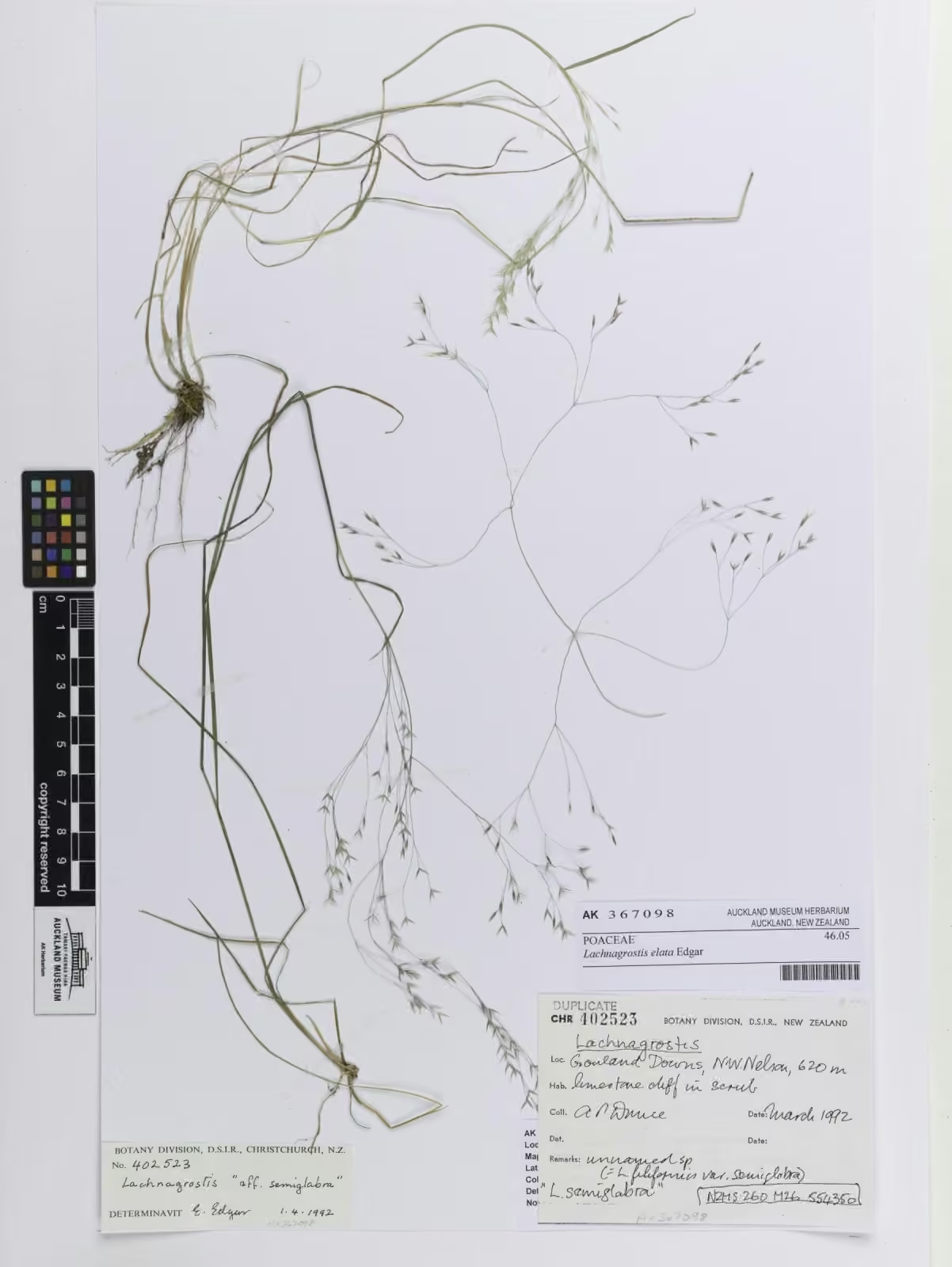
Lachnagrostis elata
Lachnagrostis elata
Plant Conservation
Kelleria laxa has been ranked Not Threatened since 2004. It is regionally Not Threatened in Otago, and regionally Data Deficient in Wellington, where it is poorly known.
Most populations are in mountain conservation land. Weed invasion of subalpine grassland and heavy grazing by introduced browsers are general threats to the low-growing flora it is part of.
Frequently Asked Questions
What does laxa mean in Kelleria laxa?
Laxa is Latin for slack or loose, describing the open, loosely spreading patches it forms compared with the denser mats of Kelleria dieffenbachii.
Does Kelleria laxa grow in Australia?
No. It was once thought to grow in Victoria, but Marks and Walsh (2014) showed the Australian plants are a separate species, Kelleria bogongensis, so K. laxa is now regarded as endemic to New Zealand.
How is Kelleria laxa different from Kelleria dieffenbachii?
Kelleria laxa has longer leaves, 4 to 5 mm long and 1 to 1.5 mm wide, linear to elliptic-oblong with a rounded hairy tip, and forms laxer patches. K. dieffenbachii has shorter 2.5 to 3.5 mm scoop-shaped leaves.
Sources and Further Reading
The botanical, growing, and conservation details for Kelleria (Kelleria laxa) on this page draw on the New Zealand plant references below. Consult them for full technical records and the latest distribution data.