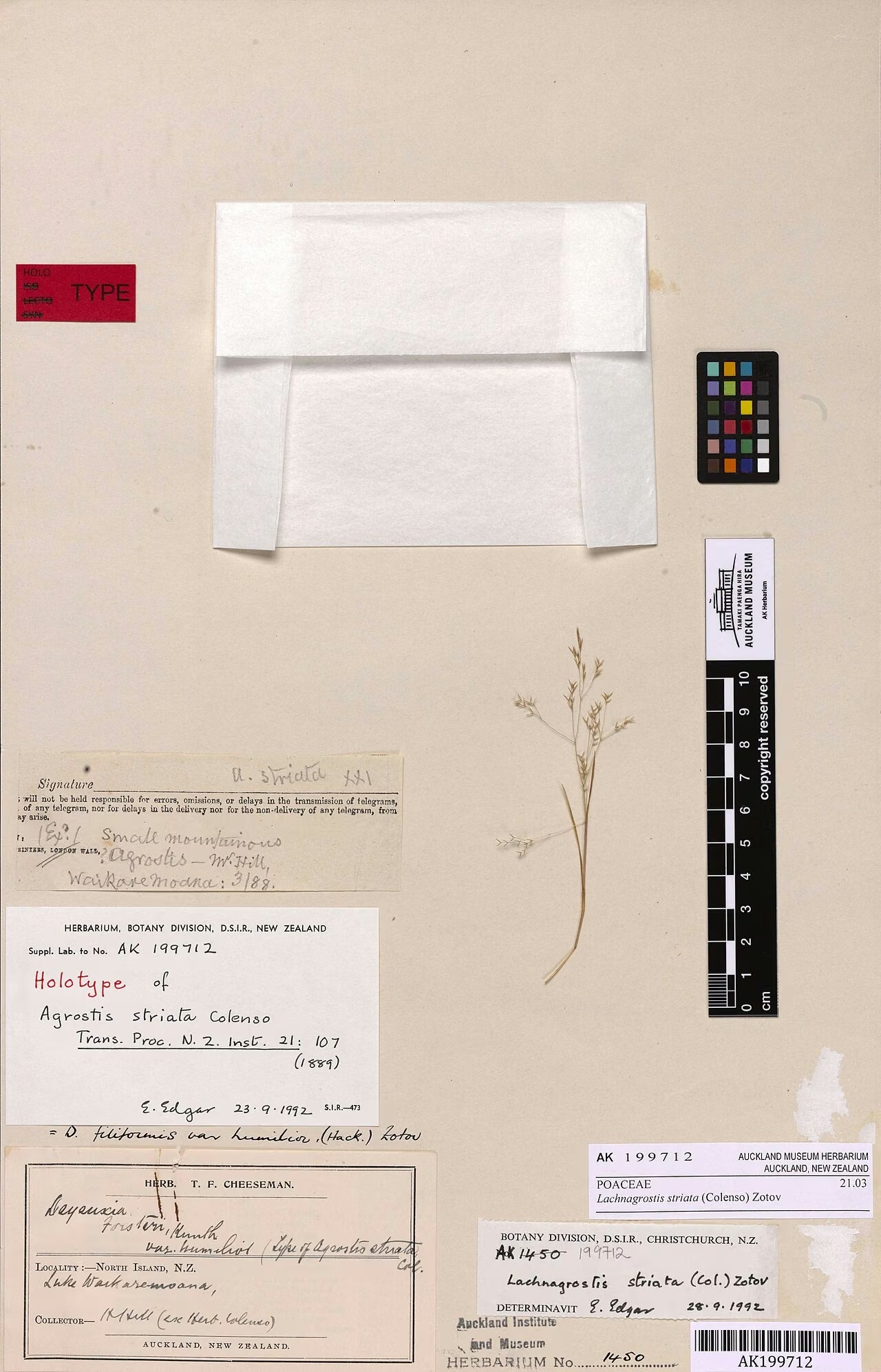
Purple Wind Grass
Lachnagrostis striata
Last updated:
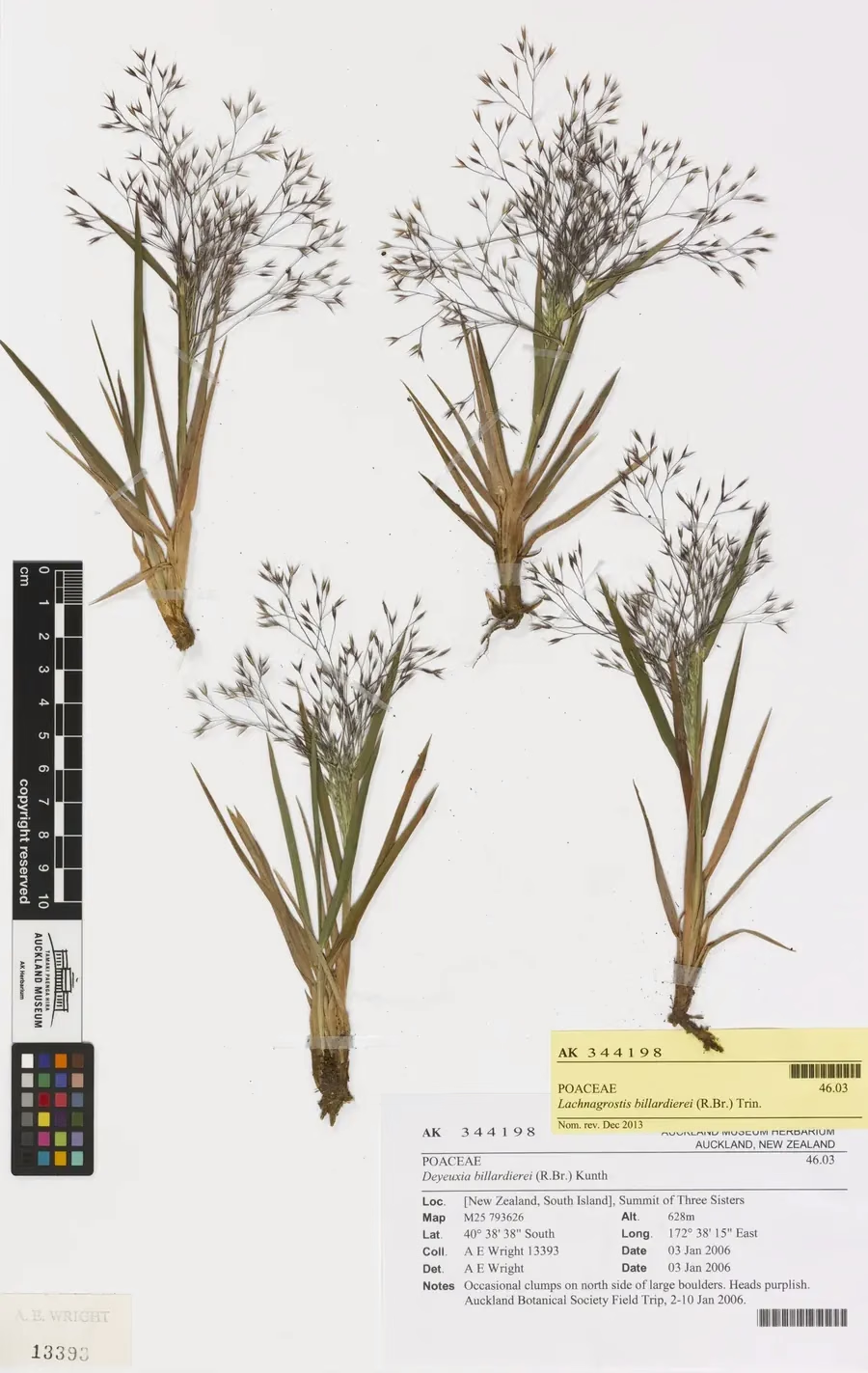
Purple wind grass (Lachnagrostis striata) is a fine-leaved, low-growing grass endemic to New Zealand. It forms small bright green to reddish tufts, usually 5 to 15 cm tall but occasionally to 40 cm, with delicate seed heads whose spikelets and awns are often purple. It grows on lake and tarn margins, especially in turf, on river banks and in damp seepages within tussock grassland, from lowland to montane altitudes. It is scattered through the North Island, common on the Volcanic Plateau, and abundant in Fiordland. It is ranked Not Threatened but is Regionally Vulnerable in Otago. Explore more native grasses and flaxes in our native plant guide.
Plant Description
Purple wind grass forms low tufts of fine, usually folded leaves 10 to 100 mm long and only 0.6 to 2 mm wide. The foliage is bright green to red-green, and new shoots break out sideways through the leaf sheaths. Most plants are 5 to 15 cm tall, though some reach 40 cm.
The panicle is delicate, 20 to 200 mm long, at first contracted and opening out to a loose, airy head as it matures. The spikelets are 2 to 3.5 mm long and green or purplish. Each lemma is 1.2 to 2.3 mm long and densely clothed in stiff, straight hairs, with a short, fine awn of 0.2 to 3 mm, usually straight and purple, arising from the upper third.
It is most like Lachnagrostis uda of alpine seepages and Lachnagrostis glabra of coastal salt marshes. The densely hairy lemma and very small anthers, usually 0.2 to 0.5 mm long, together with its lowland to montane freshwater habitat, distinguish purple wind grass.
Quick Facts
| Scientific Name | Lachnagrostis striata |
|---|---|
| Height | 0.05-0.4 m |
| Spread | Small tufts, usually under 0.15 m across |
| Water Needs | High; damp margins and seepages |
| Light | Full sun |
| Frost Tolerance | High; grows to montane altitudes |
| Salt Tolerance | Low; an inland freshwater-margin grass |
| Growth Rate | Fast |
| Lifespan | Annual to short-lived perennial |
Climate Best Suited to
Suits cool, moist temperate climates, from the frosty Volcanic Plateau to the very wet lake country of Fiordland. It needs reliably damp ground rather than any particular temperature range.
Regional Suitability
| City | Climate Suitability |
|---|---|
| Auckland | Low |
| Wellington | Medium |
| Christchurch | Medium |
| Dunedin | Medium |
Plant Habitat
Lachnagrostis striata is endemic to New Zealand. In the North Island it is scattered from Auckland southwards and is especially common on the Volcanic Plateau. In the South Island it is locally common in the east and abundant in Fiordland.
It grows from lowland to montane altitudes, usually on the margins of lakes and tarns, where it is a component of low turf communities, as well as on river banks and in damp seepages within tussock grassland. Its wetland indicator rating is Facultative Wetland.
Growing Requirements
Soil Requirements
It grows in damp silt, sand, gravel and peaty turf at the water's edge, where fluctuating water levels keep the ground open.
- Permanently moist or seasonally wet soil
- Open, low-fertility turf with little competition
- Silt, gravel or peat at lake and stream edges
Light Requirements
It is a plant of open turf and grassland and needs full light.
- Full sun
- Disappears where rank grasses or shrubs shade it out
Water Requirements
Its natural sites are kept damp by seepage or by lake and tarn levels, and it tolerates brief flooding.
- Keep the root zone moist at all times
- Suited to the drawdown zone of ponds
Planting and Establishing
Purple wind grass is not commercially available, so it is established from locally sourced seed. It is best suited to restoring lake, tarn and pond margins within its natural range.
Sow seed onto bare, damp ground at the water's edge in autumn or spring. Because it readily self-sows and NZPCN notes it can become invasive, it is not a good choice for tidy garden beds.
Ecological Role
Purple wind grass belongs to the short turf communities of lake and tarn shores, which hold many small native herbs adapted to fluctuating water levels. Being short-lived, it relies on regular disturbance and open ground for its seedlings.
It is wind pollinated and its light seed heads disperse on the wind. Specific insect or bird associations are not recorded in the sources consulted.
Uses & Significance
Garden Uses
It is mainly of interest for wetland restoration rather than ornamental gardening.
- Pond and tarn margins in naturalistic wetland plantings
- Restoring lakeshore turf with local seed
- Bog gardens that mimic montane seepages
Ecological Value
It is a characteristic grass of New Zealand's lakeshore turfs, a habitat type under pressure from weeds and altered water levels.
- Endemic wetland indicator grass
- Part of diverse lake and tarn margin turf
- Regionally Vulnerable in Otago
Landscaping Uses
In a wetland design, purple wind grass can be allowed to colonise the wet, open fringe of a pond, where its fine leaves and purplish seed heads add texture among low native turf plants.
Pair it with other low turf natives so the margin remains open, and avoid planting dense sedges right to the water's edge where they would shade it out.
Seasonal Care Calendar
Spring
Flowering starts in September as plants grow away in damp ground.
- Keep margins weed-free
- Look for the first purplish panicles
Summer
Panicles open out and seed ripens from October onward.
- Collect seed as heads turn straw coloured
- Keep soil moist if lake levels drop
Autumn
Flowering ends in April but fruiting continues until June.
- Sow fresh seed on bare damp ground
- Leave plants to self-sow
Winter
Plants persist as small tufts or as seed in the soil.
- No maintenance needed
- Avoid trampling margins
When to Prune and How Much
Pruning is unnecessary. Old, spent tufts can be removed after they have shed seed if a tidier appearance is wanted.
To prevent unwanted spread, cut off seed heads before they ripen.
How to Grow Purple Wind Grass
NZPCN describes Lachnagrostis striata as easy from fresh seed. It is usually an annual or short-lived grass that readily self-sows and can become invasive, so it is normally grown by seed rather than division. Flowering runs from September to April and fruiting from October to June, giving a long window for seed collection. Seed should be gathered from plants growing locally, so that the material suits local conditions and does not mix distinct regional populations, especially in Otago where the species is regionally threatened.
From Seed
The tiny seeds are held in single-flowered spikelets whose lemmas are covered with stiff hairs. Collect panicles when the spikelets loosen and before the wind disperses them, and sow promptly.
Seedlings grow quickly and may flower within their first season, so raise only as many as you need and plant them out while small, when they transplant best into wet ground.
- Collect ripe panicles into a paper bag
- Rub gently to free the florets
- Sow thinly on the surface of a moist, fine seed mix
- Stand the tray in a saucer of water to keep it damp
- Grow in full light until seedlings are a few centimetres tall
- Plant out small clumps onto wet margins
By Division
Where plants behave as short-lived perennials, an established tuft can be split, although new plants from seed are usually more vigorous.
- Lift a healthy tuft in spring
- Tease it into small rooted pieces
- Replant straight away into wet soil and keep moist
Pests & Diseases
No specific pests or diseases are recorded. The main problem in the wild is competition from introduced pasture grasses and wetland weeds that overrun open lakeshore turf.
Changes to lake levels, stock trampling and drainage of seepages can also destroy its habitat.
Cultural Significance
No traditional Māori name or use is recorded for purple wind grass in the sources consulted.
William Colenso described it as Agrostis striata in 1888, and Victor Zotov transferred it to Lachnagrostis in 1965. The epithet striata means striated or lined.
Bonus Tip
On a tarn margin in summer, look for a low grass with a cloud of fine purplish seed heads. A hand lens on a single floret will show the lemma bristling with stiff hairs, the quickest field check for this species among the wind grasses.
Related Plants
Explore other native plants that share similar characteristics or habitats with Purple Wind Grass (Lachnagrostis striata), offering further insights into New Zealand's diverse flora. These related species provide context and opportunities for complementary planting in your garden.
Koeleria cheesemanii
Koeleria cheesemanii
Lachnagrostis elata
Lachnagrostis elata
Lachnagrostis leptostachys
Lachnagrostis leptostachys
Coastal Wind Grass
Lachnagrostis littoralis subsp. littoralis
Lagenophora cuneata
Lagenophora cuneata
Lagenophora sublyrata
Lagenophora sublyrata
Papataniwhaniwha
Lagenophora petiolata
Coast Blowngrass
Coast Blowngrass
Plant Conservation
Purple wind grass is ranked Not Threatened (2023). Regionally it is ranked Regionally Vulnerable in Otago and Data Deficient in Wellington.
Keeping lake and tarn margins free of invasive weeds, fencing stock out of seepages and protecting natural water level fluctuations all help maintain the open turf it depends on.
Frequently Asked Questions
Where is purple wind grass found in New Zealand?
It is scattered through the North Island from Auckland south, especially on the Volcanic Plateau, is locally common in the eastern South Island and is abundant in Fiordland.
What habitat does Lachnagrostis striata grow in?
It grows on the margins of lakes and tarns, particularly in turf, on river banks and in damp seepages within tussock grassland, from lowland to montane altitudes.
How is Lachnagrostis striata identified?
Its lemma is densely covered in stiff, straight hairs and its anthers are tiny, usually 0.2 to 0.5 mm long, which separates it from Lachnagrostis uda and L. glabra.
Is purple wind grass a wetland plant?
Yes. It is rated Facultative Wetland, meaning it is usually found in wetlands but occasionally occurs on drier ground.
Sources and Further Reading
The botanical, growing, and conservation details for Purple Wind Grass (Lachnagrostis striata) on this page draw on the New Zealand plant references below. Consult them for full technical records and the latest distribution data.