Koeleria
Koeleria cheesemanii
Last updated:
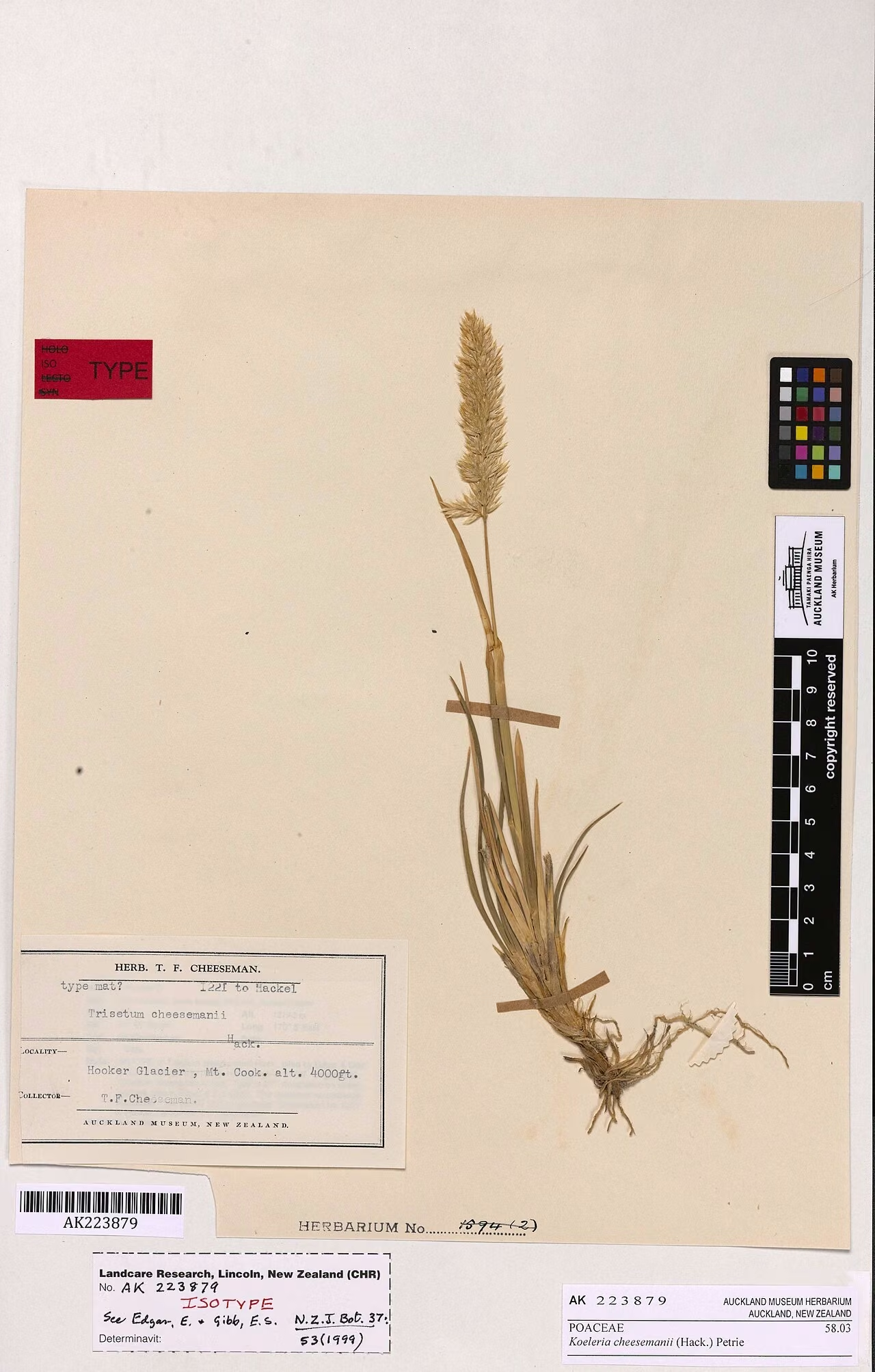
Koeleria cheesemanii is a small endemic alpine grass that forms dense, stiff, pale greyish-green tufts, usually 9 to 17 cm tall, with dense cylindrical flower heads. It grows on rocky outcrops, scree and cliff faces from 1000 to 2800 m, making it one of New Zealand's highest-growing grasses. It is abundant throughout the main South Island ranges but uncommon in the North Island, where it is known only from Mt Hikurangi, the Kaweka Range and the north-east Ruahine Range. It is ranked Not Threatened and is often found growing with Koeleria spicata. Explore more native grasses and flaxes in our native plant guide.
Plant Description
Koeleria cheesemanii forms densely caespitose (tightly clumped) tufts of low to medium stature, usually 9 to 17 cm tall but ranging from about 7 to 43 cm. The foliage is stiff, semi-pungent and pale greyish-green. Leaf sheaths often overlap and are hairless to finely hairy. The blades are 1.2 to 21 cm long and 0.5 to 5.5 mm wide, usually folded or rolled, with a prominent midrib and rough or hairy margins.
The flowering stems (culms) are 1 to 35 cm long, pale green to purple, and the internodes below the head are sparsely to densely hairy or woolly. The flower head is a densely contracted, usually cylindrical panicle 1.3 to 7.3 cm long and up to about 2 cm wide. Spikelets are 3.8 to 6.9 mm long with two or three florets, and the lemmas, 3.5 to 6 mm long, carry a short awn up to about 3 mm long at or just below the tip.
It often grows with Koeleria spicata, which also has dense spike-like heads. Several other endemic Koeleria occur in New Zealand, and separating them relies on details of the hairs, lemmas and awns, so a hand lens and the Flora of New Zealand key are needed for confident identification.
Quick Facts
| Scientific Name | Koeleria cheesemanii |
|---|---|
| Height | Usually 9-17 cm, occasionally to 43 cm |
| Spread | Compact, dense tufts; spread not documented |
| Water Needs | Damp but well drained |
| Light | Full sun |
| Frost Tolerance | Very high; grows to 2800 m |
| Salt Tolerance | Low; an alpine plant |
| Growth Rate | Slow |
| Lifespan | Perennial |
Climate Best Suited to
A high-alpine grass adapted to intense cold, snow, wind and strong sunlight, with cool summers; it cannot cope with high humidity or warmth.
Regional Suitability
| City | Climate Suitability |
|---|---|
| Auckland | Low |
| Wellington | Low |
| Christchurch | Medium |
| Dunedin | Medium |
Plant Habitat
Koeleria cheesemanii is endemic to New Zealand. In the North Island it is uncommon, known from Mt Hikurangi, the Kaweka Range and the north-east Ruahine Range. In the South Island it is abundant throughout the main mountain ranges.
It grows on rocky outcrops, scree and cliff faces from 1000 to 2800 m, often alongside Koeleria spicata. These are harsh, exposed sites with little soil, where tufts root into cracks and stable patches of fine debris.
Growing Requirements
Soil Requirements
In the wild it roots into rock crevices and stony scree with very little soil.
- Very gritty, free-draining mix
- Damp but never waterlogged
- No fertiliser
Light Requirements
An open, exposed alpine grass that needs full sun.
- Full sun
- Good air movement around the tuft
Water Requirements
NZPCN recommends well-drained but damp soil in a cool, airy place.
- Keep evenly damp in the growing season
- Avoid humid, still conditions
Planting and Establishing
Plant into a scree bed, crevice garden or trough with a very gritty mix, setting the tuft between stones so the roots stay cool and the crown dry. A cool, airy, sunny position is essential, as it will not tolerate high humidity.
In cold southern and inland gardens it can be grown outdoors; in warm northern districts an alpine house with plenty of ventilation is a better option.
Ecological Role
Like other grasses, Koeleria cheesemanii is wind pollinated. Its florets are dispersed by wind and possibly by attachment to animals or people.
As one of the few plants able to colonise high rock outcrops and scree up to 2800 m, it helps stabilise loose debris and provides a foothold for other alpine plants.
Uses & Significance
Garden Uses
A neat, small tussock for alpine and crevice gardens.
- Crevice and scree gardens
- Troughs with other alpines
- Native alpine grass collections
Ecological Value
An endemic grass of high-alpine rock habitats, contributing to the plant cover of some of New Zealand's harshest environments.
- Stabilises scree and rock ledges
- Endemic to New Zealand
Landscaping Uses
Use its stiff grey-green tufts as small accents among rocks in a crevice garden, where their fine texture contrasts with cushion plants and silver-leaved alpines.
Group three or more tufts together for a natural scree effect. Because it may not flower in the lowlands, grow it mainly for its foliage.
Seasonal Care Calendar
Spring
New leaves grow as temperatures rise.
- Divide or plant out
- Resume watering
Summer
In the mountains it produces dense cylindrical flower heads in the short alpine summer.
- Keep cool and airy
- Water in dry weather
Autumn
Seed ripens and disperses on the wind.
- Collect fresh seed
- Remove spent flower stems
Winter
Plants rest under snow in the wild; this cold period is needed for flowering.
- Leave pots outside in the cold
- Protect from waterlogging
When to Prune and How Much
Comb out dead leaves by hand in late winter or early spring to keep the tuft neat and well ventilated.
Remove old flower stems after seed has shed. Do not cut the tuft hard back.
How to Grow Koeleria
NZPCN describes Koeleria cheesemanii as easy to grow from fresh seed and by division of plants. The main challenge is not propagation but keeping plants healthy afterwards: it will not tolerate high humidity and needs a cool, airy place in well-drained, damp soil. Note that plants grown at low elevations will not flower unless given one to two months of cold, so seed is best collected from wild or cold-grown plants.
From Seed
Fresh seed germinates readily. Collect it as the dense heads mature and begin to shed florets.
Sowing in autumn and leaving the tray outdoors through winter gives seedlings natural cold, which suits a plant from 1000 to 2800 m.
- Rub ripe heads gently to release the florets.
- Sow on a gritty seed mix and cover lightly with fine grit.
- Keep moist in a cool, well-ventilated spot.
- Prick out seedlings into deep pots once they have two or three leaves.
- Grow on in full sun with good air movement.
By Division
Established tufts can be split into smaller pieces, each with roots and several shoots. Division also reproduces a plant already known to flower in your conditions.
- Lift the tuft in early spring.
- Tease or cut it into sections with healthy roots.
- Trim long leaves back by about a third to reduce water loss.
- Pot into a gritty mix and keep shaded and damp for two weeks.
- Move into full sun once new growth starts.
Pests & Diseases
No specific pests are recorded. The greatest risk in cultivation is fungal rot in warm, humid or stagnant conditions, which NZPCN warns the species will not tolerate.
Over-rich soil makes the tufts soft and prone to collapse, so keep the mix lean.
Cultural Significance
No Māori name or traditional use is recorded for Koeleria cheesemanii in the sources consulted.
The genus is named after George Ludwig Koeler (1765 to 1807), a German botanist who wrote about grasses, and the species after Thomas Frederick Cheeseman, author of the Manual of the New Zealand Flora (1906).
Bonus Tip
If you want garden plants to flower, mimic their alpine winter: leave potted plants outdoors in the coldest spot available, or in a cold district, for at least one to two months of winter cold, which NZPCN says is needed before it will flower at low elevations.
Related Plants
Explore other native plants that share similar characteristics or habitats with Koeleria (Koeleria cheesemanii), offering further insights into New Zealand's diverse flora. These related species provide context and opportunities for complementary planting in your garden.
Alpine Kelleria
Kelleria dieffenbachii
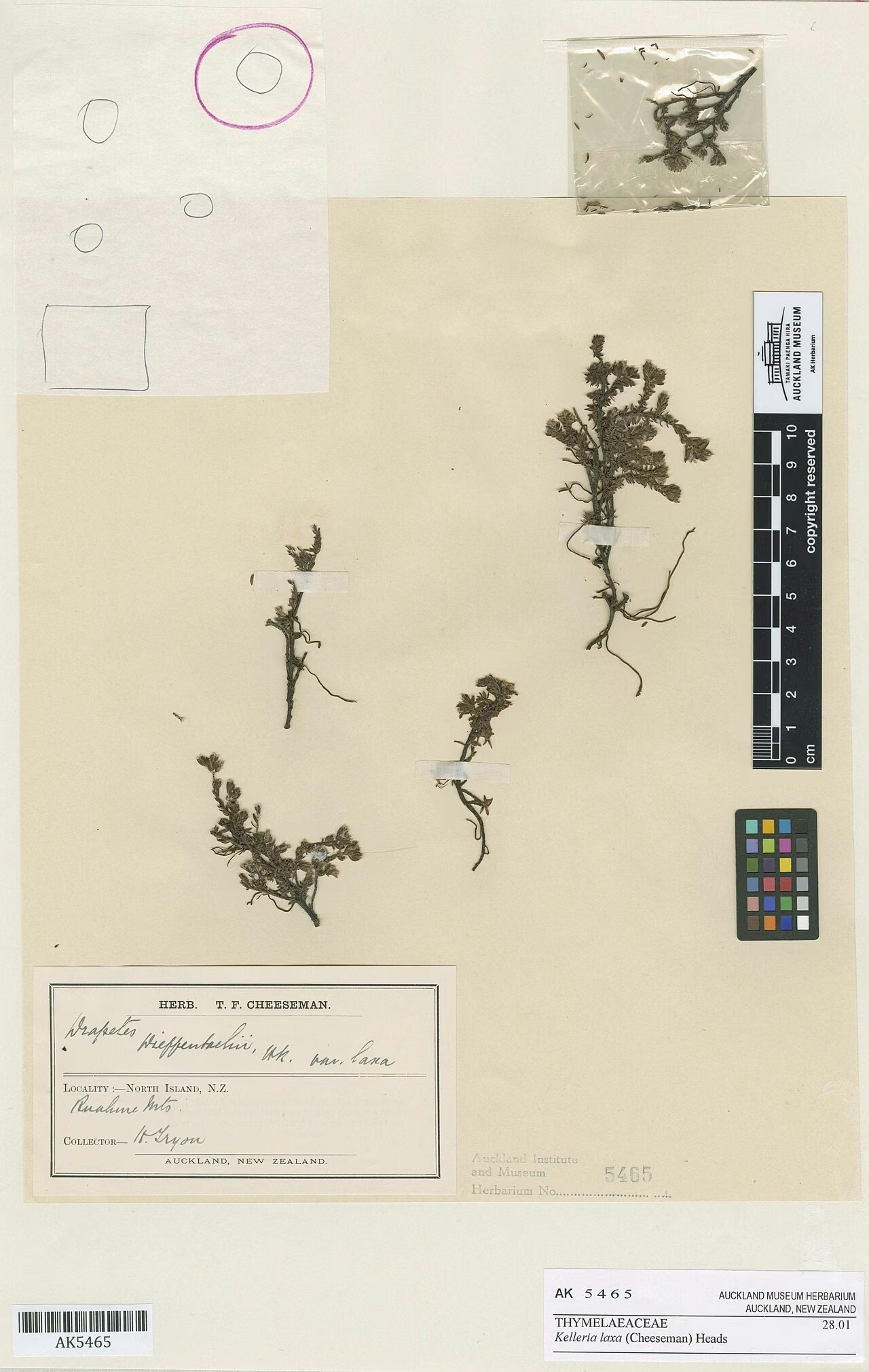
Kelleria laxa
Kelleria laxa
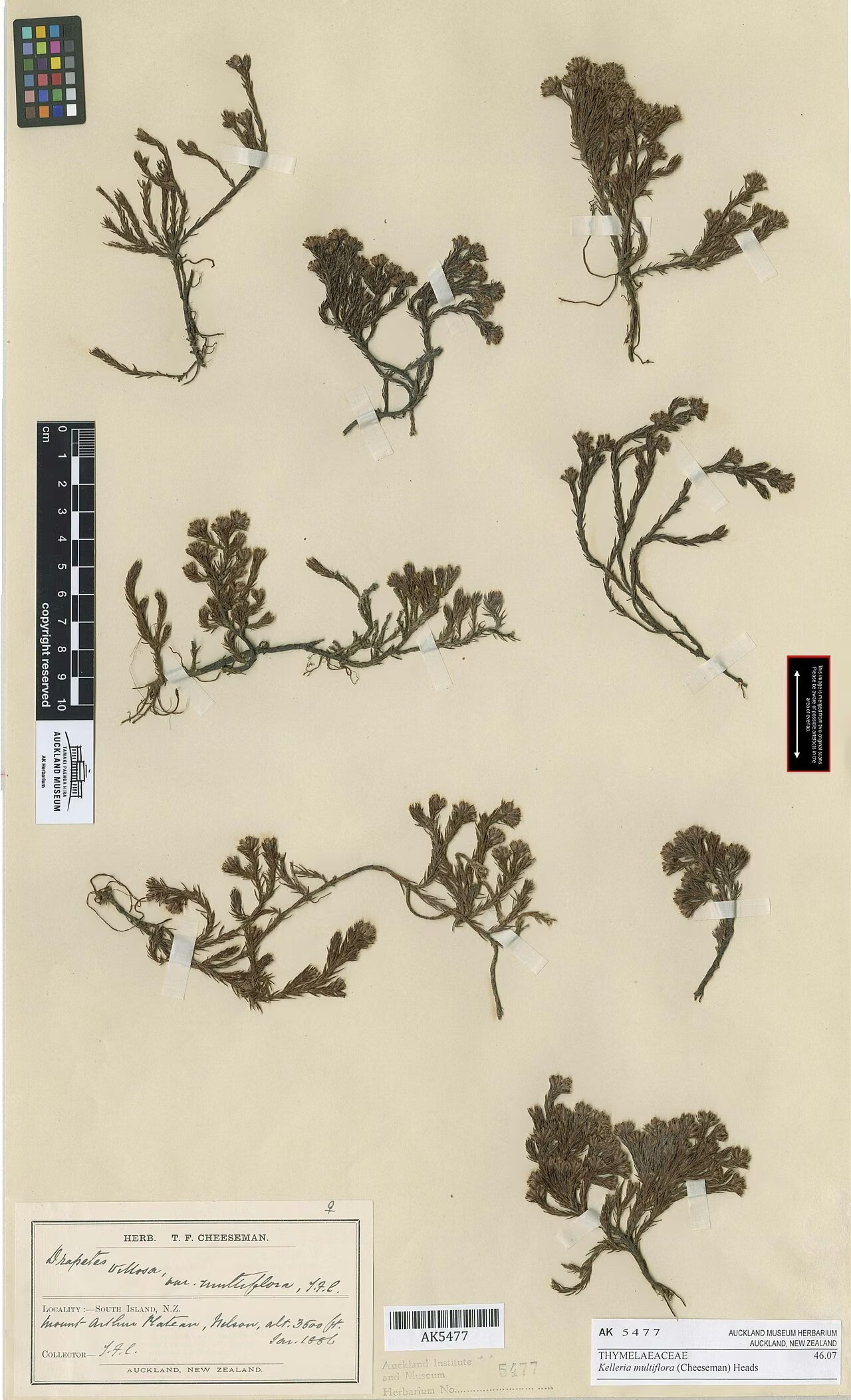
Kelleria multiflora
Kelleria multiflora
Kelleria tessellata
Kelleria tessellata
Lachnagrostis elata
Lachnagrostis elata
Lachnagrostis leptostachys
Lachnagrostis leptostachys
Coastal Wind Grass
Lachnagrostis littoralis subsp. littoralis
Purple Wind Grass
Lachnagrostis striata
Plant Conservation
Koeleria cheesemanii is ranked Not Threatened (2023). It is abundant throughout the main South Island ranges, although North Island populations are uncommon and localised.
Its high, rocky habitats are largely free from development. Climate warming that reduces alpine habitat is a long-term concern for high-mountain plants generally.
Frequently Asked Questions
Where does Koeleria cheesemanii grow?
It grows on rocky outcrops, scree and cliff faces at 1000 to 2800 m. It is abundant in the main South Island mountain ranges and uncommon in the North Island, on Mt Hikurangi, the Kaweka Range and the north-east Ruahine Range.
Why won't my Koeleria cheesemanii flower?
NZPCN notes that it will not flower at low elevations unless it receives one to two months of cold treatment, so lowland plants may stay vegetative.
Is Koeleria cheesemanii really a Koeleria?
It was first named Trisetum cheesemanii, and NZPCN notes that New Zealand Koeleria are probably better placed in Trisetum, so its name may change in future.
Who is Koeleria cheesemanii named after?
It honours Thomas Frederick Cheeseman (1846 to 1923), the Auckland Museum botanist who wrote the Manual of the New Zealand Flora in 1906.
Sources and Further Reading
The botanical, growing, and conservation details for Koeleria (Koeleria cheesemanii) on this page draw on the New Zealand plant references below. Consult them for full technical records and the latest distribution data.