Club Rush
Isolepis praetextata
Last updated:
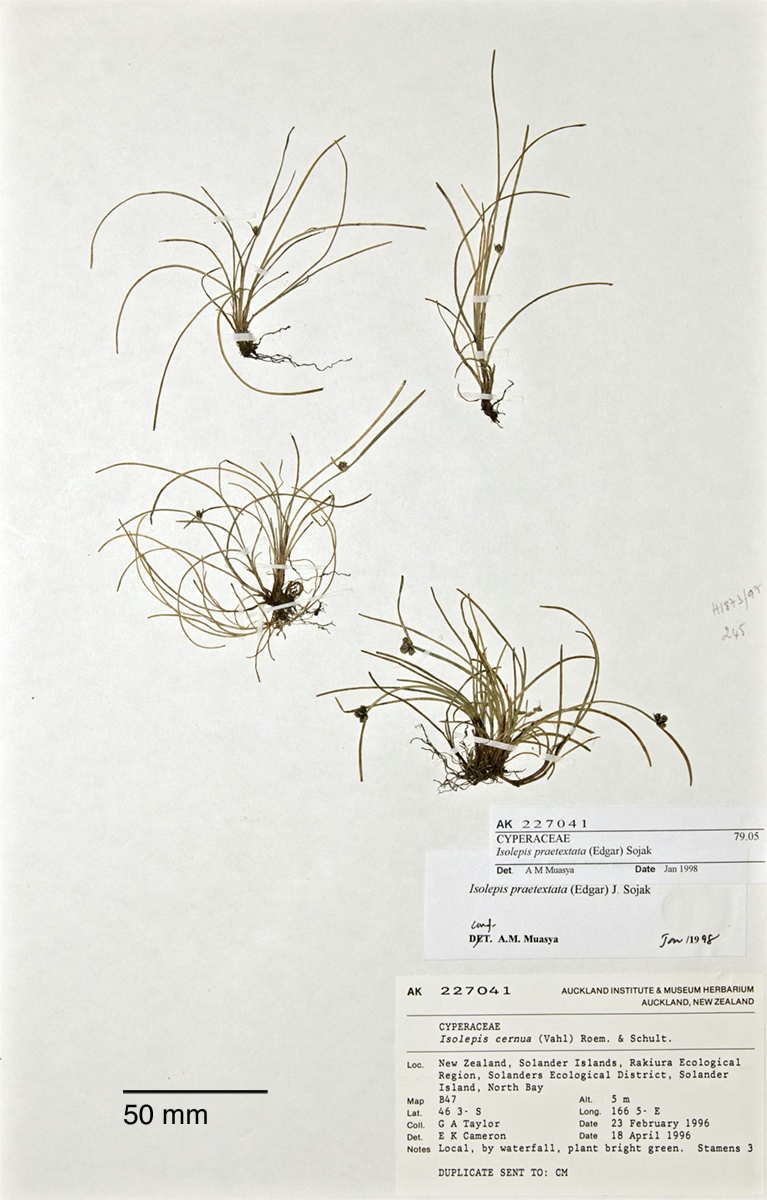
Isolepis praetextata is a small, leafy, tufted sedge endemic to New Zealand's southern and western coasts. Its culms, 30 to 300 mm long, often sprawl or droop, and end in a compact, almost semicircular head of two to five dark red-purple spikelets that turn green above and grey-brown with age. It grows on coastal banks, boulder falls, turf and seepages, sometimes under coastal scrub, from the south Wellington coast through Westland, Fiordland, Southland and Stewart Island to the Chatham Islands and the subantarctic Snares, Auckland and Campbell Islands. Its name means bordered with purple, and it is ranked Not Threatened. Explore more native grasses and flaxes in our native plant guide.
Plant Description
Isolepis praetextata is a tufted perennial that is often prostrate or drooping, growing from a slender ascending rhizome about 0.5 mm thick. Its culms are 30 to 300 mm long and 0.5 to 1 mm wide, with one or two membranous basal bracts that are grey-brown or sometimes red-purple. Each culm has usually two or three leaves, shorter than or equal to the culm, and the leaf sheaths are often streaked with red-purple.
The flower head is compact, about 4 to 5 mm high and 5 to 9 mm wide, and usually almost semicircular in outline. It is made of two to five close-packed, blunt, ovate spikelets that are dark red-purple to almost black below and green above, ageing to grey-brown. The glumes are 2 to 2.5 mm long, lanceolate and pointed, tinged red-purple, with a very thick green keel. Each flower usually has one or two stamens (rarely three in the lowest glumes), three style branches, and a smooth, pale cream, three-angled nut about 1 by 0.5 mm.
Large, leafy forms of Isolepis inundata look similar, but Isolepis praetextata is distinctly leafier, has a much longer bract below the head, usually has two stamens per glume rather than one, and has lanceolate, acute, strongly keeled glumes rather than ovate, obtuse ones.
Quick Facts
| Scientific Name | Isolepis praetextata |
|---|---|
| Height | 30-300 mm culms, often sprawling |
| Spread | Tufts from a slender ascending rhizome |
| Water Needs | High; permanently moist soil |
| Light | Partial to full shade |
| Frost Tolerance | Moderate; a southern coastal plant |
| Salt Tolerance | Grows on coastal banks and seepages; tolerance of direct salt spray not documented |
| Growth Rate | Moderate |
| Lifespan | Perennial |
Climate Best Suited to
It suits cool, wet, oceanic climates of the southern and western coasts and the subantarctic islands. Hot, dry or humid northern conditions do not suit it.
Regional Suitability
| City | Climate Suitability |
|---|---|
| Auckland | Low |
| Wellington | Medium |
| Christchurch | Medium |
| Dunedin | High |
Plant Habitat
Isolepis praetextata is endemic to New Zealand. In the North Island it is known only from the south Wellington coastline. In the South Island it occurs in Westland, Fiordland and Southland, and it extends to Stewart Island/Rakiura, the Chatham Islands, and the subantarctic Snares, Auckland and Campbell Islands.
It is a coastal plant of banks, boulder falls, turf and seepages, and is sometimes found on damp ground beneath coastal scrub and forest. It is rated facultative for wetland indication, growing both in wet seepages and on damp non-wetland ground.
Growing Requirements
Soil Requirements
NZPCN notes that it needs a permanently moist, acidic soil to flourish.
- Acidic, humus-rich, constantly moist soil
- Peaty mixes suit pot culture
- Avoid lime and alkaline soils
Light Requirements
Although it grows on open coastal banks in the cool south, in cultivation it is best in partial to full shade.
- Partial to full shade recommended
- Shade is especially important in warmer districts
Water Requirements
It grows in seepages and damp coastal turf and must not dry out.
- Keep the soil permanently moist
- Water regularly in dry spells
- Good for the damp foot of a shaded bank
Planting and Establishing
Plant divisions or pot-grown seedlings into acidic, moisture-retentive soil in a shaded position, such as a damp bank, a seepage or the shaded edge of a pond. Its sprawling, drooping habit suits being planted at the top of a low wall or the lip of a container, where the culms can hang down.
In northern or warm districts grow it in a pot with a peaty mix kept in a cool, shaded place. Space plants about 10 to 15 cm apart if you want them to join into a low cover.
Ecological Role
It flowers from October to January and fruits from December to April. Pollination is by wind, and NZPCN notes that the nuts are dispersed by water, and possibly by seed-eating animals and by attachment.
On the southern coasts and outlying islands it forms part of the low coastal turf and seepage vegetation on banks and boulder falls, where its sprawling culms help cover damp, broken ground alongside mosses and other small plants.
Uses & Significance
Garden Uses
This is a specialist sedge for cool, damp, shaded spots and native collections.
- Shaded pots and troughs with a peaty mix
- Damp, shaded banks and wall tops
- Southern coastal restoration within its range
Ecological Value
It contributes to the distinctive coastal turf and seepage flora of southern New Zealand and its outlying islands.
- Part of coastal turf and seepage communities
- Helps cover damp, unstable boulder falls
- One of the native plants of the subantarctic islands
Landscaping Uses
The drooping, dark-tipped heads and red-streaked sheaths make a subtle, fine-textured feature at eye level. Let it trail over the edge of a shaded raised bed or a stone wall where the semicircular flower heads can be seen.
Combine it with small ferns, mosses and other shade-loving wetland natives in a cool, damp corner. It is too small for screening or bulk planting.
Seasonal Care Calendar
Spring
Flowering begins in October and fresh foliage appears.
- Divide established clumps
- Top-dress pots with fresh peaty mix
Summer
Flowering finishes in January and nuts ripen from December.
- Keep plants shaded and moist
- Collect seed heads as they brown
Autumn
Fruiting continues until April.
- Sow fresh seed
- Remove leaves fallen onto small plants
Winter
Plants persist through the cool, wet months that suit them.
- No special care needed
- Ensure pots do not sit in stagnant water
When to Prune and How Much
Pruning is not needed. Old culms can be pulled out by hand to tidy the clump.
If a plant becomes straggly, divide it in spring and replant the youngest tufts rather than shearing it.
How to Grow Club Rush
NZPCN describes Isolepis praetextata as easily grown from fresh seed and by division of established plants. Whichever method is used, success depends on a permanently moist, acidic growing medium and a position in partial to full shade, which reflect the cool, wet coastal seepages and banks where it grows naturally. Raising a few plants in pots before planting out gives them the best start, because small tufts are easily dried out or overgrown in open ground.
From Seed
The pale cream nuts ripen between December and April. Harvest the dark heads as they become grey-brown and sow straight away, because fresh seed is recommended.
- Collect mature flower heads in dry weather
- Rub the heads to release the small nuts
- Sow on the surface of a moist, acidic, peat-based mix
- Cover very lightly or not at all
- Keep the tray in shade and never let it dry out
- Pot seedlings individually when they have formed small tufts
By Division
Established plants can be lifted and pulled apart into tufts that each carry roots and a section of the slender rhizome. Divide in spring as growth starts, and keep the divisions shaded and moist until new leaves appear.
Make each division a small clump of several tufts rather than a single shoot, since the slender rhizome is only about half a millimetre thick and tiny pieces dry out quickly.
- Lift the clump with a trowel
- Separate into rooted tufts
- Replant into acidic, moist soil or pots
- Water in well and keep shaded for several weeks
Pests & Diseases
No specific pests or diseases are recorded for Isolepis praetextata. The most common causes of failure in gardens are drying out, too much sun and alkaline soil.
Slugs and snails may graze young tufts in damp, shaded positions; check pots occasionally and remove them by hand.
Cultural Significance
No Māori name or traditional use specific to Isolepis praetextata has been recorded in the sources consulted.
It was described by the New Zealand botanist Elizabeth Edgar as Scirpus praetextatus and later moved to Isolepis by Soják. The epithet praetextata means bordered with purple, from the Latin praetexta, the purple-bordered toga of Roman officials.
Bonus Tip
If you have an acidic, shaded seepage on a southern property, this is one of the few native sedges that will happily colonise wet rock and boulder falls; plant small divisions directly into moist crevices where water trickles past.
Related Plants
Explore other native plants that share similar characteristics or habitats with Club Rush (Isolepis praetextata), offering further insights into New Zealand's diverse flora. These related species provide context and opportunities for complementary planting in your garden.

Pygmy Clubrush
Isolepis basilaris
Isolepis caligenis
Isolepis caligenis
Isolepis crassiuscula
Isolepis crassiuscula
Isolepis pottsii
Isolepis pottsii
Isolepis reticularis
Isolepis reticularis
Isolepis subtilissima
Isolepis subtilissima
Juncus novae zelandiae
Juncus novae zelandiae
Giant Rush
Juncus pallidus
Plant Conservation
Isolepis praetextata is ranked Not Threatened in the 2023 national assessment. Earlier assessments also rated it Not Threatened, except in 2012 when it was listed as Data Deficient.
Regionally it is ranked Naturally Uncommon in Otago and Data Deficient in Wellington, reflecting its limited occurrence there. Protecting coastal seepages and banks from trampling, weeds and development helps secure local populations.
Frequently Asked Questions
Where does Isolepis praetextata grow?
It is endemic to New Zealand and grows on the south Wellington coast, Westland, Fiordland, Southland, Stewart Island/Rakiura, and the Chatham, Snares, Auckland and Campbell Islands.
What does praetextata mean?
The epithet means bordered with purple, a reference to the red-purple colouring on its spikelets, glumes and leaf sheaths.
How is Isolepis praetextata different from Isolepis inundata?
It is leafier, has a much longer bract below the head, usually two stamens per glume rather than one, and lanceolate, acute, strongly keeled glumes rather than ovate, blunt ones.
What growing conditions does Isolepis praetextata need?
NZPCN advises a permanently moist, acidic soil in partial to full shade. It is easily grown from fresh seed or by dividing established plants.
Sources and Further Reading
The botanical, growing, and conservation details for Club Rush (Isolepis praetextata) on this page draw on the New Zealand plant references below. Consult them for full technical records and the latest distribution data.