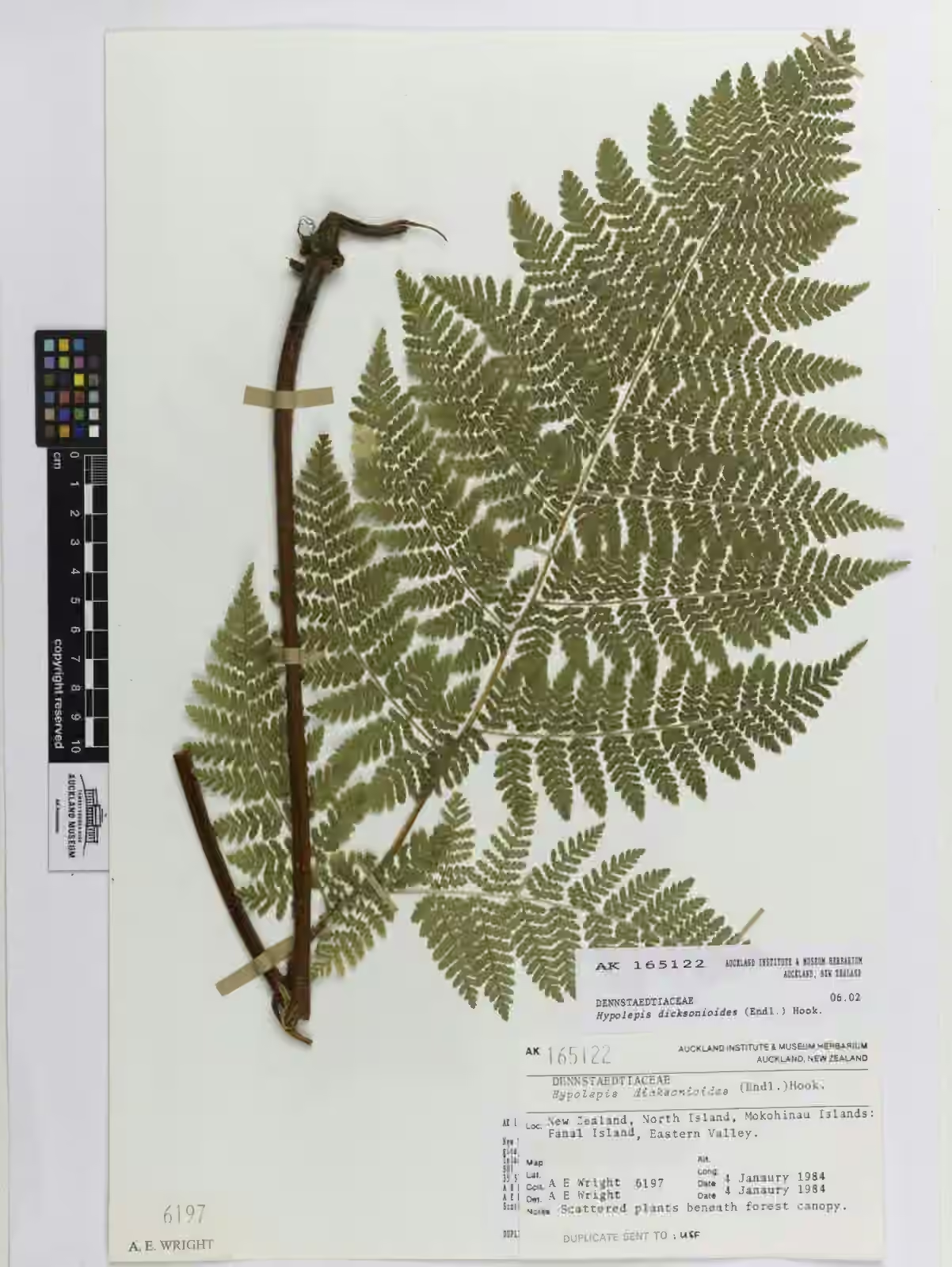
Giant Hypolepis
Hypolepis dicksonioides
Last updated:
Giant hypolepis (Hypolepis dicksonioides) is the largest of New Zealand's Hypolepis ground ferns, with finely divided, very sticky fronds that can exceed 2 m in length rising from long-creeping rhizomes. It grows from the Kermadec and Three Kings Islands down the North Island to Wellington, with scattered sites in north-west Nelson, the Marlborough Sounds, northern Westland and the Chatham Islands. It favours open, disturbed coastal and lowland ground and warm geothermal soils. Because it needs fresh disturbance and is naturally sparse on the main islands, it is ranked At Risk - Naturally Uncommon. Explore more native ferns in our native plant guide.
Plant Description
Hypolepis dicksonioides spreads by long-creeping rhizomes 3 to 8 mm thick, covered in pale brown or chestnut-brown hairs up to 3 mm long, sending up fronds every 35 to 200 mm. The stipes are stout, from 70 mm to 1.4 m long, and when fresh carry two dark vertical bands. The broadly ovate to elliptic blade can reach 2.45 m long and is 3-pinnate to deeply 4-pinnate-pinnatifid, with 15 to 30 pairs of primary pinnae below a pinnatifid tip; the lowest pairs are the longest, up to 86 cm.
The developing fronds and the midribs are clothed in long colourless hairs, many of them glandular, which make the whole frond sticky to the touch so that grit, seeds and plant debris adhere to it. The round sori sit on the underside of the segments and are each protected by a distinct reflexed flap of leaf margin, green at the base and membranous at the tip. The pale brown spores are spiny.
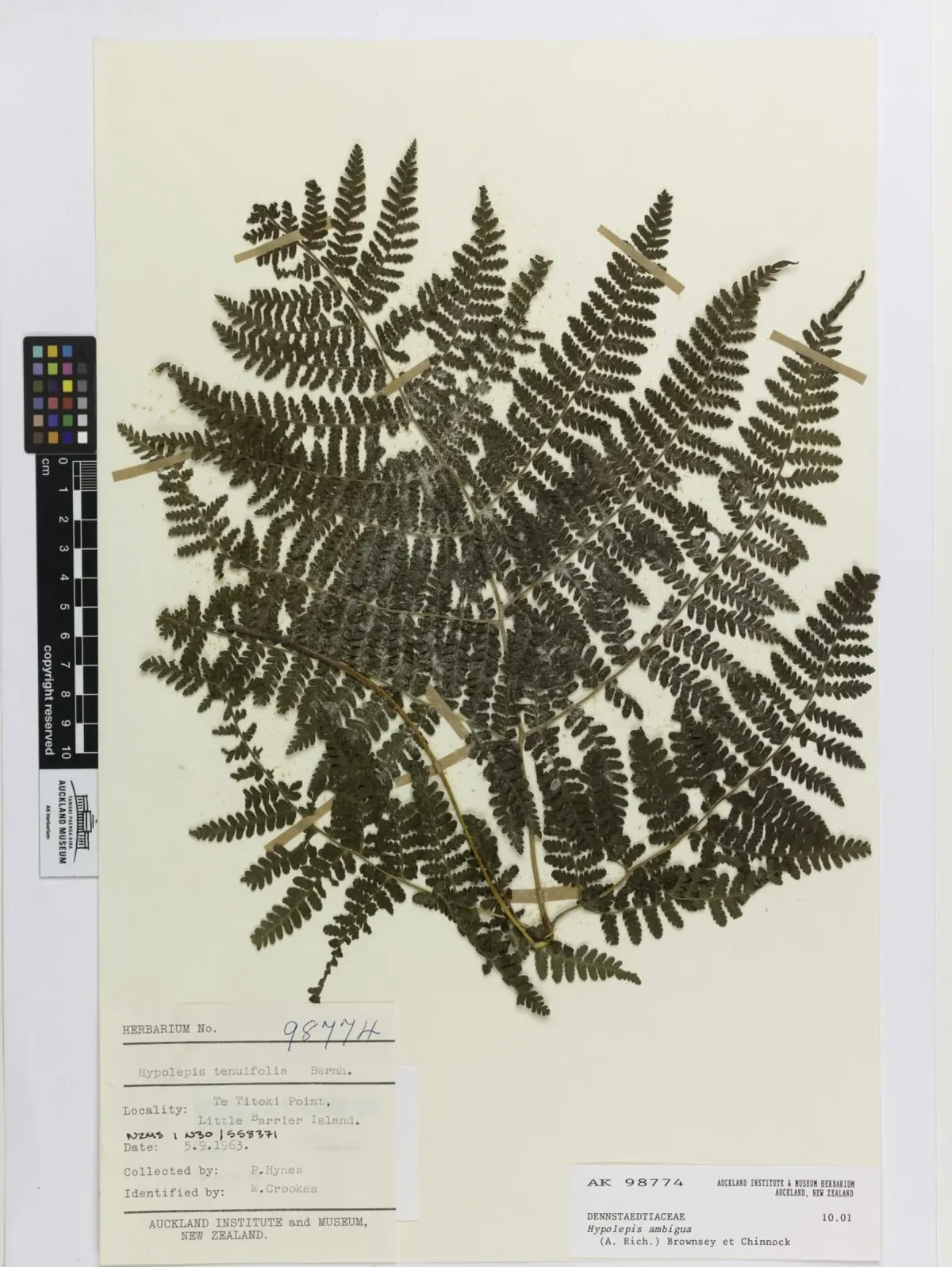
The most likely confusion is with the common pig fern, Hypolepis ambigua, which shares similar ground and also forms colonies. Giant hypolepis is bigger in every respect, much stickier, has thicker stipes and well developed indusial flaps. In thermal areas it hybridises with both H. ambigua and H. lactea, so intermediate plants can be found there.
Quick Facts
| Scientific Name | Hypolepis dicksonioides |
|---|---|
| Height | 1-2 m (fronds up to about 2.4 m long) |
| Spread | Several metres, spreading by long-creeping rhizomes |
| Water Needs | Moderate; moist but free-draining ground |
| Light | Full sun to light shade in open sites |
| Frost Tolerance | Low; frost tender |
| Salt Tolerance | Moderate; grows on rocky coastal slopes and cliff bases |
| Growth Rate | Fast once established |
| Lifespan | Perennial, but colonies are often short-lived as habitat changes |
Climate Best Suited to
A warm-temperate to subtropical fern that does best in mild, frost-free coastal climates or on naturally heated geothermal ground.
Regional Suitability
| City | Climate Suitability |
|---|---|
| Auckland | High |
| Wellington | Medium |
| Christchurch | Low |
| Dunedin | Low |
Plant Habitat
In New Zealand it is recorded from the Kermadec Islands, the Three Kings Islands, the North Island from Te Paki south to Wellington (mostly near the coast), north-west Nelson, the Marlborough Sounds, northern Westland and Chatham Island, from sea level to about 750 m. Outside New Zealand it grows on Norfolk Island and on several tropical Pacific islands including Samoa, Tahiti, the Cook Islands and the Marquesas.
It is a coloniser of open, disturbed places: rocky coastal slopes, boulder fields, the bases of cliffs, pumice beds and scoria, and thermally heated soil and the margins of hot streams in geothermal districts. NZPCN notes it also turns up on rock walls, in urban settings and even in garden centres. Its populations come and go as new open ground is created and then overgrown.
Growing Requirements
Soil Requirements
Giant hypolepis is not fussy about soil type, but it needs open, freshly disturbed ground where it can run its rhizomes without heavy competition.
- Grows naturally on pumice, scoria, rocky coastal soils and geothermally heated ground
- A free-draining, humus-enriched garden soil suits it well
- Tolerates poor, stony substrates if moisture is available
Light Requirements
In the wild it occupies open sites rather than deep forest, so give it plenty of light.
- Full sun to partial shade
- Frond growth is most vigorous in warm, bright positions
Water Requirements
Keep the root zone evenly moist while the fern establishes; mature colonies cope with drier spells but look best with regular moisture.
- Water during dry summers, especially in containers
- Avoid waterlogged, airless soils around the rhizomes
Planting and Establishing
Plant in spring once frosts are over, setting the rhizome just below the surface in a warm, sheltered spot. Allow plenty of room, since a single plant will spread several metres by its creeping rhizomes and the fronds are very large.
Because it is frost tender, giant hypolepis is best suited to northern coastal gardens. In colder districts treat it as an experimental plant for a warm courtyard or grow it in a large tub that can be moved under cover.
Ecological Role
Like all ferns it reproduces by tiny wind-dispersed spores rather than flowers, so it has no pollinators. Its spores allow it to reach newly opened sites such as slips, fresh volcanic ground and cleared rock faces, where it can quickly form dense patches.
It is an early coloniser in succession: as shrubs and trees close over a site, the fern is shaded out and the colony declines. The glandular, sticky hairs trap grit and plant debris on the fronds, although no specific insect associations are documented for this species.
Uses & Significance
Garden Uses
Giant hypolepis makes a bold, lacy ground fern for large, warm gardens, but its running habit means it needs space.
- Quick cover for banks and rough ground in frost-free coastal gardens
- Dramatic texture plant for large subtropical-style plantings
- Not suitable for small beds, where it will spread beyond its allotted space
Ecological Value
As a naturally uncommon fern of coastal and geothermal ground it contributes to the special plant communities of these habitats.
- Stabilises loose pumice, scoria and rocky slopes with its rhizome network
- Part of the distinctive geothermal fern flora of the central North Island
- Provides ground cover and shelter for invertebrates on open sites
Landscaping Uses
Use giant hypolepis where a fast, large-scale fern effect is wanted, such as on a warm bank, beside a rock wall or among boulders. Its soft, finely cut fronds contrast well with flax, coastal shrubs and bold-leaved plants like puka.
Contain it with paths, edging or rock, and avoid planting it beside delicate small ferns that it would swamp.
Seasonal Care Calendar
Spring
New croziers emerge as the soil warms.
- Plant or divide now
- Remove old, browned fronds before new growth expands
Summer
Fronds expand rapidly and reach full size.
- Water in dry spells
- Spores mature on the frond undersides
Autumn
Growth slows, and fronds remain in good condition in mild areas.
- Collect fresh spores from ripe fronds
- Check that the colony is not spreading into unwanted areas
Winter
Fronds may brown or die back after cold nights.
- Protect from frost in marginal districts
- Leave dead fronds as mulch until spring if wished
When to Prune and How Much
No formal pruning is needed. Cut away old, brown or frost-damaged fronds at ground level in spring to tidy the plant and make way for new growth.
To control spread, slice through the rhizomes with a spade around the edge of the colony and lift the unwanted pieces.
How to Grow Giant Hypolepis
NZPCN describes Hypolepis dicksonioides as easily grown from fresh spores, and it establishes rapidly once planted. Because its rhizomes run widely, division of an established colony is also a simple way to get new plants. Remember it is frost tender, so raise young plants somewhere warm and sheltered and only plant them out after the risk of frost has passed.
From Spores
Fresh spores give the best germination. Collect a fertile frond when the sori have turned brown but before they have shed, and dry it on clean paper for a few days so that the pale brown, spiny spores drop out.
- Sterilise a shallow pot of fine, moist seed-raising mix by pouring boiling water through it and let it cool
- Sprinkle the spores thinly over the surface without covering them
- Cover the pot with glass or clear plastic and stand it in a warm, bright place out of direct sun
- Keep the surface moist by watering from below; a green film of prothalli should form within weeks
- Mist lightly once prothalli are established so fertilisation can occur
- Prick out small clumps of young sporelings once the first fronds appear and grow them on in a warm, sheltered spot
By Division
Lift a section of creeping rhizome with several fronds and a good mass of roots in spring, when the soil is warming and new growth is starting.
- Cut through the rhizome with a sharp spade, keeping several fronds per piece
- Trim back large fronds to reduce water loss
- Replant at once at the same depth in moist, humus-enriched soil
- Water well and keep moist until new croziers appear
Pests & Diseases
No serious pests are recorded for giant hypolepis. The sticky glandular hairs may deter some browsing insects, although slugs and snails can damage young croziers and sporelings.
Frost, rather than pests, is the main problem in cultivation. Plants can also decline if they become shaded and overgrown by surrounding shrubs.
Cultural Significance
No Māori name or traditional use is recorded specifically for Hypolepis dicksonioides. On Norfolk Island it is known simply as ground fern.
The species epithet dicksonioides means resembling Dicksonia, the tree fern genus, and the genus name comes from the Greek hypo (under) and lepis (scale), referring to the position of the sori.
Bonus Tip
If you want to see giant hypolepis in the wild, look around geothermal areas of the central North Island, where it grows on heated soil beside hot streams. Check carefully for intermediate plants, as it hybridises with Hypolepis ambigua and H. lactea in these places.
Related Plants
Explore other native plants that share similar characteristics or habitats with Giant Hypolepis (Hypolepis dicksonioides), offering further insights into New Zealand's diverse flora. These related species provide context and opportunities for complementary planting in your garden.
Hairy Filmy Fern
Hymenophyllum villosum
Grassland Hypericum
Hypericum involutum
Swamp Hypericum
Hypericum pusillum
Hypolepis amaurorachis
Hypolepis amaurorachis
Hypolepis lactea
Hypolepis lactea
Sticky Pig Fern
Hypolepis rufobarbata
Cheeseman's Imperata
Imperata cheesemanii
Rarauhi Nehenehe
Rarauhi Nehenehe
Plant Conservation
Giant hypolepis is ranked At Risk - Naturally Uncommon (2023), with qualifiers indicating it is stable but secure overseas, has sparse populations and an episodic, fluctuating presence. Regionally it is considered Regionally Critical in Wellington and Regionally Naturally Uncommon in Auckland.
Its populations are naturally ephemeral because it depends on frequent disturbance to create open habitat. Protecting geothermal sites and coastal rock habitats from weed invasion and development helps keep space available for it.
Frequently Asked Questions
How do you identify Hypolepis dicksonioides?
Look for very large, 3 to 4 pinnate fronds covered in long colourless glandular hairs that make them sticky enough to trap debris, stout stipes with two dark vertical bands when fresh, and sori protected by distinct reflexed flaps of the leaf margin.
What is the difference between giant hypolepis and pig fern?
Giant hypolepis has much larger, more finely divided and extremely glandular fronds, thicker stipes (5 to 15 mm versus 1.5 to 6 mm in Hypolepis ambigua) and well developed indusial flaps over the sori.
Where does giant hypolepis grow in New Zealand?
It grows mainly near the coast from Te Paki to Wellington, on the Kermadec, Three Kings and Chatham Islands, and in a few South Island sites, often on rocky slopes, pumice, scoria and heated geothermal ground.
Is Hypolepis dicksonioides frost hardy?
No. NZPCN describes it as frost tender, so it is best grown in warm coastal northern gardens or in a sheltered, frost-free spot.
Sources and Further Reading
The botanical, growing, and conservation details for Giant Hypolepis (Hypolepis dicksonioides) on this page draw on the New Zealand plant references below. Consult them for full technical records and the latest distribution data.