Pennywort
Hydrocotyle pterocarpa
Last updated:
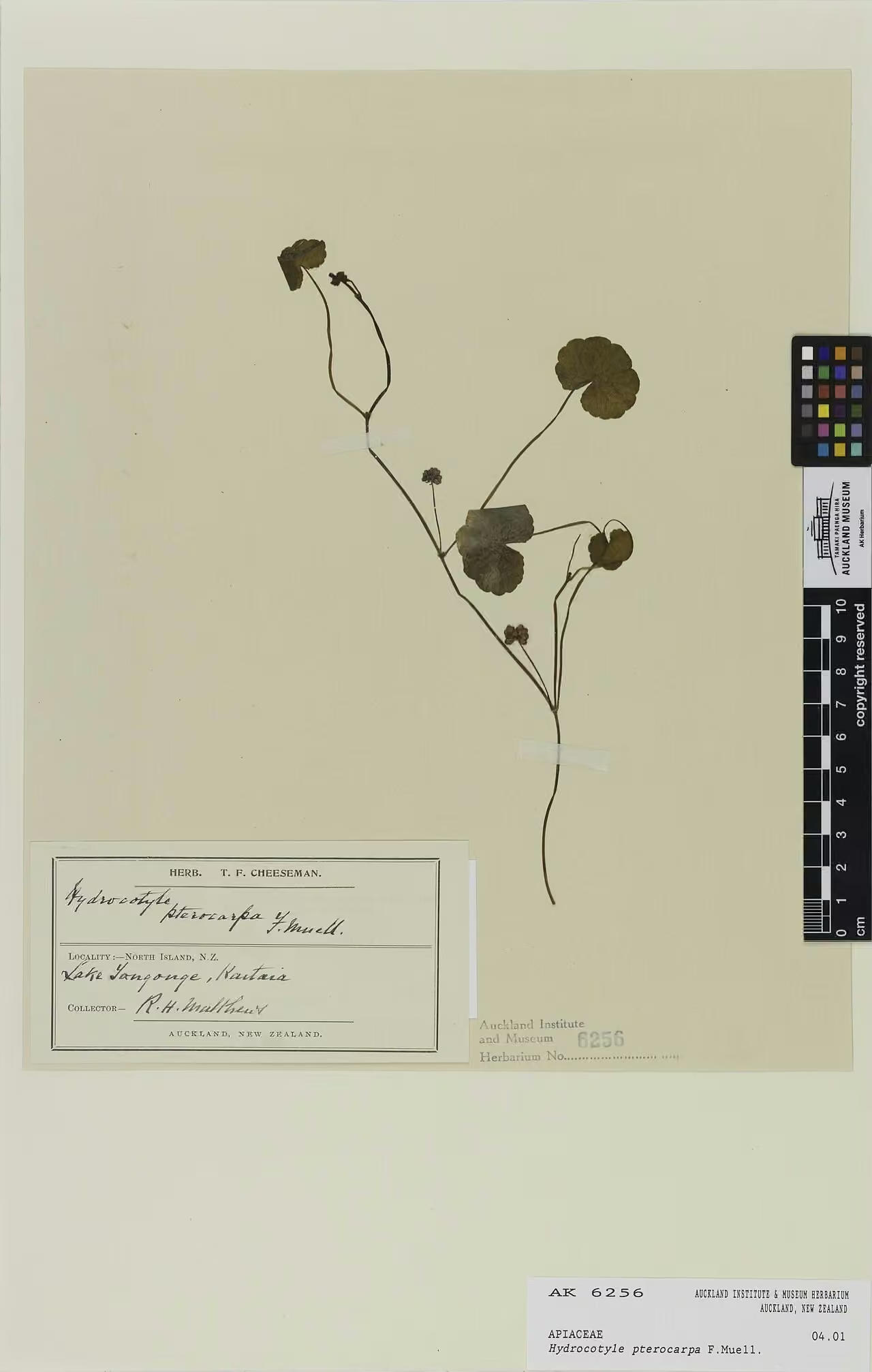
Hydrocotyle pterocarpa is a native pennywort of lowland wet ground and swamp margins in the North and South Islands, also found in Tasmania and mainland Australia. It forms patches of creeping stems with light glossy green, almost hairless leaves 10-30 mm across (occasionally to 50 mm), held on slender stalks and only shallowly lobed into seven to nine segments. Its name means winged fruit: each fruit carries a broad, sharp wing along its back, which sets it apart from all other New Zealand pennyworts. It is a wetland specialist and is local rather than common. Explore more native ground covers in our native plant guide.
Plant Description
Hydrocotyle pterocarpa is a perennial with slender to stout creeping stems that form patches; Allan described patches up to about 40 cm across, while the later Flora of New Zealand notes it can form large patches. The leaves are simple, light glossy green and usually hairless, very rarely with a few scattered hairs. They are 10-30 mm in diameter, from 8 to 50 mm, held on slender petioles 5-10 cm long, and divided less than a quarter of the way to the centre into seven to nine broad, shallowly round-toothed or almost entire segments. The leaf margins are rolled under and the teeth carry small, inconspicuous gristly points.
Flowers are borne in simple umbels of five to many on stalks shorter than or about equal to the leaves, and are almost stalkless. The fruits are hairless, 2.5-4 mm long and 2-3 mm wide, light brown, flattened and notched at both ends. Each half of the fruit has a broad, acute wing along its back, with slender raised side ribs.
No other New Zealand Hydrocotyle has such conspicuously winged fruits, so fruiting plants are easy to name. Without fruit, the large, glossy, very shallowly lobed and hairless leaves with rolled-under margins help separate it from the smaller-leaved H. microphylla and H. heteromeria and from the hairy H. moschata and H. robusta.
Quick Facts
| Scientific Name | Hydrocotyle pterocarpa |
|---|---|
| Height | Low patch; leaves on slender stalks to about 10 cm |
| Spread | Patches up to about 0.4 m across, sometimes larger |
| Water Needs | Wet; swamp margins and saturated ground |
| Light | Full sun to partial shade |
| Frost Tolerance | Moderate; a lowland species |
| Salt Tolerance | No information available |
| Growth Rate | Moderate |
| Lifespan | Perennial |
Climate Best Suited to
It suits mild, wet lowland climates where swamp margins stay saturated, and it is local rather than widespread across both main islands.
Regional Suitability
| City | Climate Suitability |
|---|---|
| Auckland | Medium |
| Wellington | Medium |
| Christchurch | Low |
| Dunedin | Low |
Plant Habitat
In New Zealand Hydrocotyle pterocarpa is recorded from the North and South Islands, where Allan described it as local on lowland wet ground and swamp margins. Outside New Zealand it occurs in Tasmania and mainland Australia, where it was first described by Ferdinand von Mueller.
NZPCN gives it obligate wetland status: it is almost always a hydrophyte and only rarely found on drier ground. Regionally it is Naturally Uncommon in Northland, Declining in Auckland and Not Threatened in Wellington.
Growing Requirements
Soil Requirements
It grows in saturated, often peaty or silty soils at the margins of swamps and other lowland wetlands.
- Permanently wet silt, mud or peat
- Rich organic swamp margin soils
- Tolerates waterlogging that kills most garden plants
Light Requirements
Swamp margins vary from open to partly shaded by sedges and shrubs, and it grows in both.
- Full sun to partial shade
- Avoid dense shade under trees
- Keep tall weeds from overtopping it
Water Requirements
It is a wetland specialist and should never dry out.
- Saturated soil year round
- Tolerates shallow standing water
- Ideal for bog gardens and pond margins
Planting and Establishing
No horticultural notes for this species were found and it is not commonly sold. In a garden or restoration site, plant rooted pieces into the wet margin of a pond or swamp, where the soil is constantly saturated but the crowns are not deeply submerged.
Space pieces about 30 cm apart and keep competing grasses and weeds down until the patches merge.
Ecological Role
Its broadly winged fruits are adapted for dispersal by water and wind, as NZPCN notes, allowing them to float or blow along swamp margins to new wet ground.
It is one of several native herbs that form the low ground layer at the edges of lowland swamps, beneath and between taller sedges and rushes. Pollination of its small flowers has not been studied.
Uses & Significance
Garden Uses
A good native ground cover for permanently wet ground where most plants fail.
- Bog gardens
- Pond and swamp margins
- Lowland wetland restoration plantings
Ecological Value
It contributes to the native herb layer of lowland swamp margins, a habitat that has been extensively drained across New Zealand.
- Covers and binds wet soils at swamp edges
- Part of declining lowland wetland communities
- Regionally significant in Northland and Auckland
Landscaping Uses
Its relatively large, glossy, rounded leaves on long stalks give a fresh, lily-pad-like texture at the water's edge, contrasting nicely with upright sedges and rushes such as Carex and Machaerina.
It needs constantly wet soil, so it is only suitable for bog gardens or natural wetland edges, not for dry beds or lawns.
Seasonal Care Calendar
Spring
New leaves unfold on lengthening stalks as the margins warm up.
- Plant or divide in wet soil
- Clear competing weeds
Summer
Flowering from November to February; winged fruits form from December.
- Keep water levels up in dry spells
- Watch for overtopping weeds
Autumn
Fruits ripen through to March and are shed onto water and mud.
- Collect winged fruits for sowing
- Allow some fruit to disperse naturally
Winter
Growth slows; plants tolerate flooding and cool wet conditions.
- No action needed
- Avoid trampling saturated margins
When to Prune and How Much
No pruning is needed. Remove any yellowed leaves if tidiness matters in a garden pond.
Cut back creeping stems that spread into areas where other plants are wanted.
How to Grow Pennywort
No species-specific propagation guidance for Hydrocotyle pterocarpa was found in NZPCN or the Flora of New Zealand. Its creeping stems form patches, which makes division straightforward, and its comparatively large winged fruits, up to 4 mm long and ripening from December to March, are easier to collect than those of most native pennyworts. Because it is regionally declining in Auckland and uncommon in Northland, take material from cultivated plants or with the landowner's and relevant agency's permission, and keep local sources for local restoration.
By Division
Rooted portions of the creeping stems re-establish readily when kept wet.
Pieces taken from the outer, actively growing edge of a patch usually root fastest.
- Lift a section of the patch in spring or autumn
- Cut it into pieces each with roots and several leaves
- Pot into a peaty, water-retentive mix and stand the pots in a tray of water
- Grow on in good light until new leaves appear
- Plant out into the saturated margin of the pond or swamp
From Seed
The winged fruits are easy to spot from December to March, light brown and flattened.
- Collect ripe light brown fruits from the umbels
- Sow fresh on the surface of a wet, fine peat and sand mix
- Keep the tray standing in shallow water in a warm, bright place
- Prick out seedlings once they have two or three true leaves
- Grow on in saturated pots before planting out
Pests & Diseases
No specific pests or diseases are recorded for this species. Slugs and snails may graze leaves at the water's edge.
No threats specific to this species are listed by NZPCN, but its habitat faces well-known pressures: drainage of lowland swamps, and invasion of swamp margins by vigorous exotic plants such as reed sweet grass and willows, which can shade out low native herbs.
Cultural Significance
No Māori name or traditional use for Hydrocotyle pterocarpa was found in the sources consulted, so none is given here.
The species was named by the Victorian government botanist Ferdinand von Mueller from Australian material. Its epithet combines the Greek pteron (wing) and karpos (fruit), describing the broadly winged fruits that distinguish it.
Bonus Tip
The quickest way to confirm this species is to wait until summer and look for fruit. Rub a ripe umbel between your fingers: if the tiny fruits are flat with a distinct wing around the back edge, you have Hydrocotyle pterocarpa, not one of the many lookalike lawn and wetland pennyworts.
Related Plants
Explore other native plants that share similar characteristics or habitats with Pennywort (Hydrocotyle pterocarpa), offering further insights into New Zealand's diverse flora. These related species provide context and opportunities for complementary planting in your garden.
Hydrocotyle dissecta
Hydrocotyle dissecta
Waxweed
Hydrocotyle heteromeria
Hydrocotyle hydrophila
Hydrocotyle hydrophila
Hydrocotyle microphylla
Hydrocotyle microphylla
Hydrocotyle robusta agg
Hydrocotyle robusta agg
Hymenophyllum armstrongii
Hymenophyllum armstrongii
Hymenophyllum australe
Hymenophyllum australe
Matua Mauku
Hymenophyllum dilatatum
Plant Conservation
Hydrocotyle pterocarpa is ranked Not Threatened in New Zealand (2023), with the Secure Overseas qualifier because it also occurs in Australia. Regionally it is Naturally Uncommon in Northland and Declining in Auckland, while Wellington ranks it Not Threatened.
Lowland swamps are among New Zealand's most reduced ecosystems, and this local species depends on them. Protecting remaining swamp margins from drainage and controlling invasive wetland weeds are the most useful actions.
Frequently Asked Questions
What makes Hydrocotyle pterocarpa different from other pennyworts?
Its fruits are the giveaway. They are relatively large, 2.5-4 mm long, with the rib on the back drawn out into a broad, acute wing. The name pterocarpa means winged fruit.
Is Hydrocotyle pterocarpa native to New Zealand?
Yes, it is indigenous. The Flora of New Zealand records it as non-endemic, as it also grows in Tasmania and mainland Australia, and its threat listing is qualified as Secure Overseas.
Where does Hydrocotyle pterocarpa grow?
It grows locally on lowland wet ground and swamp margins in the North and South Islands. NZPCN classes it as an obligate wetland plant that is almost never found away from wetlands.
When does Hydrocotyle pterocarpa flower?
Flowering runs from November to February, with umbels of five or more small flowers, and fruits ripen from December to March.
Sources and Further Reading
The botanical, growing, and conservation details for Pennywort (Hydrocotyle pterocarpa) on this page draw on the New Zealand plant references below. Consult them for full technical records and the latest distribution data.