Little Gentian
Gentianella lilliputiana
Last updated:
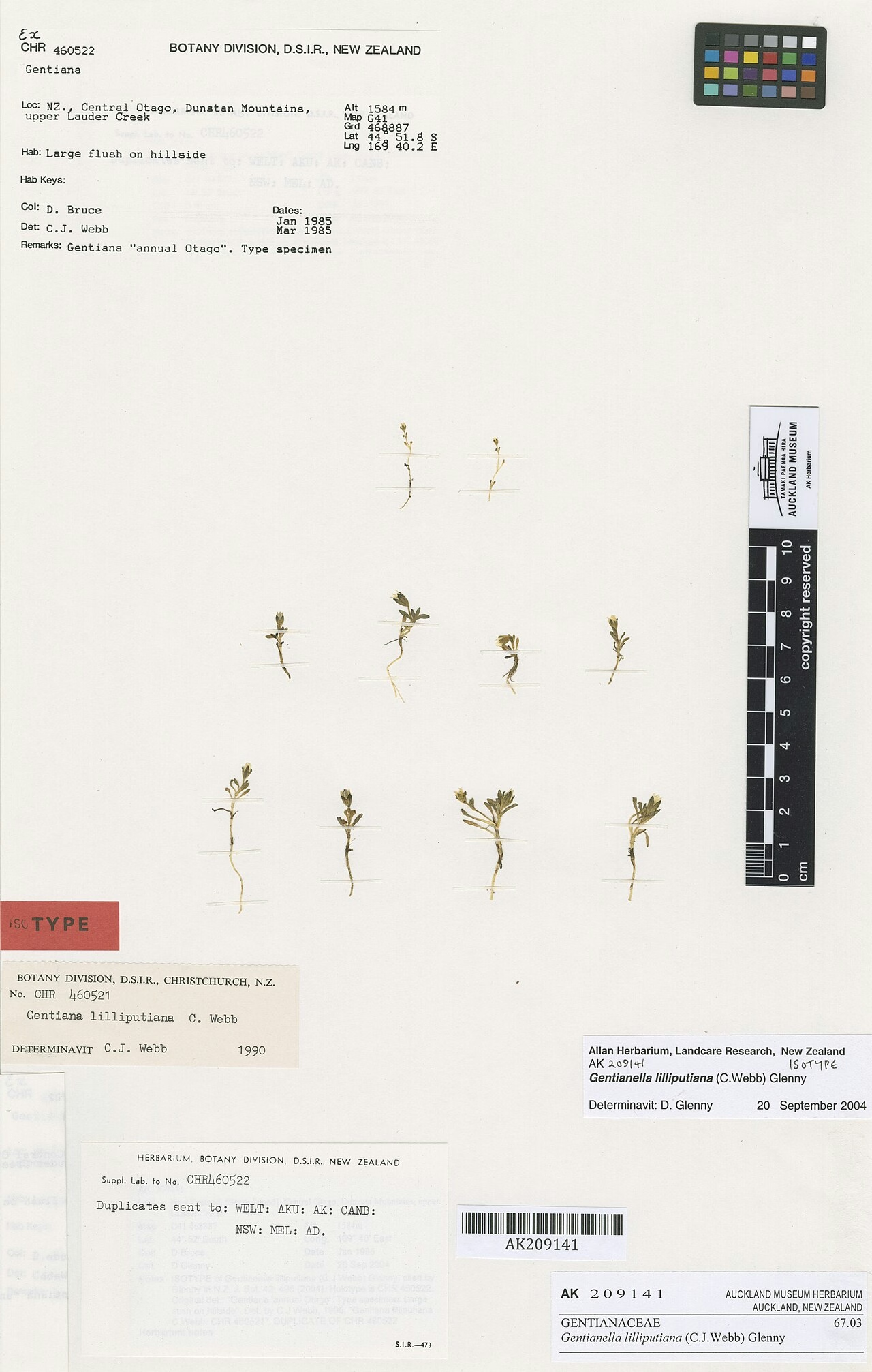
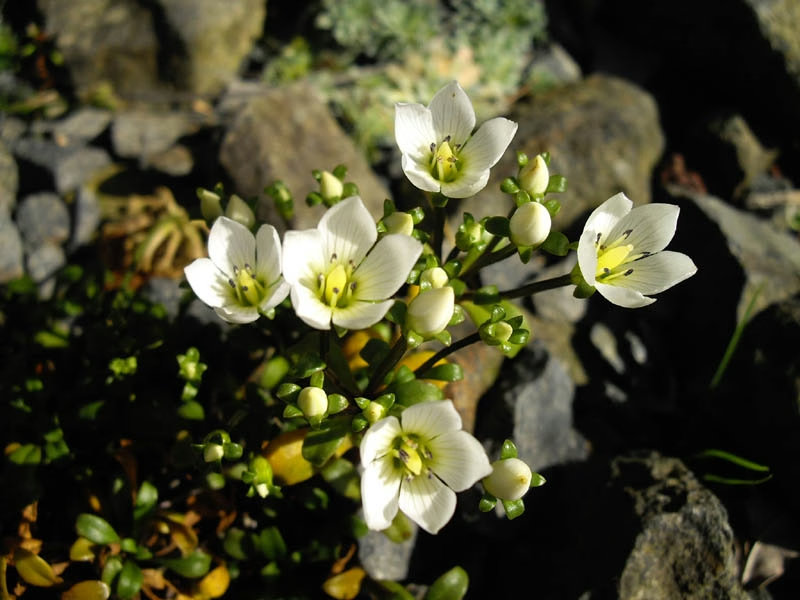
Little gentian (Gentianella lilliputiana) is a minute annual herb usually only 1 to 2 cm tall in flower. It has a few tiny linear leaves and normally a single white flower about 4 to 5 mm long. It is endemic to the eastern South Island, known from the Kirkliston and Hawkdun Ranges in south Canterbury and the Dunstan Range in Otago, where it grows in alpine bogs and flushes within grassland and herbfield on low-relief ridge tops. It flowers in January and February. Ranked At Risk - Naturally Uncommon as a sparse species, it is easily overlooked but locally common within its range. Explore more native flowering plants in our native plant guide.
Plant Description
Little gentian is a miniature annual with a single unbranched caudex and a slender taproot. Flowering plants are typically 1 to 2 cm tall and have no leaf rosette. The leaves are linear or narrowly elliptic, mostly 3.5 to 8 mm long and only 1 to 2 mm wide, flat and on an indistinct stalk. The one to four flowering stems are yellow.
Each plant usually carries a single flower, rarely up to four, 3.7 to 5 mm long on a very short stalk. The calyx is green tinted purple-black with four or five lobes. The corolla is white with uncoloured veins and four or five small lobes. Each ovary holds only a handful of ovules, usually two to four, and the capsule is 4 to 6 mm long.
Its tiny size and usually solitary white flower, only about 4 to 5 mm long, separate it readily from the larger New Zealand gentians. Before flowering it is easily overlooked among other small bog herbs.
Quick Facts
| Scientific Name | Gentianella lilliputiana |
|---|---|
| Height | 0.006-0.025 m in flower |
| Spread | A few centimetres |
| Water Needs | High; alpine bogs and flushes |
| Light | Full sun |
| Frost Tolerance | Very high; alpine |
| Salt Tolerance | Low; an inland alpine plant |
| Growth Rate | Fast; completes life in one season |
| Lifespan | Annual (monocarpic) |
Climate Best Suited to
Suits the cold, continental-influenced alpine climate of the inland ranges of south Canterbury and Central Otago, with hard frosts, winter snow and short summers.
Regional Suitability
| City | Climate Suitability |
|---|---|
| Auckland | Low |
| Wellington | Low |
| Christchurch | Low |
| Dunedin | Low |
Plant Habitat
Little gentian is endemic to the South Island, recorded from the Kirkliston Range and Hawkdun Range in south Canterbury and the Dunstan Range in Otago.
It grows in alpine bogs and flushes within alpine grassland and herbfield on low-relief ridge tops. These seepages and small bogs stay wet in summer and provide open patches where such a tiny annual can grow without being smothered.
Growing Requirements
Soil Requirements
It grows on wet, peaty or mineral soils in alpine seepages and small bogs.
- Saturated flush and bog surfaces
- Open, low-competition patches
- Cold, low-fertility soils
Light Requirements
As a miniature plant it relies on open ground where taller plants do not shade it.
- Full sun
- Bare or sparsely vegetated flush margins
Water Requirements
Constant seepage moisture through the growing season is essential.
- Wet throughout the short alpine summer
- Fed by seepage and snowmelt
Planting and Establishing
Little gentian is not grown in gardens. NZPCN describes it as difficult to propagate and advises against removing it from the wild.
Its minute size and single-season life make it impractical even for specialist alpine growers.
Ecological Role
As an annual with only a few ovules per flower, each plant produces very little seed, so populations rely on good conditions for germination each year. Seed of New Zealand gentians is generally dispersed by ballistic projection, wind and water.
It occupies small open niches in alpine flushes alongside other tiny bog herbs. Its pollinators, if any, are not documented in the sources consulted; such small flowers may also self-pollinate, but this has not been confirmed.
Uses & Significance
Garden Uses
It has no garden use.
- Of interest to botanists surveying alpine flushes
- Photographic subject for macro lenses
- Education on the diversity of New Zealand gentians
Ecological Value
It is part of the specialised flora of alpine bogs and flushes on the inland ranges of the eastern South Island.
- A narrow-range endemic of three mountain ranges
- An indicator of intact alpine flush habitats
- Shows the extreme size range of New Zealand gentians
Landscaping Uses
Little gentian has no landscaping use. The best contribution people can make is avoiding damage to alpine flushes by vehicles and trampling on the ranges where it grows.
Further survey of flushes on these ranges would help clarify how many populations exist and whether they are stable.
Seasonal Care Calendar
Spring
Seed germinates in moist flushes as snow melts from the ridge tops.
- Seedlings are minute
- Flushes are wettest at this time
Summer
Flowering takes place in January and February.
- Search flush margins on hands and knees
- Single white flowers are the main clue
Autumn
Fruiting runs from February to April, after which plants die.
- Capsules release a few seeds each
- No plants remain by late autumn
Winter
The species survives only as seed under snow on the ranges.
- Avoid vehicle use on wet ridge tops
- Frost heave may move surface soil
When to Prune and How Much
Pruning is not relevant to this tiny annual.
In any survey or monitoring work, avoid picking flowers, since each plant usually has only one and it is the plant's only chance to set seed.
How to Grow Little Gentian
NZPCN describes little gentian as difficult to propagate and states that it should not be removed from the wild. As an annual, it could only be maintained by raising new plants from seed every year, and with usually just one flower per plant and as few as two to four ovules per ovary, seed is scarce. No propagation records for this species were found in the sources consulted. If seed were needed for conservation purposes, it would have to be collected under authorisation and handled using the general approach for alpine gentians: sowing fresh seed, giving it a cold, moist winter, and keeping seedlings permanently wet in an open, low-competition medium similar to a flush. The tiny size of seedlings makes handling them extremely difficult, so seed would be best sown where the plants are to grow.
From Seed
Capsules ripen between February and April. Each contains very few seeds, so collection should only ever take a small fraction of what a population produces.
- Collect only with permits and only a few capsules
- Sow seed directly onto a saturated, peaty and gritty surface
- Keep the container outdoors to receive winter cold
- Maintain constant wetness, like a seepage
- Leave seedlings in place to flower rather than pricking out
Cuttings and Division
Division and cuttings are impossible for an annual plant only a couple of centimetres tall.
- Rely solely on seed
- Protect wild populations rather than attempting cultivation
Pests & Diseases
NZPCN lists no known current threats. The main potential risks to alpine flushes are physical damage from vehicles, stock trampling and changes to water flow.
Invasion of open flush margins by taller grasses or weeds could crowd out such a small annual, though this is not documented as a current problem.
Cultural Significance
No Māori name or traditional use is recorded for this species in the sources consulted.
Colin Webb described it as Gentiana lilliputiana, a name inspired by Jonathan Swift's tiny Lilliputians. It was later placed in Chionogentias and then transferred to Gentianella by David Glenny in 2004.
Bonus Tip
To find little gentian, visit wet flushes on the ridge tops of the Dunstan, Hawkdun or Kirkliston Ranges in late January, kneel down and scan the open wet ground closely. A white flower only 4 or 5 mm long on a stem shorter than your thumbnail is the giveaway.
Related Plants
Explore other native plants that share similar characteristics or habitats with Little Gentian (Gentianella lilliputiana), offering further insights into New Zealand's diverse flora. These related species provide context and opportunities for complementary planting in your garden.
Gentianella filipes
Gentianella filipes
Mt Anglem Gentian
Gentianella gibbsii
Forest Gentian
Gentianella grisebachii
Gentianella impressinervia
Gentianella impressinervia
Gentianella lineata
Gentianella lineata
Scree Gentian
Gentianella magnifica
Gentianella patula
Gentianella patula
Gentianella saxosa
Gentianella saxosa
Plant Conservation
Gentianella lilliputiana is ranked At Risk - Naturally Uncommon (2023) with the qualifiers Sparse and Data Poor: Trend. It is restricted in range but locally common within it.
Protecting alpine flushes and bogs on the inland ranges from vehicle damage, drainage and trampling is the most useful action, along with further survey to establish population trends.
Frequently Asked Questions
How small is the little gentian?
Flowering plants are usually 10 to 20 mm tall, occasionally from 6 to 25 mm, with leaves up to 13 mm long and usually just one white flower 3.7 to 5 mm long.
Where is Gentianella lilliputiana found?
It is known from the Kirkliston and Hawkdun Ranges in south Canterbury and the Dunstan Range in Otago, in alpine bogs and flushes on low-relief ridge tops.
Why is it called lilliputiana?
The name refers to Lilliput, the land of tiny people in Gulliver's Travels, reflecting the plant's miniature size.
Is the little gentian rare?
It is ranked At Risk - Naturally Uncommon because it is sparse, but NZPCN reports no known threats and says it is locally common within its restricted range.
Sources and Further Reading
The botanical, growing, and conservation details for Little Gentian (Gentianella lilliputiana) on this page draw on the New Zealand plant references below. Consult them for full technical records and the latest distribution data.