Forest Gentian
Gentianella grisebachii
Last updated:
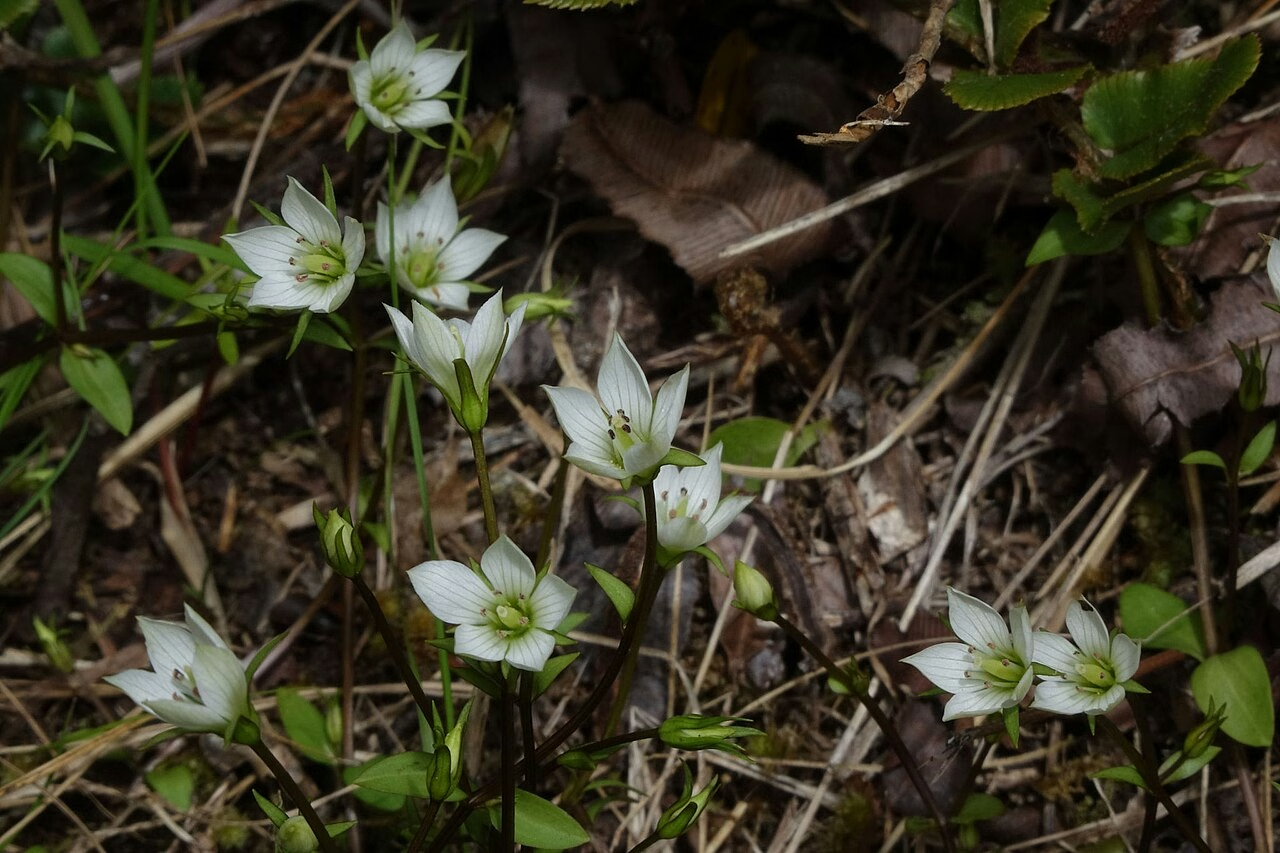
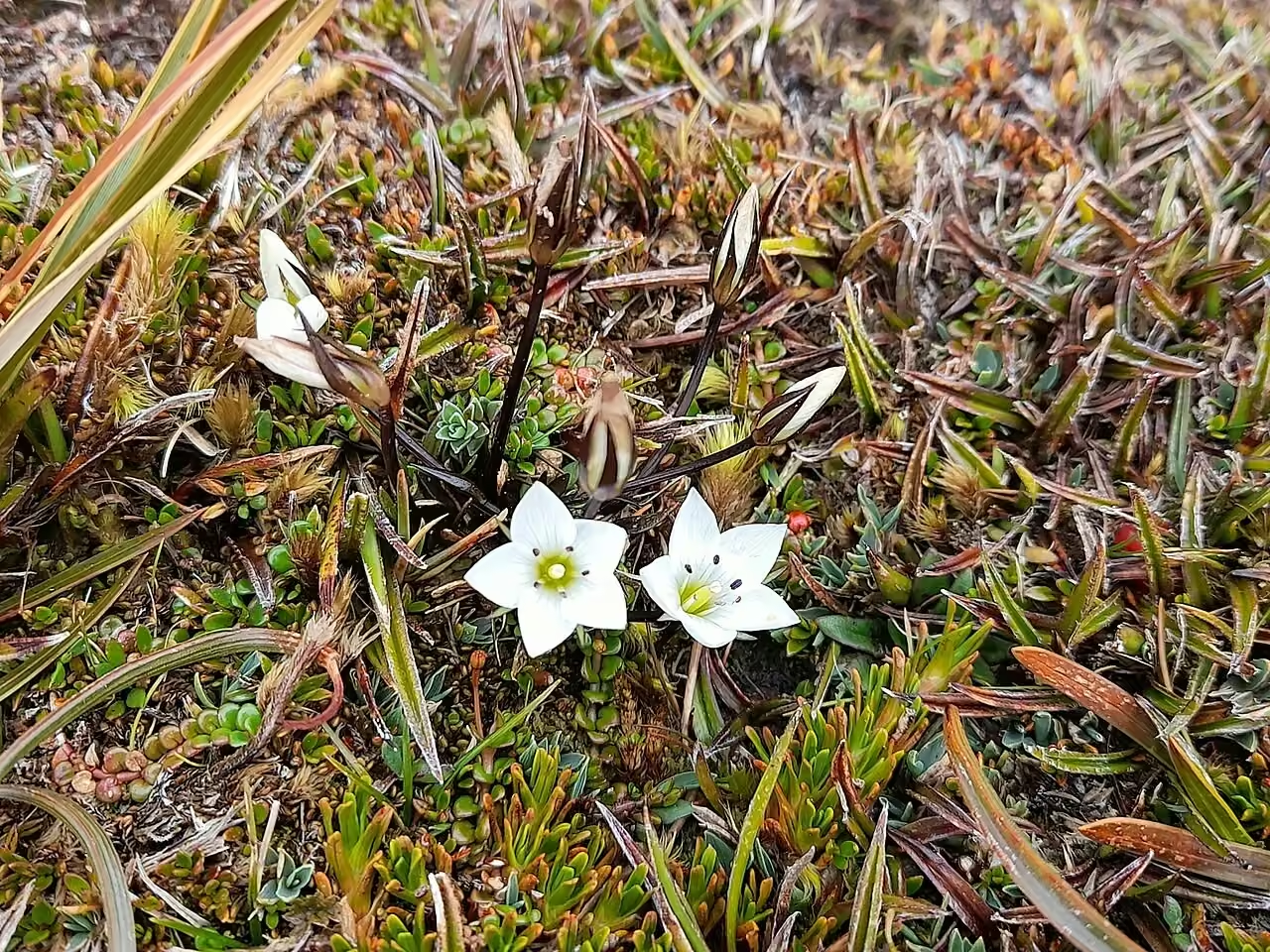
Forest gentian (Gentianella grisebachii), also called common gentian, is one of New Zealand's most widespread native gentians, found from Mt Pirongia and the Raukumara Range south through the North Island and across the South and Stewart Islands. It is a monocarpic biennial, growing as leafy shoots before flowering once on branched stems 4 to 29 cm tall bearing 3 to 49 white flowers, sometimes tinged purple-grey. Usually a montane to alpine plant, it also grows in the lowlands further south, mainly in acidic bogs, swamp forest, cloud forest, wet subalpine scrub, tussock grassland and rough pasture. It flowers from January to May and is ranked Not Threatened. Explore more native flowering plants in our native plant guide.
Plant Description
Forest gentian has a short unbranched caudex 7 to 15 mm long and a root up to 4 mm thick. Flowering plants lack a separate rosette; the leaves are narrowly elliptic, elliptic or ovate, 9 to 65 mm long and 2 to 16 mm wide, green or tinged purple-black, with a distinct stalk 11 to 18 mm long. Two to eight flowering stems, terminal and lateral or only lateral, are green or tinted crimson-orange or purple-black, with three to six pairs of stem leaves.
It bears 3 to 49 flowers, usually 7 to 12.5 mm long but up to 20 mm, on long stalks 10 to 80 mm that lengthen further after flowering. The calyx is green with purple-black tips and narrowly pointed lobes. The corolla is white, occasionally with purple-grey tinting on the lobes, and veins may be uncoloured, purple or purple-grey. Anthers are usually blue-black with a yellow to orange-red mouth. Capsules are 7 to 20 mm long.
Its wide range and variable size mean it can overlap with several other gentians, but its lack of a rosette at flowering, long flower stalks and preference for acidic, wet and often forested sites help identify it.
Quick Facts
| Scientific Name | Gentianella grisebachii |
|---|---|
| Height | 0.04-0.29 m in flower |
| Spread | About 0.1-0.2 m |
| Water Needs | High; bogs and wet ground |
| Light | Full sun to partial shade |
| Frost Tolerance | High; montane to alpine |
| Salt Tolerance | Low; an inland plant |
| Growth Rate | Moderate; flowers in its second year |
| Lifespan | Biennial (monocarpic) |
Climate Best Suited to
Suits cool, wet, cloudy climates in the mountains of the central and southern North Island and through the South and Stewart Islands, extending to lowland sites in the cooler south.
Regional Suitability
| City | Climate Suitability |
|---|---|
| Auckland | Low |
| Wellington | Medium |
| Christchurch | Low |
| Dunedin | Medium |
Plant Habitat
Forest gentian is endemic and occurs in the North Island from Mt Pirongia and the Raukumara Range south, and throughout the South and Stewart Islands. It is regionally Not Threatened in both Wellington and Otago.
It is usually montane to alpine, but grows in the lowlands in the southern part of its range. It favours moderately acidic to acidic bogs, swamp forest, cloud forest, poorly drained subalpine scrub, tussock grassland and rough pasture.
Growing Requirements
Soil Requirements
It grows in acidic, poorly drained soils, often peaty or with a thick organic layer.
- Acidic peat and boggy soil
- Wet forest floors and seepages
- Rough, unimproved pasture on wet ground
Light Requirements
It tolerates more shade than most New Zealand gentians, growing under forest and scrub as well as in open bog.
- Partial shade in cloud forest and swamp forest
- Full sun in open bogs and tussock grassland
Water Requirements
All its habitats are wet for much of the year, and it depends on constant moisture.
- Consistently moist to waterlogged
- High rainfall or frequent mist
Planting and Establishing
Forest gentian is not available from nurseries and should not be dug from the wild. As a biennial it would only persist in a garden by self-sowing.
Gardeners with a cool, wet, acidic bog garden in the south could in principle grow it from legally obtained seed, but it is generally best appreciated in the wild.
Ecological Role
Its seeds are dispersed by ballistic projection, wind and water, and its flower stalks lengthen after flowering as the capsules mature. Its open white flowers are visited by insects, though its specific pollinators are not documented in the sources consulted.
Its ability to grow in rough pasture and shaded swamp forest as well as in bogs gives it a wider ecological range than most New Zealand gentians, which is reflected in its broad distribution.
Uses & Significance
Garden Uses
It is rarely if ever cultivated.
- Specialist bog gardens in cool southern districts
- Restoration of wetland margins from local seed
- Botanising on montane tracks in late summer
Ecological Value
It is a widespread late-summer flowering herb of New Zealand's wet uplands and southern lowland bogs.
- Provides nectar in late summer and autumn
- Part of bog, cloud forest and subalpine scrub communities
- Found across three main islands
Landscaping Uses
Forest gentian is not used in landscaping. In wetland restoration it would sit naturally in open, acidic bog margins with sedges, rushes and low shrubs.
Protecting existing wetlands and cloud forest from drainage and clearance is far more valuable than attempting to plant it.
Seasonal Care Calendar
Spring
First-year plants grow leafy shoots, and second-year plants prepare to flower.
- Leaves may be tinged purple-black
- Keep wetland habitats undrained
Summer
Flowering begins in January, with white flowers on long stalks.
- Look in bogs and wet subalpine scrub
- Stems may be green or crimson-tinted
Autumn
Flowering can continue to May, and fruit ripens from February onward.
- Flower stalks lengthen as capsules mature
- Seed is shed by the capsules
Winter
Fruiting can extend into August, and flowered plants die while young plants overwinter.
- Higher sites lie under snow
- Seedlings establish in moist ground
When to Prune and How Much
No pruning is required. Leave flowering stems intact so their lengthening stalks can release seed.
In a garden, simply remove the dead plant once all capsules have opened.
How to Grow Forest Gentian
NZPCN describes forest gentian as difficult to propagate, notes it is not commercially available and advises that it should not be removed from the wild. Because it is a monocarpic biennial, any cultivated planting must be renewed from seed, either by self-sowing or by deliberate sowing. No species-specific germination study was found in the sources consulted. Specialist growers of New Zealand gentians generally sow fresh seed and give it a cold, moist winter before spring germination, and grow seedlings in cool, humid conditions. For this bog and forest species, an acidic, peat-rich mix kept permanently moist is the logical medium. Collect seed only from plants on private land with permission, or from cultivated plants.
From Seed
Fruiting runs from February through to August, giving a long window for collecting ripe capsules. Each ovary holds 23 to 72 ovules.
- Collect capsules as they split, before seed is shed
- Sow fresh seed on the surface of a moist, acidic peat and grit mix
- Leave the tray outdoors in a cool, sheltered spot over winter
- Keep the surface moist at all times
- Plant young plants into a cool bog garden in their first spring
Cuttings and Division
Neither division nor cuttings are practical for a short-lived biennial that does not form clumps.
- Rely on seed for new plants
- Allow a cultivated colony to self-sow by leaving the dying flowered plants in place until every capsule has opened
Pests & Diseases
No specific pests are recorded for forest gentian in the sources consulted. Browsing mammals may eat it in rough pasture or forest margins, but it remains widespread.
Drainage of wetlands and invasion of bogs by weeds are likely the greatest local pressures on its habitat.
Cultural Significance
No Māori name or traditional use is recorded for this species in the sources consulted.
Joseph Hooker named it Gentiana grisebachii after the German botanist August Grisebach, a specialist in the gentian family. Plants described as Gentiana novae-zelandiae and Gentiana matthewsii are now included within it.
Bonus Tip
If you are botanising in the central North Island or southern bogs in late summer, check under the edge of wet scrub as well as in the open. Forest gentian is one of the few native gentians that flowers happily in shade, and its long, slender flower stalks are a good field clue.
Related Plants
Explore other native plants that share similar characteristics or habitats with Forest Gentian (Gentianella grisebachii), offering further insights into New Zealand's diverse flora. These related species provide context and opportunities for complementary planting in your garden.
Chatham Island Gentian
Gentianella chathamica subsp. chathamica
Gentianella divisa
Gentianella divisa
Gentianella filipes
Gentianella filipes
Mt Anglem Gentian
Gentianella gibbsii
Gentianella impressinervia
Gentianella impressinervia
Little Gentian
Gentianella lilliputiana
Gentianella lineata
Gentianella lineata
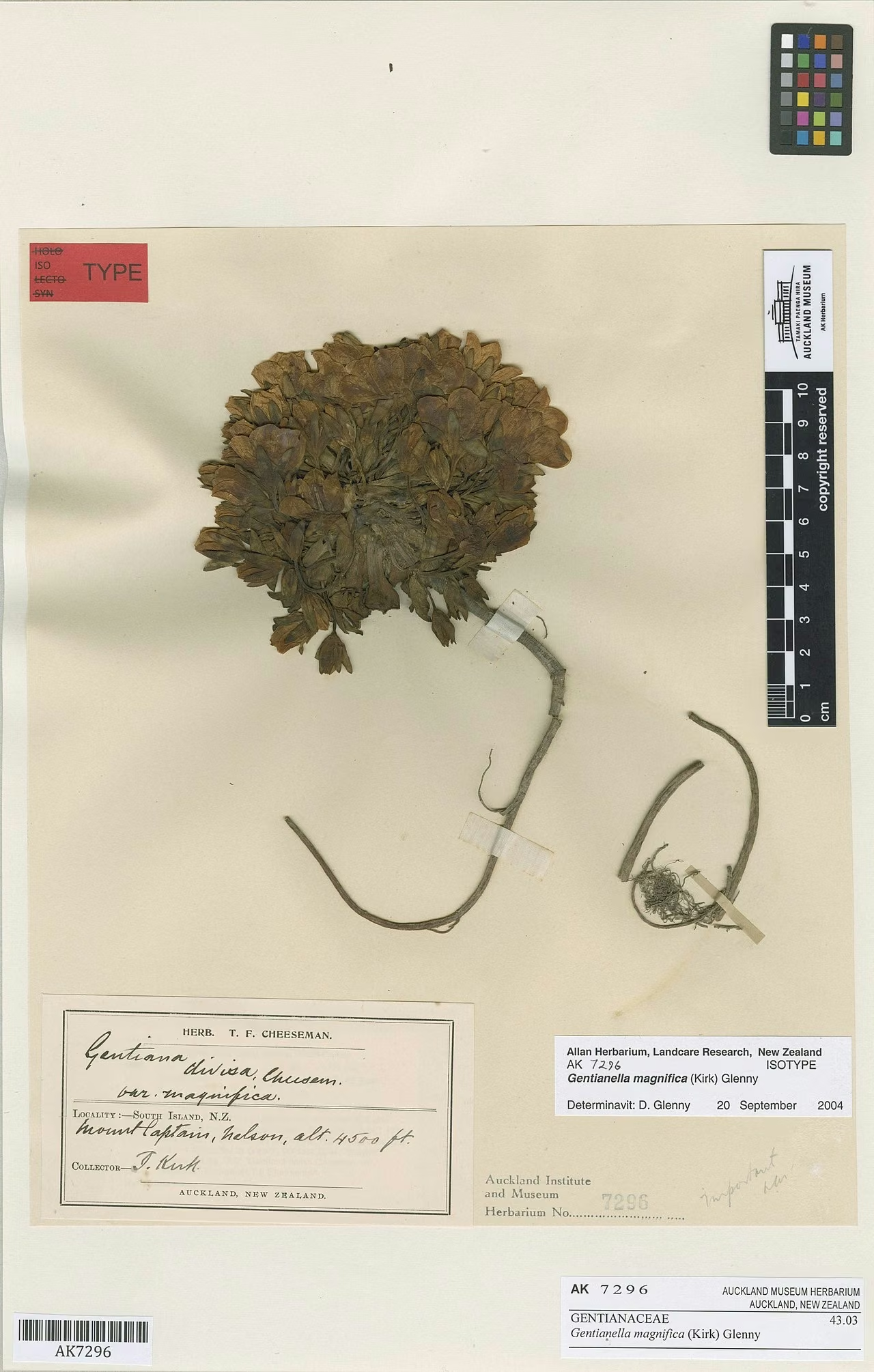
Scree Gentian
Gentianella magnifica
Plant Conservation
Forest gentian is ranked Not Threatened (2023) and has held that ranking in every assessment since 2004. Regional assessments in Wellington and Otago in 2025 also rank it Regionally Not Threatened.
Its broad range and tolerance of several habitats make it secure nationally, but protecting wetlands and montane forest remains important for local populations.
Frequently Asked Questions
Why is Gentianella grisebachii called forest gentian?
Unlike most New Zealand gentians, which grow in open alpine country, it often grows in swamp forest, cloud forest and poorly drained subalpine scrub, although it also occurs in bogs and tussock grassland.
Where does forest gentian grow?
It occurs in the North Island from Mt Pirongia and the Raukumara Range south, and throughout the South and Stewart Islands, usually at montane to alpine levels but in lowland sites further south.
Is forest gentian a perennial?
No. It is a monocarpic biennial that grows for a season, flowers once in its second year, sets seed and dies.
Can I buy forest gentian for my garden?
NZPCN notes it is not commercially available and describes it as difficult to propagate, advising that it should not be removed from the wild.
Sources and Further Reading
The botanical, growing, and conservation details for Forest Gentian (Gentianella grisebachii) on this page draw on the New Zealand plant references below. Consult them for full technical records and the latest distribution data.