Pareora Gentian
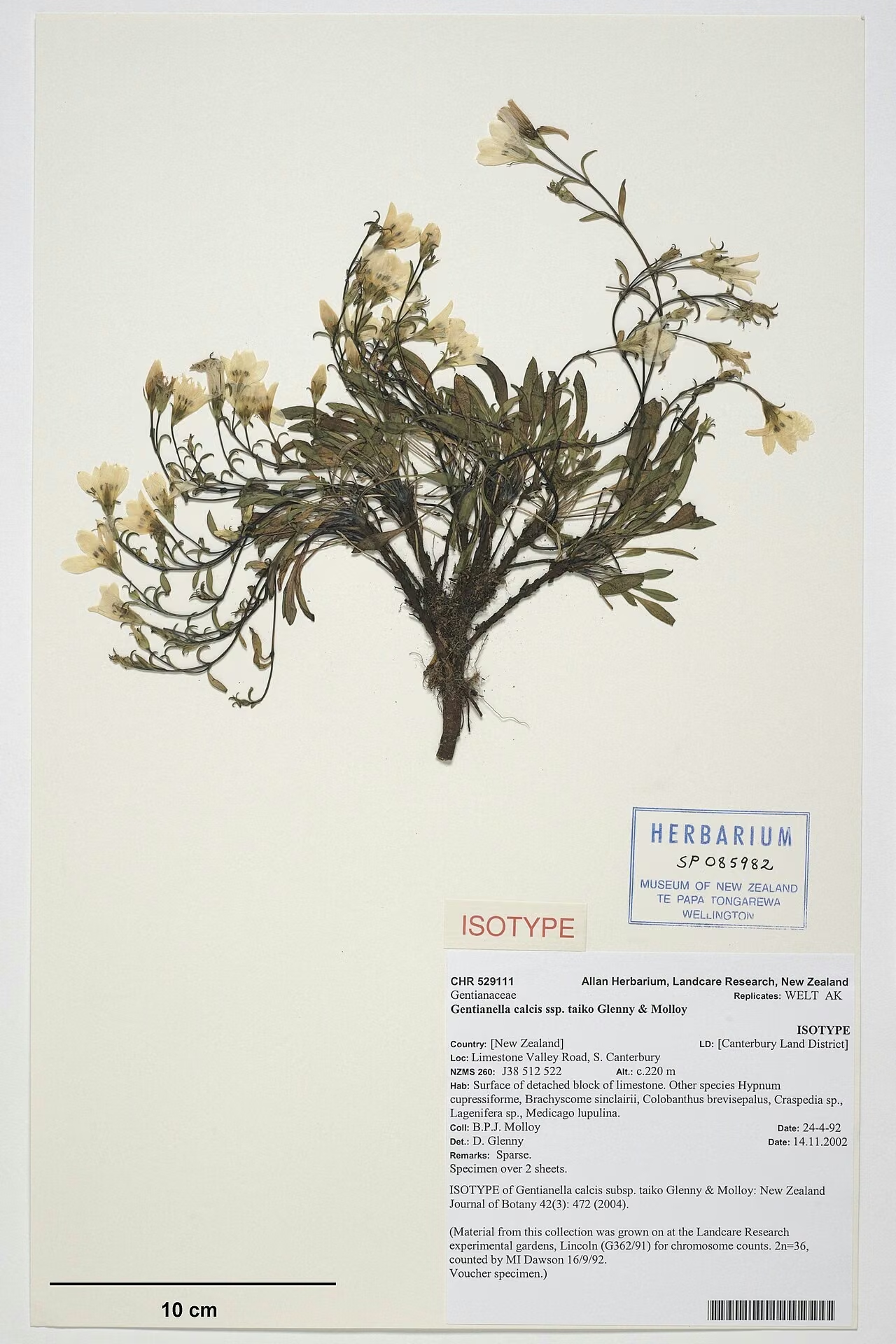
Gentianella calcis subsp. taiko
Last updated:
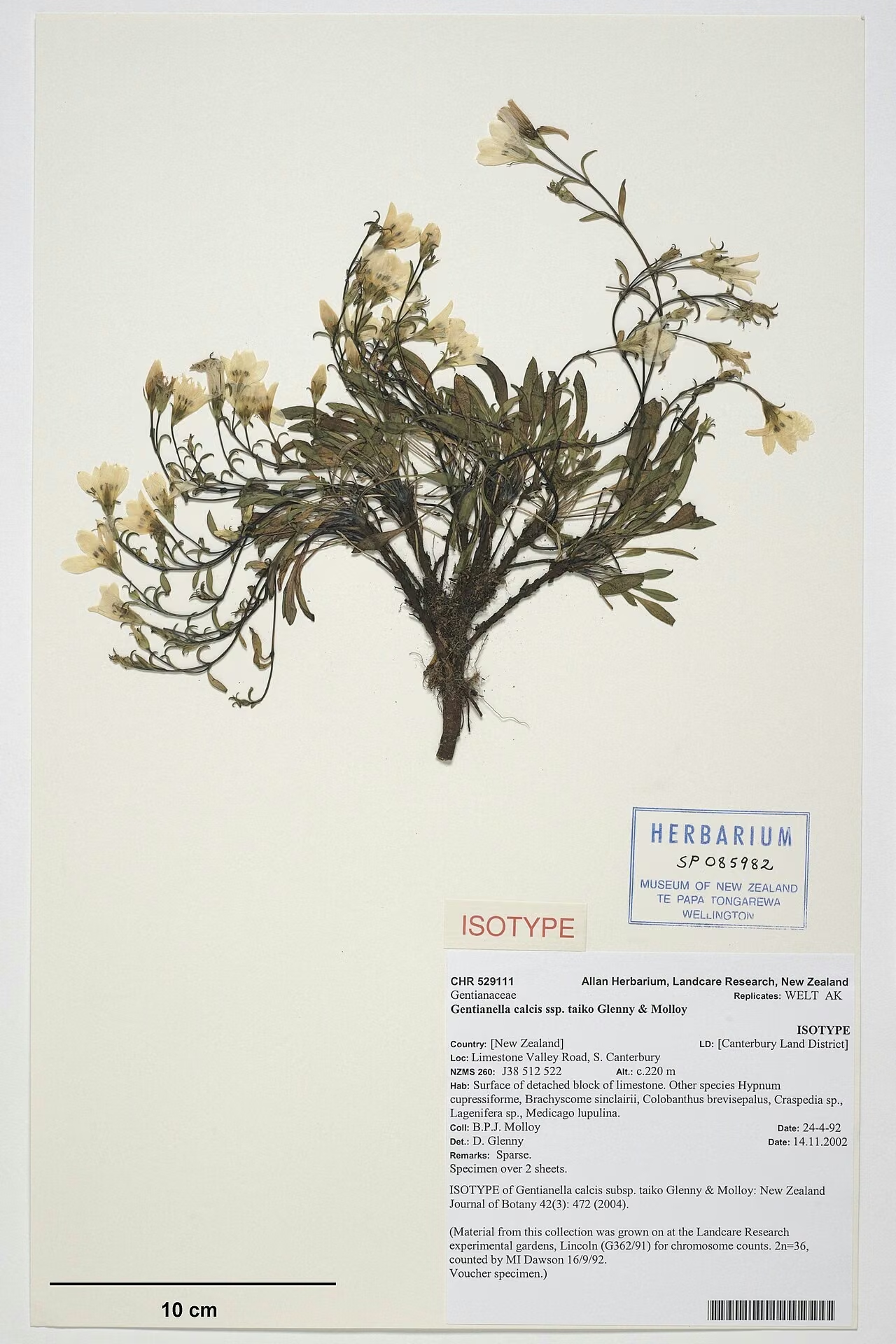
The Pareora gentian (Gentianella calcis subsp. taiko) is a rare limestone gentian of South Canterbury, named for the Pareora district where it grows near Limestone Valley Road. It is a tufted perennial herb with stalked, narrowly elliptic rosette leaves 42 to 75 mm long and up to five purple-black stems that together carry 28 to 65 white flowers in autumn, mainly April and May. Compared with the other subspecies of Gentianella calcis it has wider leaves and prefers shaded, moister sites on limestone bluffs and boulders. It is ranked Threatened - Nationally Critical, with weeds, goats and quarrying among the threats. Explore more native flowering plants in our native plant guide.
Plant Description
The Pareora gentian is a perennial tufted herb. Its rosette leaves have distinct stalks 15 to 50 mm long and narrowly elliptic blades 42 to 75 mm long and 4.4 to 8.8 mm wide. They are green, weakly V-shaped and slightly recurved, with acute to blunt tips. The stem leaves are linear and recurved.
There are one to five purple-black flowering stems per plant, each with 1 to 18 flowers, giving 28 to 65 flowers per plant. The flowers are 16 to 18 mm long, with a green calyx tinted purple-black whose lobes are strongly recurved. The corolla is 11.7 to 19 mm long with colourless veins and lobes usually toothed at the margin. Capsules are 13 to 16.5 mm long.
Among the four subspecies of Gentianella calcis, taiko is recognised by its wide leaves, its flowering stems with little secondary branching and its large, uniformly white corolla with a smooth-edged nectary flap. Subsp. calcis of North Otago has narrower, stalkless rosette leaves.
Quick Facts
| Scientific Name | Gentianella calcis subsp. taiko |
|---|---|
| Height | Low tufted rosette with short flowering stems |
| Spread | A small tuft |
| Water Needs | Moderate; prefers moister sites than related subspecies |
| Light | Partial shade on limestone bluffs and boulders |
| Frost Tolerance | Moderate to high; lowland South Canterbury frosts |
| Salt Tolerance | No information available |
| Growth Rate | Slow |
| Lifespan | Perennial |
Climate Best Suited to
Suits the lowland climate of inland South Canterbury, with warm summers, frosty winters and moderate rainfall. It relies on the cooler, moister microclimate of shaded limestone faces.
Regional Suitability
| City | Climate Suitability |
|---|---|
| Auckland | Low |
| Wellington | Low |
| Christchurch | Low |
| Dunedin | Low |
Plant Habitat
Gentianella calcis subsp. taiko is endemic to South Canterbury. NZPCN gives its distribution as near Pareora, on Limestone Valley Road. The 2025 genetic study sampled five populations: Limestone Valley (more than 500 plants), Totara Valley (more than 1000), Mount Donald (125), Maungati (27) and the Pareora River (22).
It is a limestone endemic of lowland areas, confined to shaded sites on limestone bluffs and boulders and the rendzina soils associated with them. The genetic study notes that it prefers a moister habitat than the other subspecies of Gentianella calcis.
Growing Requirements
Soil Requirements
It grows only on limestone, in crevices and ledges and in the shallow, lime-rich rendzina soils at the base of bluffs and boulders.
- Limestone rock and boulders
- Rendzina soils
- Shaded, slightly moist ground
Light Requirements
Unlike its sun-loving relatives, the Pareora gentian is found in shaded sites on limestone.
- Shade or partial shade from rock faces
- Open enough that grasses do not smother it
Water Requirements
Shaded limestone faces hold more moisture than exposed bluffs, which suits this subspecies' preference for moister sites.
- Moderate, steady moisture
- Free drainage through limestone rubble
Planting and Establishing
The Pareora gentian is not available for planting and should not be grown in private gardens. NZPCN describes it as difficult to propagate and states that it should not be removed from the wild.
Conservation planting, if undertaken, would be led by the Department of Conservation and partners using seed from the same population, as recommended by the 2025 genetic study.
Ecological Role
Like the rest of Gentianella calcis it is self-compatible and appears to spread little, if at all, by clonal growth, so populations depend on seed. Its round, smooth seeds are released from open capsules in a censer-like way as the stems sway. The insects that visit its autumn flowers have not been documented in the sources consulted.
Genetic work shows the South Canterbury populations are strongly differentiated from each other, with geographic distance explaining about half the genetic variation. This means each small population holds genetic diversity found nowhere else.
Uses & Significance
Garden Uses
It has no garden use; its future depends on protection where it grows.
- Not commercially available
- Never collect from the wild
- A focus for limestone conservation in South Canterbury
Ecological Value
It is one of the rarest members of New Zealand's limestone flora.
- Autumn flowers for insects
- Part of rare shaded limestone communities
- Genetically unique populations
Landscaping Uses
This subspecies has no landscaping role. Its setting is the limestone outcrops and valleys of the Pareora and Totara districts of South Canterbury, much of it within farmland.
Farmers with limestone boulders and bluffs can help by fencing out goats and stock from known sites and controlling hawkweed and pasture grasses around the rocks.
Seasonal Care Calendar
Spring
Rosettes grow actively in the moist shade of limestone boulders.
- Rosette leaves expand
- Weed growth also increases
Summer
Plants continue to build their rosettes, and flowering stems start to develop later in the season.
- Dry spells test plants on thin soils
- Shade helps retain moisture
Autumn
Flowering occurs from April to May, sometimes from March, with white flowers on purple-black stems.
- Main flowering season
- Capsules develop after flowering
Winter
Plants persist as rosettes or rootstocks through the cold months. Fruiting times are not documented for this subspecies.
- Seed shed from capsules
- Rockfall and slumping risk in wet weather
When to Prune and How Much
Pruning does not apply to this wild herb.
Old flowering stems should be left on the plant so that the capsules can release their seed.
How to Grow Pareora Gentian
NZPCN describes the Pareora gentian as difficult to propagate and says it should not be removed from the wild. As a Nationally Critical taxon, any collection of seed or plants needs Department of Conservation authorisation and landowner permission. The 2025 genomics study recommended that plants grown from seed collected from each population could be used to increase population sizes, and that the larger Limestone Valley and Totara Valley populations be prioritised for management. The following outlines the general approach for conservation propagation only.
From Seed
Seed is the natural and only practical means of increase for this self-compatible gentian. Because each population is genetically distinct, seed from different sites should never be mixed.
Plants returned to the wild do best in weeded, shaded crevices and ledges, matching the moist limestone microsites where the subspecies naturally grows.
- Collect a small proportion of ripe capsules only under permit
- Record and label the source population of every seed lot
- Sow on the surface of a free-draining mix containing crushed limestone
- Keep pots in a shaded, cool, evenly moist position, reflecting its natural habitat
- Grow seedlings on singly and return them only to their source site
Division and Cuttings
Division is not recommended because plants show little or no clonal spread and digging them would endanger tiny populations. Seed-raised plants also carry more genetic diversity.
- Leave wild plants undisturbed
- Support seed banking and population monitoring instead
- Report new sightings on South Canterbury limestone to the Department of Conservation
Pests & Diseases
Invasive plants are the most severe threat: mouse-ear hawkweed (Pilosella officinarum), Chewings fescue (Festuca rubra) and pasture grasses spread over the ground the gentian needs. Feral goats browse plants on the bluffs.
Other threats include habitat loss from changes in land use, limestone quarrying, and erosion and rockfall, which can destroy plants in populations as small as the 22 recorded at the Pareora River.
Cultural Significance
No Māori traditional use is recorded for the Pareora gentian, and the meaning of the subspecies name taiko was not found in the sources consulted. Its common name refers to the Pareora area of South Canterbury.
It was described within Gentianella calcis by David Glenny and Brian Molloy in the New Zealand Journal of Botany in 2004. Their work recognised four limestone subspecies, each confined to a small part of the eastern South Island.
Bonus Tip
When surveying South Canterbury limestone for this gentian, check the shaded sides and bases of boulders and bluffs rather than the sunny tops, as subsp. taiko favours moister, shaded sites. Visit in April or May to find it in flower.
Related Plants
Explore other native plants that share similar characteristics or habitats with Pareora Gentian (Gentianella calcis subsp. taiko), offering further insights into New Zealand's diverse flora. These related species provide context and opportunities for complementary planting in your garden.
Gaultheria parvula
Gaultheria parvula
Gentianella amabilis
Gentianella amabilis
Antipodes Islands Gentian
Gentianella antipoda
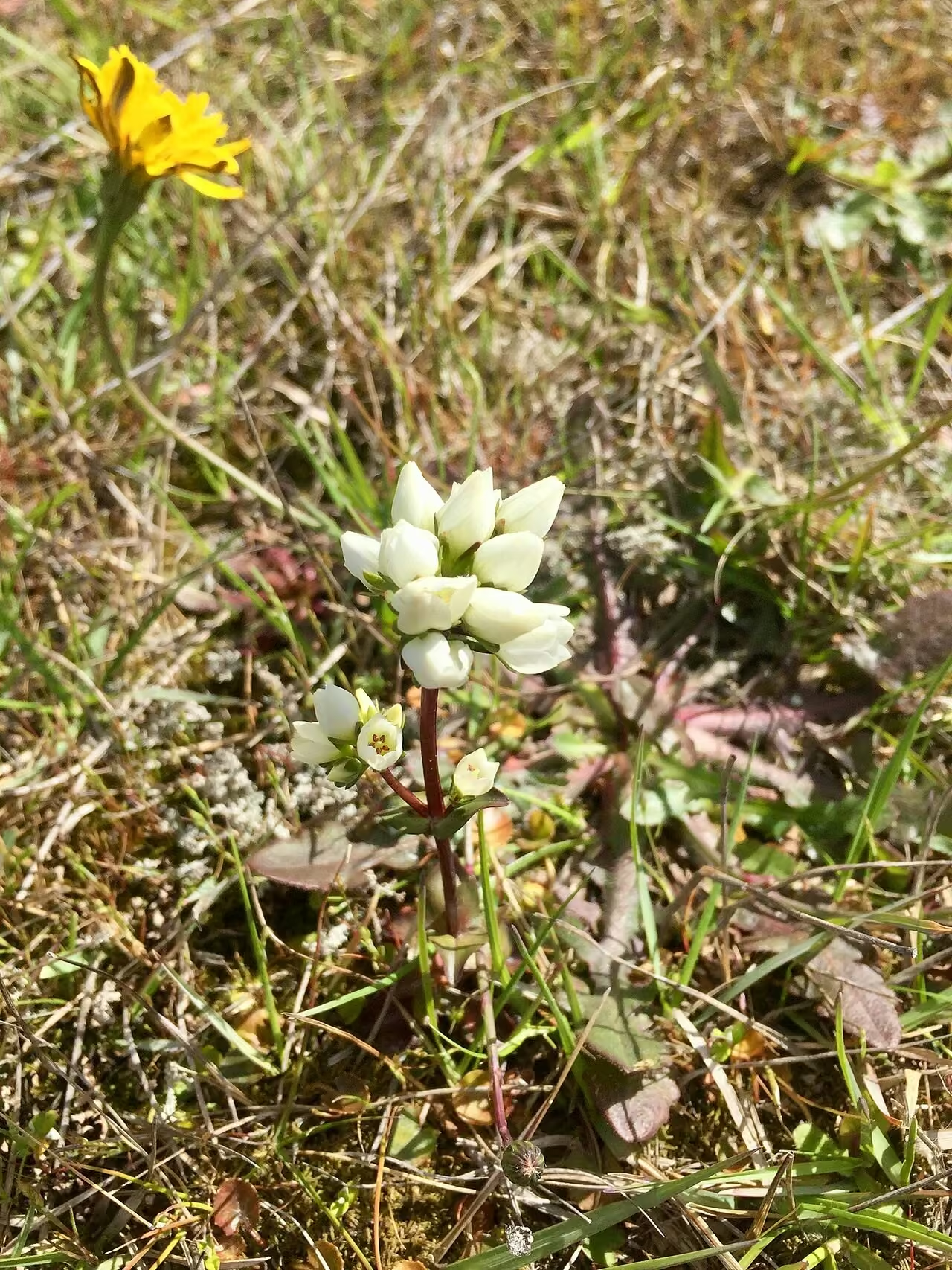
Awahokomo Gentian
Gentianella calcis subsp. calcis
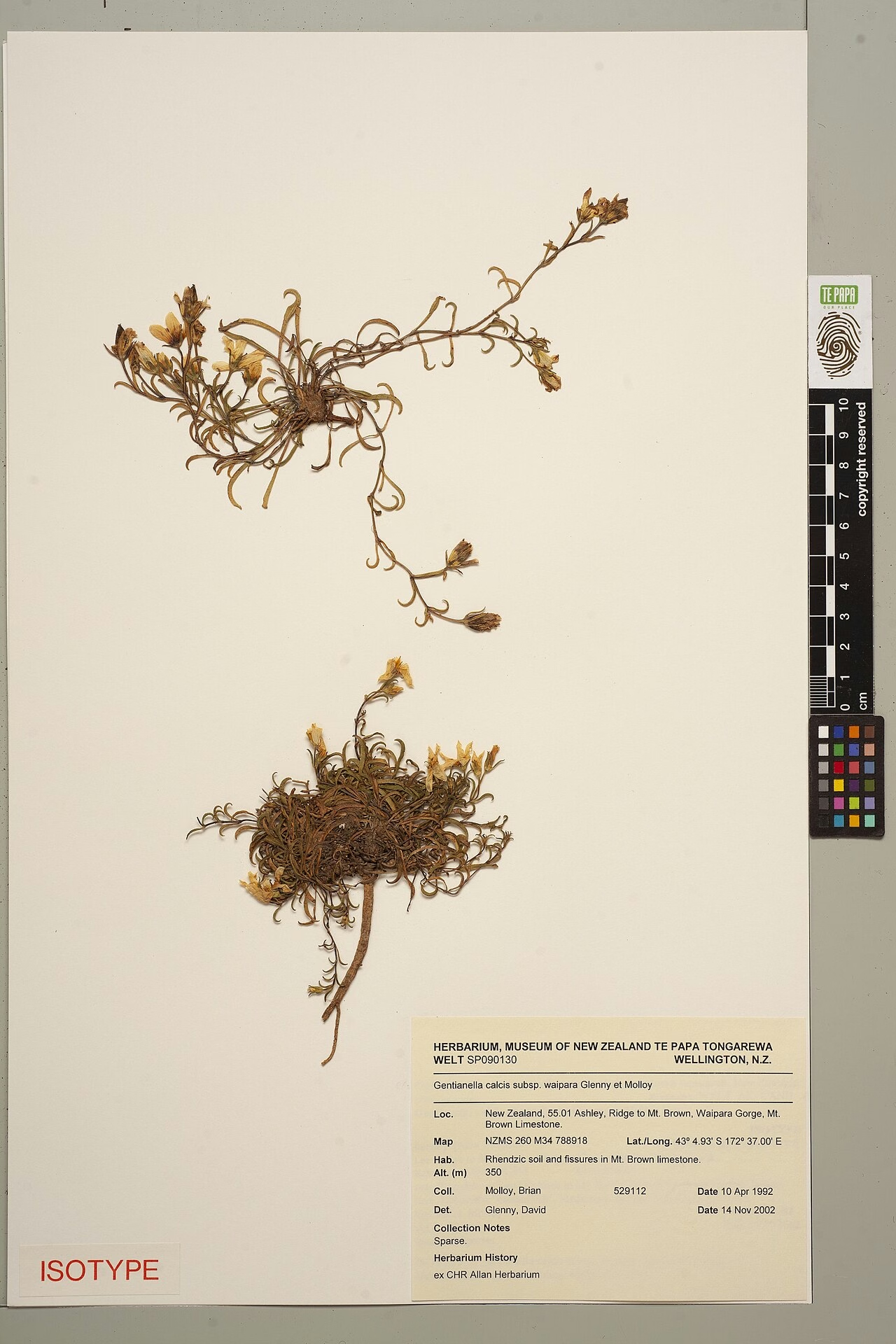
Waipara Gentian
Gentianella calcis subsp. waipara
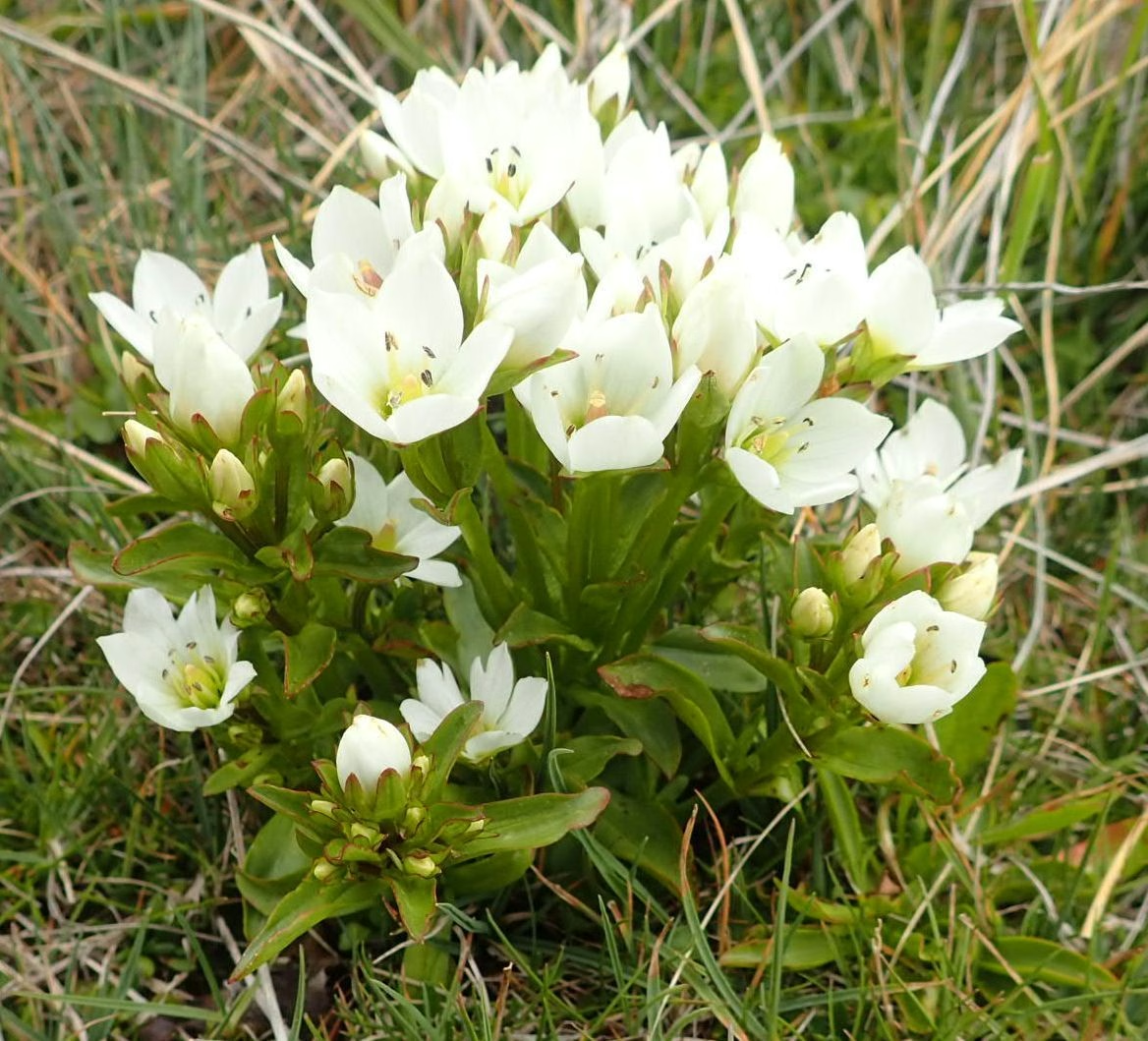
Chatham Island Gentian
Gentianella chathamica subsp. chathamica
Gentianella divisa
Gentianella divisa
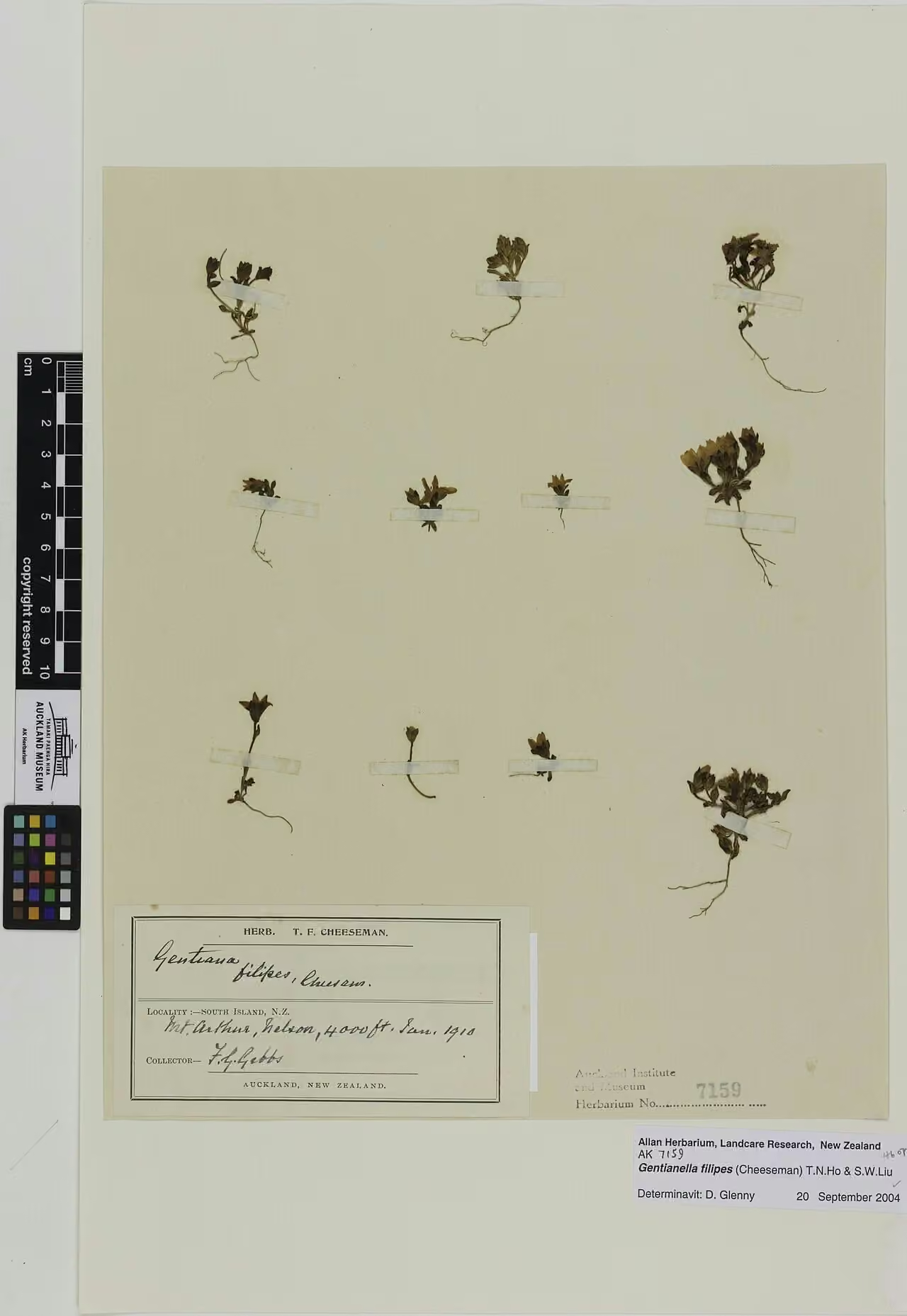
Gentianella filipes
Gentianella filipes
Plant Conservation
The Pareora gentian is ranked Threatened - Nationally Critical (2023) with the qualifiers DPT (data poor trend) and RR (range restricted). Several of its populations hold fewer than 130 plants.
Weed control, exclusion of goats and stock, protection from quarrying and land conversion, and seed collection for ex situ conservation all help. Because there are not enough resources to manage every population, the 2025 genetic study suggested prioritising Limestone Valley and Totara Valley, the two largest.
Frequently Asked Questions
Where does the Pareora gentian grow?
It is endemic to lowland limestone in South Canterbury. NZPCN gives its range as near Pareora on Limestone Valley Road, and a 2025 genetic study sampled populations at Limestone Valley, Totara Valley, Mount Donald, Maungati and the Pareora River.
How is subsp. taiko different from other Gentianella calcis subspecies?
It has wider rosette leaves, 4.4 to 8.8 mm across, on distinct stalks, little secondary branching of its flowering stems and large, uniformly white flowers with an untoothed nectary flap.
What threatens the Pareora gentian?
Spreading weeds such as mouse-ear hawkweed, Chewings fescue and pasture grasses, land use change, browsing by feral goats, limestone quarrying, erosion and rockfall all threaten it.
When does the Pareora gentian flower?
It flowers in autumn, from April to May and sometimes from March, when its white flowers open on purple-black stems among shaded limestone rocks.
Sources and Further Reading
The botanical, growing, and conservation details for Pareora Gentian (Gentianella calcis subsp. taiko) on this page draw on the New Zealand plant references below. Consult them for full technical records and the latest distribution data.