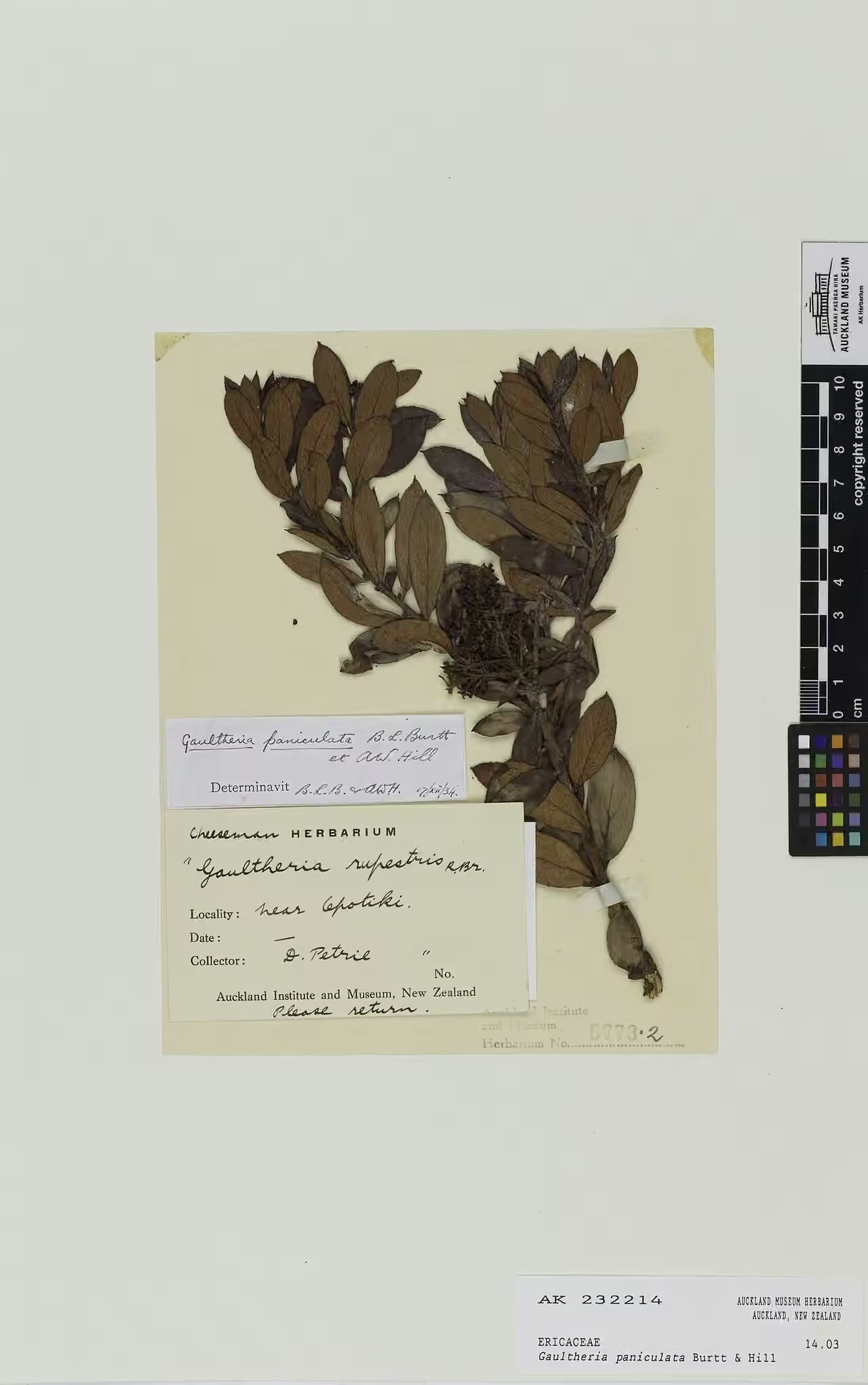
Snowberry
Gaultheria paniculata
Last updated:
Gaultheria paniculata is a bushy, erect to sprawling shrub up to about 2 m tall, endemic to open country in the North Island. It is the largest-leaved of the local Gaultheria, with elliptic, leathery, finely toothed leaves 2 to 6 cm long on reddish twigs clad in dark bristly hairs. From October to December it produces branched sprays of small cream to white urn-shaped flowers up to 6 cm long and wide at the branch tips, which give the species its name. The fruit is a small dry capsule. It is ranked Not Threatened and often hybridises with mountain snowberry where the two meet. Explore more native shrubs in our native plant guide.
Plant Description
Gaultheria paniculata is an erect shrub to about 2 m high with ascending to spreading branches. The twigs are reddish and carry stiff, dark, bristly hairs. The leaves are alternate on thick stalks about 3 mm long, with a blade usually 20 to 60 mm long and 10 to 25 mm wide, elliptic to oblong-elliptic, leathery but not thick, rather densely bristly when young, abruptly pointed at the tip and finely toothed along the margin.
The flowers are produced at or near the tips of the branches in terminal panicles up to about 6 by 6 cm, with whitish hairs on the flower stalks. Each flower has an urn-shaped cream to white corolla 3.5 to 6 mm long with small oblong lobes. The fruit is a dry capsule 3 to 4 mm across, enclosed in the dry calyx.
The large leaves, dark bristly hairs and well-branched flower sprays distinguish it from Gaultheria colensoi, which has leaves only 8 to 12 mm long and downy rather than bristly twigs. Gaultheria antipoda, which also reaches shrub size, has fleshy red or white fruit. Hybrids with intermediate features are frequent where Gaultheria species grow together.
Quick Facts
| Scientific Name | Gaultheria paniculata |
|---|---|
| Height | Up to about 2 m |
| Spread | 1 to 2 m, bushy and spreading |
| Water Needs | Moderate |
| Light | Full sun to light shade in open areas |
| Frost Tolerance | Moderate to high; grows in inland North Island districts |
| Salt Tolerance | No reliable information available |
| Growth Rate | Moderate |
| Lifespan | Long-lived perennial shrub |
Climate Best Suited to
Suits the temperate climate of the inland North Island, with cool winters, frosts and reasonably reliable rainfall. It should also grow in cool southern gardens with good drainage.
Regional Suitability
| City | Climate Suitability |
|---|---|
| Auckland | Medium |
| Wellington | Medium |
| Christchurch | Medium |
| Dunedin | Medium |
Plant Habitat
Gaultheria paniculata is endemic to the North Island of New Zealand. NZPCN describes it as a shrub of open areas, and Kew's Plants of the World Online lists the North Island as its whole native range. Herbarium and fungal host records include collections from the Taupō district, where it shares the landscape with Gaultheria colensoi.
It grows in open shrubland and scrubby, disturbed ground rather than under forest canopy. More precise information on its altitudinal range and regional distribution was not found in the sources consulted.
Growing Requirements
Soil Requirements
Like other members of the heath family it prefers acidic, free-draining and fairly infertile soils, such as the pumice and volcanic soils of the central North Island.
- Free-draining, acidic soil
- Pumice or gritty loam suits it well
- Avoid lime and rich fertilisers
Light Requirements
It is a plant of open areas and flowers best in full sun, though it tolerates light shade.
- Full sun for the most flowers
- Light shade tolerated but growth becomes more open
Water Requirements
Once established it copes with ordinary rainfall, but young plants need regular moisture while roots develop.
- Water young plants during dry spells
- Avoid waterlogged sites
Planting and Establishing
Plant in autumn or spring in a sunny, well-drained position. Improve heavy clay with pumice or grit and mulch with bark to keep the roots cool and moist. Space plants 1 to 1.5 m apart if growing them as a group.
It is seldom sold by nurseries, so garden plants usually come from specialist native growers or from locally collected seed or cuttings. For restoration, use material from the same district to avoid mixing hybrid forms into wild populations.
Ecological Role
Its many small cream bell flowers offer nectar and pollen to native insects in late spring, although the pollinators of this particular species are not documented in the sources consulted. NZPCN records that its seeds are wind-dispersed from the dry capsules.
As a shrub of open ground it forms part of the low native shrubland of the North Island, alongside other heath-family shrubs. The fungus Coccomyces radiatus is recorded from this shrub in the Biota of New Zealand database.
Uses & Significance
Garden Uses
A hardy, informal native shrub with attractive spring flower sprays for cool, sunny gardens.
- Mixed native shrub borders
- Dry banks with acidic soil
- Restoration plantings on North Island volcanic soils
Ecological Value
It adds diversity to North Island shrublands and provides seasonal resources for invertebrates.
- Spring nectar for native insects
- Early successional cover on open ground
- Host to native fungi
Landscaping Uses
Use Gaultheria paniculata among other heath-family shrubs such as Leucopogon and Dracophyllum, or with mānuka and Coprosma, to recreate a Central Plateau shrubland. Its reddish twigs and leathery leaves look good year round.
Place it where its spring sprays of cream flowers can be seen close up, such as beside a path or at the front of a native border.
Seasonal Care Calendar
Spring
Branched sprays of cream to white urn-shaped flowers open from October.
- Enjoy the main flowering display
- Plant new shrubs early in the season
Summer
Flowering finishes in December and dry capsules develop.
- Lightly trim after flowering if needed
- Water young plants during drought
Autumn
Capsules ripen and release fine seed.
- Collect seed
- Take semi-hardwood cuttings
Winter
An evergreen shrub that remains leafy through frosts.
- Check drainage after heavy rain
- Little other care needed
When to Prune and How Much
Prune lightly straight after flowering to keep the shrub bushy, shortening long shoots back to a leafy side branch.
Avoid heavy cuts into old wood. Remove dead or crossing branches in late winter or early spring.
How to Grow Snowberry
Gaultheria paniculata can be propagated from seed or from semi-hardwood cuttings. The seed is fine and comes from dry capsules that split open when ripe, so it should be collected promptly before it blows away. Cuttings give faster results and keep the features of the parent shrub. Because New Zealand Gaultheria hybridise readily, seed gathered from plants growing near Gaultheria colensoi or other species may produce intermediate seedlings, so collect from plants in pure stands when growing true-to-type material.
From Seed
Gather the capsules as they turn brown in late summer and autumn and shake out the fine seed in a paper bag. Surface sowing is important because tiny seeds need light and have little stored energy.
- Prepare a tray of fine acidic seed mix with a little added bark or pumice
- Sprinkle the seed thinly on the surface and press it in gently without covering
- Water from below and cover with clear plastic or glass
- Keep in a cool, bright place out of direct hot sun
- Prick out seedlings into pots once they have several true leaves
From Cuttings
Semi-hardwood cuttings of the current season's growth taken from late summer into autumn usually root well in a humid environment.
- Cut 8 to 10 cm lengths from healthy non-flowering shoots
- Remove the lower leaves and treat the base with rooting hormone
- Insert into a mix of fine bark and perlite
- Keep in a shaded propagator or under a plastic tent
- Pot on into an acidic potting mix when well rooted
Pests & Diseases
No serious pests or diseases are recorded for Gaultheria paniculata in the sources consulted. In cultivation, root rot in heavy or poorly drained soil is the main risk.
Keep the plant healthy with good drainage and mulch rather than sprays; a vigorous shrub tolerates minor leaf damage without harm.
Cultural Significance
No Māori name or traditional use specific to Gaultheria paniculata was found in the sources consulted.
The species was described by the British botanists B.L. Burtt and A.W. Hill in 1935 in the Journal of the Linnean Society, Botany. Its name refers to the panicles of flowers that set it apart from the other North Island Gaultheria.
Bonus Tip
To check whether a large-leaved Gaultheria on the Central Plateau is G. paniculata, look at the twigs and flowers: dark bristly hairs and flower sprays that branch into a broad panicle near the shoot tips point to this species, while short unbranched clusters and small downy leaves suggest G. colensoi or a hybrid.
Related Plants
Explore other native plants that share similar characteristics or habitats with Snowberry (Gaultheria paniculata), offering further insights into New Zealand's diverse flora. These related species provide context and opportunities for complementary planting in your garden.
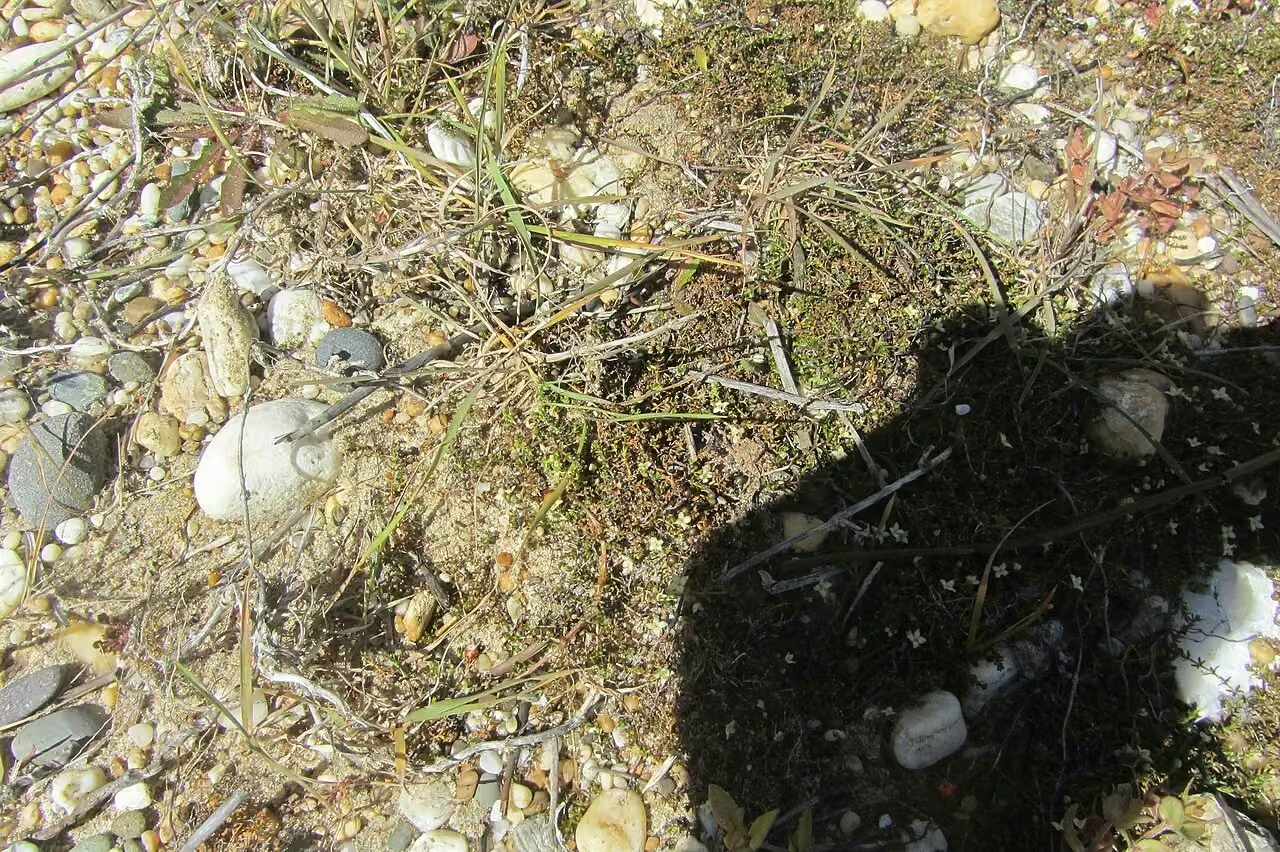
Dwarf Bedstraw
Asperula perpusilla
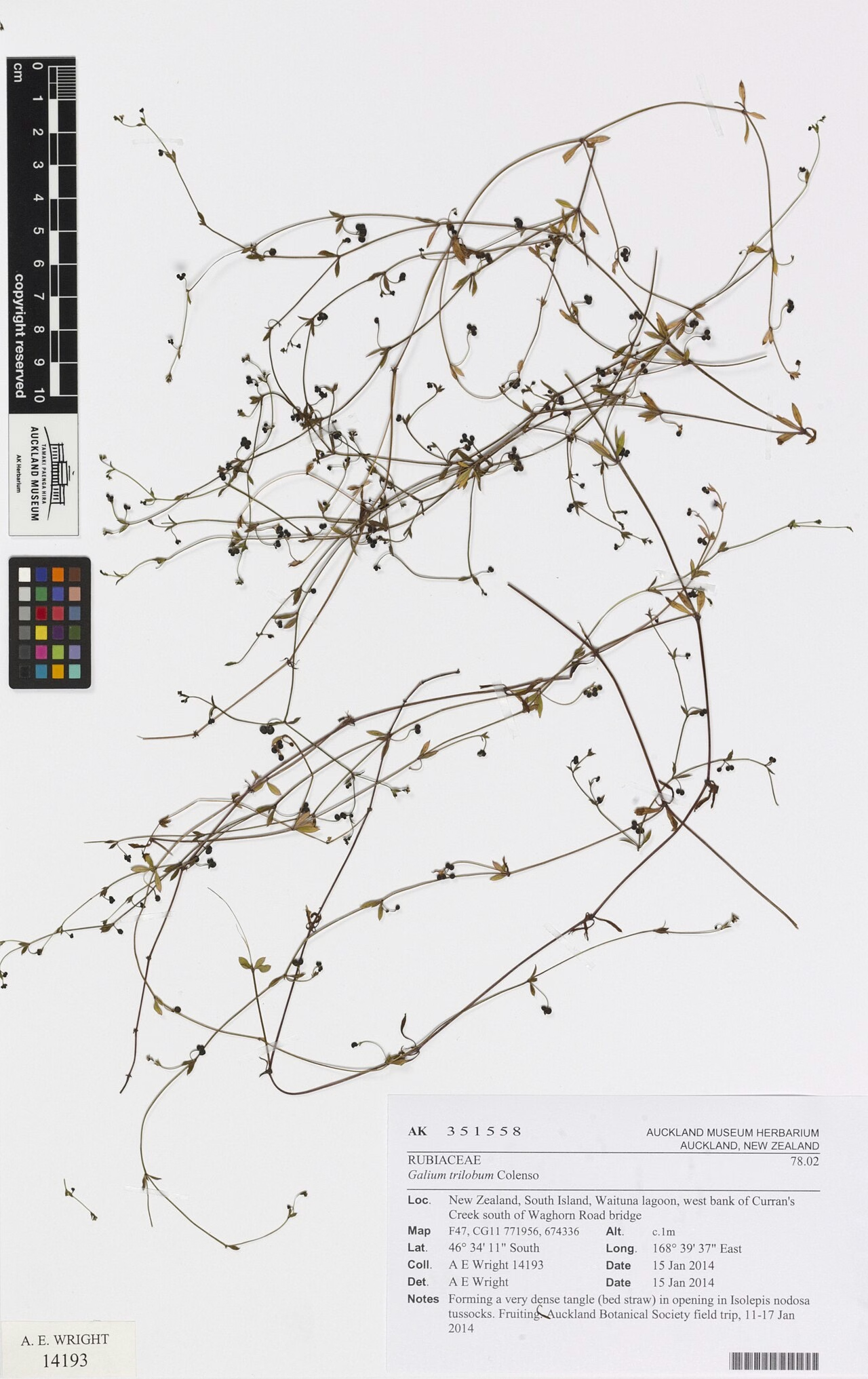
Native Bedstraw
Galium trilobum
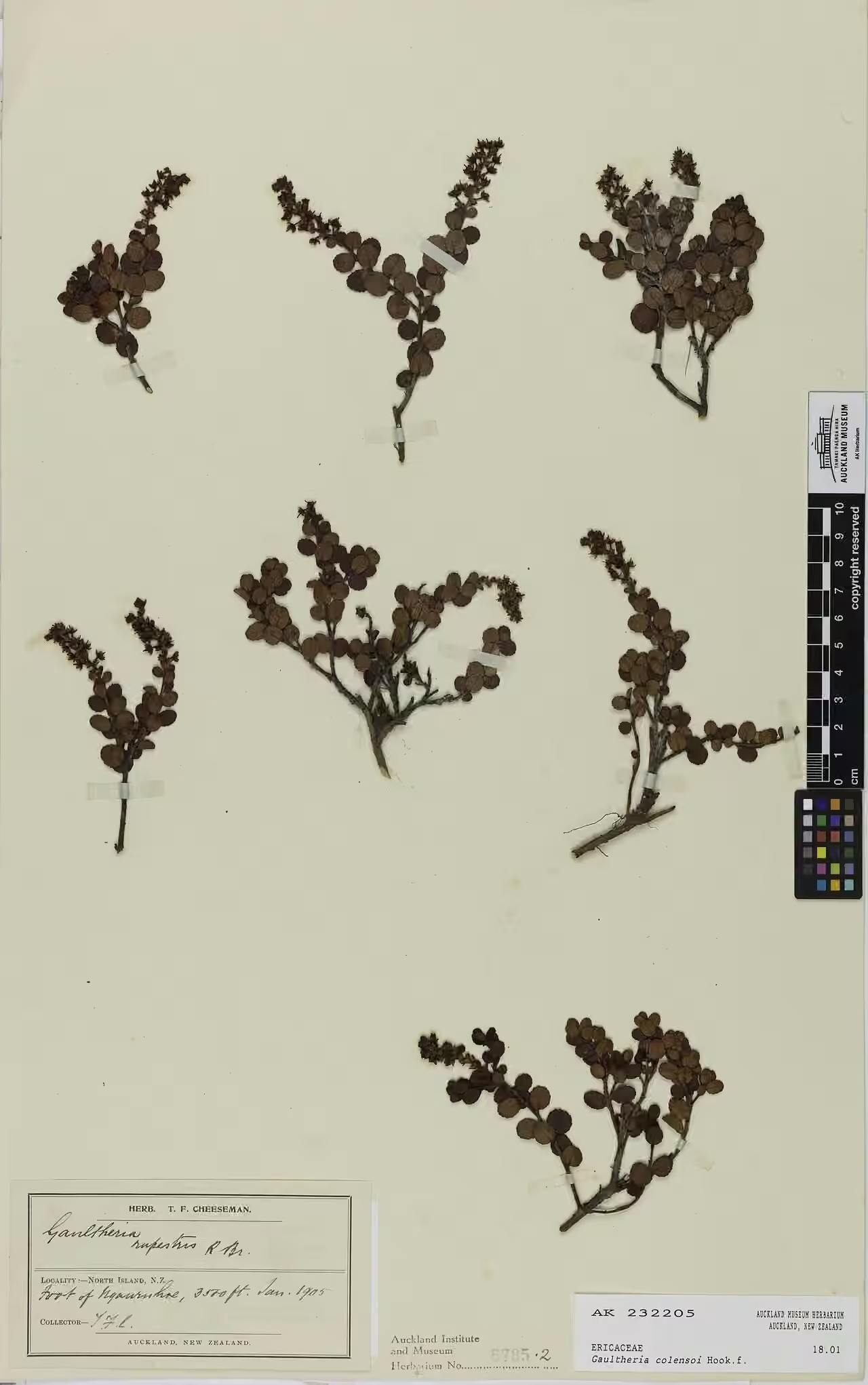
Gaultheria colensoi
Gaultheria colensoi
Gaultheria nubicola
Gaultheria nubicola
Gaultheria parvula
Gaultheria parvula
Gentianella amabilis
Gentianella amabilis
Antipodes Islands Gentian
Gentianella antipoda
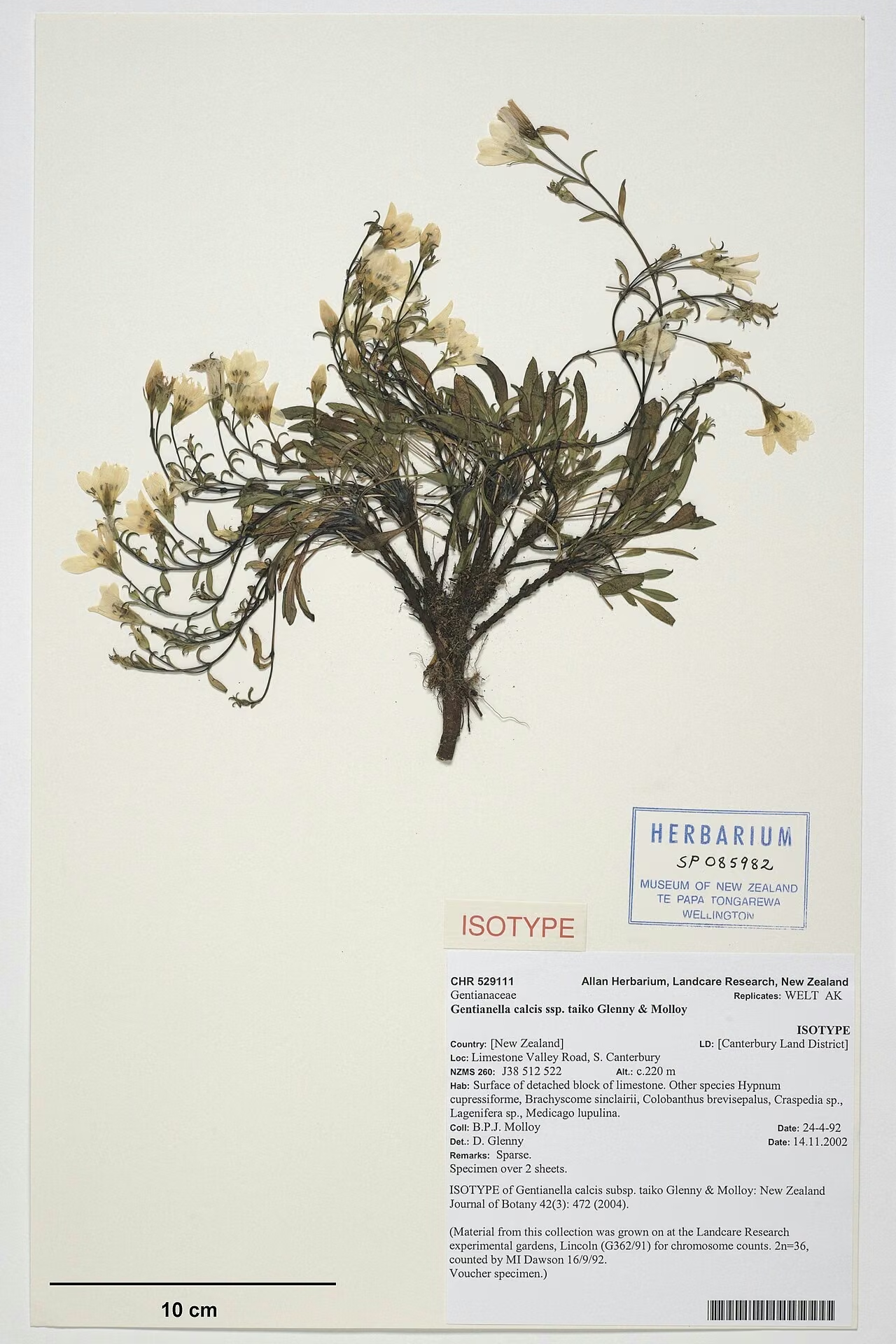
Awahokomo Gentian
Gentianella calcis subsp. calcis
Plant Conservation
Gaultheria paniculata is ranked Not Threatened and has held that status in every national assessment since 2004.
Like other plants of open North Island shrubland, it can be displaced by invasive weeds such as heather and wilding conifers, and by land conversion. Weed control in native shrublands and the use of locally sourced plants in restoration help to keep wild populations distinct.
Frequently Asked Questions
Why is it called Gaultheria paniculata?
Paniculata refers to the flowers, which are carried in branched sprays called panicles up to about 6 cm long and 6 cm wide at the tips of the twigs.
When does Gaultheria paniculata flower?
The Flora of New Zealand records flowering from October to December, when cream or white urn-shaped flowers cover the branch tips.
Is Gaultheria paniculata native to the South Island?
No. It is endemic to New Zealand and both NZPCN and Kew record it only from the North Island, where it grows in open areas.
Does Gaultheria paniculata hybridise with other snowberries?
Yes. New Zealand Gaultheria cross readily, and herbarium specimens once named G. paniculata have been re-identified as hybrids with Gaultheria colensoi.
Sources and Further Reading
The botanical, growing, and conservation details for Snowberry (Gaultheria paniculata) on this page draw on the New Zealand plant references below. Consult them for full technical records and the latest distribution data.