Native Bedstraw
Galium trilobum
Last updated:
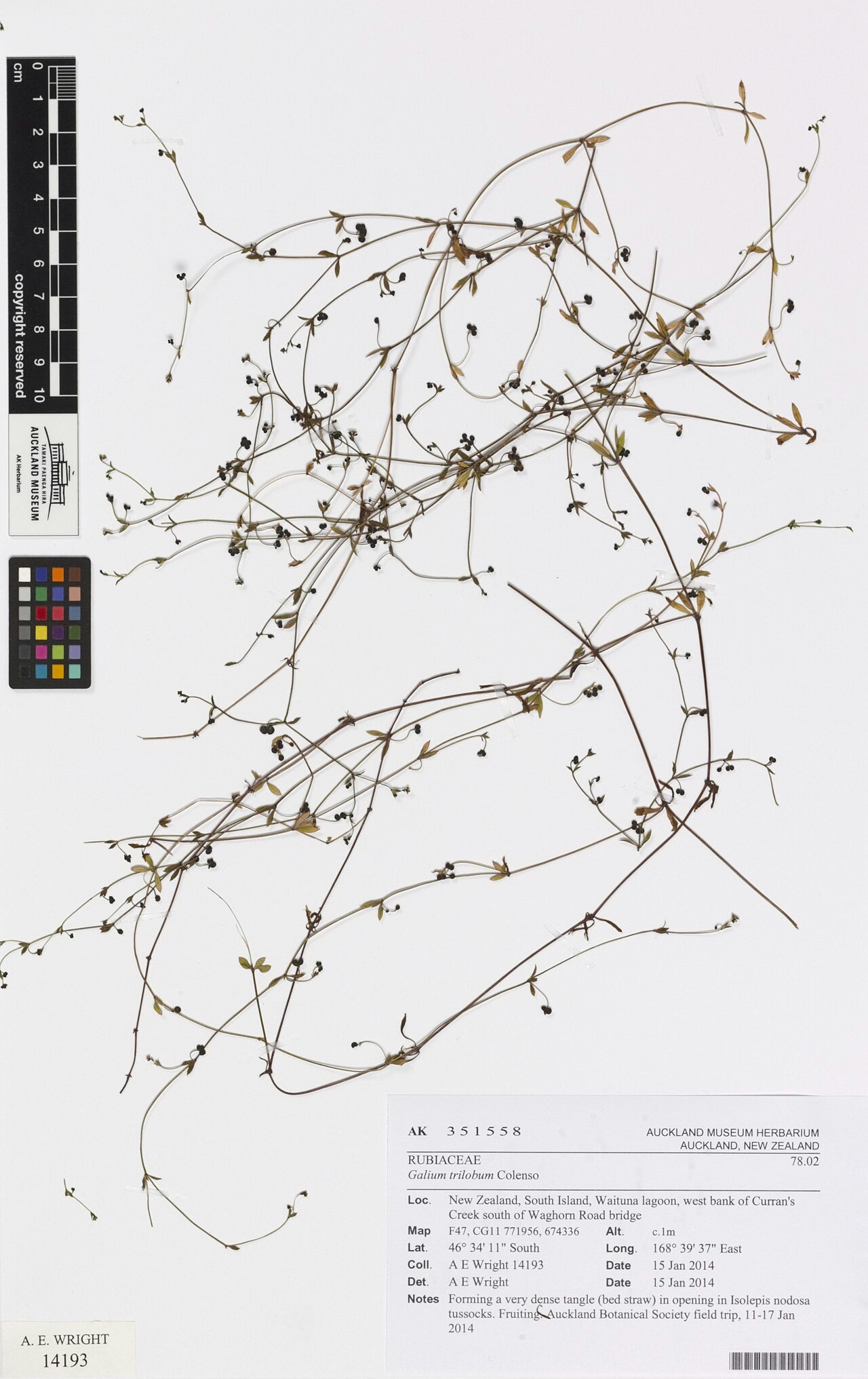
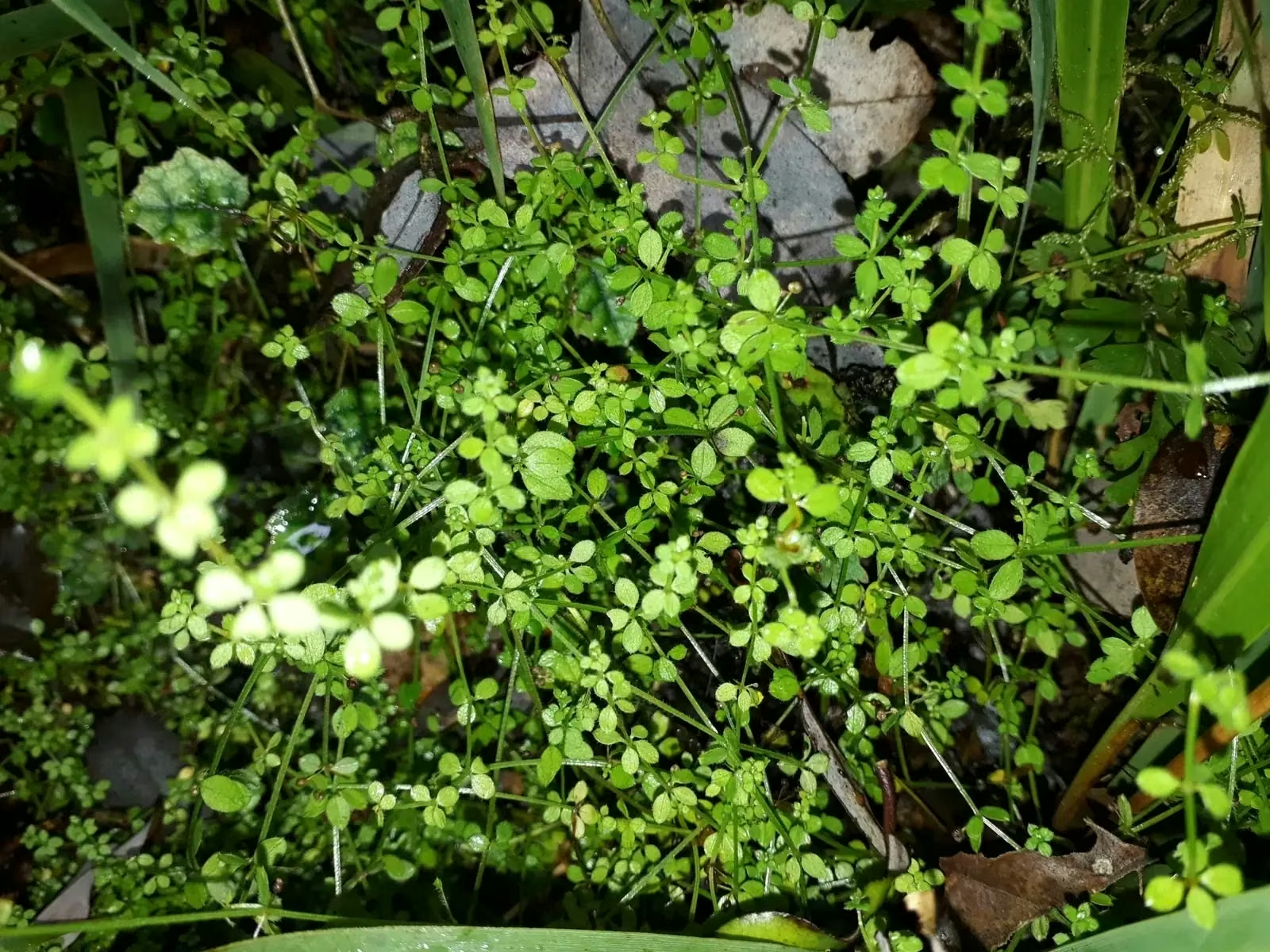
Native bedstraw (Galium trilobum) is a slender, straggling perennial herb endemic to New Zealand. Its thin, angled stems scramble 10 to 70 cm through other vegetation, carrying narrow leaves in whorls of four and small clusters of starry white flowers 2 to 3 mm across, followed by tiny dark brown round fruits. It grows from the lowlands to the uplands of the North and South Islands in shady, damp and wet places such as forest margins, scrub, stream and lake sides, moist pasture and tussockland. It is ranked Not Threatened, but it has declined in the northern North Island and is often confused with introduced bedstraws. Explore more native ground covers in our native plant guide.
Plant Description
Galium trilobum is a perennial herb in the Rubiaceae. It has slender, straggling or scrambling, angled stems 10 to 70 cm long that lean on surrounding plants. Leaves and leaf-like stipules are arranged in whorls of four. They are narrowly elliptic to spoon-shaped (spathulate), about 2 to 10 mm long according to NZPCN, or up to 20 mm in the Flora of New Zealand, and 0.8 to 4 mm wide.
The flowers are white and starry, 2 to 3 mm across, usually three or four clumped together in the leaf axils or at the shoot tips. They are followed by small, round, dark brown fruits made of two globose mericarps about 1 to 1.5 mm across.
It resembles the native Galium propinquum and the introduced G. palustre, and also G. perpusillum. It differs from G. propinquum in its narrower, longer leaves and its larger flowers on longer flower stems. Because it is so often mistaken for introduced marsh bedstraw (G. palustre) and G. debile, its full distribution is uncertain.
Quick Facts
| Scientific Name | Galium trilobum |
|---|---|
| Height | Low; stems 0.1-0.7 m long, straggling |
| Spread | Scrambles up to about 0.7 m |
| Water Needs | Moist to wet |
| Light | Partial to full shade |
| Frost Tolerance | Good; grows to upland altitudes |
| Salt Tolerance | No information available |
| Growth Rate | Moderate to fast |
| Lifespan | Perennial |
Climate Best Suited to
Native bedstraw suits mild to cool, moist climates and grows from lowland to upland elevations. It does best where damp shade is available through summer.
Regional Suitability
| City | Climate Suitability |
|---|---|
| Auckland | Medium |
| Wellington | High |
| Christchurch | High |
| Dunedin | High |
Plant Habitat
Galium trilobum is endemic to New Zealand and is found in the North and South Islands from lowland to upland zones. Herbarium evidence suggests it has declined in the northern North Island, but it remains common in the southern North Island and the eastern South Island.
It favours shady, damp and wet places: forest margins, scrub, stream and lake sides, moist pastures and tussockland. Its straggling stems scramble through grasses, sedges and low shrubs. NZPCN rates it Facultative Upland, meaning it occasionally grows in wetlands but usually on non-wetland ground.
Growing Requirements
Soil Requirements
It grows in moist soils, often rich in organic matter, along forest edges and stream banks.
- Moist, humus-rich soils
- Tolerates damp pasture and tussockland soils
- Avoid dry, sandy or droughty sites
Light Requirements
NZPCN describes its habitats as shady, damp and wet places, so it prefers partial shade.
- Partial shade is ideal
- Tolerates fairly deep shade at forest margins
- Open sites only where soil stays moist
Water Requirements
It needs consistent moisture and grows naturally beside streams and lakes and in damp pasture.
- Keep soil moist year round
- Water in dry summers
- Tolerates seasonally wet ground
Planting and Establishing
Plant native bedstraw in a damp, partly shaded spot such as beside a pond, along a shady stream bank or under the edge of shrubs, where its scrambling stems can lean on neighbouring plants. Spring or autumn planting works well.
NZPCN notes that although it is easy to propagate, it appears hard to maintain in cultivation, so allow it to self-sow or take fresh cuttings each year to keep it going. It is not commercially available.
Ecological Role
Galium trilobum is part of the low herb layer of damp forest margins, scrub and wetland edges. Its small white flowers are open over a long season from spring into autumn, providing nectar for small insects, though specific pollinators are not documented in the sources consulted.
Its small round fruits split into two mericarps. Its specific dispersal mode is not recorded, though NZPCN records dispersal by attachment to animals for the related dwarf bedstraw. Its scrambling habit lets it weave through taller vegetation to reach light.
Uses & Significance
Garden Uses
A modest plant for naturalistic plantings in damp shade, where it adds fine texture and tiny white flowers.
- Pond and stream margins
- Shady, damp woodland garden edges
- Restoration plantings of wet forest margins
Ecological Value
As an endemic herb of damp forest edges and wetlands, it adds to the native diversity of these often weedy habitats.
- Endemic part of the wetland and forest-margin herb layer
- Long flowering season for small insects
- A native alternative to introduced bedstraws
Landscaping Uses
Use native bedstraw to soften the edges of a shaded pond or a damp path, letting its fine stems drape over rocks or through sedges and ferns. It is too slight to form a groundcover on its own.
In restoration projects it can be included in the herb layer of riparian plantings once taller plants provide shade and support.
Seasonal Care Calendar
Spring
New stems grow quickly and flowering starts from September (NZPCN) or November (Flora of New Zealand).
- Fresh growth
- Flowering begins
Summer
Plants flower freely, with small white starry flowers among the whorled leaves, and fruits start forming from November.
- Main flowering
- Keep the soil moist
Autumn
Late flowers continue into autumn, and fruits ripen through to May.
- Collect fresh seed
- Take cuttings
Winter
Growth slows and some stems die back. Plants persist in damp, sheltered sites.
- Little growth
- Remove dead stems if untidy
When to Prune and How Much
No regular pruning is needed. Trim back straggling or dead stems in late winter to tidy the plant and encourage fresh growth from the base.
Because it appears hard to keep in cultivation, use some of the trimmed healthy stems as cuttings to maintain a supply of young plants.
How to Grow Native Bedstraw
NZPCN describes Galium trilobum as easily grown from cuttings and fresh seed, but notes that it appears to be hard to maintain in cultivation. That makes regular propagation the key to keeping it in a garden: raise new plants each year rather than relying on a single old plant. It is not commercially available, so material usually comes from a known wild or garden source. Before collecting, check the identity carefully, as introduced Galium palustre and G. debile are easily mistaken for it.
From Seed
Fruits ripen from November to May. Collect the small dark brown fruits when they are fully coloured and sow them fresh, as NZPCN specifies fresh seed.
- Collect ripe dark brown fruits from late spring to autumn.
- Sow fresh onto a moist, fine seed-raising mix.
- Cover lightly with sieved mix.
- Keep in a shaded, sheltered place and do not let the mix dry out.
- Prick out seedlings when they have a few whorls of leaves.
- Plant out into damp, partly shaded ground once well rooted.
From Cuttings
Short cuttings of healthy stems root easily. The stems are slender, so handle them gently and keep them humid until roots form.
- Take 5 to 8 cm cuttings of healthy, non-flowering stem tips.
- Remove the lowest whorl of leaves.
- Insert into a moist mix of potting mix and perlite or sand.
- Keep shaded and humid until new growth shows that roots have formed.
Pests & Diseases
No specific pests or diseases are recorded for Galium trilobum. In gardens, slugs and snails may graze young shoots, and plants may fail if the soil dries out.
In the wild, competition from vigorous exotic grasses and weeds, and drainage of damp ground, are likely pressures, especially in the northern North Island where it has declined.
Cultural Significance
No traditional Māori name or use for Galium trilobum is recorded in the sources consulted.
The species was described by the missionary botanist William Colenso in 1888. The genus name Galium comes from Greek galo, milk, because leaves of the European Galium verum were once used to curdle milk for cheese, and the epithet trilobum means three-lobed. The common name bedstraw comes from the European use of dried Galium for stuffing mattresses.
Bonus Tip
If you are adding native bedstraw to a restoration planting, confirm its identity in flower first: introduced marsh bedstraw is common in the same damp places, and planting the weed by mistake is easy. Narrow leaves in fours and starry flowers 2 to 3 mm across in small axillary clusters point to G. trilobum.
Related Plants
Explore other native plants that share similar characteristics or habitats with Native Bedstraw (Galium trilobum), offering further insights into New Zealand's diverse flora. These related species provide context and opportunities for complementary planting in your garden.
Fimbristylis velata
Fimbristylis velata
Forstera sedifolia
Forstera sedifolia
Dwarf Bedstraw
Asperula perpusilla
Gaultheria colensoi
Gaultheria colensoi
Gaultheria nubicola
Gaultheria nubicola
Gaultheria paniculata
Gaultheria paniculata
Gaultheria parvula
Gaultheria parvula
Propinquum Plant
Propinquum Plant
Plant Conservation
Galium trilobum is ranked Not Threatened (2023). It remains common in the southern North Island and eastern South Island.
Herbarium records suggest it has declined in the northern North Island, and confusion with introduced bedstraws makes its true status hard to judge. Protecting damp forest margins and wetland edges from drainage and weed invasion, and recording correctly identified populations, both help.
Frequently Asked Questions
How do you tell native bedstraw from introduced Galium species?
Galium trilobum is often confused with the introduced Galium palustre and G. debile. Compared with the native Galium propinquum it has narrower, longer leaves and larger flowers on longer stalks; careful checking of leaves and flowers is needed.
Where does Galium trilobum grow?
It grows from lowland to upland areas of the North and South Islands in shady, damp and wet places, including forest margins, scrub, stream and lake sides, moist pastures and tussockland.
Can you grow native bedstraw in a garden?
NZPCN says it is easily grown from cuttings and fresh seed but appears to be hard to maintain in cultivation, so treat it as a short-term or self-renewing plant for damp, shady corners.
Is Galium trilobum declining?
It is ranked Not Threatened, but herbarium evidence suggests it has declined in the northern North Island while remaining common in the southern North Island and eastern South Island.
Sources and Further Reading
The botanical, growing, and conservation details for Native Bedstraw (Galium trilobum) on this page draw on the New Zealand plant references below. Consult them for full technical records and the latest distribution data.