Eyebright
Euphrasia townsonii
Last updated:
Euphrasia townsonii is a slender, tufted perennial eyebright endemic to the mountains of the northern South Island. It forms much-branched clumps 50 to 150 mm tall, sometimes from a stout woody base, with stems that root at the nodes and small toothed leaves. From November to February, and sometimes into April, it produces large white flowers 15 to 20 mm across with golden yellow anthers. It grows at 500 to 1500 m on damp, peaty ground from north-west Nelson to the Paparoa Range and the St Arnaud Range. Like all eyebrights it is a hemiparasite, and it is ranked Not Threatened. Explore more native flowering plants in our native plant guide.
Plant Description
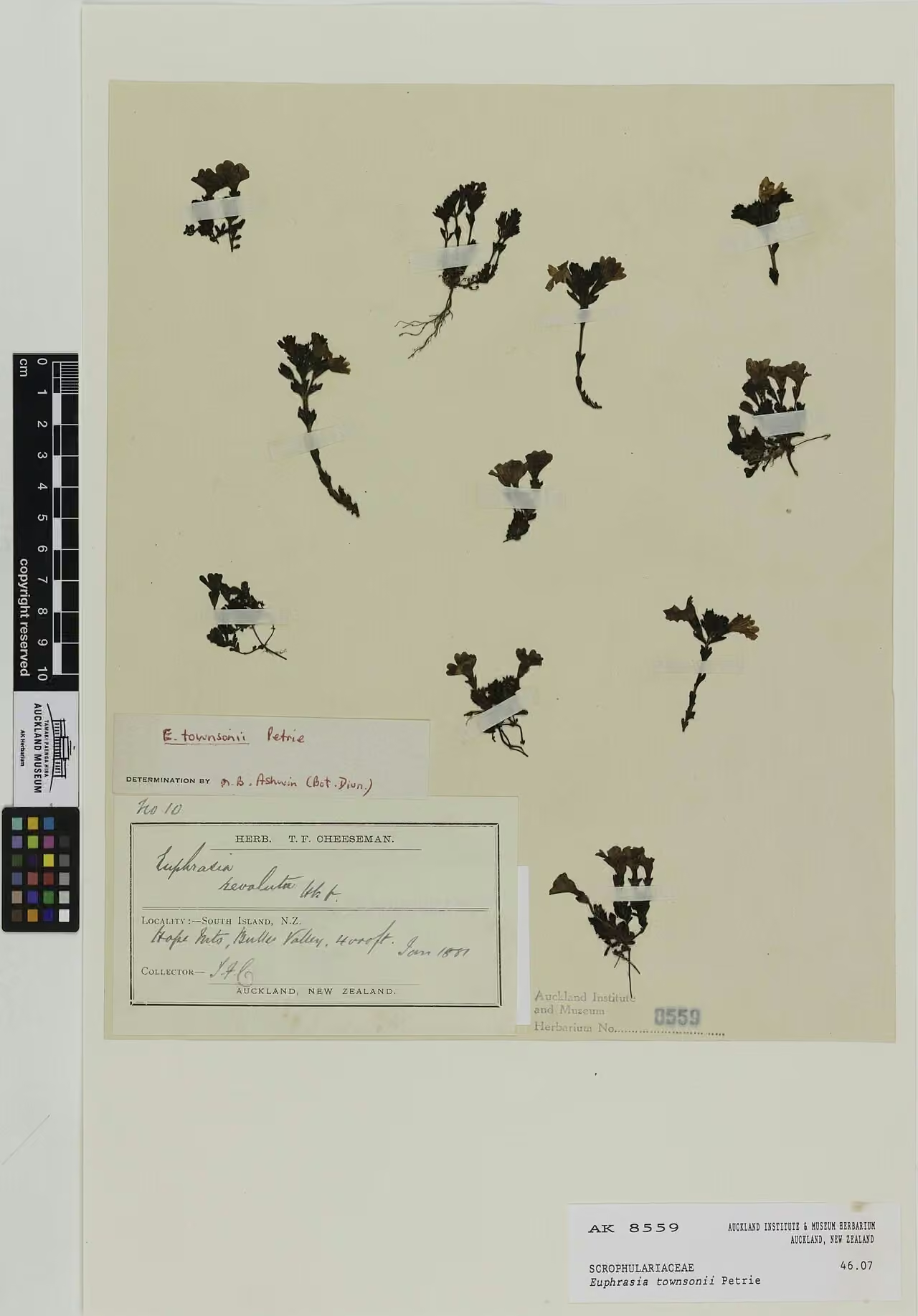
Euphrasia townsonii is a slender, tufted perennial herb, sometimes with a stout woody stock. Its stems are slender, much branched and root at the nodes, with erect branches 50 to 150 mm tall that are densely hairy.
The leaves are stalkless, usually rather widely spaced, 4 to 10 mm long (occasionally to 15 mm) and 2 to 4 mm wide (to 7 mm), narrow to ovate-rhomboid, with one or two pairs of lateral teeth and a terminal lobe. The flowers are large for the size of the plant: the white corolla is usually 15 to 20 mm long and across, with golden yellow anthers. The capsule is 3 to 7 mm long, about equal to or much shorter than the calyx, and holds eight to ten seeds in each chamber.
It could be mistaken for small forms of Euphrasia revoluta, but E. townsonii has two pairs of relatively large lateral teeth on its leaves and glandular hairs on the calyx. Its perennial, tufted habit and large flowers also separate it from the small annual eyebrights of bogs in the same region.
Quick Facts
| Scientific Name | Euphrasia townsonii |
|---|---|
| Height | 0.05-0.15 m |
| Spread | Small tufts, spreading slowly by stems rooting at the nodes |
| Water Needs | Damp; peaty ground that stays moist |
| Light | Full sun in open montane and subalpine sites |
| Frost Tolerance | High; grows up to 1500 m |
| Salt Tolerance | No information available |
| Growth Rate | No information available |
| Lifespan | Perennial |
Climate Best Suited to
Suits the cool, wet montane and subalpine climate of the north-western South Island, with high rainfall, frost and winter snow.
Regional Suitability
| City | Climate Suitability |
|---|---|
| Auckland | Low |
| Wellington | Low |
| Christchurch | Low |
| Dunedin | Low |
Plant Habitat
Euphrasia townsonii is endemic to the South Island. It ranges through the mountains of north-west Nelson south to the Paparoa Range and east to the St Arnaud Range near Nelson Lakes.
It is found between 500 and 1500 m above sea level, usually in damp and peaty ground. Such sites include tussock grassland, herbfield and wet openings where the vegetation is short enough for a small perennial herb to receive full light.
Growing Requirements
Soil Requirements
It grows in damp, peaty, generally infertile soils in the mountains.
- Moist, acid, peaty soil
- Low nutrient levels
- Short vegetation that can provide host roots
Light Requirements
Its montane and subalpine habitats are open, giving the plants full light.
- Full sun
- Intolerant of being overgrown by shrubs or rank grass
Water Requirements
The high rainfall of its range keeps its peaty sites damp most of the year.
- Needs moist ground through summer
- Avoid both drying out and stagnant water
Planting and Establishing
Euphrasia townsonii is not available from nurseries and has no documented history in cultivation. As a hemiparasite, it would need to be grown with suitable host plants, and wild plants should not be dug up.
Walkers on the tops of Kahurangi National Park, the Paparoa Range or Nelson Lakes National Park in early summer are well placed to see its large white flowers on damp peaty ground.
Ecological Role
Like other eyebrights, Euphrasia townsonii is a hemiparasite, carrying out photosynthesis but also tapping into the roots of neighbouring plants for water and nutrients. Its hosts have not been recorded. NZPCN states that its seeds are dispersed by wind and possibly by water and ballistic projection.
Its large, open white flowers with golden anthers are well displayed for insect visitors, though pollinators have not been studied for this species. As a perennial that roots at the nodes, it can persist and spread locally between years rather than relying entirely on seed.
Uses & Significance
Garden Uses
It is not a practical garden plant, though its flowers are among the showiest of the small native eyebrights.
- Not commercially available
- Of interest to alpine plant specialists and botanic gardens
- Best enjoyed in the mountains of the northern South Island
Ecological Value
It contributes to the diversity of montane and subalpine herb communities in the northern South Island.
- Endemic perennial of damp mountain grassland and herbfield
- Flowers provide nectar and pollen to insects
- Root hemiparasite interacting with surrounding plants
Landscaping Uses
Because it has not been cultivated, Euphrasia townsonii has no established landscaping role. In theory a damp alpine trough with native tussocks or small grasses as hosts would suit it, but this has not been tested.
In the wild, its flowers create bright white patches against the green and tawny tones of mountain grassland in early summer.
Seasonal Care Calendar
Spring
New shoots grow from the perennial tufts as snow recedes from its montane sites.
- Early growth before flowering
Summer
Main flowering from November to February, with large white flowers and golden anthers.
- Peak time to see it
- Capsules begin forming from January
Autumn
Some plants continue flowering into April, and capsules ripen and release seed.
- Late flowers possible
- Seed dispersal
Winter
Plants persist as low tufts, often under snow at higher sites.
- Dormant period
When to Prune and How Much
No pruning is needed for this small wild perennial.
If grown experimentally, spent flowering stems could be left to ripen seed before being trimmed.
How to Grow Eyebright
No propagation of Euphrasia townsonii has been documented. Its hemiparasitic habit means any plant raised will need a living host, and NZPCN warns for a related native eyebright that such plants cannot be cultivated without studying host relationships. Being perennial with stems that root at the nodes, it offers two possible routes, seed and rooted stem pieces, both of which should be treated as trials. Because much of its range lies in national parks, collecting requires a Department of Conservation permit.
From Seed
Each capsule contains around 16 to 20 seeds, eight to ten per chamber, maturing from January to April. Seed collection is the least damaging way to obtain material from wild plants.
Germination needs are not known, so sowing in autumn and overwintering outdoors mimics natural conditions.
- Collect ripe capsules with permission
- Prepare pots of moist peaty mix with small native grasses already established as hosts
- Sow seed on the surface among the grasses in autumn
- Overwinter outdoors in a cold, bright place, keeping the mix damp
- Look for germination in spring and record which hosts seedlings grow beside
From Rooted Stem Cuttings
Because its stems root at the nodes, a small rooted piece could be potted with a host, but this is untested. Taking the host turf with the rooted piece keeps any existing root connections intact.
- Select a stem that has already rooted at a node
- Lift it with a small plug of the surrounding turf
- Pot into damp peaty mix and keep cool and shaded until established
- Gradually move into full light
Pests & Diseases
No pests or diseases are recorded for Euphrasia townsonii.
In the wild it may be browsed by introduced herbivores along with other mountain herbs, but no specific impacts have been documented.
Cultural Significance
No Māori name or traditional use has been recorded for Euphrasia townsonii. The genus name Euphrasia means eye-medicine, from historic European herbal uses of other eyebrights.
The species honours William L. Townson (1855-1926), a collector after whom it was named in recognition of his botanical work.
Bonus Tip
If you find a large-flowered white eyebright in the mountains of north-west Nelson, check two features with a hand lens: two pairs of big teeth on each leaf and sticky glandular hairs on the calyx. Together they confirm Euphrasia townsonii rather than the similar Euphrasia revoluta.
Related Plants
Explore other native plants that share similar characteristics or habitats with Eyebright (Euphrasia townsonii), offering further insights into New Zealand's diverse flora. These related species provide context and opportunities for complementary planting in your garden.
Yellow Eyebright
Euphrasia cockayneana
Creeping Eyebright
Euphrasia dyeri
Euphrasia integrifolia
Euphrasia integrifolia
Euphrasia repens
Euphrasia repens
Euphrasia zelandica
Euphrasia zelandica
Ewartia
Ewartiothamnus sinclairii
Serpentinite Fescue
Festuca ultramafica
Fimbristylis velata
Fimbristylis velata
Plant Conservation
Euphrasia townsonii is ranked Not Threatened (2023). It has a fairly wide range across the mountains of the northern South Island, much of it within Kahurangi, Paparoa and Nelson Lakes National Parks.
Its long-term security depends on keeping damp, peaty montane sites intact and free from weeds and damage. Recording observations on iNaturalist NZ helps track its distribution.
Frequently Asked Questions
Is Euphrasia townsonii annual or perennial?
It is a perennial. NZPCN describes it as a slender tufted perennial herb, sometimes with a stout woody stock, unlike several small New Zealand eyebrights that are annuals.
How do you tell Euphrasia townsonii from Euphrasia revoluta?
Small forms can look alike, but E. townsonii leaves have two pairs of relatively large lateral teeth, and its calyx bears glandular hairs, which E. revoluta lacks.
Where can I see Euphrasia townsonii in flower?
Look on damp, peaty ground between 500 and 1500 m in the mountains of north-west Nelson, the Paparoa Range and the St Arnaud Range, mainly from November to February.
Sources and Further Reading
The botanical, growing, and conservation details for Eyebright (Euphrasia townsonii) on this page draw on the New Zealand plant references below. Consult them for full technical records and the latest distribution data.